
In breve: HR teams and recruitment agencies are exposed if they use poor workflows for their digital right to work checks. Most issues are operational and to build a compliant right to work check in UK, teams need the correct check for the right person, at the right time with the proper evidence retained. Learn how to avoid these seven mistakes for HR right to work checks.
Digital Right to Work Is Becoming A HR Problem
As hiring in the UK becomes more digital, recruitment needs to be fast and accessible. Recruitment processes need to be built for remote identity verification especially as more teams use digital onboarding.
According to GOV.UK, 89% of employers were confident they were carrying out Right to Work checks correctly. Conducting a check may seem simple, but it is so much more than filling out some paperwork. It is ensuring all of the correct checks are happening to the right person at the exact point that the hiring team expects.
With 1st October 2026 changes in place, it expands the Right to Work scheme to encompass contractors, gig workers, and freelancers. Failing to conduct digital right to work checks to obtain statutory excuses can result in serious civil penalties from the government or result in a prison sentence. Therefore, it is of utmost importance for an employer’s HR team to understand where most failures occur and at what point in time to prevent illegal working.
Seven Digital Right to Work Mistakes HR Teams Make
Although digital right to work checks make the hiring process faster and more consistent, risks sit outside the check itself. It completely depends on how HR teams route employees or candidates, interpret results, and keep evidence. It is also incredibly important to manage exceptions and follow up when a worker’s status changes.
Right to Work issues rarely happen during the check.
Billy Baird, Account Executive at ComplyCube, says, “They’re more likely to happen in the workflow gaps between verification, HR review, evidence, and follow-ups.” These operational gaps are important to close before they turn into full compliance failures. These are seven common mistakes HR teams must address.
1. Putting Every Candidate Through The Same Right to Work Checks
No journey is one and the same especially when it comes to verifying someone’s right to work in the UK. Depending on immigration status, human resource teams may use an original document check. A good example might be a British or Irish citizen using a valid British or Irish passport. Other examples include qualifying nationality identity documents such as passport cards.
Another way to conduct a digital right to work check is through a UK Home Office service. This applies to non-UK citizens or those in the EU settlement scheme. Here, HR teams can check online immigration status or a share code which is valid for 90 days. Share codes are typically generated by the candidate with their UKVI account especially for folks with digital immigration status.
If neither option works for their prospective applicant, they could use an eligible digital verification agency. However, it still does not take away the responsibility of work compliance from the employer hiring the candidate or sub contract. It is their job to show they carried out the prescribed check to ensure that their candidate is not an illegal worker.
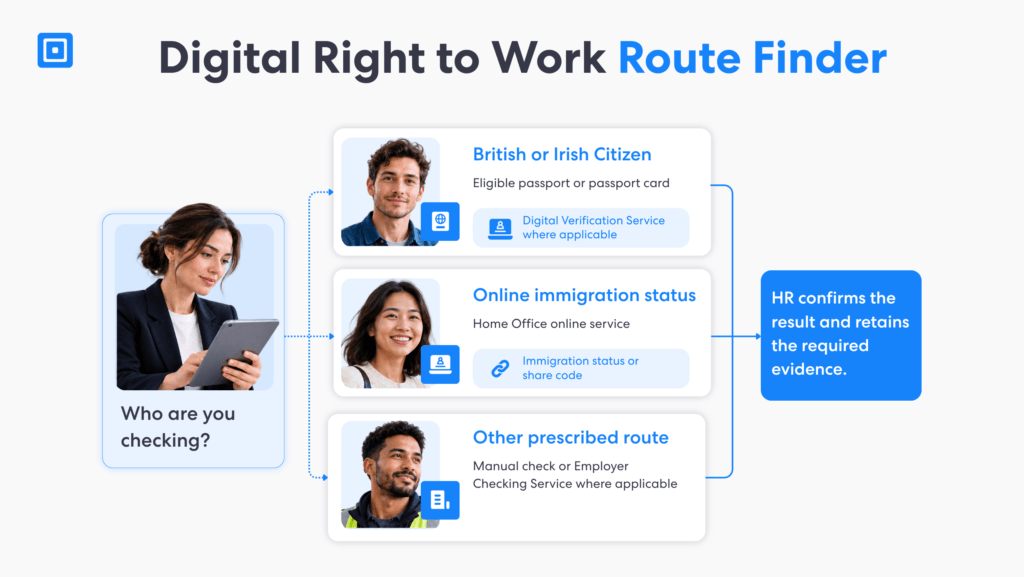
In un Home Office employer research study, 79% used manual checks, compared to 37% that used the Home Office online service, and 23% using an Identity Service Provider (IDSP). A strong digital right to work flow must identify the candidate’s correct routing before even starting the verification process. Otherwise, the automation can make the wrong check happen faster. It is important to automate the decision tree, not just the check itself.
2. Treating Identity Verification as Proof of Right to Work in the UK Permission
Identification Document Validation Technology, also known as IDVT, is a digital system that can scan, identify, and authenticate data from passports, licenses, and biometric residence permits to detect fraud. It verifies identity evidence, but it does not satisfy every immigration-status requirement. Providers are allowed to check, providers must also check across several key categories:
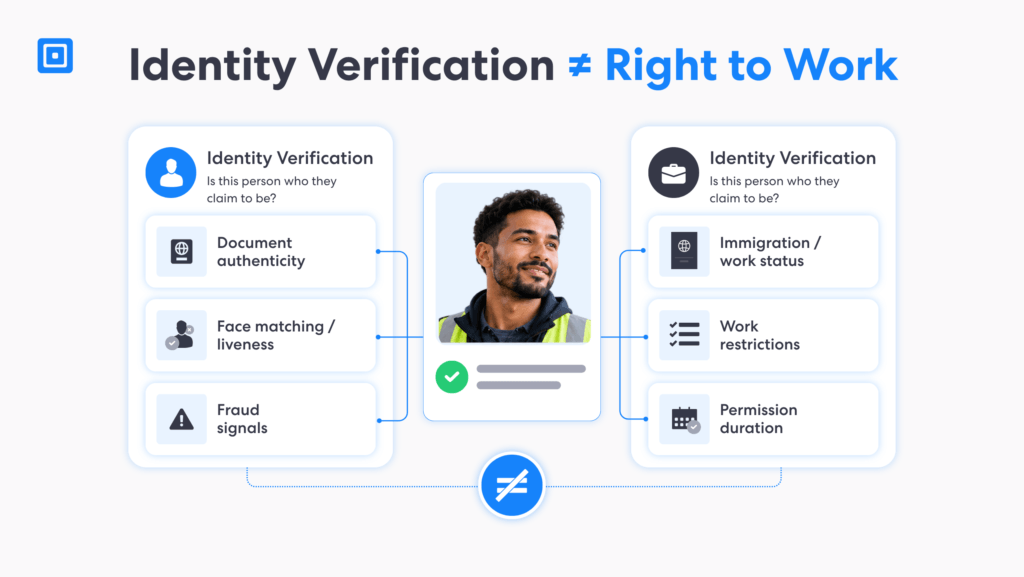
It is the responsibility of HR to differentiate who the person is from whether they can legally perform the work. A real identity could still have restrictions and rules in place on the work that an individual can perform. Identity and right to work status need to connect, but they are not interchangeable.
Case Study: Document Checks Mistaken for Right to Work Checks
In 2025, a fish-and-chip shop hired a worker who presented several records linking to false identities. This included a photocopy of a page from a British passport. Unfortunately, the employer did not conduct the digital right to work check correctly. As a result, the Home Office issued a £40,000 civil penalty.
Structured Digital Right to Work Flow
HR teams need a strong workflow instead of leaning on documents that merely appear credible. A strong process would route the candidate through the correct prescribed checking method. It would verify identity evidence, retain records, and create a clear audit trail to show how and when the digital right to work check was completed.
Risultati
- Was issued £40,000 in civil penalties, but later paid £28,000.
- Many documents did not provide a strong statutory excuse for the worker.
- It is the responsibility of HR teams to verify eligibility and identity the right way.
3. Using a Provider Does Not Outsource Extended Liability
To add to the list of responsibilities, HR also must verify if the identity during the digital controllo del diritto al lavoro corresponds with the person that turns up for work at the office. The employer needs to keep the required evidence and proof of statutory excuse for their records.
Employers that choose a Digital Verification Service (DVS) path need a UK DIATF-certified service to get the statutory excuse details through that route. Technology should help with compliance, but not transfer accountability.
4. Losing the Candidate Between Verification and Hiring
A lot of the time, remote recruitment processes result in a continuity issue specifically around identity. The reason this is particularly important is that identity fraud, impersonation, and substitution play a huge role in contractor and platform work. The new supplementary code as of 2026, expressly addresses services that are used to confirm that a person carrying out work or services is the same worker on whom the Right to Work check was conducted.
This is where biometric matching or liveness detection can strengthen a remote onboarding workflow for organisations and businesses. Passing the initial check should not result in a blind spot between the verification and work commencing.
5. Treating Flexible Workers Like Employees
Da 1° ottobre 2026, specified subcontracting arrangements for workers, agency staff, and supply chain workers. It also applies to online matching-service arrangements. These contracts are becoming part of digital right to work checks. The extended liability requirements also impacts relevant contractual arrangements. Businesses must know who owns the check across the whole onboarding process. As a result, contracts and onboarding responsibilities must align.
6. Completing the Check But Losing the Evidence
Automation is necessary, but more importantly, it must produce a retrievable digital record. HR should not rely on random screenshots, emails, or records that sit in someone’s downloads folder. Required evidence must flow into a company’s HR or compliance record. It is the employer’s responsibility to keep prescribed information for the duration of employment plus two years.
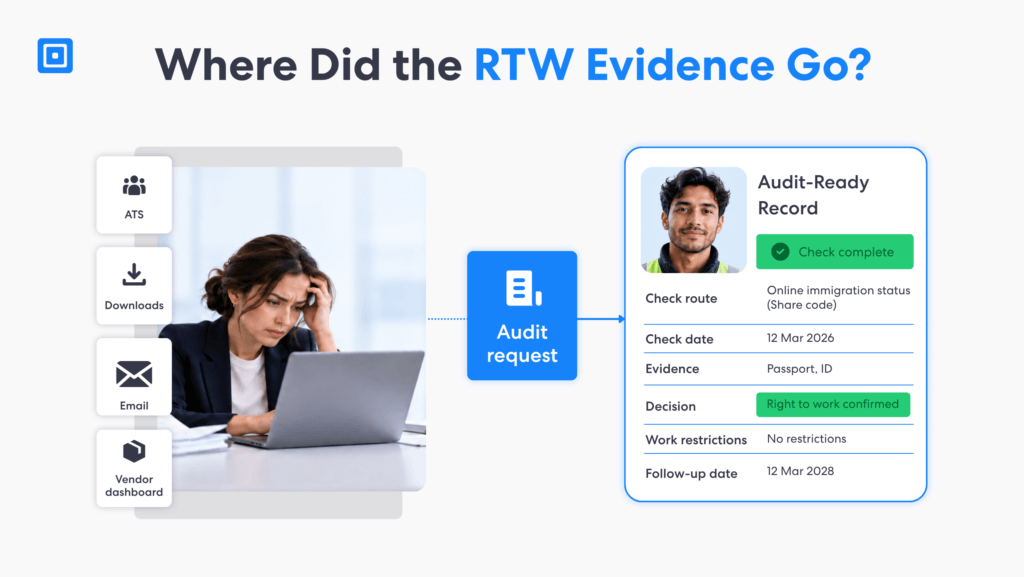
However, retention does come with its own privacy obligations. Keeping everything forever is not considered good compliance. UK General Data Protection Regulation (GDPR) guidance and advice sets the baseline for how employers should retain data. Best practice is to build systems for a future audit, not just initial onboarding.
7. Treating Digital Right to Work as a One-Time Onboarding Task
Some workers only have a time limit on their permission to work. As a result, HR teams must demonstrate reviews and follow up checks to prove that they still have permission to work in the UK. As a result, it is important for HR workflows to establish expiry dates and status information. Workflows must also trigger follow up actions on candidates and employees instead of relying on someone’s physical calendar. A workflow must prepare for verification to be ongoing.
How to Secure Digital Right to Work for HR Teams
A secure process for HR teams must guide prospective candidates or existing employees through the correct route. The program must link identity and work authorisation checks. It must ensure results reach the right HR system with a clear audit trail. You can learn more here: Top 5 Right to Work Compliance Software for UK Employers in 2026
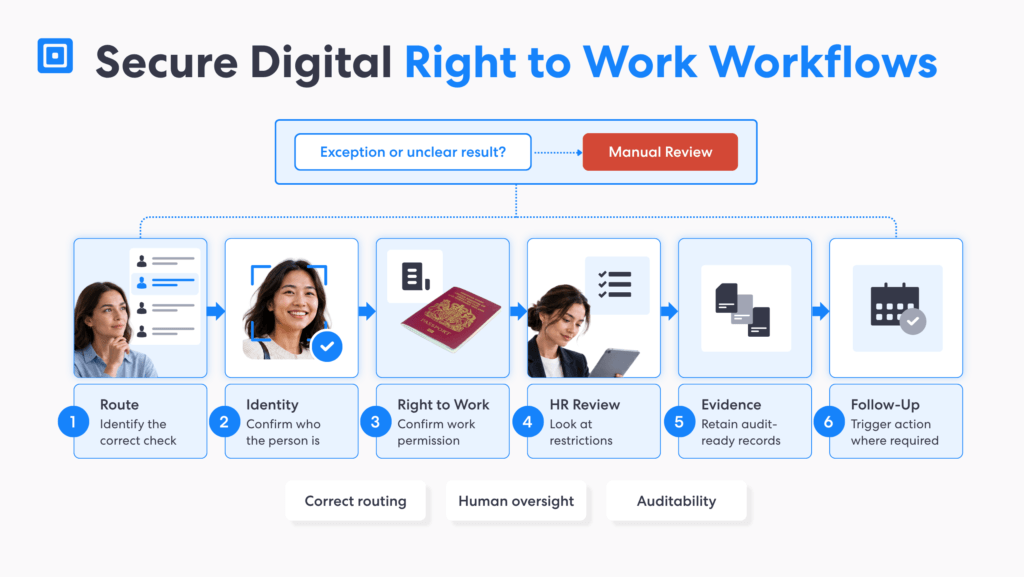
The goal is to remove any manual admin work without removing the human oversight or judgement. Automation helps HR teams see patterns or spot exceptions and lets them demonstrate how quickly each hiring decision was made.
Questions HR Teams Must Ask About Their Workflows
To be clear, HR teams do not need more checks for their workflow. They just need to feel confident that the systems they have in place are performing checks consistently. The following three questions help poke holes in HR’s existing workflows:
- Are candidates being sent down the correct Right to Work route?
- Can we prove who was checked, when, and on what basis?
- Does the workflow know when HR needs to act again?
If any of those answers are unclear, this is a huge indicator that the workflow is the main issue and not the verification technology itself. Digital right to work frameworks are meant to prevent exploitation and ensure basic labour standards. They must also aim to balance efficiency with employee privacy and data protection. These 1 October 2026 changes mean that businesses must review contracts for compliance with new regulations.
Punti chiave
- Digital Right to Work goes beyond a single check.
- Every potential candidate should not follow the same route.
- Using a digital Right to Work provider does not remove employer responsibility.
- Good audit trails are just as important as speed.
- Diritto al lavoro requires ongoing action and should not end at onboarding.
Build Digital Right to Work Into Your Workflow
In summary, HR teams looking to build a digital Right to Work process into a wider onboarding workflow can build it with ComplyCube. Our solution helps link identity verification, work eligibility, and audit-ready evidence in one journey.
Teams can reduce manual gaps in review while keeping control of compliance decisions for HR teams. Prenota una demo and find out how ComplyCube’s digital Right to Work solution builds a more secure, and consistent hiring process.

Domande frequenti
Can employers complete Right to Work checks remotely?
Yes. Specific Right to Work checks can be done remotely using the UK Home Office online service or an eligible DVS. Employers must follow the prescribed digital right to work check process and they must confirm that the person presenting for work matches the verified identity of the candidate.
How should HR teams choose the correct Right to Work checking route?
HR teams must determine the worker’s immigration status with any available evidence before deciding on what check they must complete. This allows them to route people into the right prescribed check according to UK Home Office guidance. Different candidates may need a manual document check, a Home Office online check, or an eligible DVS.
What records should employers keep after a Digital Right to Work check?
Employers are required to keep evidence that shows who was checks, when it was complete, and the final result. They also must retain any documents that were relied upon during the verification. These records are stored safely and remain easy to gather for any audit purposes. They are also held for a certain period of time as determined by UK GDPR.
Do employers need to repeat Right to Work checks?
Sometimes. Repeat Right to Work checks are needed where a worker has a specific time limit for the permission to work in the UK. HR teams are responsible for tracking any relevant expiry dates, and status changes. They are responsible for ensuring that repeat checks take place before the current Right to Work permission expires.
How can ComplyCube help HR teams with Digital Right to Work checks?
HR teams can embed Digital Right to Work checks into client’s onboarding workflows with ComplyCube. They can combine identity verification, biometric checks, and configurable routing with audit-ready records. Platforms like these can reduce manual work, improve consistency, and make it easier for HR teams to manage evidence and follow-ups.