In breve: The best right to work provider is one that is certified for the identity documents your candidates hold. Compare Right to Work compliance software providers on certified coverage, data retention, and audit trails. The 1 October 2026 rules change the scope of who carries out employment checks, so the choice is more important than ever.
Why Certified Coverage Is Important
Two separate providers can be certified, yet still cover different ground. Certified identity profiles set out which combinations of identity evidence that a provider is capable of verifying. Moreover, depending on the certified profile, they can also provide a certain level of assurance. Typically, the more profiles held, the wider the range of candidates a provider is approved to check.
The most important part to understand is whether a provider’s certified profiles match the candidates that you hire. As the rules and scope expand on 1 October, this is the lens through which providers should be compared.
What Is Right to Work Compliance Software?
Good Right to Work compliance software helps employers verify and manage evidence of whether a person is legally permitted to work. Depending on an individual’s immigration status, documents, and nationality, the process may involve digital Right to Work checks, a Home Office share code, or another valid route. You can learn more here: What Changed in 2026 Right to Work Legislation?
Right to Work software aims to standardise checks for candidates who have received conditional offers. However, it does not remove the employer’s legal requirements to complete the full and correct process. Employers that cannot provide statutory excuses are liable and can face civil penalties of up to £60,000 per illegal worker for repeated offences. The 1 October legislation changes also extend liabilities to broader working arrangements such as subcontracting, labour supply chains, and online matching platforms.
Pre-Employment Checks Go Beyond Right to Work Compliance Software
Right to Work is one part of pre-employment checks before a binding employment contract. An organisation typically verifies work status, qualifications, previous employment, and references. They also look at any professional licences or other documents containing identity information before a new employee starts. For certain roles, employers carry out criminal record checks through the Disclosure and Barring Service (DBS). Roles involving children or vulnerable adults may need additional screening.
Pre-employment screening works best when treated as a connected process.
Harry Varatharasan, Chief Product Officer at ComplyCube says, “When employers bring multiple checks into a single onboarding flow, it becomes easier to reduce delays for employee verification and allows teams to maintain a clear audit trail for future reviews”. A criminal record does not necessarily stop someone from getting a new job. The screening process needs to be appropriate and lawful with written consent obtained wherever it’s needed.
What Should Be Compared in Right to Work Compliance Software?
Digital Right to Work services must slot into the wider recruitment process. Providers are certified against Good Practice Guide (GPG) 45 identity profiles under the UK Digital Identity and Attributes Trust Framework (DIATF). Although, certification comes first as it defines the candidates that providers are allowed to check, providers must also check across several key categories:
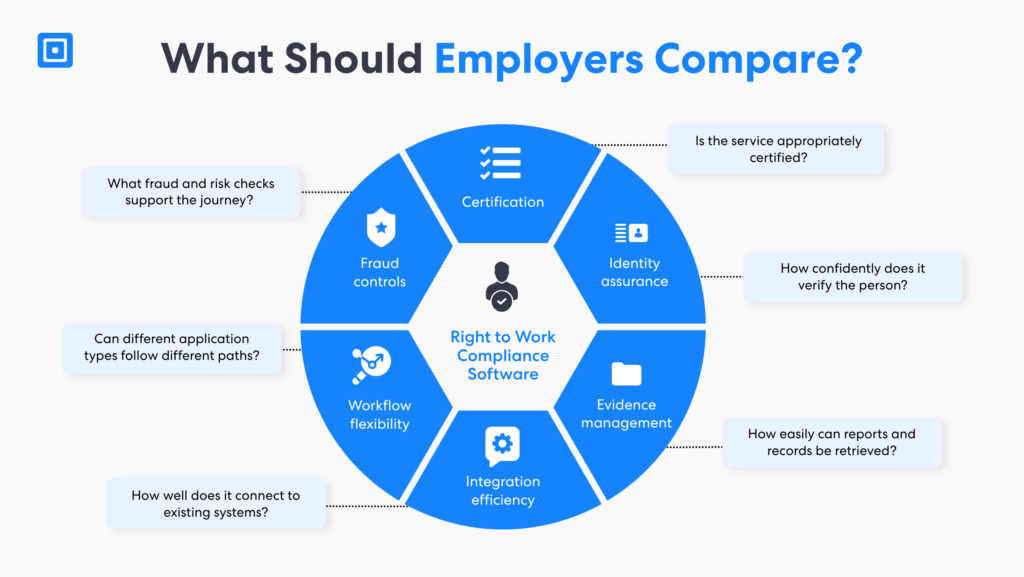
- Certification
- Fraud controls
- Verifica dell’identità
- Workflow flexibility
- Evidence management
- Integration efficiency
All of these factors allow employers to move candidates from a conditional offer to final approval without any extra manual labour. It should be noted that though certification shows what a provider is approved to verify, it doesn’t outline how it performs day-to-day. Ensure to ask every provider for its onboarding completion data.
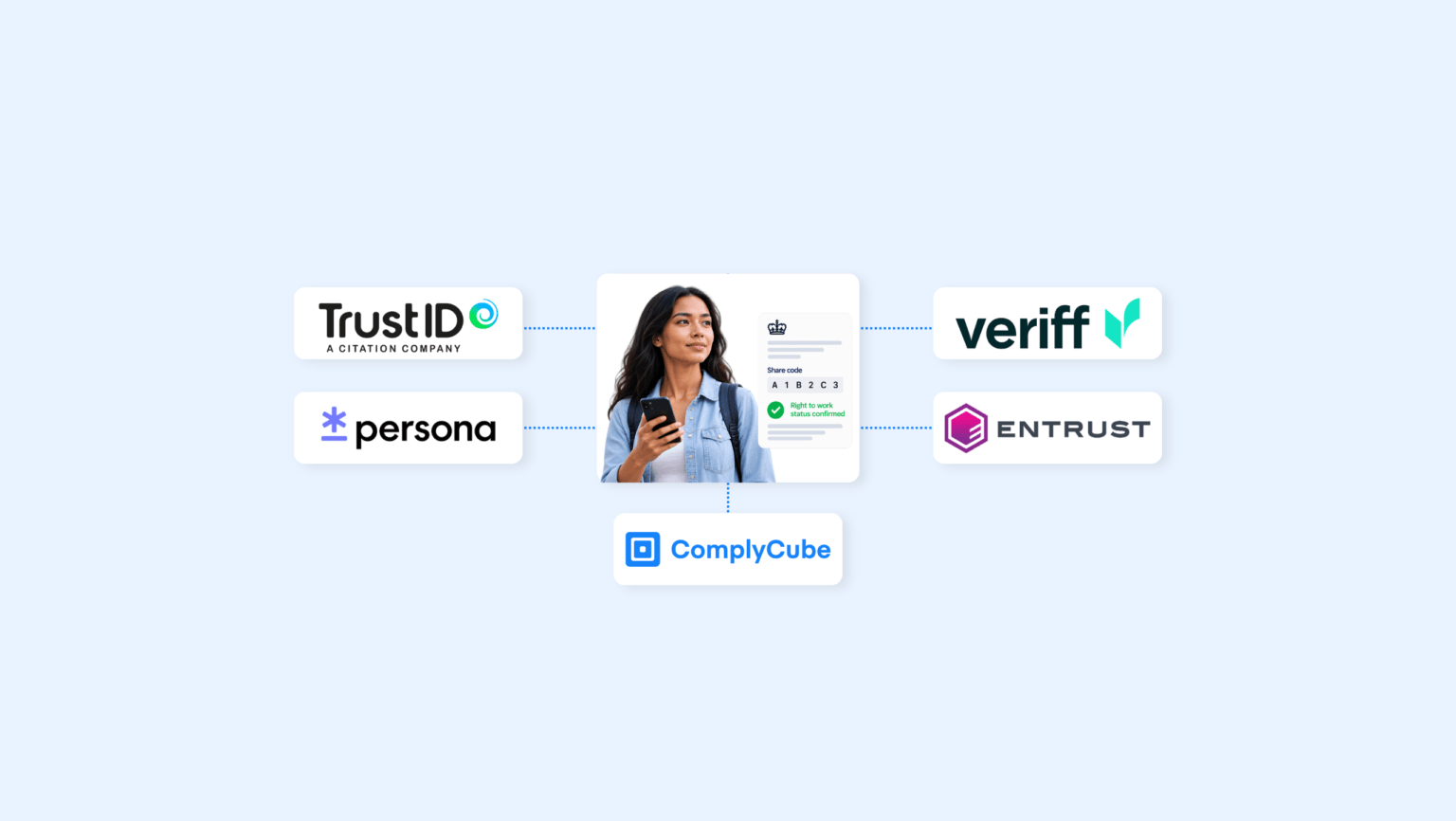
ComplyCube
ComplyCube is a standout. Its sheer breadth of UK DIATF certification can speak for itself. GOV.UK registration lists 23 certified identity profiles of which 21 are available for Right to Work. It covers a much wider range of identity evidence and assurance options that the remaining providers in this shortlist.
Beyond certification coverage, ComplyCube provides flexible workflows, advanced biometric detection, and fraud prevention controls. They also give employers thorough audit logs and flexible deployment. ComplyCube is best for those who want to incorporate more than just a singular Right to Work into their workflow.
- Certified coverage: 23 overall, including 21 Right to Work profiles.
- Beyond certification: Blends document verification, biometrics, fraud controls, and reports. Also provides audit logs, APIs, SDKs, and hosted workflows all within one platform.
- Considerazioni dell'acquirente: Employers that need broad certified coverage and the flexibility to blend employment, identity, and compliance, ComplyCube is the right choice.
TrustID
TrustID takes a specialised approach to employment screening. The platform provides Right to Work, Right to Rent, and DBS supplementary certifications across four certified identity profiles. Its value lies in employment-focused verification with analyst-assisted review.
- Certified coverage: Four profiles – M1A, M2C, H1A, and H2B – spanning medium and high assurance.
- Beyond certification: Offers automated employment verification with analyst support for cases requiring further review.
- Considerazioni dell'acquirente: Compare TrustID’s employment-focused and evidence-retaining process against platforms offering broader fraud, workflow, and identity infrastructure.
Veriff
Veriff has a strong global Identity Verification (IDV) platform, its certified profile coverage is more concentrated. Their registration lists three certified identity profiles, two of which that apply specifically to Right to Work. Therefore, buyers who want a recognised IDV platform with a narrower UK certified profile set should consider Veriff.
- Certified coverage: 3 profiles, with 2 Right to Work profiles.
- Beyond certification: Can add document verification, biometrics and fraud detection to a wider global IDV platform.
- Considerazioni dell'acquirente: Assess if Veriff’s smaller certified profile set and more fixed certified journey allows for flexibility as needed.
Entrust IDV
Entrust provides the Right to Work with a wider enterprise identity and security ecosystem. Two identity profiles are listed: M1A and H2B. Both of these profiles are available for Right to Work and cover both medium and high assurance levels. This offers a greater variety of assurance levels than some competitors, but the range of certified profiles is still relatively narrow.
- Certified coverage: Two, M1A and H2B certified profiles across medium and high assurance.
- Beyond certification: Sits within Entrust’s broader enterprise identity, authentication, and security infrastructure.
- Considerazioni dell'acquirente: Organisations should weigh the value of Entrust’s wider ecosystem against more concentrated certified profile coverage and long-term integration requirements.
Persona
Persona is best known for its configurable identity orchestration. Its one certified identity profile, M1C, applies both to Right to Work and Right to Rent. There is an important distinction between the flexibility of Persona’s wider platform and the breadth of its certified UK employment check journey.
- Certified coverage: One Right to Work profile – M1C.
- Beyond certification: Provides conditional workflow logic, cases, manual review, and broader identity orchestration.
- Considerazioni dell'acquirente: Consider the difference between Persona’s broad platform configurability and the narrower certified profile coverage available.
Case Study: The Cost of Non-Compliance for Right to Work
Nel 2026, Al Balad Restaurant faced a review after Immigration Enforcement (IE) officers found illegal workers without the correct Right to Work status. After several enforcement visits, the business faced penalties exceeding £200,000.
Reading Biometric Identity Documents to Access Control
Employers need a consistent process for verifying status before work begins. If IE or any other regulatory body reviews the business, correctly completing Right to Work checks as prescribed builds a statutory excuse against civil penalties.
Risultati
- Illegal-working breaches resulted in penalties over £200,000.
- Non-compliance created operational consequences beyond fines.
- An auditable Right to Work process with checks, evidence, and follow-up can be retrieved fast for an investigation.
The Seven Questions Every Buyer Should Ask
There are many questions every employer should ask of their Right to Work compliance software provider. Certification is a great starting point and these remaining questions test what it cannot tell you. Bring these to every provider:
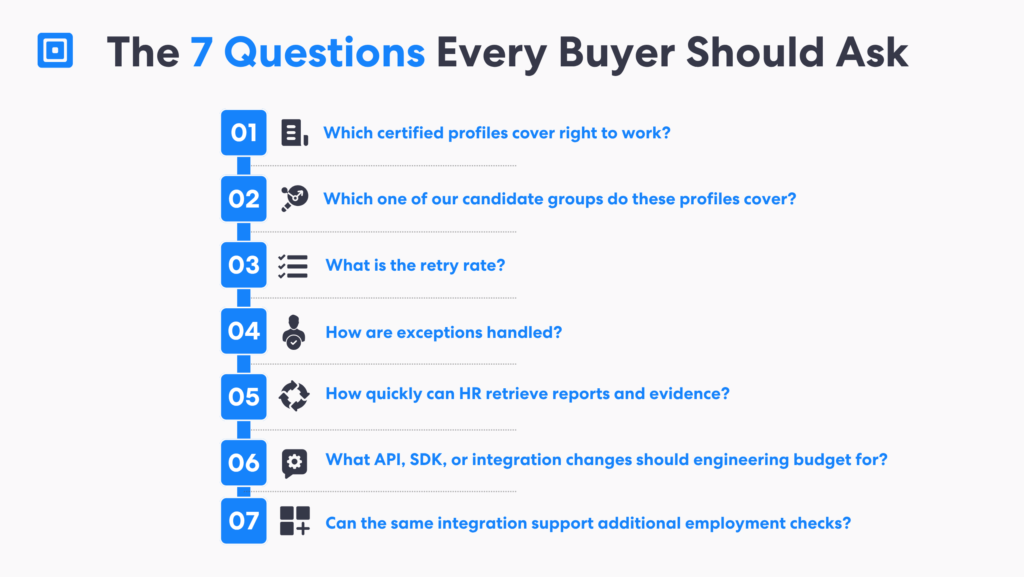
- Which certified profiles cover Right to Work?
- Which of our candidate groups do they cover?
- What is the retry rate?
- How are exceptions handled?
- How quickly does the Right to Work compliance software retrieve evidence for HR?
- What integration changes must be accounted for by the IT team?
- Can additional employment checks use the same Right to Work workflow?
Strong answers across all of these questions show consistent performance across automation, data retrieval and long-term operations, without unnecessary overhead. It is crucial to ask them before your team makes a final decision on how to comply with the updates on Right to Work legislation.
Punti chiave
- Right to Work compliance software checks need strong certified coverage.
- Certified coverage should match your candidate mix.
- Assurance, evidence, and flexibility impact long-term value.
- Criminal record, identity, and DBS checks are part of a wider employment process.
- ComplyCube has 23 certified identity profiles and conduct certified employment checks and fraud controls within one platform.
Right To Work Compliance Software with ComplyCube
When choosing which Right to Work compliance software is best, teams should look to reduce compliance risk and the amount of operational work. To learn more about your Right to Work requirements, get in touch with ComplyCube. Find out how you can blend verification, assurance, and Right to Work compliance using an award-winning modular platform.

Domande frequenti
Can a share code prove Right to Work for new employees?
Yes. Eligible workers can use a Home Office share code to prove their immigration status. Employers use the codes and detials to access official records. This route often differs from passport-based digital identity verification.
Can a criminal record affect a job offer for a job applicant?
Having a criminal record does not necessarily impact someone from being employed. The impact it would have truly depends on the role, offence, and any applicable rules. Employers must keep decisions proportionate and relevant to the job at hand.
Can digital Right to Work checks be completed remotely?
Most applicants are able to carry out the verification process remotely if they have the proper documents. The process as a whole is based on the applicant’s employment situation and the documents they have available. Employers should obtain advice from the appropriate trust framework and comply with any further requirements set by the Home Office.
What pre-employment checks can a new employer carry out for a new job?
Pre-employment checks cover Right to Work, references, qualifications, identity or DBS screening. Additionally, health checks can be conducted when relevant to the position. Every Right to Work request needs to be necessary, transparent, and appropriate to the level of work.
Why consider ComplyCube for Right to Work compliance?
ComplyCube combines Right to Work with document, biometric and fraud-verification workflows. It has APIs, SDKs, hosted journeys, reports and audit logs that sits within one platform.