TL;DR: Anti-Money Laundering risks can manifest as criminal activity, sanctions evasion, or the financing of terrorism. For compliance teams, AML risk can be particularly damaging to a business’s financial system and reputation. This guide explores the different types of AML red flags and how to build strong defenses against them.
Why Has AML Risk Become a Pervasive Challenge?
Over the years, Anti-Money Laundering (AML) risk has become a widespread challenge for authorities, businesses, and consumers alike. According to the Gambling Commission, there has been a sharp rise in the volume and sophistication of attempts to bypass security controls using AI-enabled tools. This includes fraudulent documents, deepfake videos, and more.
Accounts created with AI are more likely to be used for criminal activity, such as money laundering or terrorist financing.
Aside from AI-driven tools, digital innovation has also intensified the scalability of AML risks. Rapid digital payments, global transactions, and the rise of cryptoassets and decentralized finance (DeFi) channels have created avenues for criminals to layer illicit funds undetected. In 2025, money launderers moved $82 billion in cryptocurrencies, a sharp increase from $10 billion in 2020.
What is AML Risk?
Anti-Money Laundering risks refer to the possibility that a company or service may be used for illicit activity, such as money laundering, terrorist financing, or other financial crimes. Typically, criminals exploit products, business relationships, or customers to funnel illicit funds via drugs, trafficking, sanctions evasions, and more.
The United Nations estimates that money launderers move between $800 billion and $2 trillion annually. In the UK itself, this exceeds over $436 billion annually.
AML risk requires its own compliance framework, and compliance teams must treat it appropriately to meet regulatory requirements. Global authorities, such as the Financial Action Task Force (FATF), require firms to use a risk-based model to continuously identify, understand, and mitigate risks. The impact of AML risk can be staggering. It spans three dimensions:
- Regulatory Enforcement: Million-dollar fines, sanctions, business closure, license revocation.
- Financial Losses: Fraud losses, seized funds, and consumer compensation.
- Reputational Damage: Erodes client, partner, investor, and customer trust for years.
Common Anti-Money Laundering Risks
It is critical for compliance and Know Your Customer (KYC) teams to understand common AML risk factors. This supports a targeted, risk-based approach, in which compliance teams allocate resources and due diligence controls where potential risks are greatest. You can learn more here: The Evolution of the Risk-Based Approach in AML.
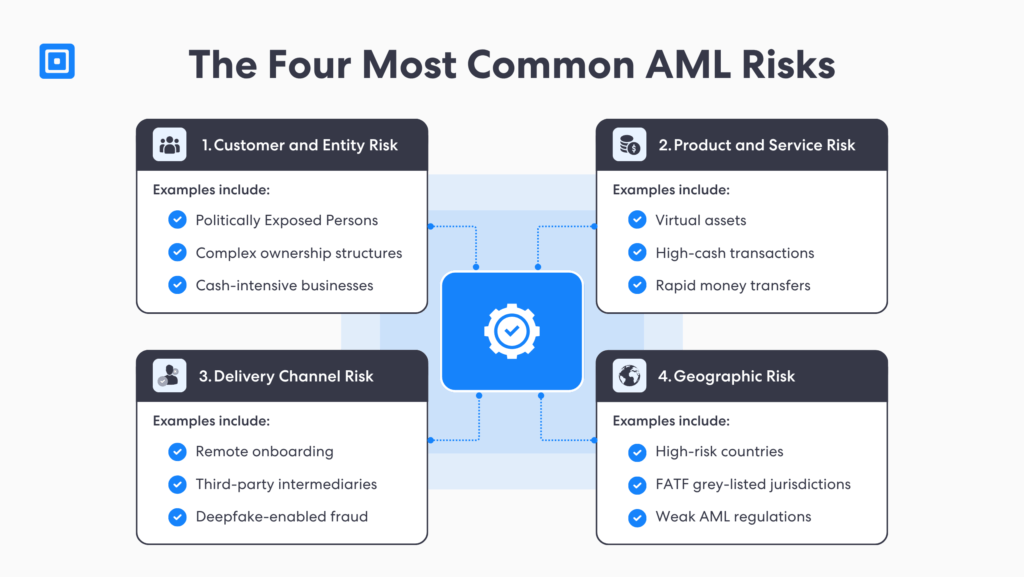
Additionally, Key Risk Indicators (KRIs) help assess money-laundering vulnerabilities by tracking metrics such as the volume of high-risk customer onboarding, sanctions-screening hit rates, and alert-escalation trends. Anti-money laundering risks typically fall into four core dimensions: customer, product, channel, and geographic risk.
- Customer and third-party entity risk: Includes customers and businesses that pose a higher risk due to their likelihood of money laundering and other fraudulent activity. Examples are Politically Exposed Persons (PEPs), complex beneficial ownership structures, and cash-intensive businesses.
- Product and service risk: Refers to product or service-specific risks. For instance, it covers virtual assets and transactions involving cash amounts over $10,000. Additionally, services that enable fast, global transfers may provide criminals with greater anonymity and reduce the risk of detection.
- Delivery channel risk: This can include risks associated with the methods or intermediaries used to deliver a product or service. For example, remote onboarding is considered a high-risk channel because it allows users to falsify or hide their identities using fake documents or deepfakes.
- Geographic risk: These risks relate to countries that pose high-risk threats due to significant money-laundering risks in the area. The FATF and the EU countries list these countries on grey and blocklists due to weaknesses identified in their AML and CFT programs.
Case Study: Ikano Bank Devastating $15 M AML Fine
On June 17, 2026, the Swedish financial institution Ikano Bank was fined SEK 140 million by the Swedish watchdog, Finansinspektionen, for significant weaknesses in its Anti-Money Laundering (AML) risk assessment processes.
AML Risk Assessment Failure
Regulators noted that the bank had a significant knowledge gap regarding the AML risks associated with its products and clients. For instance, Ikano Bank failed to document and examine the risk exposure of its financial services and its corporate clients.
Outcomes
The regulator fined the company SEK 140 million (USD 15 M), underscoring the financial and reputational consequences of its compliance failures.
Ikano Bank’s incomplete risk assessments suggest that the firm missed multiple AML red flags that should have been triggered.
Without a comprehensive mapping of AML risk factors, a high-risk customer can access services without being routed to the appropriate customer due diligence flow.
Understanding Anti-Money Laundering Risk for Compliance
Regulators are increasingly demanding robust AML risk assessments, requiring businesses to identify where their exposure is highest and to document clear, proportionate controls to combat it. These assessments need to inform decision-making in Customer Due Diligence (CDD), Enhanced Due Diligence (EDD), and additional screening steps.
No customer type presents a single, uniform risk or a particular risk profile related to money laundering, terrorist financing, or other illicit financial activity.
Leading regulatory frameworks, such as the UK Money Laundering Regulations (MLR2017), require financial institutions and regulated organizations to assess the risks of money laundering and terrorist financing and document them in written risk assessments. Jurisdictions across the world share the same obligations.
In the US, the Bank Secrecy Act emphasizes risk-based CDD, using risk assessments to support the identification of ML/TF and other illicit finance risks and to inform mitigation steps. In Singapore, the Monetary Authority of Singapore (MAS) emphasizes the need to comprehensively identify and assess ML/TF risks.
The three components that all compliance officers must understand are:
- Inherent risk: Total risk exposure that is present before any mitigating controls are placed.
- Control effectiveness: Measures how well AML controls, such as sanctions screening and CDD, perform in practice.
- Residual risk: Remaining risk that persists and must be included within a firm’s documented risk appetite.
Modern AML risk assessment should combine qualitative expert judgment from compliance officers with quantitative indicators. To support regulatory reporting requirements, these decisions must be clearly delivered with audit trails, logs, and timestamps.
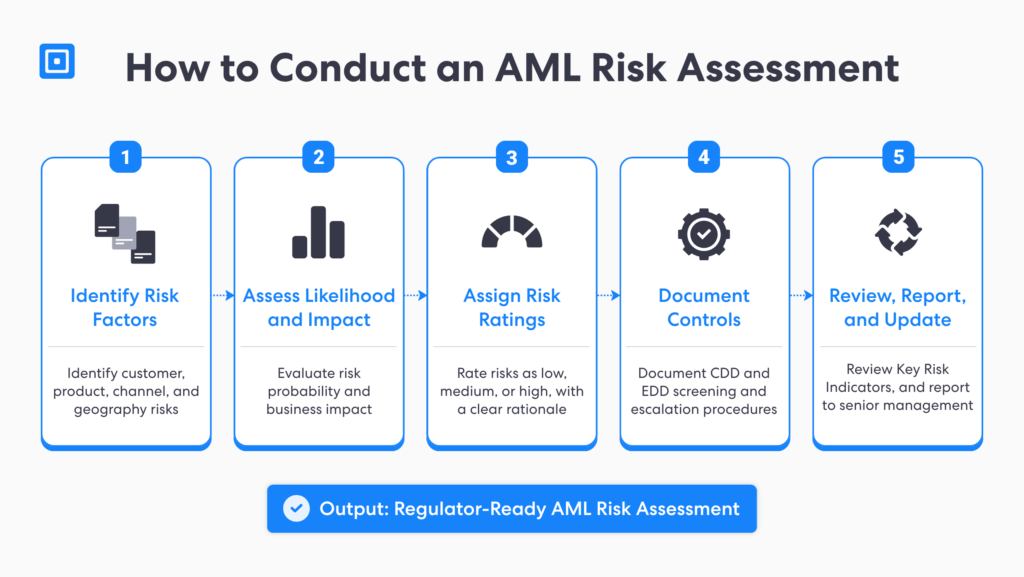
How to conduct an AML risk assessment:
- Document all risk factors: Identify the total risk factors across customers, products, channels, geography, and governance.
- Assess likelihood: Evaluate and quantify risk based on their likelihood of occurring and business impact for each factor.
- Assign risk ratings: Determine the risk ratings, i.e., low, medium, or high, and ensure they’re backed up by clear decision rationale.
- Document controls: Map out the required and existing policies and processes in place to combat these risks, including CDD and ongoing monitoring steps.
- Review, report, and update: Monitor key risk indicators and periodically update your framework. Additionally, keep these records up to date with senior management approval.
The Role of Technology and Integrated Systems in Financial Crime Compliance
To effectively combat counter terrorism financing and signs of money laundering, businesses require a unified, automated workflow. Milosh Caunhye, Solution Consultant at ComplyCube, further notes, “Manual anti-money laundering risks assessments cannot outpace the large and rapid nature of digital transactions today. Additionally, it is not enough to get ahead of the risks posed by evolving technology used in criminal methods.”
An automated AML risk management process uses machine learning and AI for anomaly detection, the identification of suspicious transactions, and the detection of sudden changes in current and new customers. It has the power to surface risks that a manual, rule-based system alone could miss. Moreover, integrated systems unify customer data, monitoring alerts, and each customer’s risk ratings into a single view. You can learn more here: AML Compliance Checklist: What Most Firms Still Get Wrong.
An all-in-one, advanced AML platform streamlines regulatory obligations and lowers false positives, improving both operational efficiency and investigative quality. Common features include:
- Sanctions and PEP screening: Scan customers against global sanctions lists and PEP registries to identify and prevent dealing with high-risk users.
- Adverse media checks: Screen for negative news coverage and reputational risk indicators that may connect to illicit activity.
- Smart KYC forms: Collect relevant information, including source of funds, customer consent, and e-signatures to support CDD decisions. You can learn more here: What are Smart Forms?
- Risk scoring: Achieve automated, explainable risk ratings based on a customer, product, and jurisdiction.
- Ongoing monitoring: Detect any changes in a customer’s risk profile at any time to comply and support continuous risk assessment.
- Case management: Centralize compliance decisions and maintain audit-ready reports to meet regulatory obligations.
Key Takeaways
AML risk is the possibility that a business may be used for criminal activity, such as money laundering and terrorist financing.
Understanding AML risk enables businesses to create policies and controls to prevent money laundering and protect the financial system.
AML risks are typically derived and vary by a specific product or service, delivery channel, jurisdiction, or customer.
Leading jurisdictions mandate a risk-based approach to AML red flags, rather than a uniform checklist.
Automated AML software integrates multiple checks, high-quality data, and ongoing monitoring to keep pace with evolving money-laundering risks.
Meet Evolving Anti-Money Laundering Regulations
For compliance teams, understanding AML red flags and risks helps focus resources where threat exposure is highest. A strong AML risk framework supports regulatory compliance and helps firms identify suspicious activity earlier. An automated AML program that combines PEP and sanctions screening, ongoing monitoring, and risk scoring creates a proactive, risk-based workflow. To learn more about how you can build your own AML risk assessment, contact a member of the team.

Frequently Asked Questions
How often should an AML risk assessment be updated?
AML risk assessments should be reviewed every 12 to 18 months. Crucial updates, such as new products, entering new markets, or regulatory changes, will typically require a refresh. To keep pace with regulatory expectations and evolving threats, regulated businesses should opt for semi-annual or quarterly reviews.
What is the difference between fraud versus anti-money laundering risks?
Fraud risks involve direct deception, such as stealing another person’s identity for financial gain. On the other hand, AML risk refers to the use of the financial system to launder illicit funds. These two risks are increasingly converging to inform a strong AML program; however, they still require different controls for detection and prevention.
Are all customers from high-risk jurisdictions automatically risky and blocked?
Regulated businesses use multi-bureau checks because they create a stronger defense against AI-powered fraud and account takeover beyond document or biometric verification alone. It validates whether a customer’s identity details exist and are consistent across independent sources.
How to measure AML risk management effectiveness?
To measure the effectiveness of Anti-Money Laundering (AML) risk management, several metrics are used. This includes the number of Suspicious Activity Reports (SARs), alert-to-SAR conversion rates, timeliness of investigations, and trends in customer risk scores. As such, compliance teams can support ongoing calibration on the warning signs of money laundering.
Does ComplyCube offer AML risk management?
ComplyCube offers an all-in-one Anti-Money Laundering (AML) risk management platform. It supports automated Politically Exposed Person (PEP) and sanctions screening, adverse media, watchlist checks, and ongoing monitoring. Additionally, the platform supports Enhanced Due Diligence (EDD) with real-time risk scoring and case management to meet AML compliance.