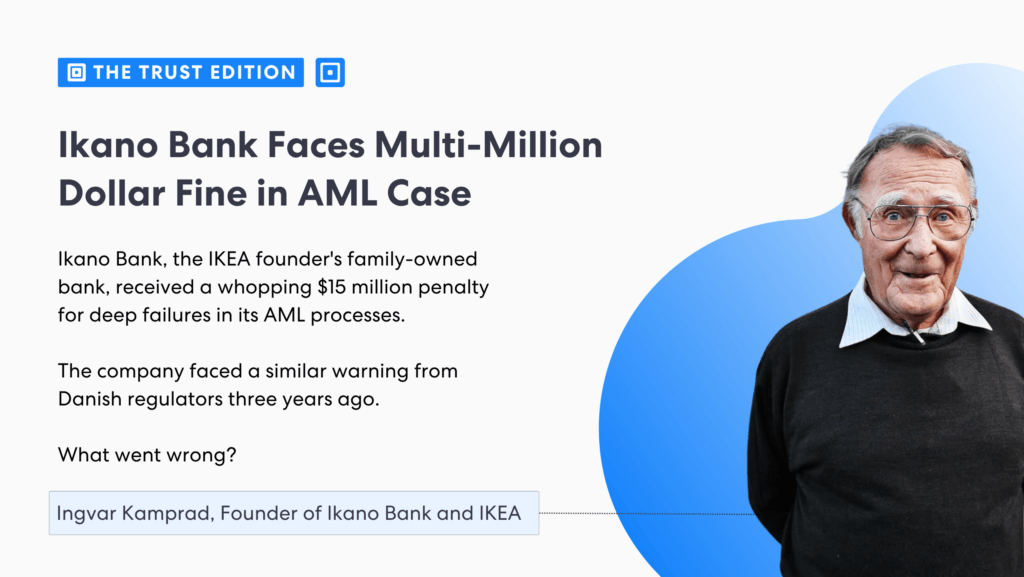
On June 17, 2026, the Swedish company, Ikano Bank AB, was fined SEK 140 million (USD$15 M) by Sweden’s Financial Supervisory Authority, the Finansinspektionen, for failures to comply with the country’s Anti-Money Laundering (AML) and Counter-Terrorist Financing (CTF) Act (2017:630).
Background: Ikano Bank AB was first founded in 1995 by Ingvar Kamprad, the founder of IKEA. The bank provides financial services to a large portfolio of leading clients, including Volkswagen, Audi, Linex, and Shell.
What Actually Went Wrong?
In a statement by the Finansinspektionen, there were four clear areas in its AML and CTF program that Ikano Bank failed to follow. Firstly, the company had incomplete risk assessments. It did not have a comprehensive assessment of the risk exposure level of its products. Without a clear product or service-specific risk assessment, this meant the bank could not identify the specific red flags that would be triggered in the event that a criminal was potentially moving illicit funds.
Secondly, the bank failed to consider risk factors that have a link to its actual corporate customers. This meant that the company had never realistically identified what classifies a customer as low, medium, or high risk. In practice, this could lead to a high-risk customer receiving the same due diligence measures as a low-risk one, despite being of a higher threat.
Key Facts: In 2023, Denmark inspected the Danish branch of Ikano Bank and noted it had insufficient beneficial owner documentation and inadequate customer knowledge procedures. Three years later, Sweden found the same issues, indicating a pattern of systemic AML weakness.
Thirdly, Ikano Bank had not examined or integrated updated ML and TF methods by regulators in the appropriate manner. As such, the company maintained outdated frameworks, instead of evolving them based on new information from Swedish authorities on the evolving tactics used by criminals to commit financial crime. Effectively, this implied that Ikano’s systems missed new red flags provided by regulators.
Lastly, the company did not gather adequate knowledge in order to implement Enhanced Due Diligence (EDD) measures. This suggested that the company had failed to gather crucial information, such as the purpose of the business relationship, source of funds, source of wealth, and beneficial ownership details. As a result, high-risk customers or entities could access financial services without proper verification.
Finansinspektionen’s AML Enforcement Surge
The Swedish Financial Intelligence Unit (FIU) has issued large AML penalties in recent months. Just last month, Norion Bank was penalized SEK 90 million (USD$9.75 M) for violations of AML and CTF rules. The regulator explicitly mentions its focus on sectors with elevated money laundering risks.
How financial firms prevent money laundering is a priority issue for Sweden’s FIU.
For companies across regulated markets, this case highlights the importance of rigorous, product-specific AML frameworks. Businesses must map and have a deep understanding of how actual customers can misuse specific products for money laundering.

Subscribe to ComplyCube’s Trust Edition newsletter, where we explore the top developments across identity verification and AML globally. Plus, we share valuable insights on compliance with the latest regulations.