TL;DR: Major jurisdictions across the US, UK, Singapore, and the UAE require businesses to identify and screen a Politically Exposed Person (PEP) for Anti-Money Laundering (AML) compliance. This guide explores different types of politically exposed persons and how to screen them effectively for PEP KYC compliance.
What is a Politically Exposed Person?
A Politically Exposed Person (PEP) is an individual who holds a prominent public position or function, either domestically or internationally. Common examples include government officials, military officers, judges, and senior executives of state-owned enterprises. Regulators consider PEPs as high-risk due to their potential influence and access to sensitive information.
As a result, PEPs are more vulnerable to corruption, bribery, and money laundering. RCA of PEPs are also considered high risk due to their connections, which can present similar AML risks. Due to the potential indirect influence or involvement in corruption, they thus also require appropriate risk management and due diligence measures.
Identifying a politically exposed person is crucial for financial institutions to comply with PEP Know Your Customer (KYC) and AML regulations. It helps businesses mitigate the risk of money laundering, fraud, and other financial crimes while protecting customers.
Types of Politically Exposed Persons
Today, there are several types of PEPs, including:
1. Domestic PEPs: These individuals hold prominent public positions within their own country. Common examples include government officials, high-ranking military officers, and judges. Their influence and access to national resources make them susceptible to corruption and bribery.
2. Foreign PEPs: These individuals hold prominent public positions in other countries. This category includes heads of state, government ministers, and senior government executives. Due to their international influence, they pose a significant risk for cross-border money laundering activities.
3. International Organization PEPs: These are individuals who hold high-ranking positions in global firms, such as the United Nations, the World Bank, and the International Monetary Fund. Their global reach and decision-making power make them targets for corruption and financial crimes.
4. Immediate Family Members: Spouses, children, parents, and siblings of PEPs, also referred to as Relatives and Close Associates (RCA), are also considered high-risk due to their close relationship. Their association with a PEP can expose them to similar risks of involvement in illicit activities, even if only indirectly.
Levels of Politically Exposed Persons
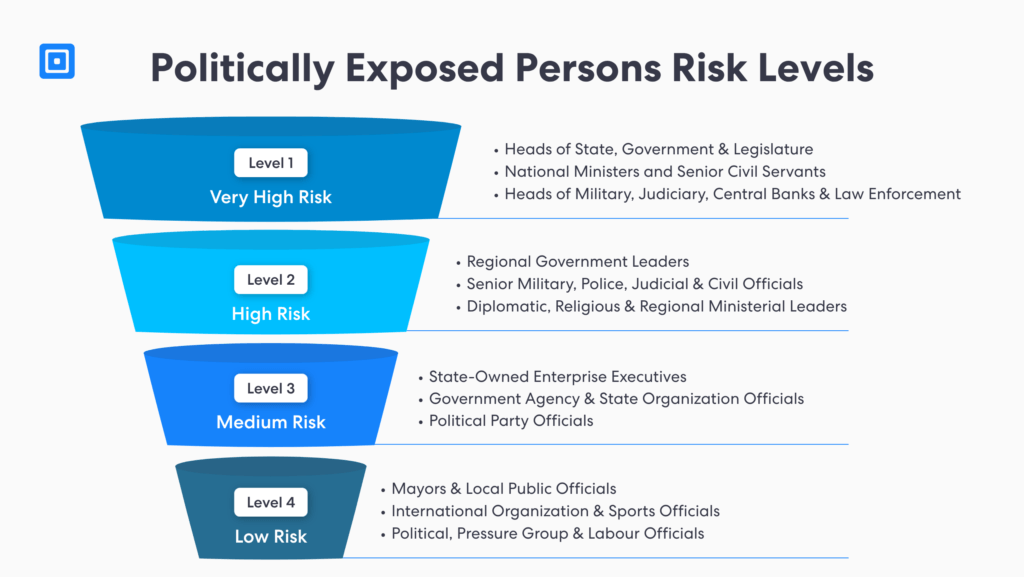
Politically Exposed Persons (PEPs) are typically categorized into four different levels in AML processes. This categorization largely depends on the level of risk they pose relative to their position and influence. With clear classifications, businesses can determine the appropriate level of scrutiny for each customer.
First, Level 1 addresses Prominent figures representing an international body. Next, the second level examines individuals holding national-level positions. Then, Level 3 covers officials holding state-level positions. Finally, Level 4 comprises civil servants holding positions at the local level.
Authorities require financial institutions to screen for PEPs and implement adequate AML measures to reduce their risks and liabilities. Notably, a Risk-Based Approach (RBA) enables businesses to tailor AML controls to the identified risks. PEP KYC is crucial because they ensure compliance with AML and Counter-Terrorist Financing (CTF) regulations. You can learn more here: Navigating KYC vs AML Compliance for Finance Firms.
Case Study: Argentine President Highlights Importance of PEP Screening
In 2025, the Argentinian President, Javier Milei, publicly expressed his favorable opinion on the $LIBRA cryptocurrency. This caused the token’s value to surge rapidly before collapsing. Opposing lawmakers called for Milei’s impeachment, with fraud complaints fueling across the country.
Significant Influence of PEP
This case showed how powerful political figures are and the influence they have over financial markets. For businesses, individuals such as Milei can create heightened compliance risks, thereby reinforcing the importance of PEP identification and Enhanced Due Diligence (EDD).
Outcomes
- While the case was not an enforcement action against a company, it illustrates why firms must closely identify and monitor PEPs.
- Ongoing monitoring of emerging adverse media and reputational risks helps maintain an accurate risk assessment.
- Milei’s case highlights how rapidly evolving events can impact financial crime risk assessments, requiring timely and ongoing alerts.
Why is it Important to Conduct a PEP Screening?
Local and international regulatory authorities have tightened regulations on financial institutions to protect both businesses and consumers from fraud and other crimes. In fact, fines imposed by bodies such as the Financial Action Task Force (FATF) and the Financial Crimes Enforcement Network (FinCEN) for AML non-compliance have reached millions of dollars.
To meet AML and KYC obligations, organizations must identify individuals who qualify as Politically Exposed Persons (PEPs) and assess their risk levels. PEP screening enables institutions to better understand the risk profiles of customers and beneficial owners, helping to detect and manage potential exposure to money laundering and terrorist financing.
For many financial institutions, the “once a PEP, always a PEP” approach (i.e., ongoing PEP status) is therefore adopted even after clients have left their governmental or civic positions.
PEP (Politically Exposed Person) screening is crucial for businesses as it helps mitigate the risks associated with financial crimes.
Harry Varatharasan, Chief Product Officer at ComplyCube, states, “PEP (Politically Exposed Person) screening is crucial for businesses as it helps mitigate the risks associated with financial crimes, corruption, and money laundering. By identifying and monitoring high-risk individuals, companies protect their reputation, ensure compliance with regulatory standards, and maintain trust with stakeholders and customers.”
Case Study: PEP KYC Remediation at GlobalBank
In 2025, GlobalBank failed to detect multiple politically exposed persons (PEPs) during onboarding and ongoing monitoring. Its legacy PEP KYC systems did not screen for indirect PEP links or apply enhanced due diligence effectively.
Enhanced Risk Scoring and Monitoring Integration
To demonstrate change, GlobalBank integrated automated PEP KYC workflows to identify every politically exposed person across jurisdictions. It adopted a risk-based approach, implemented enhanced due diligence, and enabled real-time alerts for politically exposed persons.
Outcomes
- 98% reduction in missed PEP matches within 6 months.
80% decrease in remediation backlog.
Strengthened reputation and reduced financial crime exposure.
How to Conduct Politically Exposed Person (PEP) Due Diligence
In practice, PEP due diligence depends on the level of risk each customer presents, which in turn determines the extent of AML controls required. While the specific due diligence steps and risk assessments may vary by jurisdiction, most frameworks recommend an RBA, combined with ongoing monitoring.
However, understanding the unique characteristics of each customer relationship is crucial in determining the appropriate level of due diligence. For example, the depth of due diligence should consider factors such as political influence, country of exposure, products and services used, and any links to high-risk jurisdictions or adverse media.
Elements of PEP Due Diligence
PEP risk is not static. A person can become a PEP after onboarding, assume a more influential public role, or become associated with corruption allegations at a later stage. Thus, PEP due diligence should extend beyond onboarding and require continuous monitoring. Typically, the process should incorporate:
1. A Risk-Based Approach
Instead of treating all PEP the same, a risk-based approach applies proportionate controls based on multiple risk factors. This is critical, especially as leading bodies, such as the FATF, warn against blanket de-risking based on a single factor, as highlighted in their June Plenary update. You can learn more here: The Evolution of the Risk-Based Approach in AML.
2. Verify the Customer and Identify Political Exposure
When verifying a customer, a business should collect robust, relevant information to determine if someone is a politically exposed person or an RCA of a PEP. As political exposure can be indirect, businesses may need to screen beneficial owners or controlling persons. You can learn more here: What is Ultimate Beneficial Ownership (UBO)?
3. Establish Source of Wealth and Source of Funds
Businesses should perform Source of Wealth (SOW) and Source of Funds (SOF) verification for high-risk PEPs. Major AML jurisdictions across Australia, Hong Kong, the US, and the UK mandate SOW and SOF checks to assess financial crime risks for high-risk PEP.
4. Conduct Adverse Media and Sanctions Screening
To fulfill PEP KYC requirements, businesses must conduct adverse media and sanctions screening. Ongoing screening and monitoring ensure that adverse media and sanctions findings are always up to date. Where required, these findings should trigger further investigation. You can learn more here: Perform Adverse Media Checks for KYC.
5. Obtain Senior Management Approval
Several rules, including the UK’s Money Laundering, Terrorist Financing and Transfer of Funds (Information on the Payer) Regulations 2017 (MLR2017), mandate senior management approval before establishing or continuing a business relationship with a PEP.
6. Perform Ongoing Monitoring and Risk Reviews
Effective PEP KYC calls for continuous monitoring of a customer’s risk via automated, real-time screening against PEP, sanctions, watchlist, and adverse media databases. Businesses should implement event-driven triggers, such as changes in political positions or ownership structures, to keep risk assessments up to date.
Data Sources for PEP Identification
Accurate PEP identification typically requires screening against multiple trusted data sources rather than a single database. As a result, businesses can enhance screening accuracy while lowering false positives. Some examples of these authoritative sources may include:
- Government Lists: Official lists of government officials, politicians, and other public figures provide a reliable source of information for identifying PEPs.
- Publicly Available Information: News articles, social media, and other publicly available sources offer valuable insights into individuals’ public roles and affiliations, helping to identify PEPs.
- Commercial Databases: Specialized databases compile information on PEPs, including their names, positions, and affiliations, for more thorough screening.
- Sanctions Lists: Lists of individuals and entities subject to economic sanctions often include PEPs. These lists help financial institutions identify high-risk individuals and entities that require EDD.
- Adverse Media: Monitor reports of negative news or adverse information about an individual or entity that may point to reputational risk or emerging corruption allegations.
By combining these trusted data sources, financial institutions can effectively identify PEPs and maintain compliance with evolving AML regulations.
Key Takeaways
- A Politically Exposed Person (PEP) holds a prominent public position and presents heightened financial crime risks.
- PEP KYC compliance requires enhanced due diligence based on jurisdiction and risk level.
- Screening must cover direct PEPs, family members, and close associates.
- Risk-based monitoring and ongoing due diligence are essential for maintaining AML compliance.
- Combining multiple, trusted PEP data sources improves screening accuracy and lowers false positives.
Strengthen Politically Exposed Person (PEP) Controls
Understanding the definition of a PEP and how to screen them is critical for compliance with AML laws and regulations. With increased scrutiny from regulatory authorities, financial institutions must implement adequate measures to reduce their risks and liabilities.
All-in-one AML vendors, such as ComplyCube, provide comprehensive AML screening solutions, including PEP screening, to help businesses mitigate risks and ensure compliance. Contact a member of the team to learn more about our services and how you can safeguard your business against financial crimes.
Frequently Asked Questions
What is a Politically Exposed Person (PEP) in financial compliance?
A Politically Exposed Person (PEP) is someone in a high-ranking public role, such as a government official, judge, or military leader, who may be at higher risk for financial crime. Global regulations, including those in the UK, EU, US, and APAC regions, require firms to identify PEPs as part of KYC and AML compliance.
Why is PEP screening important under EU and UK AML laws?
Under the UK’s Money Laundering Regulations and the EU’s Fourth and Fifth AML Directives, identifying politically exposed persons is mandatory. PEP screening helps regulated entities apply enhanced due diligence and avoid penalties from authorities like the FCA or EU regulators.
How are Politically Exposed Persons classified across jurisdictions?
Most regulatory bodies classify PEPs into four levels, international, national, regional, and local officials. This tiered structure is used in the UK, US (FinCEN guidance), EU, and FATF recommendations to guide the depth of KYC checks required.
What are common PEP screening challenges in cross-border compliance?
Cross-border firms face challenges in identifying foreign PEPs, keeping lists updated across languages, and complying with country-specific definitions. For example, a PEP in one country may not meet the same threshold in another, requiring flexible and jurisdiction-aware PEP KYC workflows.
How does ComplyCube help meet global PEP KYC requirements?
ComplyCube provides automated, multi-jurisdictional PEP screening with real-time updates from global watchlists and adverse media sources. Its risk-based engine supports UK, EU, US, and APAC compliance, helping businesses detect politically exposed persons and maintain continuous AML readiness.