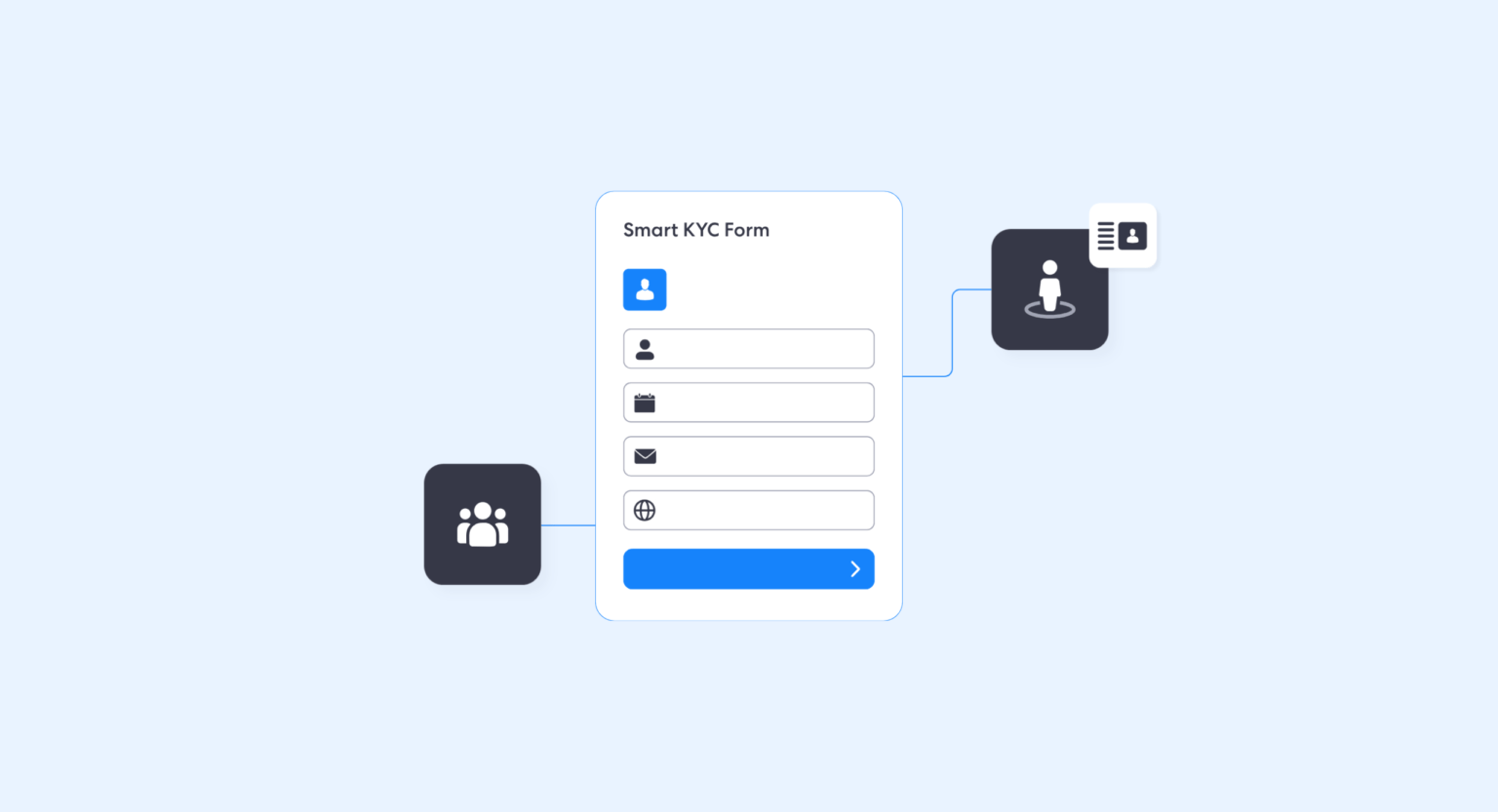
TL;DR: Customers often face lengthy, irrelevant questionnaires to start a new service. Adaptive smart forms for onboarding streamlines this via tailored questions to each user. Smart forms for KYC further adapt questions to user type and risk signals, supporting due diligence requirements. This guide explores smart forms and how they support risk-based onboarding journeys.
What Are Smart Forms?
Smart forms, also known as dynamic questionnaires, are used to capture customer information during onboarding. Modern compliance teams use adaptive smart forms for Know Your Customer (KYC) and Know Your Business (KYB) processes. These tools help collect the right customer details to meet regulatory obligations while supporting a seamless onboarding experience.
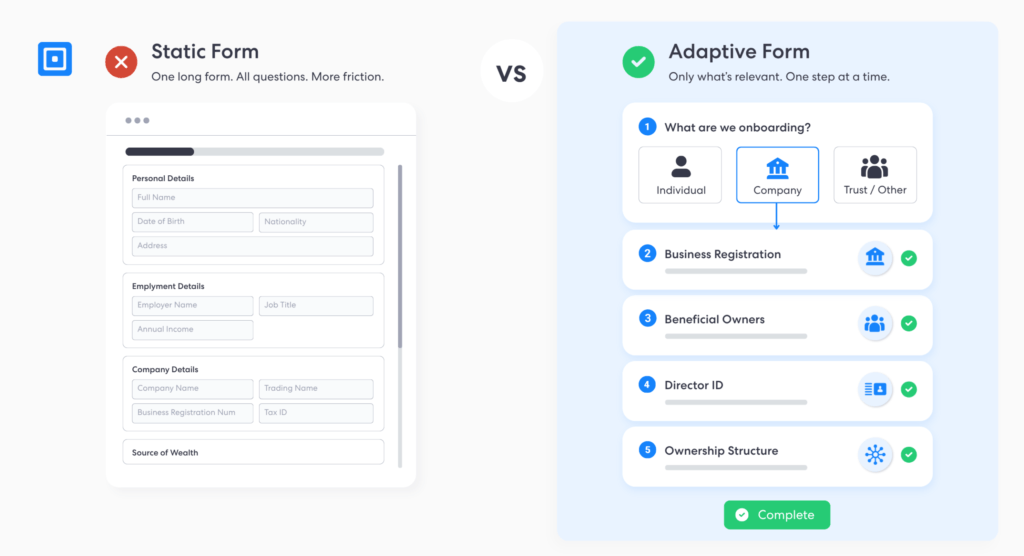
Adaptive smart forms for KYC use advanced conditional logic and data validation. These features expand, hide, or change form fields based on the responses a user provides in real-time. Additionally, regtech vendors, such as ComplyCube, enable businesses to layer identity verification checks after a user completes the form. This helps close the regulatory gaps by verifying that a person or business filling the form is legitimate.
Smart Forms for KYC Compliance
High-growth, regulated businesses increasingly use smart forms to support KYC compliance. This is because they support clear data capture, enhanced customer experiences, and more proportionate compliance checks. As such, it shifts from static to dynamic forms, where users see questions based on identity, jurisdiction, and risk indicators.
This is critical, especially for Customer Due Diligence (CDD), where firms must collect and evidence the right information at the appropriate level of depth. According to the UK’s Financial Conduct Authority, poor practices of CDD include the lack of documentation around key information, such as the purpose and intended nature of the business relationship. On the other hand, strong practices tailor CDD to customers’ risk profiles, supporting the need for dynamic, risk-based smart forms.
Customer Due Diligence Obligations
Smart forms help businesses meet global regulatory alignment. For instance, international regulatory standards such as the Financial Action Task Force (FATF) recommend collecting information to meet compliance. This includes confirming customer identity, beneficial ownership, the purpose of a business relationship, and ongoing monitoring.
Additionally, other leading regimes echo the same standards. For instance, the EU’s Anti-Money Laundering Directive (AMLD) mandates risk-based CDD, while the U.S. Bank Secrecy Act (BSA) emphasizes beneficial ownership verification and suspicious transaction reporting. Although the requirements can look different across various jurisdictions, the need for complete, accurate, and auditable information is clear.
For this reason, advanced KYC or KYB smart forms go beyond data collection. They act as strong compliance journeys, integrating identity verification, Enhanced Due Diligence (EDD) triggers, and consent capture in one process.
Supporting a Risk-Based Approach
Instead of applying the same level of questioning to every customer, companies can collect targeted, essential information. For example, if an applicant filling the form identifies as a company, the form automatically switches to a KYB flow. Instead, it requests documents related to business information and ownership structure.
Similarly, answering “yes” to a Politically Exposed Person (PEP) status or high-risk country of residence can trigger additional steps. This includes source of wealth questions or enhanced ID documents. On the flip side, the form routes low-risk users into a streamlined flow that collects the core KYC fields required by local regulators.
The key benefits of adaptive smart forms include:
- Faster reviews: Reduces back-and-forth emails between businesses and clients for extra information. It also reduces the potential risk of manual error during data collection.
- Better data: Makes use of standardized formats, real-time validation, and required fields to reduce errors or incomplete information before submission.
- Risk-based KYC: A low-risk customer sees fewer questions, while a high-risk customer can be routed to additional steps, such as enhanced document uploads or bank statement requests.
- Stronger auditability: Each answer, uploaded file, and consent is timestamped, maintaining a clear record for internal reviews and enhancing audit readiness.
- Lower abandonment: Improve data quality by simplifying data collection, leading to improved customer experiences and conversion rates.
- Periodic reviews: Beyond customer onboarding, smart forms can streamline KYC refreshes by collecting updated customer information where risk factors change or a certain time has passed.
- Fraud prevention: Smart forms can be layered into KYC and Anti-Money Laundering (AML) workflows, identifying any inconsistencies to confirm that an individual or business is legitimate.
Conditional Logic and Dynamic Flows
Unlike static questionnaires, adaptive smart forms for KYC extend verification workflows with fully customizable data capture steps. They are driven by if-then rules, event triggers, and integrations with internal systems. As such, compliance officers can build flexible KYC and AML workflows.
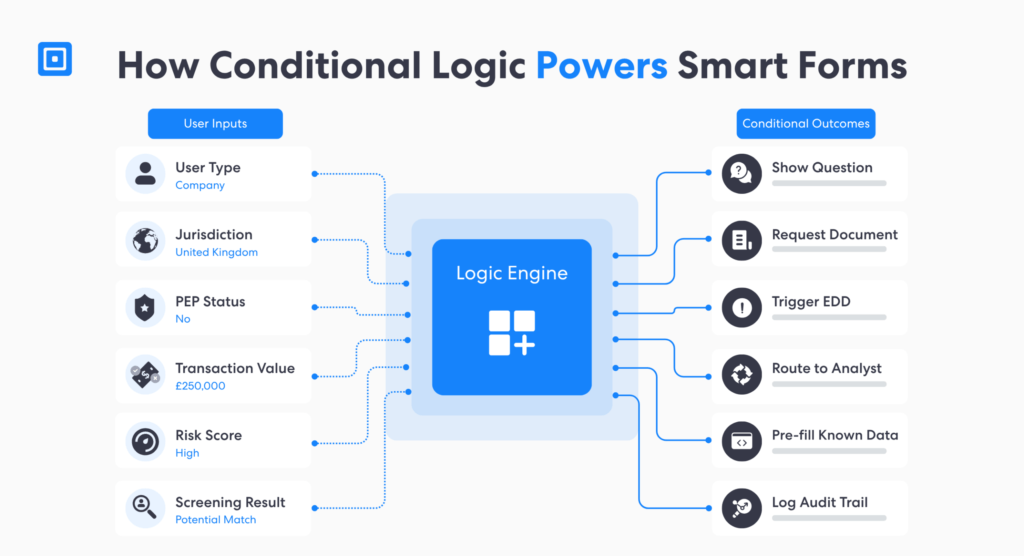
Providers, such as ComplyCube, offer smart forms that leverage enhanced conditional logic to determine the sections, questions, and text that will appear based on a user’s responses, customer profile, or risk scores. For instance, if a client fills a text field mentioning they require a loan amount above a certain threshold, the form can trigger additional questions and route the case for EDD.
Furthermore, with APIs or webhooks, all responses can be securely stored and linked to a workflow session, which can be accessed in real time. In practice, this means known information from identity verification steps can be pre-populated, irrelevant fields are hidden, and submission accuracy is significantly improved.
Examples of KYC Questions Enhanced by Smart Logic
- Individual versus company: Individuals provide personal details and ID documents, while businesses provide company details such as ownership information and a primary contact.
- Tax residence: If a customer selects another tax jurisdiction, the KYC form reveals tax identification number fields and self-certification statements.
- PEP status: If a customer declares itself as a PEP, the form requests essential details, including role, source of wealth, and supporting document uploads.
- High-value intent: If expected transactions exceed a set threshold, the system routes the case to EDD review.
Adaptive Smart Forms Use Cases
Smart forms can be used in various sectors to support employment history verification, source-of-wealth declarations, and more. According to reports, more than half of individuals who start a digital bank account application never end up finishing it, often due to unclear steps and excessive questions.
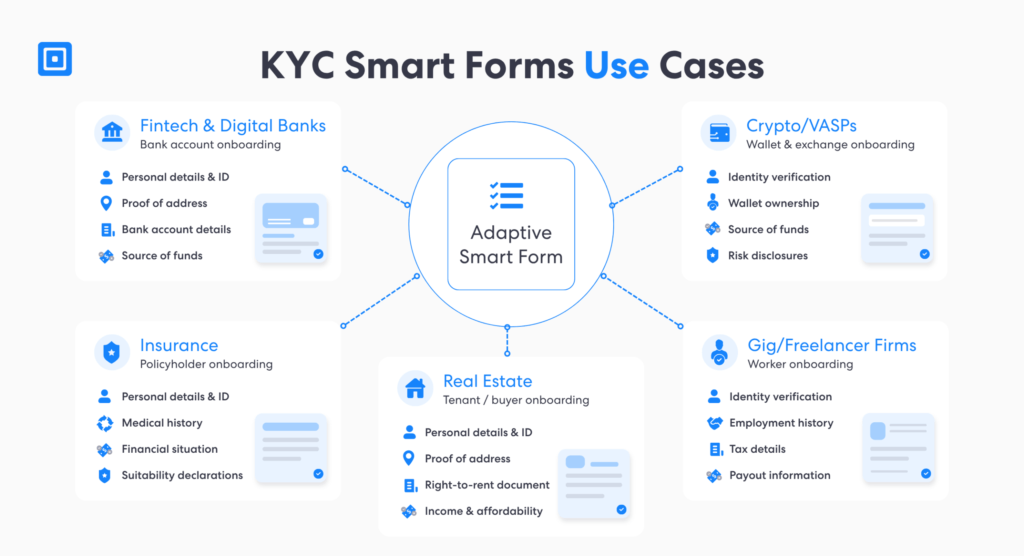
To combat this challenge, businesses can use an adaptive onboarding form template or a KYC form template to guide applicants through the right onboarding checklist. As such, it reduces manual data collection and minimizes compliance risks across different user journeys.
Adaptive smart forms are no longer just a digital upgrade to paper forms. They are the strategic layer that turns fragmented onboarding tasks into a single, risk‑based workflow.
According to ComplyCube’s Chief Product Officer, Harry Varatharasan, “Adaptive smart forms are the strategic layer that turns fragmented onboarding tasks into a single, risk‑based workflow.” Whether a business needs to gather necessary information for new customers to open a bank account or collect right-to-work proof for new hires, smart forms can meet these specific needs. Adaptive smart forms are applicable across various industries, including finance, healthcare, and e-commerce, enhancing workflows by automating data capture and compliance processes:
1. Fintech or Digital Banking
FinTechs and digital banks use smart forms to streamline account opening while meeting compliance requirements. Firms can capture financial information such as expected transaction volumes, business or personal declarations, and bank details securely. Moreover, high-risk applicants can trigger additional document uploads.
2. Cryptocurrency or Virtual Asset Service Providers (VASPs)
Crypto‑asset platforms use smart forms to verify new clients and gather source of funds and source of wealth declarations for high-value activity. For instance, if a customer makes a large deposit or withdrawal, the form can trigger information about the origin of funds or wallet ownership. Additionally, firms can capture customer attestations, risk disclosures and consent confirmations for trading.
3. Insurance
Insurers deploy smart forms for KYC to gather tax records, suitability information and policy-specific declarations. For example, life or medical insurance can request additional information about income, occupation, medical history, or investment risk appetite. As a result, insurers gather the exact information they require for underwriting and tax compliance.
4. Property and Real Estate
Companies in the property or real estate sector make use of smart forms to gather tenancy history, right-to-rent, and right-to-work information. Furthermore, for high-value purchases or complex ownership structures, questions around beneficial ownership and transaction purpose can be triggered to onboard customers accurately.
5. Gig Economy and Freelancer Platforms
HR departments, gig platforms, and freelancer marketplaces use smart forms to collect employee details, right‑to‑work proofs, and tax‑related records. Where there are high‑value contracts, additional checks can be requested. Consequently, this helps verify and support employee engagement via a guided, digital onboarding experience.
Case Study: UBS Monaco Fined €6M for Weak Customer Due Diligence
Monaco’s regulator, the AMSF, issued UBS Monaco a €6 million fine for compliance failures. Reports indicate that the bank failed to meet crucial CDD requirements. From 2018 to 2023, UBS Monaco repeatedly failed to perform Enhanced Due Diligence (EDD) for high-risk clients.
Poor Risk-based KYC Controls
UBS Monaco did not have the right procedures in place for collecting information proportionate to the risks present. For instance, the firm failed to verify beneficial ownership in complex corporate structures and did not conduct source of wealth assessments for high-risk clients.
Outcomes
In addition to the fine, the AMSF will publish the enforcement decision for five years, leading to reputational damage.
- Some notable cases include enabling $800,000 transaction from poorly verified businesses and incomplete PEP screening in 5 out of 25 cases.
During investigations, the bank could not provide regulators with information about several clients, signalling deep systematic gaps in its audit function.
Core Features of Smart Forms
Not all digital forms can deliver the same functionality that is required in today’s modern compliance and onboarding requirements. For instance, a wizard-style navigation is a user interface design that breaks down complex processes into step-by-step flows with progress indicators for enhanced customer experience. Additionally, real-time validation checks ensure formats such as emails or phone numbers are accurate before submission.
As a result, organizations can benefit from improved conversion rates resulting from shorter perceived forms. This reduces friction in the process, leading to more sign-ups, leads, or purchases. Moreover, since AML frameworks mandate KYC processes, banks, insurers, and accountants must ensure the forms can meet the CDD requirements in their respective jurisdictions. Some of the key capabilities that can support this include:
- No-code setup: Supports teams in creating, updating, and deploying forms without knowledge of coding required. As such, businesses can adapt and scale faster to regulatory changes.
- Security: Ensure to look for end-to-end encryption in transit and at rest. Additionally, role-based access controls, SSL encryption, and real-time audits further safeguard sensitive data.
- Responsive and adaptive layouts: Smart forms need to resize seamlessly across multiple devices, supporting fully responsive forms across mobile and web, regardless of screen size.
- Integrations: Look for breadth of integration capabilities, including API connectivity with CRM systems, case management tools, and sanctions and PEP screening.
- Analytics: Delivers dashboards with actionable insights on completion rates, drop-off points, time to complete, and optimization opportunities.
Key Takeaways
Adaptive smart forms are digital forms that change in real-time based on a user’s identity, previous answers, and risk profile, making KYC compliance and onboarding seamless.
Smart forms for KYC use conditional logic to collect relevant client information, improving completion rates and data quality.
Regulated businesses use smart forms to streamline the client onboarding process, reduce manual reviews, and minimize compliance risks.
Modern smart forms connect identity verification, document uploads, consent forms, and e-signatures into one secure onboarding process.
Advanced smart forms for onboarding include a no-code setup, customizable rules, deep integrations, and robust analytics.
Meet Customer Due Diligence Requirements
Global, high-paced companies that use adaptive smart forms can gain strategic business advantages while building strong regulatory trust. Smart forms are crucial in reducing form fatigue, lowering abandonment rates, and improving data quality by simplifying data collection.
Moreover, organizations can embed compliance documents into the onboarding journey, helping them meet KYC requirements efficiently and consistently. As regulatory expectations continue to evolve, smart forms provide the agility, accuracy, and user-centric design needed to scale compliance operations without compromising customer experience. Contact the ComplyCube team to get started with smart forms today.

Frequently Asked Questions
What are smart forms?
Smart forms or dynamic questionnaires adapt to a customer’s responses, automatically filling known data and hiding irrelevant questions in real-time. Regulated businesses use these forms to gather client data to support KYC and AML compliance, including right-to-work or bank account information.
How does adaptive smart forms help with compliance?
Smart forms use advanced conditional logic and data validation to streamline compliance requirements across borders. These forms adapt to the customer type and risks present based on their responses. Since every interaction, such as question paths and acknowledgements are recorded in real-time, it supports clear audit trails for KYC and AML regulatory reporting.
Are smart forms only relevant for financial institutions?
No. Regulated companies in financial services use smart forms to stay compliant while maintaining a smooth transition during onboarding. However, insurers, real estate firms, and healthcare providers are increasingly using smart forms to detect and reduce compliance risks earlier in the onboarding process.
What to look for in KYC smart forms?
A KYC smart form should collect the relevant information for existing and new clients to verify identity, assess risk, and meet due diligence obligations effectively. Leading regulated organizations opt for smart forms with a no-code setup, advanced conditional logic, and deep integrations to reduce manual entry, validate responses, and build clear audit trails.
Can ComplyCube’s smart forms handle document uploads and e-signatures?
Yes. Modern smart forms can collect various types of documents, digital signatures, and certificates. ComplyCube’s smart forms are built to accept multiple file documents, including payslips, address proof, and tenancy information. It also captures e-signatures to support policy acknowledgements, risk warnings, and truthfulness declarations that meet regulatory standards.