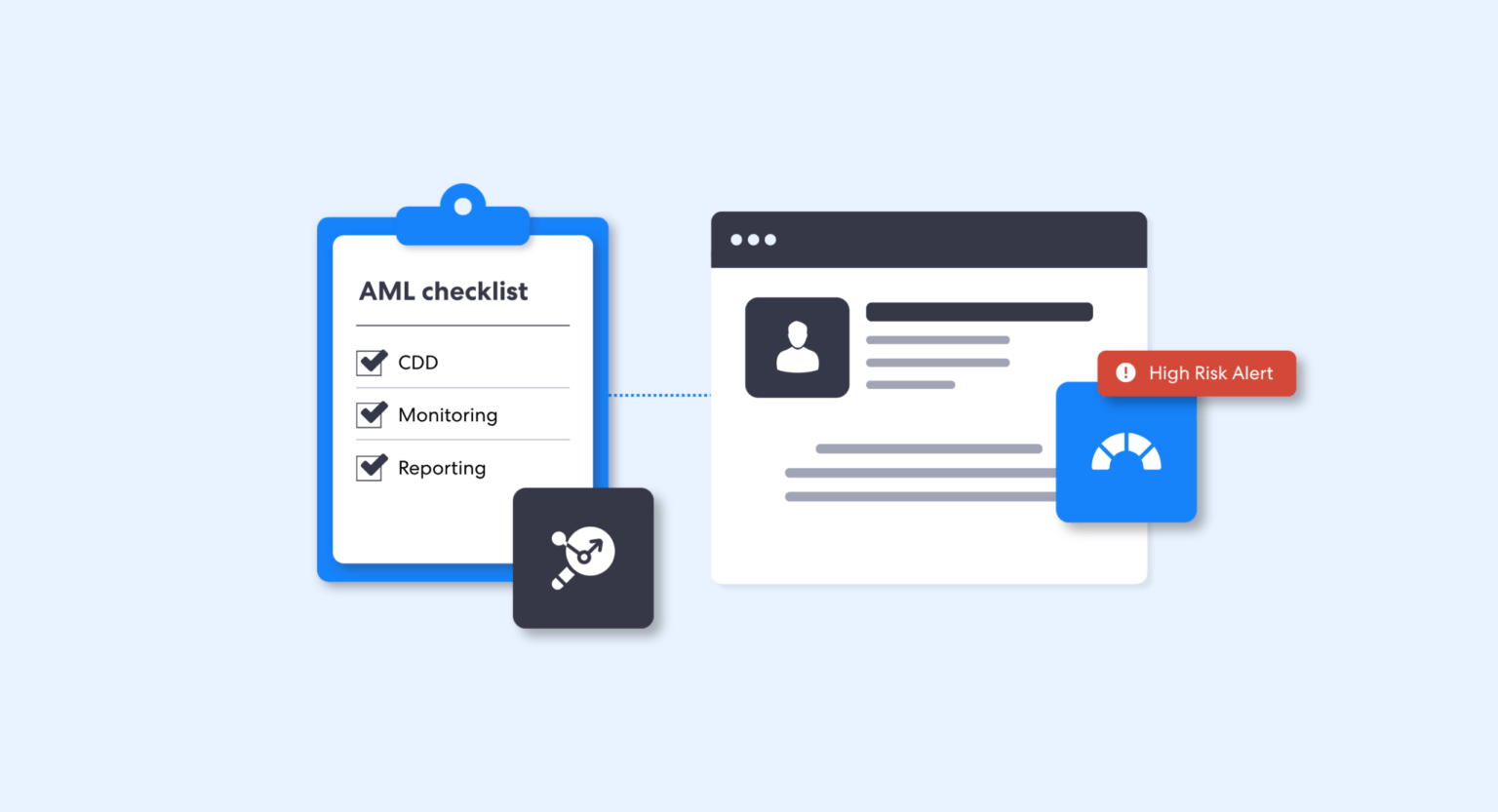
TL;DR: An AML compliance checklist often provides financial institutions with structure to manage financial crime risks. As a result, an AML checklist blends risk assessment, customer due diligence (CDD), and ongoing monitoring into an effective checklist.
What Is an AML Compliance Checklist?
In today’s world, an AML compliance checklist is absolutely necessary. It is a framework for financial institutions to prevent, detect, and report any financial crime. By bringing together key compliance processes such as verifying customer identity, and suspicious activity reports, AML compliance can fit within a single operational model.
Now, organizations can better meet regulatory requirements while ensuring compliance across all businesses. In reality, it acts as a guide for putting controls in place rather than a simple list of tasks to be completed. The AML checklist looks at critical actions in the AML and compliance processes that help ensure proper risk management. It also looks at alignment with different regulations across many jurisdictions.
More importantly, an AML checklist makes up the backbone of a wider AML compliance program that changes and grows alongside emerging risks. This checklist helps compliance and money laundering reporting officers (MLROs) get clarity on due diligence procedures, internal controls, and risk escalation protocols.
The MLROs are responsible for dealing with compliance issues, managing escalation processes and fulfilling any reporting obligations to Financial Intelligence Units (FIUs). According to practical guidance from the Financial Action Task Force (FATF), organizations need to constantly change their controls to reflect the changing financial crime risks in real time. A checklist should be a living system rather than a stand-alone and static document.
Why an AML Compliance Checklist Matters for Financial Institutions
In 2023, there were more than $7 billion in fines reported across various industries and companies due to a lack of strong Anti-Money Laundering controls and programs. As a result, AML compliance has now become one of the biggest priorities for financial institutions and relevant authorities globally. This statistic shows the financial and reputational risks of weak AML compliance processes.
Such enforcement actions or fines show that regulatory bodies have clear expectations of different organizations. It is clear that they must take proactive measure in order to detect and stop financial crime before it starts. The Bank Secrecy Act from the Financial Crimes Enforcement Network (FinCEN) is one of the foundational regulations in AML compliance. It plays an important role in preventing any financial crimes and it underscores the many significant risks of non-compliance across the board.
Therefore, supervisory authorities are much more interventionist today. The Financial Conduct Authority (FCA) sent warning letters to over 1,000 financial institutions in March 2024 for compliance deficiencies identified during AML audits, indicating a proactive regulatory approach to enforcement. However, this is not even the latest regulatory update. It marks the shift to earlier detection of compliance deficiencies and stricter rules around AML controls. As a result, financial institutions need their AML compliance checklists to support both regulations and operations incredibly well.
From AML Checklist to AML Compliance Program
A lot of different organizations look at an AML checklist as a static requirement. However, regulators want more of a fully integrated AML compliance program. They want it to link policies, procedures, and monitoring into a continuous cycle that goes across customer onboarding all the way through to ongoing monitoring. As a result, compliance efforts remain consistent, measurable, and aligned with regulatory expectations.
An AML compliance checklist only works when controls are clearly defined, consistently applied, and continuously tested against real-world risk.
Solutions Consultant, Milosh Caunhye, adds on, “At ComplyCube, that means treating the checklist as an operational framework rather than a static compliance document.” When firms take this approach, it becomes more of a practical tool for managing, monitoring, escalation, and reporting in a consistent way. By linking multiple factors, organizations can strengthen compliance outcomes and build a more tough AML compliance program.
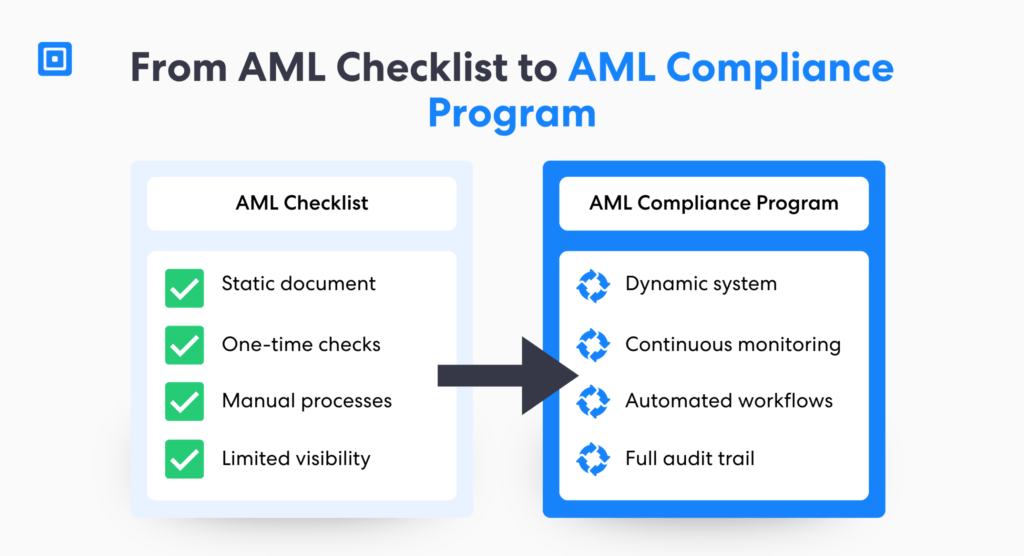
A thorough compliance framework focuses on five core pillars. It looks at the appointment of a compliance officer, development of AML policies, customer due diligence, independent testing, and regular ongoing AML training. These work together to form a system of AML controls that help continuous monitoring and overall risk management.
The Role of Risk Assessment in an AML Compliance Checklist
Another huge part of an AML compliance checklist is risk assessment. It provides a strong base for a risk-based approach (RBA) to compliance. It helps financial institutions find any potential money laundering risks across customers, products, services, and geographic regions. This ensures that resources allocation is done appropriately and responsibilities are assigned based on the highest risk exposure.
The best way to perform a risk assessment is to assign risk ratings, figure out risk appetite, and conduct occasional reviews to monitor changing conditions. This ensures more effective decision-making across compliance programs. By regularly assessing risk profiles, companies and organizations can modify their AML compliance checklist and lower any vulnerabilities within their own AML process. You can learn more about RBA here: What is a Risk-Based Approach (RBA)?
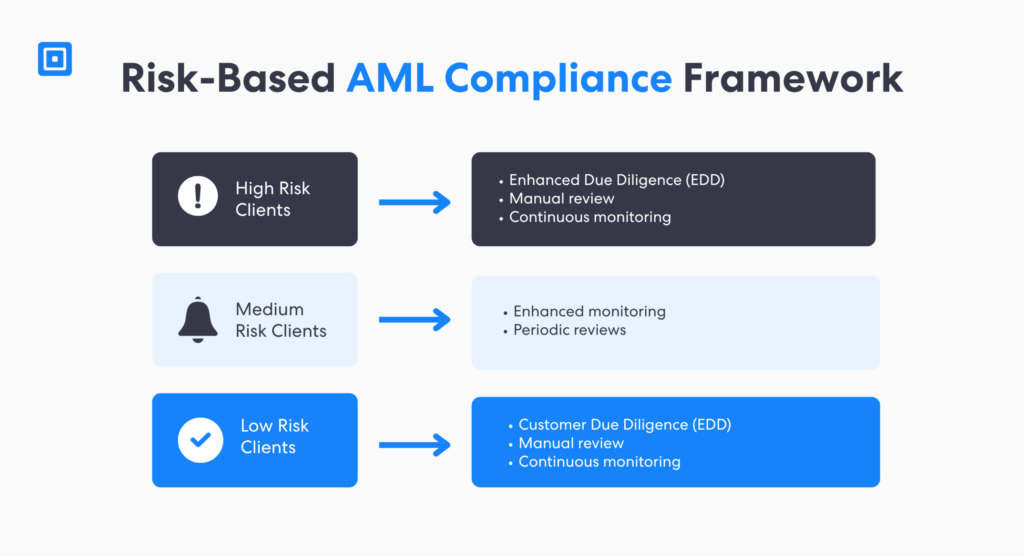
Overall, a strong risk-based approach is necessary for AML compliance programs for organizations. It helps companies find, learn about, and fix any potential money laundering and terrorist financing risk. This covers all types of financial risks, particularly those in connection with customers, products, services, and regions. This is normally determined by FATF.
Establishing a Risk-Based Framework in AML Policies
As aforementioned, rather than apply the same levels of scrutiny to every single customer or transaction, compliance teams must to look toward a risk-based approach. This version of targeted AML strategy helps financial institutions to move the necessary resources properly, prioritizing compliance on the areas with the biggest AML risks.
By focusing on high-risk profiles or customers, products, and regions, financial institutions and organizations must better protect themselves against any potential threats. This clearly ensures that AML compliance frameworks are consistently growing and changing based on regulatory requirements, expectations, and financial crime risks.
Key Components of a Risk-Based Framework
The first step in order to build a successful risk-based approach is around finding out which crucial components are necessary. By seeing what needs to work together, a strong risk-based AML framework can lower any exposure to money laundering or additional terrorist financing risks. The 4 components of a risk-based framework are:
- Risk Assessment: Conducting thorough risk assessments that find and assess any money laundering risks over all businesses and customer segments.
- Customer Due Diligence: Put in place proper due diligence protocols to determine customer identity, learn about beneficial ownership, and look through risk profiles.
- Ongoing Monitoring: Keeping continuous monitoring of customers and their activities helps update risk profiles to show changes in behavior or circumstances.
- Training and Awareness: Give regular AML training through awareness programs so employees learn the risks and consequences that come with diligence procedures.
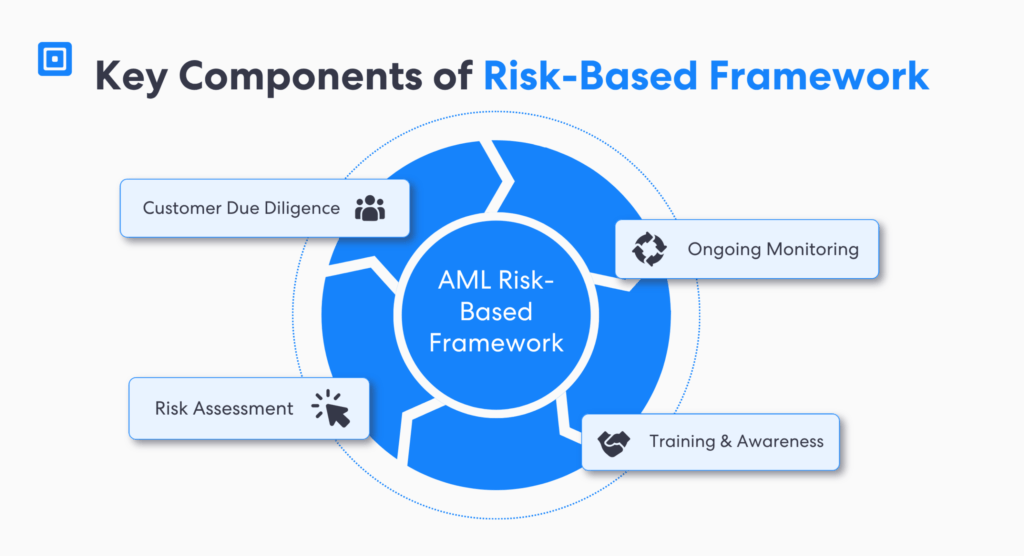
As a result, by putting all of these different components of AML Risk Assessments in one place, today’s financial institutions must stay well ahead by building a dynamic and responsive AML compliance program. One that changes based on new threats and rule changes with varying regulatory bodies, business lines, and jurisdictions.
Customer Due Diligence in Anti-Money Laundering AML
Today, customer due diligence (CDD) is known to be a cornerstone of Anti-Money Laundering (AML) programs. By identifying customers, looking at beneficial ownership, and reviewing risk levels, CDD does screening well before starting or building upon a business relationship. This way, financial institutions can find any criminal activity at the very beginning at customer onboarding. You can learn more here: What is Customer Due Diligence (CDD)?
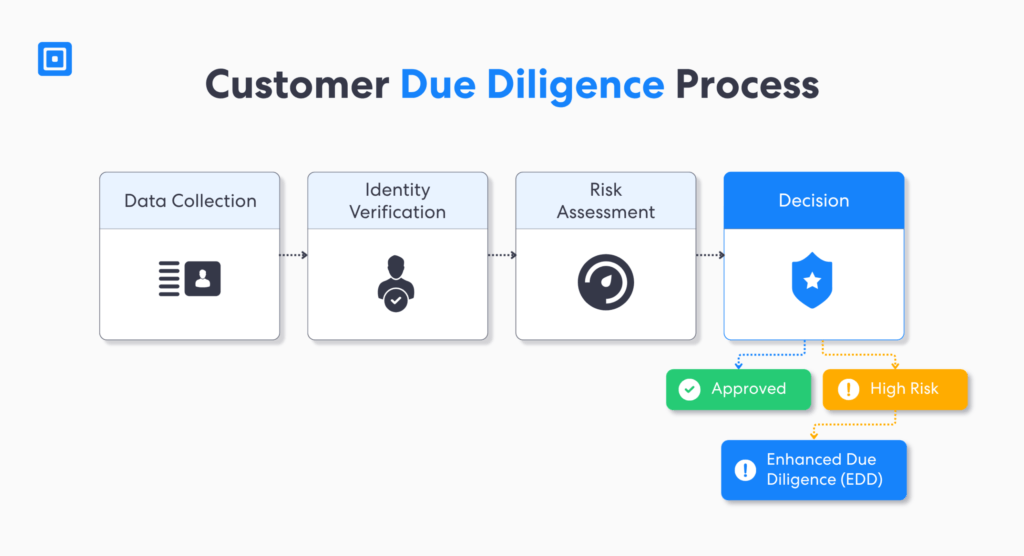
However, a thorough CDD process is very involved. It needs identification document or data collection, further identity document verification, and looking at transaction behavior. Such procedures support companies trying to build incredibly accurate risk profiles. It stops high-risk individuals from coming into a financial system. Strong CDD also shows compliance with regulatory bodies and indication of continuous monitoring over the customer lifecycle.
Enhanced Due Diligence for High-Risk Clients
Similarly, Enhanced Due Diligence (EDD) comes into play when standard customer due diligence is not enough to manage risk properly. For example, this EDD process would apply to high-risk clients that are potentially politically exposed persons or customers that operate from high-risk regions. These types of people need much deeper investigations so that financial institutions can fully know their risk exposure.
EDD needs even more data, manual review and a much closer review of transaction patterns to find any odd behavior. This high level of scrutiny helps mitigate terrorist financing risks at a high degree. It ensures better compliance with regulatory authorities. Therefore, without any effective EDD, senior management will struggle to find any complex money laundering schemes that fall outside of regular AML controls.
Ongoing Monitoring Processes
Ongoing monitoring ensures that customer risk profiles remain accurate throughout the lifecycle of the relationship. It involves continuously reviewing transaction activity, updating customer data, and identifying changes that may indicate financial crime risks. This process is essential for maintaining compliance with AML regulations.
Also known as continuous monitoring, it enables organizations to respond proactively to emerging risks, reducing the likelihood of regulatory penalties. By conducting periodic reviews and updating risk profiles, financial institutions must ensure that their compliance programs remain effective. This reinforces the importance of treating compliance as an ongoing process rather than a one-time requirement. You can learn more here: What is an Ongoing Monitoring Process?
Suspicious Activity Reporting and Regulatory Expectations
One critical output from AML compliance programs are Suspicious Activity Reports (SARs). They give valuable information to regulatory bodies and authorities. They help law enforcement agencies to better detect and investigate financial criminal activity. Thereby, making it a key component of the global compliance framework.
Therefore, it is incredibly important to have timely and confident SAR submissions. Financial institutions absolutely need to set up clear processes to make sure reports are in fact accurate and do not negatively impact investigations. A strong SAR program prioritizes quality, giving actionable insights rather than excessive reporting volumes.
Record Keeping and Audit Trail Requirements
Most importantly, record keeping is a fundamental part of any AML compliance checklist. Strong and thorough record-keeping means keeping all customer identification, transactions, and investigation records for at the very least five years or as required by local laws and regulations. Maintaining accurate and accessible data, is crucial for AML compliance.
Maintaining detailed records of customer identity, transactions, and investigations supports audit trail creation and regulatory compliance. It enables organizations to demonstrate adherence to aml regulations and respond effectively to requests from authorities. Strong record keeping also supports continuous improvement by providing valuable insights into compliance performance.
Independent Audit and Continuous Improvement
Finally, independent audit reviews and independent testing are essential. They thoroughly evaluate the effectiveness of AML compliance programs. These compliance processes provide an objective assessment of internal controls, identifying gaps and areas for improvement. They are critical for maintaining alignment with regulatory requirements of governing bodies.
For instance, audit findings should be used to refine policies, improve risk assessment frameworks, and enhance transaction monitoring systems. This ensures that compliance programs remain effective in a constantly evolving regulatory landscape. Therefore, continuous improvement is key to staying ahead of emerging financial crime risks.
Case Study: Airwallex and AUSTRAC in AML Review
In April 2026, Airwallex came under scrutiny from AUSTRAC, Australia’s financial intelligence agency, over potential gaps in its Anti-Money Laundering (AML) controls. Reported concerns centered on customer due diligence, transaction monitoring, and governance oversight.
Strengthening Controls with a Risk-Based AML Checklist
Consequently, the Airwallex response reinforces a risk-based AML compliance program rather than relying on static policies alone. That meant tighter customer due diligence, better transaction monitoring calibration, and clearer escalation highlights the value of stronger internal controls.
Solutions & Outcomes
Increased regulatory focus on the operational effectiveness of AML checklists
Reinforced the need for real-time monitoring, stronger governance, and audit readiness
Shows why a risk-based AML framework is needed for lowering compliance failures
AML Training and Ongoing Staff Training
AML training is a critical component of any compliance program, ensuring that employees understand their responsibilities and can identify financial crime risks. Training programs should cover key areas such as customer due diligence, transaction monitoring, and suspicious activity reporting. This ensures consistency across business operations.
According to the FCA, financial firms must make room for regular and role-specific training to maintain compliance as part of their operations. Ongoing training ensures that employees remain informed about regulatory changes and emerging threats. As a result, this strengthens the overall compliance culture and reduces operational risk.
Key Takeaways
AML compliance requires a risk-based approach aligned with real-world risks.
Customer due diligence and enhanced due diligence are critical AML components.
Continuous monitoring ensures accurate and up-to-date risk profiles.
Independent audits and training support long-term compliance effectiveness.
Strong AML training enables scalable and efficient AML compliance programs.
Strengthen Your AML Compliance Checklist with ComplyCube
Building an AML compliance checklist requires more than policies and procedures. It demands a unified approach that integrates identity verification, transaction monitoring, and continuous monitoring into a single compliance program. Financial institutions must ensure that all components work together seamlessly to detect and prevent financial crime.
Talk to our compliance experts to enhance your AML compliance checklist and build a scalable, risk-based compliance program with ComplyCube’s unified platform.

Frequently Asked Questions
What is an AML compliance checklist?
An AML compliance checklist is a structured set of controls used to detect, prevent, and report financial crime or fraud. Though these checklist covers due diligence, monitoring, reporting, and record keeping, organizations are moving away from a simple checklist into an integrated compliance program.
What are the key components of AML compliance?
There are many key components of AML compliance such as risk assessment, customer due diligence, sanctions screening, and suspicious activity reporting. Up-to-date AML compliance training, regularly scheduled audits, and thorough record keeping also support compliance operations.
How does a risk-based approach support AML compliance?
A risk-based approach (RBA) helps firms put in place even stronger controls where risk exposure is extremely high. It improves efficiency by lining up customer due diligence, enhanced due diligence, ongoing monitoring, and manual reviews with actual risk.
How often should AML compliance processes be reviewed?
AML compliance processes should be reviewed regularly. Policies and controls must be updated to reflect evolving regulatory requirements and emerging financial crime risks. This supports continuous improvement and ensures long-term compliance effectiveness.
How can ComplyCube improve AML compliance processes?
ComplyCube enables organizations to automate AML compliance processes, including customer due diligence, transaction monitoring, and ongoing monitoring. Its unified platform reduces false positives, improves efficiency, and supports real-time risk decisioning.