👋 Welcome back! In this CryptoCubed May Edition, we explore several major regulatory developments impacting the crypto landscape globally. This includes the EU’s latest MiCA crypto rules review, the UK’s Money Laundering and Terrorist Financing (Amendment) Regulations 2026, and the Indian Government’s scrutiny of Virtual Digital Assets (VDA). Additionally, we also cover the recent Binance Iran crypto allegations and new sanctions targeting Russia. Read on below!
India Flags Crypto as High-Risk Sector
India, May 26, 2026 🇮🇳: India’s government delivers a warning to the parliamentary finance panel, classifying VDA and the broader crypto ecosystem as “high-risk.” This is crucial, as the parliamentary finance panel reviews India’s VDA regulatory framework.

The warning sets a tone for the direction of where the policy may go next, which can include tighter surveillance and possibly more restrictive regulation rather than a friendlier framework. As such, it shifts the message from “we tax crypto” to “the crypto market can create significant financial and security challenges.”
For more information, click here.
Binance Iran Crypto Allegations
United States, May 22, 2026, 🇺🇸: A recent article by the Wall Street Journal alleged that Binance, the world’s largest cryptocurrency exchange, enabled $850 million in transactions to move through an Iranian-linked network, despite multiple compliance red flags.

This case follows the company’s 2023 guilty plea, which saw Binance fined $4.3 billion for major Anti-Money Laundering (AML) and sanctions failures. In the article, it was stated that the transactions were linked to an Iranian-linked trading network associated with Babak Zanjani, an Iranian businessman who has publicly described himself as “anti-sanctions”.
The Wall Street Journal alleged that the compliance team at Binance flagged the activity as suspicious, and yet the account still stayed active for about 15 months. Binance has strongly rejected these claims, reiterating that it has “zero-tolerance for illicit activity.”
For more information, click here.
UK AML Amendments to Tighten Crypto Controls
United Kingdom, May 22, 2026, 🇬🇧: The UK introduces the Money Laundering and Terrorist Financing (Amendment) Regulations 2026, expecting to tighten AML controls for businesses, including crypto firms. The amendments introduce a set of changes, with most provisions to come into force in June-July 2026.
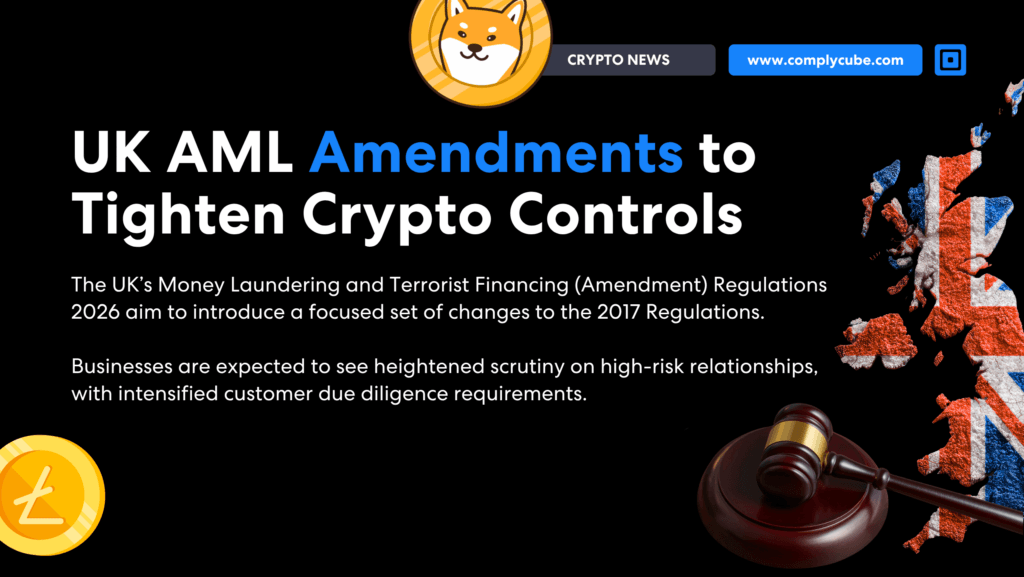
Some of the changes introduced include heightened Enhanced Due Diligence (EDD) for certain crypto correspondent relationships, echoing banking-style risk controls. As such, this can also mean stronger senior-management approval, ongoing monitoring, and stronger risk assessment.
Other updates link to changes in crypto transfer threshold and Travel Rule-style information requirements. These updates are designed to strengthen supervision of cryptoasset businesses and align AML arrangements under the wider Financial Services and Markets Act (FSMA) crypto regime.
For more information, click here.
EU Reviews MiCA Crypto Rules
European Union, May 20, 2026 🇪🇺: The EU Commission opens up a public consultation to gather feedback on the functioning of the Markets in Crypto-Assets Regulation (MiCA). The consultation aims to assess whether MiCA is still fit for purpose, given how quickly crypto markets have evolved since then.
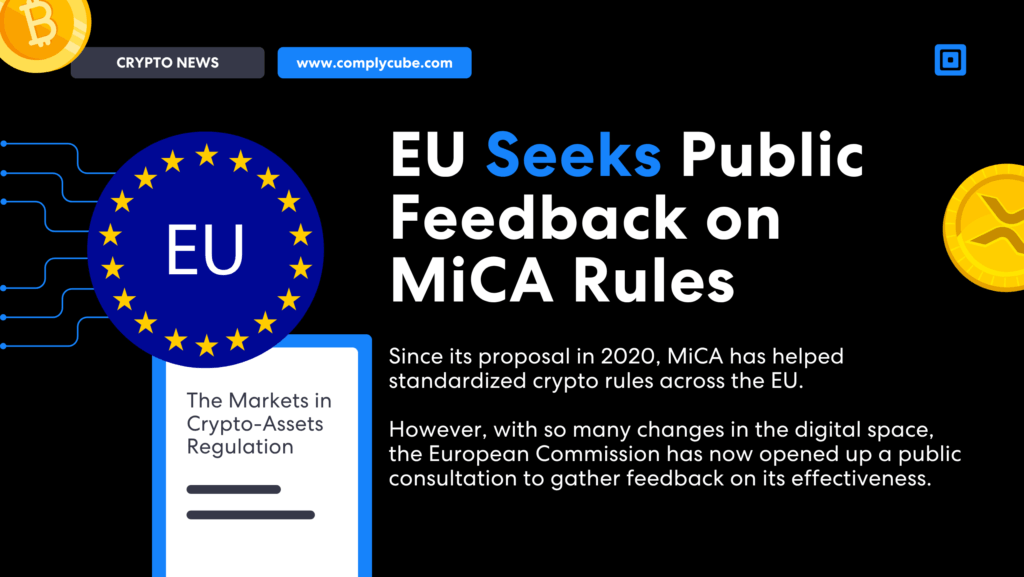
The MiCA was first proposed in 2020 to inform rules and policies for the crypto industry. Since it came into force in 2023, the law has harmonized EU framework for crypto-assets, stablecoins, issuers, and crypto-asset service providers (CASPs).
After full establishment, the European Commission is collecting feedback from stakeholders and the public on the effectiveness of the MiCA law. For crypto firms, this review is crucial, as it can influence the next phase of EU crypto regulations. The review is open until 31 August 2026, giving exchanges, banks, and many others the chance to influence the next iteration of the EU crypto rulebook.
For more information, click here.
FCA Leads Sanctions on Russian Crypto Networks
United Kingdom, May 25, 2026 🇬🇧: The UK imposes its new sanctions package, targeting 18 entities and individuals connected to Russia-linked cryptocurrency platforms and financial networks. This moves the country from a broad sanctions pressure to a targeted crypto crackdown as illicit Russian flows escalate.
The new sanctions aim at dismantling the Kremlin-backed A7 network, which UK officials say actively exploits offshore and regional financial channels, including Kyrgyzstan’s financial systems, to route funds around Western restrictions. In 2025, this same network had processed over $90 billion.
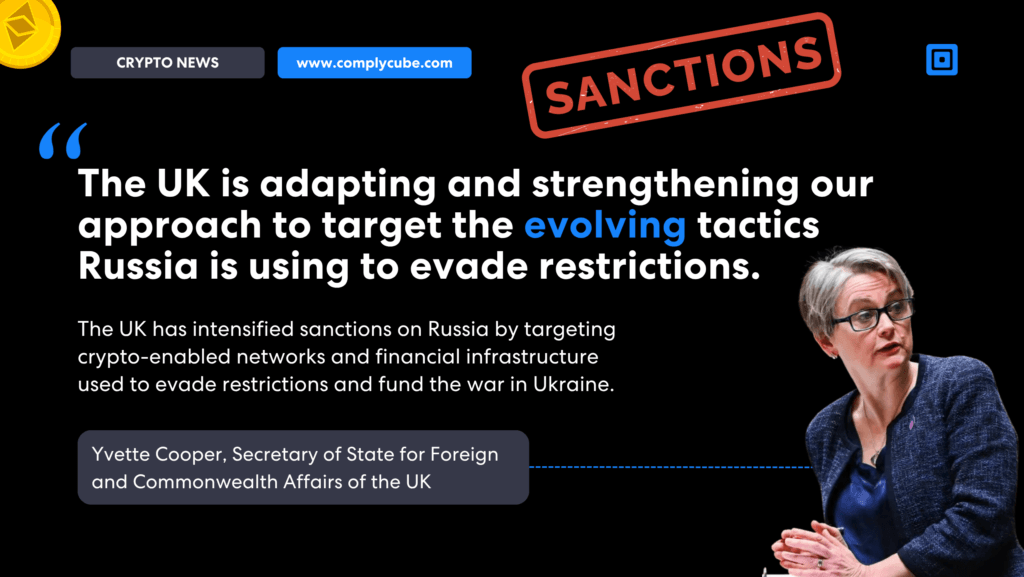
The UK is adapting and strengthening our approach to target the evolving tactics Russia is using to evade restrictions.
Yvette Cooper, Foreign Secretary, noted in a statement, “The UK is adapting and strengthening our approach to target the evolving tactics Russia is using to evade restrictions. We are going after the infrastructure that underpins its war economy at the same time as Ukraine is increasing the pressure on Russia on the battlefield.”
For compliance teams, regulators are now expecting strong demonstrations of stronger transaction monitoring and self-reporting mechanisms. Businesses must build strong risk signals and detect patterns that may suggest being used as a channel for sanctioned entities.
For more information, click here.
Time for Some Light-Hearted Creative Criticism?
So you’ve made it to the end of our newsletter. It’s time to enjoy a little satire, worthy reader, you’ve earned it.
🔥THE CRYPTO CUBED POEM: MAY🔥
India deems crypto as a high-risk space,
As billions slip through Binance’s case.
UK tightens AML, crypto now in line,
EU now reviews MiCA, checking if rules align.
FCA leads sanctions, Russia’s crypto undone,
Across nations, regulators converge as one.
From red flags raised to networks cut and barred,
The age of crypto compliance has begun.
Stay tuned for our June newsletter, and have a great month!