👋 Welcome to the August CryptoCubed edition. This month, we see crypto enforcement moving at the speed of light! From a €2.2M crypto seizure and 96 ATM shut downs to sanctions, and high profile deals under renewed scrutiny, regulators are looking far beyond the transaction itself.
The biggest story is who is behind the money, where it is moving, and what happens when critical Anti-Money Laundering (AML) controls fail.
Aqua 1’s $100M WLFI Deal Faces New AML Scrutiny
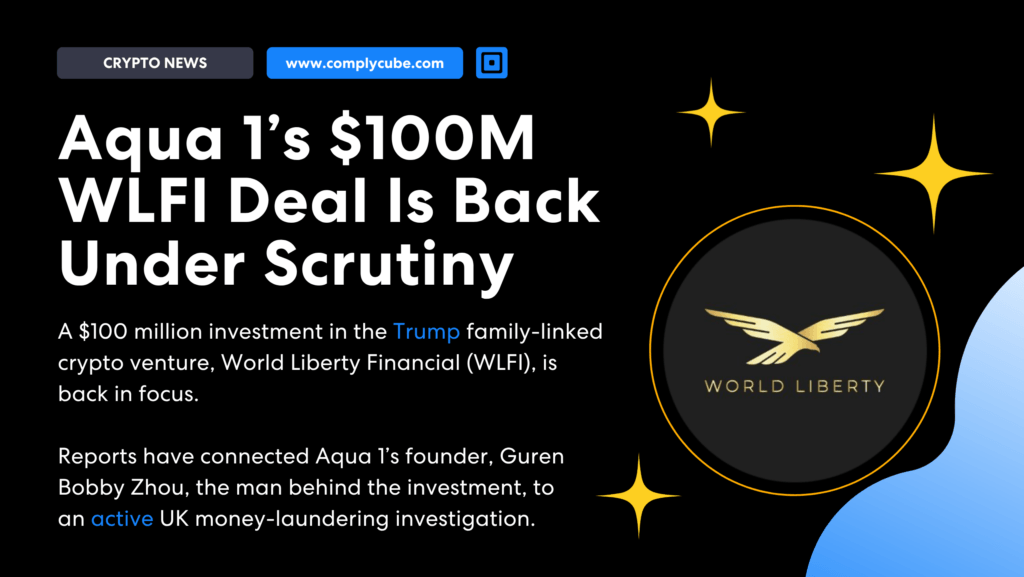
United States, August 10, 2026 🇺🇸: In June 2025, Aqua 1, a UAE-based crypto fund, acquired WLFI governance tokens. The deal involved a $100 million investment in World Liberty Financial, the Trump family-linked crypto venture. This month, this investment came under scrutiny again.
Reports indicated that Guren Bobby Zhou, the businessman behind Aqua 1, was linked to an ongoing UK money-laundering probe. Authorities arrested Zhou in Britain in 2021, and he continues under investigation with no criminal charges.
The case has refocused attention on the original $100 million deal and, crucially, the source of capital behind it. Blockchain analytics reveal transactions between wallets. They do not show who controls an investment vehicle. It also does not reveal how the capital was obtained or whether the transaction aligns with the investor’s financial profile.
Compliance Takeaway:
For compliance teams, this serves as a reminder that tracking where crypto moves does not reveal who owns the funds. Tracking movement alone may miss ownership details. Effective verification links on-chain activity to ownership checks. It highlights the potential gap in wallet monitoring. As such, it is crucial to connect on-chain activity with other forms of verification, including beneficial ownership, adverse media, and source-of-funds checks, to form a complete picture of financial crime risk.
For more information, click here.
Knaken’s €2.2M Crypto Seizure After Failed MiCA License
Netherlands, August 17, 2026 🇳🇱: Dutch regulators liquidated roughly €2.2 million ($2.5 million) in cryptocurrency seized from the crypto platform Knaken, which went bankrupt last month. This case brings a key question into focus: what happens to customers’ money when a platform fails?
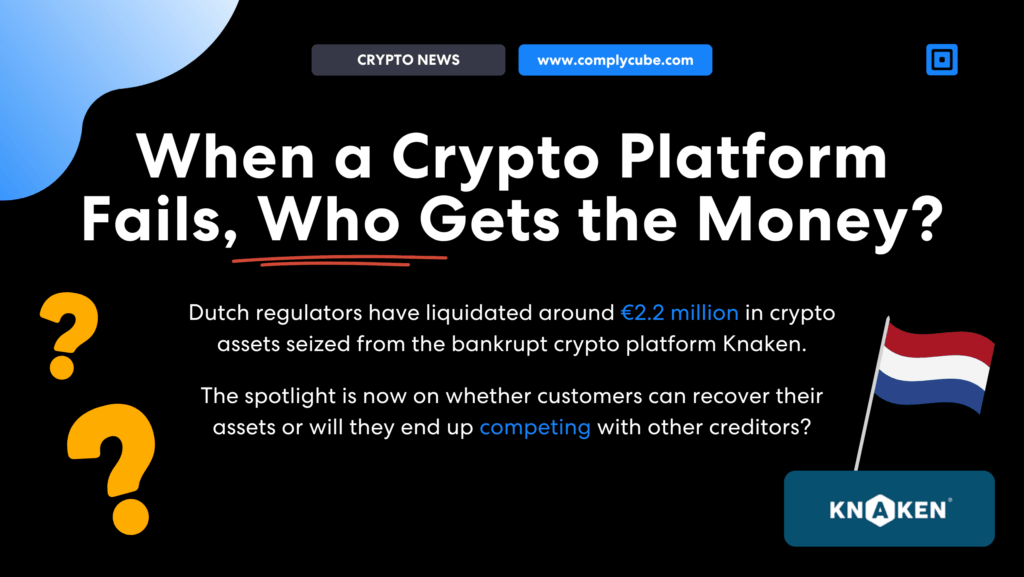
Just last year, Knaken failed to obtain the EU’s Markets in Crypto-Assets Regulation (MiCA) license. This meant the company could not operate as a crypto-asset service provider across the EU market. As a result, the company ceased its operations and started winding down.
Who will the $2.5 million go to? How Knaken held, recorded, and separated customer assets could now determine whether users can retrieve their holdings directly or must compete with other creditors for what remains.
Compliance Takeaway:
The case reinforces the need for firms to treat MiCA readiness as a business-critical priority. Beyond licensing, maintaining clear ownership records and having credible wind-down plans are no longer just compliance requirements, as they can directly affect a firm’s ability to remain in the market and protect customers if things go wrong.
For more information, click here.
Binance Employees Face UAE Interrogation
United Arab Emirates, August 20, 2026, 🇦🇪: Binance is facing renewed scrutiny in the UAE after two of its employees were detained and interrogated separately as part of a wider financial crime investigation. According to Binance, the employees were asked for information about the flow of funds from third parties through a Binance client-money account.
Officials detained one employee in Sharjah and questioned another at a police station before releasing them. Notably, Binance holds an active Virtual Asset Service Provider (VASP) license from Dubai’s Virtual Assets Regulatory Authority (VARA).
The episode also comes against a much broader backdrop of regulatory scrutiny. Binance has faced major AML and sanctions-related probes in the US, Australia and Nigeria, including a landmark $4.3 billion US settlement in 2023.
Compliance takeaway
The Knaken case highlights crypto licensing’s importance, while the Binance case indicates licensing cannot serve as a shield. Businesses must demonstrate that their AML controls can remain defensible against evolving risks. Furthermore, Binance’s history shows that regulatory issues do not remain confined to a single jurisdiction. Consistent global controls, documented remediation, and strong governance are critical in preventing sustained scrutiny.
For more information, click here.
96 Crypto ATMs Closed Over AML Issues
Australia, August 9, 2026 🇦🇺: Australian crypto ATM operator Cryptolink has been ordered to take all 96 of its machines offline after the Australian Transaction Reports and Analysis Center (AUSTRAC) suspended its registration due to ongoing AML and Counter-Terrorism Financing (CTF) concerns.
In October 2025, AUSTRAC revealed that the company failed to submit large cash transaction reports on time and identified multiple weaknesses in its financial crime risk assessments. Cryptolink paid an infringement notice of $56,340 and entered an enforceable undertaking to strengthen its controls.
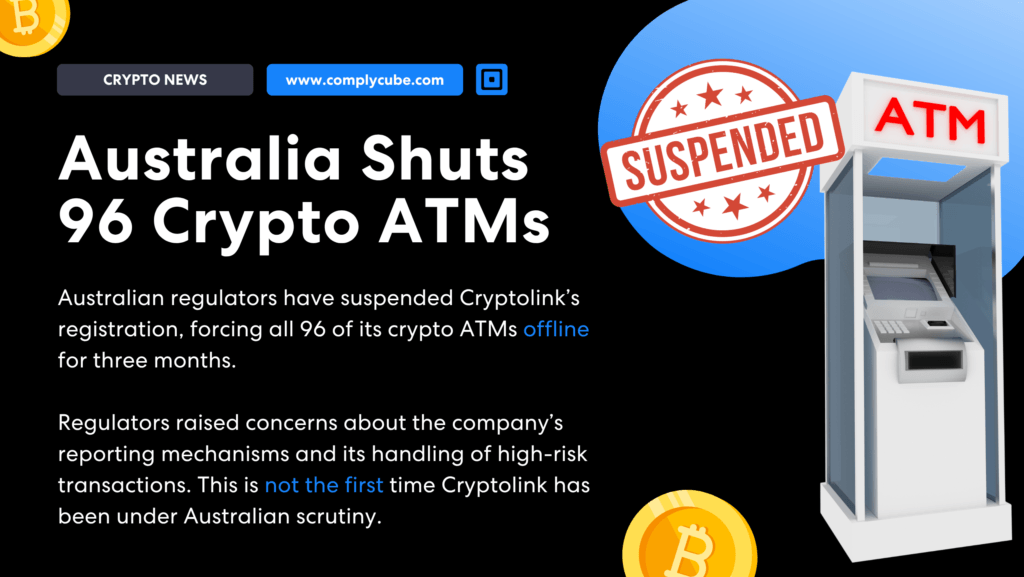
This month, AUSTRAC suspended Cryptolink’s VASP registration for three months, preventing it from operating its network of crypto ATMs. Although Cryptolink had complied with conditions under the earlier undertaking, AUSTRAC noted that the firm failed to provide required threshold transaction reports and did not adequately respond to a formal request for information.
Compliance Takeaway:
For compliance teams, this case shows that paying a penalty or completing an undertaking does not immediately end regulatory scrutiny, especially when weaknesses continue. In particular, crypto ATM operators must maintain accurate and timely transaction reporting and regulatory communications around high-risk, cash-to-crypto activity.
For more information, click here.
OFAC Targets Iran-Linked Crypto Exchanges
United States, August 7, 2026 🇺🇸: The US Treasury steps up its crypto sanctions campaign targeting exchanges and financial networks used to move illicit funds for Iran and the Islamic Revolutionary Guard Corps (IRGC).
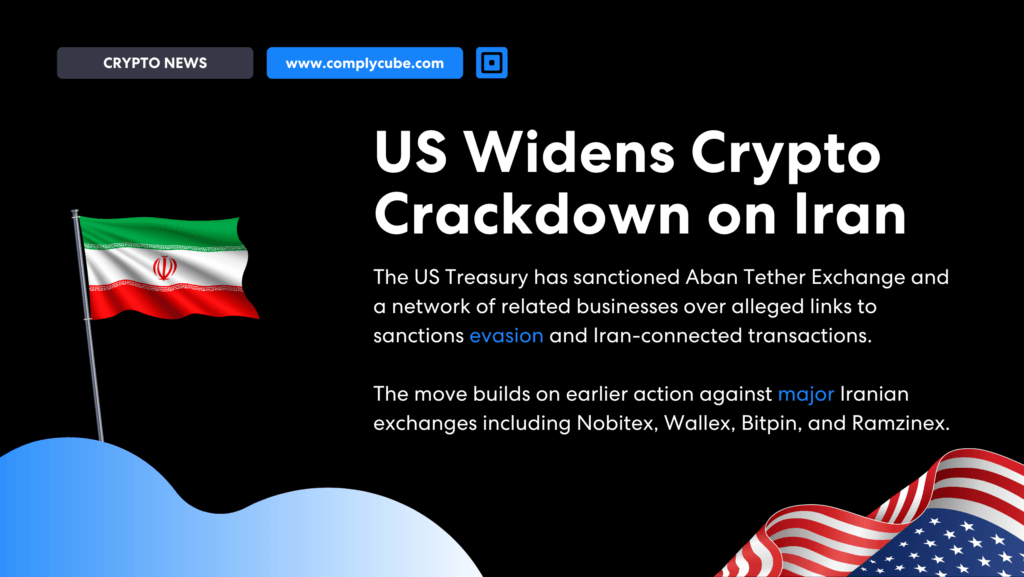
According to the Treasury, Iranian actors had used lightly regulated or unlicensed digital asset platforms, corporate structures, and an online gambling network to move large volumes of cryptocurrency. Consequently, they were able to evade sanctions and support regime-linked actors including the IRGC.
Subsequently, OFAC sanctioned Aban Tether Exchange and several related businesses based in the UAE, Georgia, and Poland. Earlier in June, OFAC targeted major Iranian exchanges, including Nobitex, Wallex, Bitpin and Ramzinex, over alleged sanctions evasion and IRGC-linked transactions.
Crucially, OFAC clarified in August that the risk does not end with US firms: non-US financial institutions and businesses transacting with designated Iranian crypto exchanges could themselves face secondary sanctions exposure.
Compliance Takeaway:
Businesses must treat exposure to Iranian crypto exchanges as a heightened sanctions risk, including where transactions are indirect or routed through offshore intermediaries. Most importantly, enhanced due diligence and robust screening are critical in identifying potential high-risk entities and associated wallet addresses.
For more information, click here.
Time for Some Light-Hearted Creative Criticism?
So you’ve made it to the end of our newsletter. It’s time to enjoy a little satire, worthy reader, you’ve earned it.
🔥THE CRYPTO CUBED POEM: AUGUST🔥
This month in crypto, the pressure climbed,
Deals were questioned, and companies were fined.
ATMs went dark, exchanges were named,
Millions were seized and networks were blamed.
Across borders, the scrutiny grew,
Old transactions came back into view.
Follow the money, the people, the trail,
Because in crypto, the details prevail.
Stay tuned for our September newsletter, and have a great month!