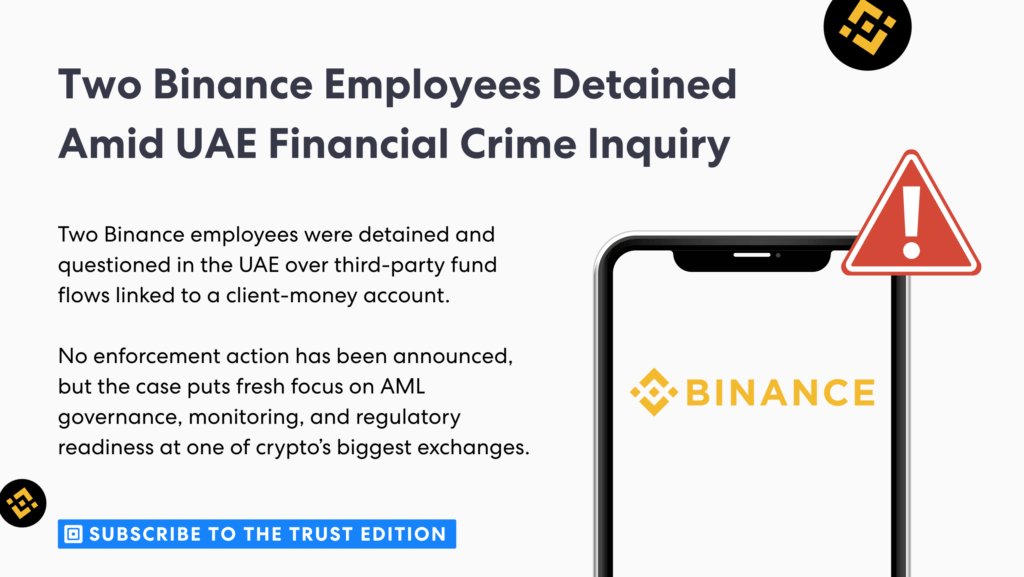
On 20 August 2026, The New York Times reported that two Binance employees were stopped and detained in the United Arab Emirates (UAE) in recent weeks. According to Binance, its employees were questioned as part of the UAE’s routine inquiries into a broader financial crime investigation.
Why Were Two Binance Employees Detained?
Of the two employees, one was a mid-level staff member detained in Sharjah, while the other was an official from Binance’s Dubai-based subsidiary, who was questioned at a police station in July.
A Binance spokesperson noted that its employees were asked to provide information as part of “routine” checks involving the company’s third-party fund flows through a Binance client-money account.
Here is what was disclosed so far:
- The two Binance employees were detained separately in the UAE in recent weeks.
- The UAE was reportedly investigating potential financial crime concerns on the crypto platform.
- Binance mentions that its employees were not targets of the inquiries and were released quickly.
- The specifics of the investigation remain unclear, as UAE regulators have not disclosed further details.
Currently, no further news has been shared about the case. As such, no enforcement actions have been reported from these detentions. You can subscribe to ComplyCube’s Trust Edition newsletter here for ongoing crypto, financial crime, and AML updates.
Binance Holds an Active Crypto License in Dubai
Interestingly, Binance holds an active license to operate its financial services in Dubai. In particular, Binance FZE is an authorized Virtual Asset Service Provider (VASP) under Dubai’s Virtual Assets Regulatory Authority (VARA) public register.
Regulated businesses remain accountable for continuously monitoring customer activity.
Notably, its full VASP license was issued in 2024, enabling the crypto firm to operate key operations, including lending and borrowing, investment, and broker- and dealer-related services. This news exposes a critical finding, that being licensed does not eliminate financial crime exposure.
Harry Varatharan, Chief Product Officer at ComplyCube, notes, “Regulated businesses, whether licensed or not, remain accountable for monitoring evolving customer risks on an ongoing basis.” In a recent US court filing, Binance noted that around 25% of its employees worked in compliance, investigations, and risk functions. The message is clear, headcount alone is not an indicator of compliance effectiveness.
Binance’s Historical AML Scrutiny
This is not the first time Binance has been caught across multiple jurisdictions. A quick search of the company will surface multiple fines and compliance disputes from regulators all over the world. These cases involve weak due diligence, sanctions exposure, and illegal transactions.
February 2026: US Regulators Investigate Illegal Iran-Binance Transactions
The US Department of Justice (DOJ) opens an investigation into whether Binance was used as a platform for Iran to evade sanctions and move funds. Allegations indicate that over $1 billion in transactions were traced to an Iranian-linked network. Binance denies knowingly facilitating sanctioned activity.
August 2025: Australia Orders Binance to Appoint External AML Auditor
The Australian Transaction Reports and Analysis Centre (AUSTRAC), demands Binance to appoint an external compliance auditor after finding major lapses in its AML processes. Investigations found weaknesses in governance, compliance resources, and senior management oversight.
August 2025: Paxos $48.5 Million Settlement Linked to Binance Partnership
This case specifically highlights the importance of due diligence when forming business relationships. The New York Department of Financial Services (NYDFS) reaches a $48.5 million settlement with Paxos over failures to adequately assess and monitor risks related to Binance.
October 2024: Binance Executive Detained for 8 Months in Nigeria
Tigran Gambaryan, one of Binance’s financial crime compliance executive was detained in Nigeria after authorities accused him of potential involvement in money laundering of over $35 million, alongside Binance. Charges were dropped for Tigran, but the case against Binance in Nigeria is ongoing.
November 2023: Binance Hit with Historic $4.3 billion Fine
In 2023, the crypto company was penalized with the world’s largest fine by US authorities. Investigations by the DOJ showed that Binance violated multiple sanctions laws, failed to report suspicious customer activity, and did not implement sufficient customer identity verification.
What Compliance Teams Can Learn From the Binance UAE Case
Asking a business to strengthen AML controls can sound simple, but in reality, it can be complex, especially if you do not know where to start. This is particularly true in this case, where risk is fragmented across varying users and channels. The following questions can expose weaknesses in existing controls.
- License is a baseline, not a shield: Being authorized to operate in a country does not reduce the need to meet AML, sanctions, and financial crime compliance requirements. Businesses need to continuously review controls, train staff, and test current compliance infrastructure against the relevant jurisdiction laws.
- Keep audit trails always clear: Having transparent, timestamped audit trails is critical to building a defensible AML framework. Compliance teams must maintain documentation of why alerts were closed, escalated, or approved so that decisions can be clearly explained during unexpected regulatory investigations.
- Preparation for law-enforcement requests is critical: Consider providing compliance staff with clear procedures during regulatory and police inquiries. Periodic training, defined escalation paths, and accessible records can support teams in responding quickly and consistently to information requests, avoiding situations such as the Nigeria case.

Find out more AML news in ComplyCube’s Trust Edition newsletter. We explore the latest in developments across identity verification and AML globally.