
TL;DR: Recruitment firms must check employee right to work alongside employers. It must show who is responsible and whether the right verification route was chosen. This guide shows examples of how to check right to work UK requirements for hiring. It also helps firms strengthen recruitment right to work UK processes before 1 October 2026.
Why Right to Work is a Recruitment Priority in 2026
UK recruitment firms are being put under a sharper enforcement backdrop and a currently changing legal framework. Right to work checks impact every single employer. However, agencies face more issues when the organisation sourcing a job applicant is not always the organisation employing or engaging that person.
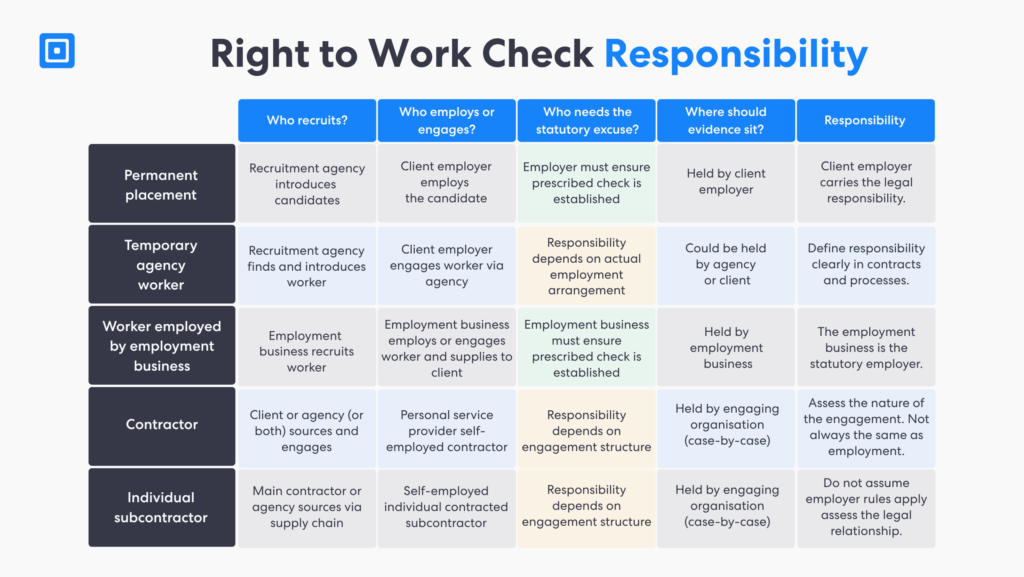
Right to work matters before any job offer turns into employment. A flawed process can leave an employer without a statutory excuse if an illegal worker is found later on. Moreover, unclear responsibility between recruiter and hirer can create huge gaps even when both organisations think that a check happened.
A Right to Work check should not be treated as a one-off identity event.
Milosh Caunhye, Solutions Consultant at ComplyCube adds, “Right to work checks are mandatory for all employees. In reality, UK recruitment firms need to have a process that links who was verified, which route was applied, and what permission was confirmed.”
Right now, civil penalties can reach up to £45,000 per illegal worker for a first breach, going up to £60,000 per illegal worker for a repeat breach within three years. It can also result in serious jail-time. Employing someone without permission to work in the UK knowingly can also result in up to five years in prison, and an unlimited fine.
These right to work checks have been required by UK law since 1997. However, from 1 October 2026, the goal is to extend their scope into workers contract, individual subcontracting, and certain work online matching arrangements.
How Do You Check Employee Right to Work?
Checking employee right to work according to compliance requirements begins with using a verification route that is appropriate for the individual in front of you. Recruitment teams need to look at nationality, immigration act status (settled, temporary, asylum, etc…), available documents, and if the person is eligible for a digital check before any real evidence is assessed. You can learn more here: Employers Guide to Proof of Right to Work in UK with Certified IDSPs
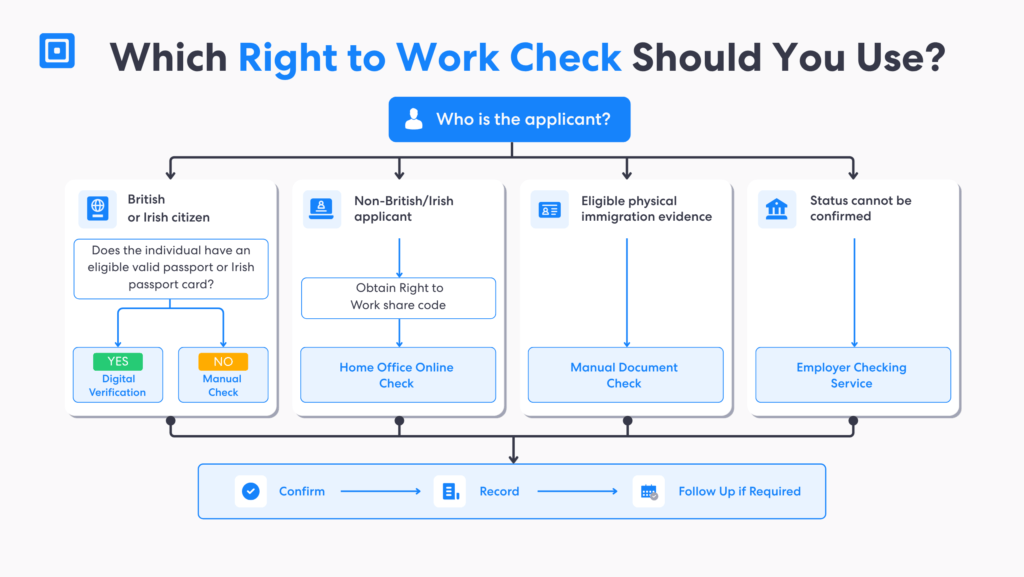
It is important to keep a secure record and arrange follow-up checks where right to work checks have a limited amount of time. According to gov.UK guidance, right to work checks can be done through online checks using the Home Office’s Employer Checking Service, manual checks, or through certified Identity Service Providers (IDSPs).
Identify the Person and Correct Route
The necessary right to work check depends on nationality, immigration status, and available evidence. For example, British and Irish citizens have completely different routes from most people who typically rely on an e-Visa or other immigration permissions. That is why recruiters must apply checks consistently to every single potential employee instead of making assumptions. This prevents discrimination, and inconsistent recruitment decisions.
Confirm Permission to Work in the UK
To have a compliant work check, it is important to confirm that the person has the right permission for the work that is being offered. For students, an employer may also need evidence of study and vacation times where working-hour restrictions apply.
Retain the Evidence Securely
Retaining evidence is necessary to check employee right to work. Employers need to keep copies or digital records of pages and documents. They must also record the date that the check happened. Evidence must be kept over the course of their employment period and at least for two years after their contract ends.
How Does Identity Document Validation Technology Work in the UK?
An important part of right to work checks is Identity Document Validation Technology (IDVT). It has historically been used by certified identity providers for digital Right to Work identity checks in the UK. Current Home Office guidance increasingly uses the broader term Digital Verification Service (DVS). Right to work checks can be conducted through online checks, manual checks, or IDSPs.
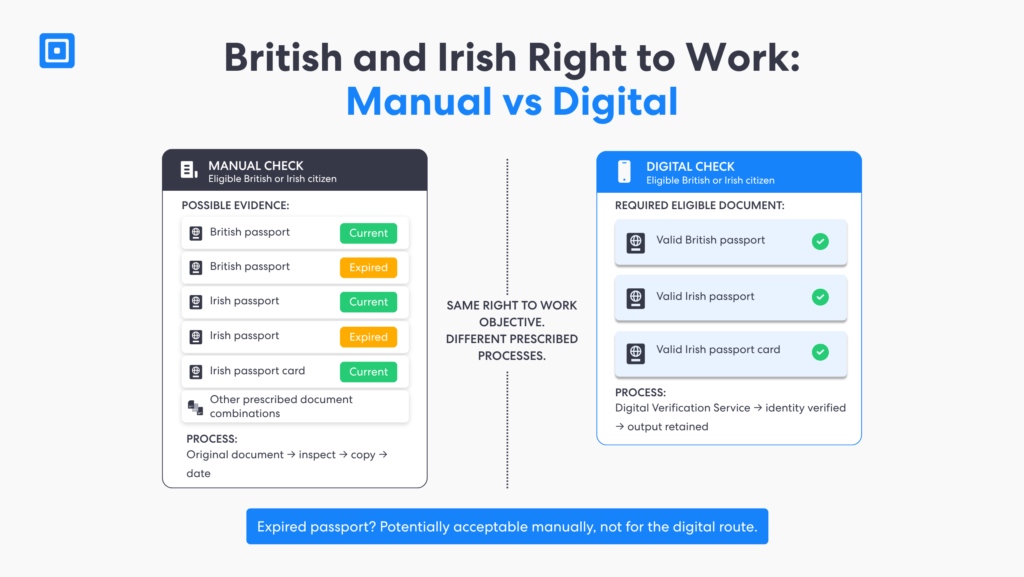
These digital identity checks are available for eligible British or Irish citizens using supporting documents showing important data such as a valid passport. For instance, a British citizen can use a valid British passport or an Irish citizen can use an Irish passport or Irish passport card. It is important to note that though expired documents cannot be used for a digital verification route, an expired British or Irish passport is still acceptable for a manual check.
Moreover, if they do not hold a passport, another acceptable form of documentation is a birth or adoption certificate. Similarly, applicants can provide a certificate of registration or naturalisation along with an official letter from a previous employer or government agency. This document needs to have the person’s name and National Insurance Number. Marriage certificates and divorce decrees do not independently prove right to work.
Immigration Status to Check Employee Right to Work
The Home Office online service is the primary route for digital immigration status for most non-British and non-Irish applicants. This also applies to EU settlement scheme applicants and Commonwealth citizens. Now, an e-Visa is the most important digital record of a person’s identity, visa, or immigration permission. This also includes whether they have the right to work in the UK. This is typically accessed through a UKVI account.
Share Codes
Most of the time, a worker can get a share code online and provide it with their date of birth. A right to work share code contains nine characters, starting with the letter W, and remains valid for about 90 days. Then, the employer needs to use that online share code through the official employer service.
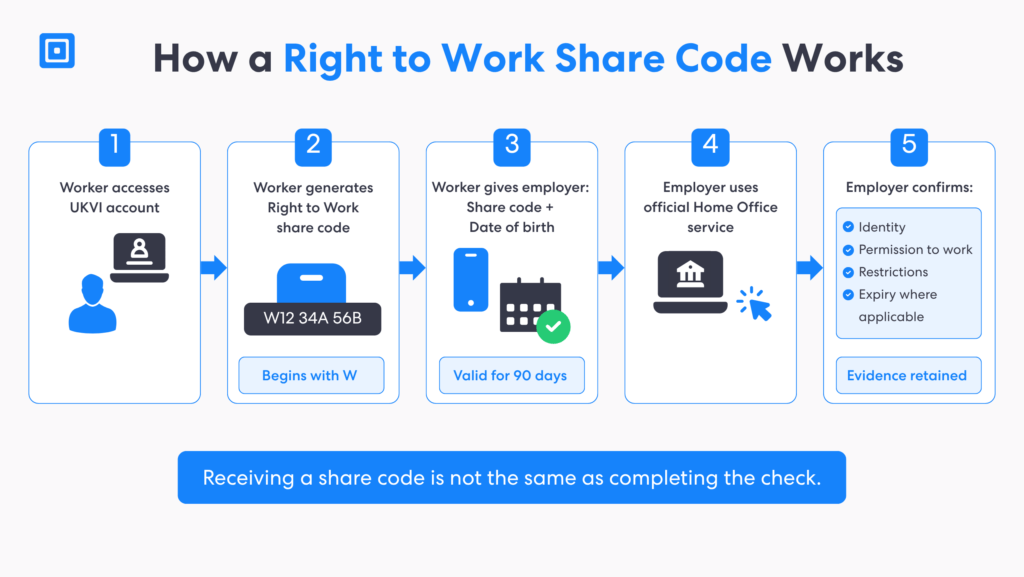
Just looking at the information from their application is not the same as completing the prescribed online check. The online right to work process lets the employer confirm the type of work allowed and how long the individual can work.
Biometric Residence Permits
Previously, another way to check right to work is through a physical biometric residence permit (BRP). However, they are no longer accepted as a standalone piece of evidence for Right to Work. BRPs have been replaced by e-Visas for immigration-status purposes.
Someone with a BRP can still use its details to access digital services to obtain a share code. Additionally, the printed expiry date on a biometric residence permit must not be treated as the person’s current immigration permission.
Biometric Residence Cards
Just like the BRP, a biometric residence card (BRC) is no longer acceptable as a singular way to check employee right to work. The relevant individuals need to prove their current immigration status through their UKVI account and Home Office service as well.
When Should the Home Office Checking Service Be Used?
The Employer Checking Service is an option for people whose immigration status document cannot be verified using the applicant’s original documents normally or through the online system. An example of this could be an applicant present that has an outstanding appeal, administrative review, qualifying pending application, or an Application Registration Card.
An Application Registration Card needs to show that the work is permitted, and it is the employer’s responsibility to use the Home Office Employer Checking Service to establish the necessary statutory excuse based on immigration documents, applicant dates, vignette stickers, etc… Through this process, the work checking service can issue a Positive Verification Notice where the person is permitted to undertake the proposed work.
When Do You Check Employee Right to Work?
Sometimes, follow up checks are required. This is typically when an employee has a time-limited leave permission such as a Youth Mobility Scheme or Graduate Scheme visa. After some time, the statutory excuse will expire.
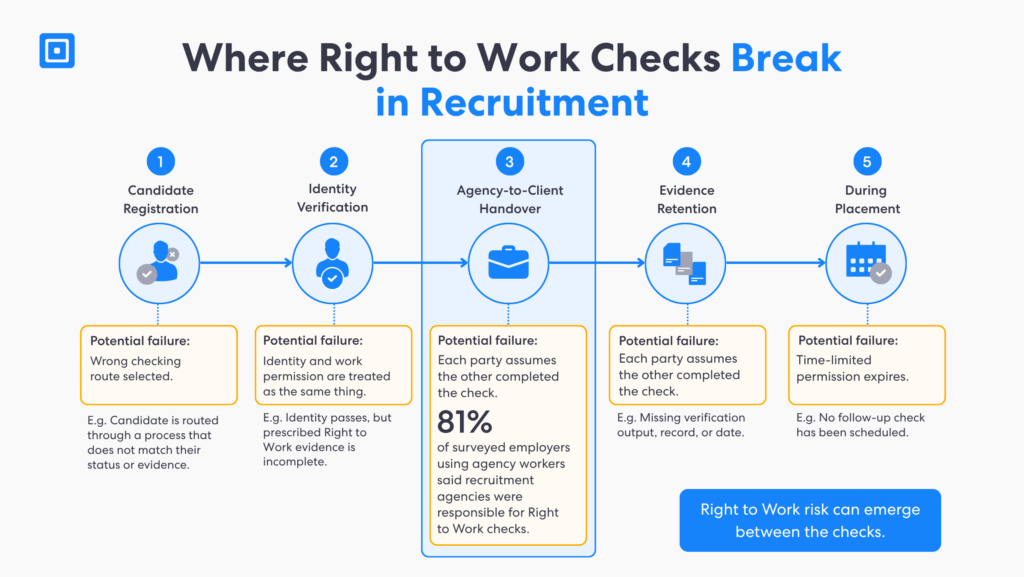
However, someone with indefinite leave to remain or another continuous right to work route will not need recurring checks. The prescribed process for right to work will correctly establish continuous permission.
Case Study: UK Illegal Working Enforcement Reaches Record Levels
Excell Care Services Limited received £110,000 civil penalty for illegal working during the Home Office reporting period from October to December 2025. With temporary staffing models, right to work responsibility is much harder to assign. So, if the ownership is unclear, checks can be missed or poorly evidenced.
Check Employee Right to Work Responsibilities
The practical response is to define responsibility before job or contract placements. Recruitment firms also need to complete the correct right to work check, and keep evidence securely for audit purposes. There should also be scheduled follow-up checks before the existing statutory excuse expires based on time-limited leave.
Outcomes
- Excell Care Services Ltd. was liable for a six-figure illegal-working penalty.
- Companies House considers the firm as a temporary work agency.
- Recruitment firms need documented ownership of Right to Work checks.
What Changes to Check Employee Right to Work from 1 October 2026?
From 1 October 2026, the revised framework is intended to extend checks beyond conventional contracts of employment to additional worker contracts, individual subcontractors, and specified online matching arrangements.
This matters for recruitment businesses managing flexible labour. Processes built exclusively around conventional employee onboarding may need to accommodate a broader group of people providing work or services.
Key Takeaways
- Complete a prescribed Right to Work check before employment begins.
Match the checking route to nationality, immigration status, and available evidence.
Keep evidence securely throughout employment and for two years afterwards.
Schedule follow-up checks where an individual’s permission is time limited.
Prepare recruitment workflows now for the wider arrangements covered from 1 October 2026.
Using ComplyCube to Check Employee Right To Work
When processing right to work checks at scale, the best approach is to combine regulatory clarity with strong identity evidence and audit-ready workflows. ComplyCube’s certified digital identity capabilities, configurable onboarding, APIs, biometrics, and compliance controls can help with right to work processes. Get in contact with our team today to discuss how ComplyCube can support right to work verification that fits into your recruitment workflows.

Frequently Asked Questions
Do employers accept an expired British passport for a right to work check?
Yes, a current or expired British passport can help with a prescribed manual right to work check for employers. However, a digital check through a certified Digital Verification Service requires a valid, unexpired British passport.
How long is a right to work share code valid?
In order to work in the UK, applicants require a right to work share code. They are typically valid for 90 days. It consists of nine characters and begins with the letter W when generated to prove right to work for employers.
Can a biometric residence permit be used for a right to work check?
A physical Biometric Residence Permit, also known as a BRP, cannot be used as a standalone piece of evidence for right to work verification. The relevant individuals need to use their digital immigration status and Home Office online service where necessary.
What happens if an applicant cannot provide documents or a share code?
If an applicant cannot provide documents or a share code, the employer needs to use the Employer Checking Service. This is particularly relevant where the individual has a qualifying pending application, outstanding appeal, technical issue, or Application Registration Card.
How can ComplyCube support right to work checks for recruitment firms?
ComplyCube supports digital right to work workflows through certified identity verification, document checks, biometrics, and configurable onboarding journeys. Recruitment firms can integrate these checks through APIs, SDKs, hosted flows, or low-code tools.