
TL;DR: Anti money laundering checks for solicitors are more than just a client onboarding task. The best AML checks for solicitors is one that supports risk-based controls, enhanced due diligence, transparent audit trails, and suspicious activity reporting.
Why are Anti-Money Laundering (AML) Checks Critical for UK Law Firms?
Anti money laundering checks are a legal requirement in the United Kingdom. Solicitors and law firms alike face unique risks as they may manage client funds, facilitate property transactions, and be exposed to complex structures involving multiple jurisdictions. As such, these sector-specific vulnerabilities make them prime targets for money launderers and criminal activity.
The Solicitors Regulation Authority (SRA) notes that entities offering a combination of legal services, such as solicitors, are at the greatest risk in the sector. Notably, conveyancing, trust or company services, and the misuse of client accounts are particularly vulnerable to financial crime.
Over £100 billion is laundered through the UK every year.
According to the National Crime Agency (NCA), over £100 billion is laundered through the UK every year. The impact of financial crime is damaging; it can hamper growth and security on a national level. As such, regulators have tightened anti money laundering regulations.
HMRC issued over 739 fines for AML and Counter-Terrorism Financing (CTF) breaches from 2024-25.
In HM Treasury’s AML and CTF Supervision Report, penalties imposed by the SRA for AML violations amounted to £1.5 million. In contrast, the FCA levied more than £59.5 million in fines from 2024 to 2025. This marks greater expectations for UK law firms to strengthen and invest in comprehensive anti money laundering checks.
Who Sets AML Regulations in the UK Legal Sector?
Understanding the regulatory bodies that oversee anti money laundering checks is critical to determining which requirements must be met. This is crucial to remain compliant, as fines have increased in both frequency and severity. Here are the primary regulators UK solicitors must know:
- Money Laundering, Terrorist Financing and Transfer of Funds (Information on the Payer) Regulations 2017 (MLR 2017): The main rulebook that sets out AML and CTF obligations for regulated firms. It sets out requirements for Customer Due Diligence (CDD), ongoing monitoring, and risk assessment.
- Proceeds of Crime Act 2002 (POCA) and the National Crime Agency (NCA): Creates offenses and reporting duties, such as submission of a Suspicious Activity Report (SAR) to the NCA. Operates alongside the MLR2017 and centers on cases where solicitors fail to report suspicious transactions.
- HM Treasury and the Office of Financial Sanctions Implementation (OFSI): Maintains and sets out UK financial sanctions policy. On the other hand, the OFSI arm implements enforcement actions against companies that violate sanctions policy.
- The Solicitors Regulation Authority (SRA): Designated AML supervisor built specifically for firms operating in the legal sector across England and Wales. It oversees registration, supervision, and enforcement of AML checks for solicitors.
- Financial Conduct Authority (FCA): AML and CTF supervisor of a broader range of firms in the UK. Unlike the SRA, the FCA is a financial regulator with greater authority to enforce registration, conduct risk-based supervision, and impose penalties on non-compliant firms.
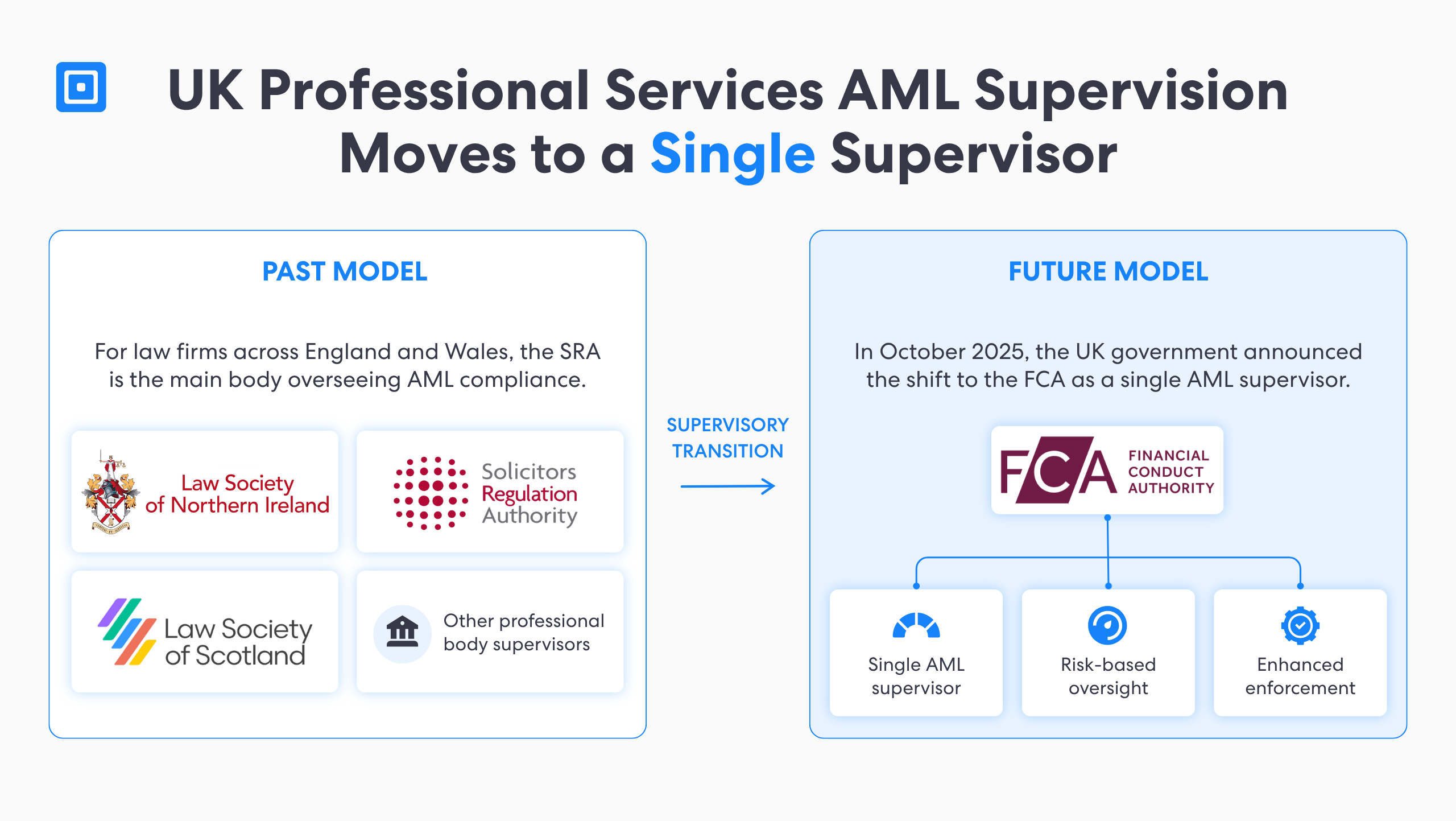
In October 2025, the UK government announced that the FCA will assume the powers of a single professional services supervisor for AML/CTF compliance. Consequently, it will take over supervision from the SRA, the Law Society of Scotland, the Law Society of Northern Ireland, and other professional bodies. As a result, solicitors and other legal services will face more demanding AML requirements.
Must all UK Solicitors Comply with AML Requirements?
Under the MLR 2017, any company or individual carrying out “relevant business,” such as conveyancing, managing client money, company formation, trust work, or tax advice, must comply with the UK’s AML obligations. Moreover, the SRA states that anti money laundering checks do not differentiate between large firms and sole solicitors.
Case Study: The Cost of Weak AML Oversight
In June 2026, Belgian authorities started investigating Wise over alleged money laundering that involved using company accounts to transfer illegal funds. According to reports, around €500 million in suspicious transactions were uncovered.
Control Failure Pattern
However, this was not the first time Wise was under scrutiny. In 2025, US regulators fined Wise millions over AML deficiencies, including weaknesses in suspicious activity monitoring. This case reinforced the need for consistent, scalable AML oversight.
Outcomes
- Rapid growth can expose weaknesses in existing AML controls.
- Strong Enhanced Due Diligence, ongoing monitoring, and audit trails are essential.
- Repeated scrutiny across jurisdictions shows how quickly control gaps can become a wider regulatory issue.
Non-negotiable Requirements for AML Checks for Solicitors
Anti money laundering checks for solicitors are more than identity checks. They must include Ultimate Beneficial Owner (UBO) verification, source of funds and source of wealth checks, ongoing monitoring, reporting of suspicious activity, and more. Here are the core obligatory AML checks for solicitors:
Customer Due Diligence (CDD)
CDD involves verifying and assessing an individual’s identity, relationships, and associated money-laundering risks. For individuals, verification is done primarily through documents, address, and biometric verification. For corporates and trusts, CDD can entail corporate registry searches, and UBO verification is required for individuals who exercise over 25% control in a business.
Source of Wealth (SOW) and Source of Funds (SOF) Verification
Source of wealth and Source of funds checks help solicitors understand a client’s financial background. SOF establishes the origin of transactions, while SOW assesses how a client achieved their total asset. Although crucial, many law firms fall short of this requirement. From 2024 to 2025, 11% of the files the SRA reviewed lacked SOF checks, and 8% had information that did not support the client’s explanation.
Enhanced Due Diligence (EDD)
The MLR2017 calls for comprehensive EDD workflows for higher-risk customers. For instance, examples of high-risk factors include Politically Exposed Persons (PEPs), links to a high-risk jurisdiction, complex ownership structures, or unusual transactions. EDD processes require further information on a client’s background and may require senior management approval or frequent reviews.
Sanctions, PEP, and Adverse Media Screening
Businesses in the legal profession are accountable for countering financial crime and terrorism financing. To build a defensible AML framework, it is mandated to screen clients against sanctions, PEP, and adverse media data sources. These checks, therefore, help solicitors identify high-risk clients who may pose money-laundering risks.
Risk Assessment and Risk-Based Approach (RBA)
Under Regulation 18, regulated businesses must conduct and maintain an updated record of their risk assessments. As a result, solicitors are required to document a client’s risk profile, potential risks, and rationale for onboarding. In particular, a risk-based approach helps firms allocate resources in proportion to the identified risk level, strengthening financial crime prevention.
Suspicious Activity Reporting (SAR) and Ongoing Monitoring
Ongoing monitoring throughout a customer or business relationship ensures that a client’s account reflects the current risk they carry. This is crucial as new risks can exist after onboarding. Furthermore, a Money Laundering Reporting Officer (MLRO) has a duty to alert the NCA where they suspect suspicious activities or transactions.
Evaluating Anti Money Laundering Checks for Solicitors
A practical framework for selecting anti money laundering checks for solicitors will assess how well it meets compliance and security requirements while maintaining high operational efficiency. There are six key areas to consider for UK solicitors considering AML checks:
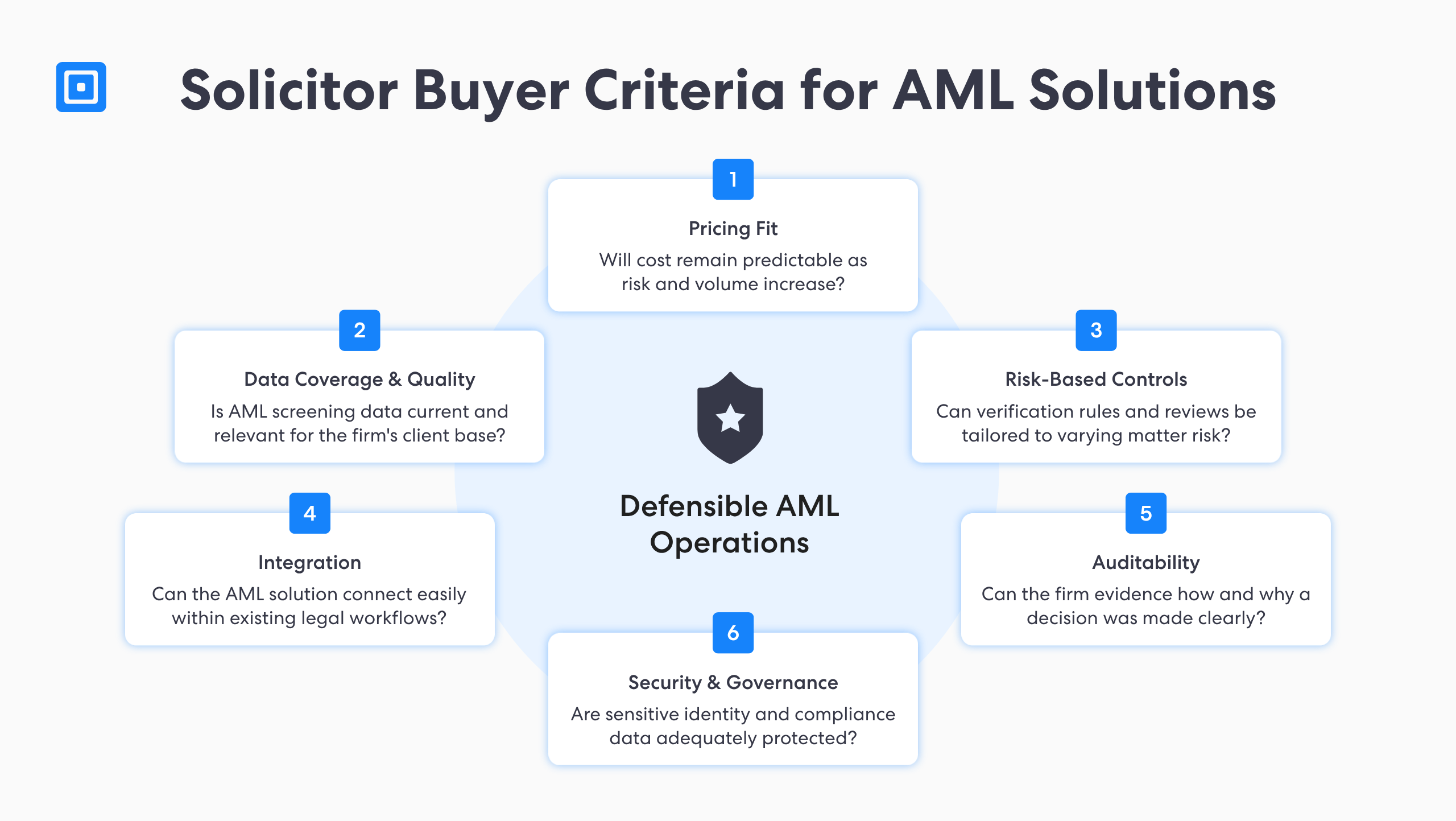
1. Pricing: Assess how the selected pricing tier can handle volume increases, EDD, and ongoing monitoring to understand the total cost of ownership. Also, ensure you confirm setup, maintenance, and integration fees upfront to avoid hidden costs.
2. Data breadth and quality: Consider AML solutions that provide updated, reliable data sources for PEP, sanctions, adverse media, and Companies House screening. Assess whether the solution supports the checks relevant to your firm, including identity verification and, where appropriate, UBO verification for the jurisdictions and client types your firm serves.
3. Risk-based controls and configurability: A suitable AML platform should enable solicitors to apply varying levels of due diligence based on client and matter risk. As such, consider whether workflows, risk scoring, escalation rules, and reviews can be configured to reflect your firm’s policies.
4. Integration: Invest in an AML platform that integrates easily with your existing onboarding and case management processes. For example, relevant API, SDK, and CRM integration helps reduce duplicate data entry and make AML checks easier to incorporate into day-to-day legal workflows.
5. Auditability and oversight: Regulators expect firms to demonstrate how AML decisions are reached. Thus, AML checks for solicitors should offer and log records of checks, risk assessments, supporting evidence, approvals, alerts, and changes over time.
6. Security: Strong security controls help solicitors protect sensitive information and meet UK data protection requirements. Law firms should assess whether an AML solution supports UK GDPR compliance and holds relevant certifications, such as ISO 27001. Essential features may also include multi-factor authentication and role-based access controls.
Essential vs. Differentiating AML Capabilities for Solicitors
Once the broader evaluation criteria have been considered, firms can look more closely at individual product capabilities. Features such as no-code workflows, complete global coverage, and dynamic workflow routing can save time, provide scalability, and enhance compliance operations. As such, UK solicitors are encouraged to assess and score them against the business’s priorities and needs.
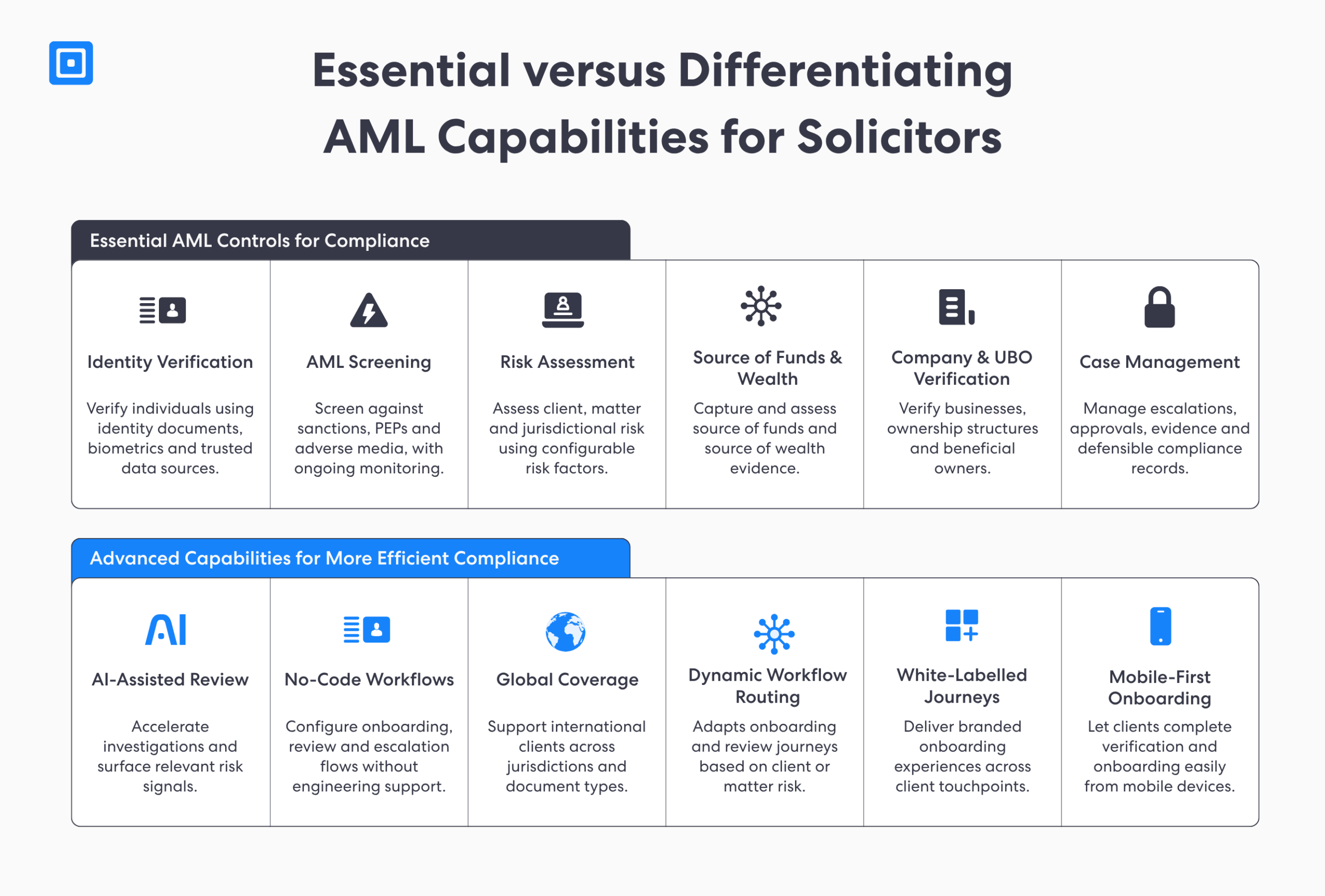
While investing in an all-in-one automated AML platform may seem complex at first, it can provide operational benefits for UK solicitors. A unified solution can help reduce false positives, data fragmentation across third-party vendors, and manual checks without weakening record-keeping or compliance oversight.
Key Takeaways
- UK solicitors must carry out AML checks under the Money Laundering Regulations 2017.
In 2025, AML supervision of law firms was transferred to the Financial Conduct Authority.
Under the FCA, firms may now face greater scrutiny and more demanding AML requirements.
Risk-based due diligence, risk assessment, and ongoing monitoring are crucial for compliance.
Solicitors should evaluate data coverage, integration, and reporting capabilities for AML systems.
Strengthen AML Compliance in the UK
Choosing the right anti money laundering checks for solicitors goes beyond basic identity verification. The legal duty to identify and combat financial crime falls on UK law firms. As such, it is important to invest in solutions with adequate measures for EDD, ongoing monitoring, and clear audit trails.
Additionally, selecting AML checks with strong data quality, integration, and automation can strengthen compliance without creating operational friction. Learn more about how you can implement ComplyCube’s law firm-focused AML platform to meet stringent compliance obligations today.

Frequently Asked Questions
What are the consequences of AML non-compliance for solicitors?
The consequences of AML non-compliance for solicitors can go beyond £10,000 fines. It includes regulatory sanctions on operations, disciplinary action for senior officers, and criminal prosecution for those that fail to report criminal activity.
Why must solicitors use a risk-based approach in AML compliance?
The Financial Action Task Force (FATF) and multiple UK regulatory supervisors mandate a risk-based approach for AML compliance as it enables firms to focus investigations where the risk of money laundering and terrorist financing is highest. As such, solicitors can identify and investigate financial crime more quickly.
What is the difference between source of funds and source of wealth for law firms?
Source of funds refers to the origin of a specific transaction. An example includes is a customer providing evidence of bank statements for a particular purchase. Source of wealth refers to how a client achieved their financial position. Examples include salary or inheritance declarations. Law firms collect source of funds and wealth evidence dependent on the risk present.
How often should UK law firms refresh due diligence on existing clients?
While there is no established refresh period for due diligence, law firms must conduct ongoing monitoring and update customer due diligence where customer information or risk changes. This enables firms to meet compliance on an ongoing basis.
Does ComplyCube provide AML checks for solicitors?
Yes, ComplyCube provides tailored AML tools built for solicitors and legal firms. Its AML suite includes both individual and business verification, ongoing screening against watchlist, PEP, and sanctions lists, as well as ongoing monitoring and case management to support compliance. ComplyCube meets AML policies in over 250 countries, supporting operations for global firms.