TL;DR: Know Your Customer (KYC) checks are necessary for secure, scalable onboarding. KYC checks help verify users, reduce fraud and meet compliance obligations without slowing growth. Choosing the best KYC solution means finding a platform that supports real-time verification, risk-based decisioning, and ongoing monitoring.
Financial institutions must adhere to stringent regulatory requirements to combat money laundering, terrorism financing, and other financial crimes. This is as outlined by the Bank Secrecy Act, the Financial Industry Regulatory Authority (FINRA), and the Financial Crimes Enforcement Network (FinCEN).
The use of Know Your Customer (KYC) checks allows organizations to obtain regulatory compliance within their sector and jurisdiction. However, KYC checks also enable businesses to strengthen their customer onboarding processes. They can analyze customer risk and carry out appropriate due diligence measures and KYC procedures. A risk-based approach ensures that enhanced due diligence can then be carried out only when necessary. This further supports efficiency in customer onboarding.
This strategic approach to KYC helps prevent financial crimes and fosters stronger, more transparent relationships between institutions and their clients. By focusing resources where they are most needed, financial institutions can maintain compliance, mitigate risk, and improve operational efficiency. They do this all while contributing to the broader goal of safeguarding the global financial ecosystem from illicit activities.
Scalable Onboarding with KYC Checks
Many businesses still lack automated KYC processes. Secure and effective onboarding of new customers can slow down growth and constrain operations. As businesses scale, they must implement KYC solutions that allow them to do so easily.
“Last year, the fallout of Silicon Valley Bank and Signature Bank underscored the importance of onboarding experiences. The aftermath saw a seismic shift in deposit patterns. Larger banks found themselves grappling with an unexpected influx of business, overwhelming their operational capacities. One way for banks and FIs to address these challenges is through digital onboarding.”
Onboarding processes must be able to support a fast influx of new customers. They still must ensure every customer’s identity is verified. This is in accordance with KYC regulations to avoid money laundering and other types of financial crime.
The Price of Foregoing KYC Checks
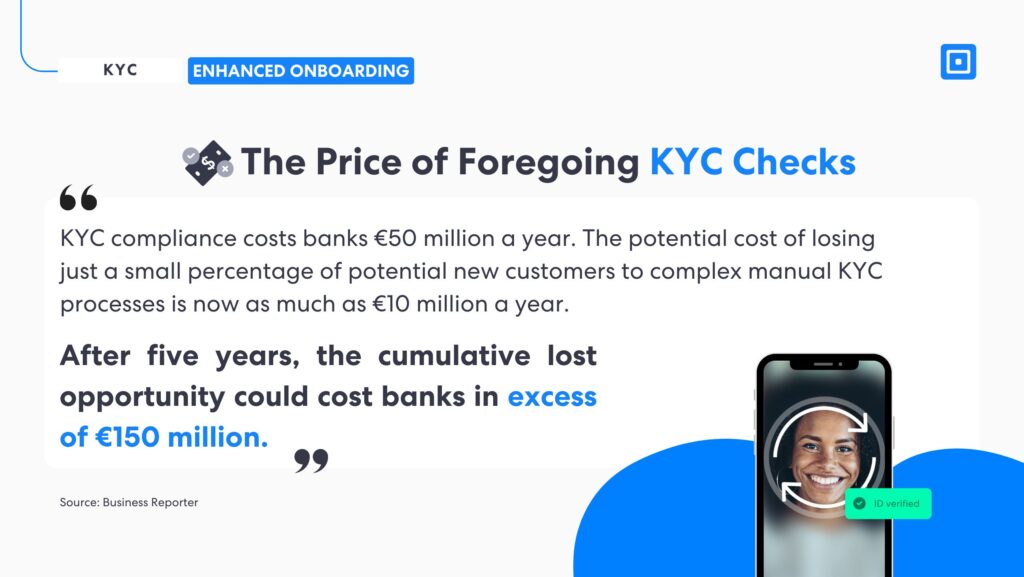
An article from the Business Reporter effectively quantified what losses can look like when onboarding processes are unable to handle large amounts of KYC checks. It highlights the risks businesses take when not adequately investing in KYC verification. “According to research conducted by Mitek and Consult Hyperion, KYC compliance costs banks €50 million a year. The potential cost of losing just a small percentage of potential new customers to complex manual KYC processes is now as much as €10 million a year. After five years, the cumulative lost opportunity could cost banks in excess of €150 million.”
KYC compliance costs banks €50 million a year. The potential cost of losing just a small percentage of potential new customers to complex manual KYC processes is now as much as €10 million a year.
This is a key point that organizations must consider, as whilst investing in a robust KYC process might seem costly, the loss of potential business could be far more substantial. Furthermore, there is also the cost of financial penalties which might be received, which must also be considered.
Proactive Risk Management
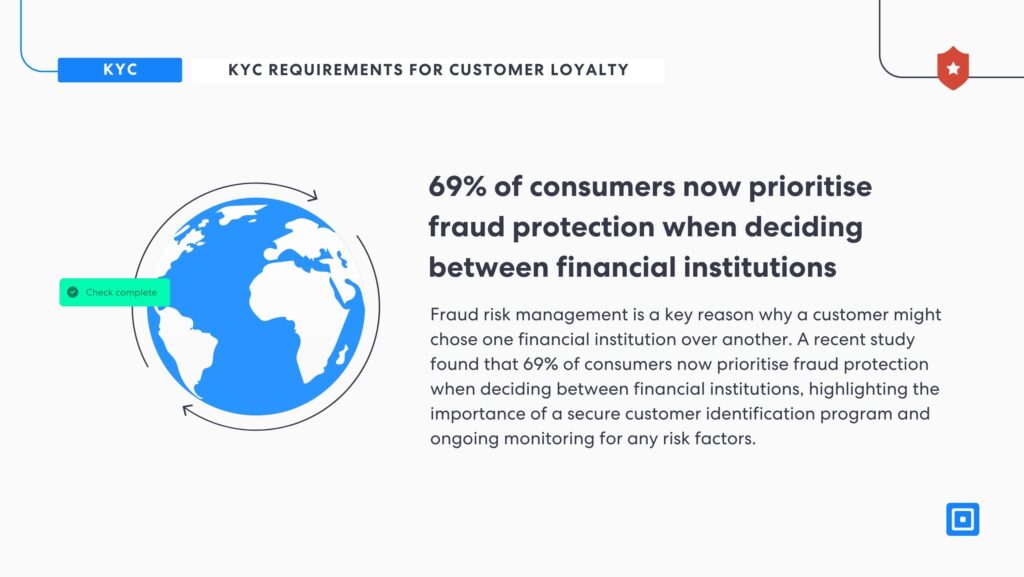
Fraud risk management is a key reason why a customer might choose a different financial institution. A recent study found that 69% of consumers now prioritize fraud protection when deciding between financial institutions. This highlights the importance of a secure customer identification program and ongoing monitoring for any risk factors.
There are many kinds of scams that take place on financial platforms, including the creation of new accounts using a false or stolen identity, account takeovers, unauthorized credit or loan applications, and more. Some of the critical protections needed to instill loyalty and trust among customers might include:
Safeguarding accounts with biometric authentication makes account takeovers much more difficult to carry out.
A secure identity verification process that leverages liveness detection technology to quickly and effectively identify synthetic identities, stolen identities, or false identities. This allows businesses to quickly stop fraudsters from applying for credit or loans and stop them from opening an account in someone else’s name.
The use of ongoing monitoring with fraud alerts and notifications. Giving customers real-time alerts when potentially fraudulent activities are detected on their accounts is crucial to building customer trust.
In addition, strict AML screening includes sanctions screening, PEP screening, and adverse media checks. Moreover, watchlist screening, and continuous monitoring also ensure full AML compliance, fostering increased digital trust.
Advanced Fraud Detection
Fraud detection has come a long way with new AI-powered technologies. Powering KYC processes with market-leading AI tools helps build a trustworthy global reputation. Some of the latest technologies include:
Liveness Detection
Liveness detection can identify stolen or false identities. It uses AI to pull biometric data from a submitted video during customer onboarding to verify whether or not the individual is a real person. Leveraging liveness detection ensures that businesses spot deepfake technologies during these onboarding processes, analyzing subtle micro-expressions and skin texture to ensure liveness. The customer’s identity is verified effectively, meeting KYC regulations when used with an advanced document verification check. For more on liveness detection, read “Liveness Detection: Best Practices for Anti-Spoofing Security.”
Optical Character Recognition
Optical Character Recognition (OCR) helps extract data from images of KYC documents quickly and effectively, verifying a client’s identity. OCR technology extracts key data points (e.g., name, date of birth, address) from identity documents, ensuring no manual errors or inconsistencies occur.
This extracted information can then be cross-checked against databases, such as sanctions lists, politically exposed persons (PEP) lists, and watchlists, to identify high-risk individuals. OCR can identify anomalies within images of government-issued KYC documents, which might indicate fraudulent tampering. Find more information on OCR here.
KYC Requirements as a Competitive Advantage
In the past couple of years, sophisticated KYC compliance processes within financial institutions to prevent fraud have become a clear competitive advantage. Customers look for platforms that can protect them at all times, especially since so many financial institutions have recently been victims of large-scale scams.
The banking sector has emerged as a key target for identity theft and synthetic identity fraud. According to Synectics Solutions, which manages the UK’s largest syndicated risk intelligence database, 45% of all adverse contributions in the finance sector in 2023 were linked to stolen identities and identity fraud. Fraudsters leverage falsified or stolen identities to drain funds from accounts, make unauthorized purchases, or fraudulently secure loans.
Differentiating Through Compliance
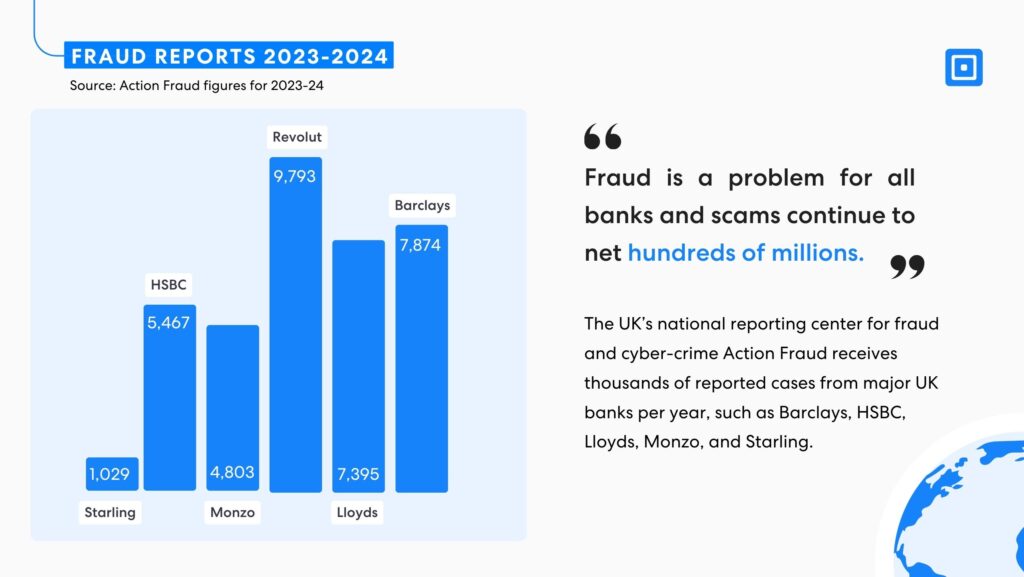
Between 2023 and 2024, fraud reports surged across major financial institutions, with HSBC receiving 5,467 reports, Revolut 9,793, Lloyds 7,395, and Barclays 7,874. These figures highlight the pervasive and sophisticated nature of modern fraudulent practices, underscoring the urgent need for financial institutions to reassess their priorities in order to win over customer trust and loyalty. For more information on identity fraud within UK financial institutions, read “Revolut Falls Victim to Identity Fraud.”
Stringent KYC processes will also enable businesses to operate in highly regulated markets, supporting global market expansion. This positions organisations as reliable international players, providing reassurance for investors and instilling confidence in customers and stakeholders.
Therefore, businesses that can differentiate themselves through reliable fraud defenses will continue to hold a competitive advantage as customers continue to prioritize security. An organisation that remains compliant with worldwide KYC and AML regulations, maintaining a strong reputation of security, is far more likely to win over a customer.
Case Study: ABN AMRO Deepfake Onboarding Fraud
In March 2026, DutchNews reported that prosecutors told an Amsterdam court a man had opened 46 ABN AMRO bank accounts in other people’s names using deepfake technology and stolen bank identity details. The reported accounts were allegedly created through remote onboarding flows that relied on identity document uploads and facial recognition.
Strong Onboarding Models Have Layered KYC
A strong onboarding model has layered KYC checks instead of a single selfie-to-ID match. With document authenticity, biometric verification, device signals, and trusted data-source checks, teams could verify if an applicant genuinely matched the identity being used. Any mismatch would have triggered Enhanced Due Diligence (EDD) or escalation.
Outcomes
46 fraudulent ABN AMRO bank accounts were reportedly identified.
This exposed how deepfakes can undermine weak or static remote onboarding.
It reinforced the need for continuous, risk-based KYC that adapts to AI-enabled fraud.
What Does a Comprehensive KYC Process Look Like?
As a result, for a KYC process to be a robust defense against fraud and ensure compliance, several key steps must be implemented. Some of these include:
Advanced Document Check: A document check will verify a government-issued identity document, checking for signs of tampering and extracting key information with OCR technology.
Biometric Verification with Liveness Detection: Biometric verification will quickly identify presentation attacks, such as those using deepfake technology. Biometric data samples are pulled from submitted images and videos to be examined, and details such as skin texture and subtle involuntary movements are analyzed.
Multi-Bureau Checks: With a Multi-Bureau Check, businesses can verify customer details, such as name, address, date of birth, and social security numbers, against trusted, authoritative sources such as government and credit bureaus.
Key Takeaways
KYC supports both compliance and growth by helping firms meet regulatory duties while keeping onboarding efficient and scalable.
Manual onboarding can become a commercial bottleneck, especially when customer volumes spike or when verification processes are too slow.
Risk-based KYC improves efficiency because enhanced due diligence can be reserved for higher-risk customers rather than applied uniformly.
Fraud prevention is now a customer-trust issue, not just a back-office compliance concern.
Layered verification is essential, combining identity checks, liveness detection, authoritative data checks, AML screening, risk scoring, and ongoing monitoring.
Compliance with ComplyCube
In summary, ComplyCube offers state-of-the-art KYC solutions to help businesses safeguard their customers and their platforms from fraud. Achieving compliance across complex regulatory structures enables businesses to scale quickly and seamlessly, which ComplyCube’s platform supports.
For more information on fortifying your business with a robust KYC process, get in touch with one of our compliance experts.
Frequently Asked Questions
What are KYC checks in customer onboarding?
KYC checks are identity verification and due diligence measures used to confirm who a customer is, assess their risk level, and help businesses prevent money laundering, fraud, terrorist financing, and other financial crimes.
Why are KYC checks important for scalable onboarding
KYC checks help businesses onboard more customers without sacrificing compliance or security. Automated KYC reduces manual review, speeds up verification, and allows companies to grow while maintaining regulatory controls.
How does risk-based KYC improve onboarding efficiency?
A risk-based KYC approach scores customers according to risk signals, so low-risk users can move through onboarding faster while higher-risk users receive enhanced due diligence.
What types of fraud can KYC checks help prevent?
KYC checks can help prevent new account fraud, stolen identity use, synthetic identity fraud, unauthorized credit or loan applications, account misuse, and money laundering.
How does ComplyCube support secure and scalable KYC checks?
ComplyCube helps businesses run automated KYC checks by combining identity verification, biometric checks, AML screening, risk scoring, and ongoing monitoring. This makes onboarding faster, safer, and easier to scale.
Sofia Daley
Sofia Daley is a Content Marketing Executive at ComplyCube with strong expertise in growth marketing, social media strategy, and AML/KYC compliance. She combines creative storytelling with regulatory knowledge to deliver impactful content that drives customer trust and business growth.
A developer-focused guide to MRZ verification. This guide covers what it takes to have successful checksums, data mismatches, passport fraud, NFC chip data, and biometrics to demonstrate why MRZ by itself cannot prove identities....
Identity document optical character recognition solutions automates KYC data extraction, reduces manual errors, and supports faster, accurate customer onboarding. It uses advanced technologies to support precise data recognition....
Rank Group’s £5M settlement case has put land-based casino Anti-Money Laundering controls under the spotlight. Learn how this settlement exposed serious gaps in risk scoring, source-of-funds checks and Enhanced Due Diligence....