
TL;DR: A customer identification program (CIP) is the first step of KYC. If you are asking what is CIP, it is a flexible, risk-based onboarding procedure. It is designed to deter fraudsters, financial criminals, and terrorist. CIP requirements focus on capturing identifying information and validating them against documents and trusted sources.
What is a Customer Identification Program?
When regulated businesses establish new user relationships, they must verify each customer’s identity. This requirement matters most in financial services, but it also applies across other industries. Beyond 2026, more firms will strengthen identity checks as onboarding moves further online, helping them reduce fraud risk while maintaining a smooth customer experience.
A Customer Identification Program is a procedure that most companies must follow when onboarding new clients. It deters bad actors, financial criminals, and known or suspected terrorists. It proves that customers are who they say they are and is a crucial first step in the KYC process. Done well, a CIP also gives compliance teams a reliable foundation for due diligence and ongoing monitoring later in the customer lifecycle.
The Financial Crimes Enforcement Network’s (FinCEN’s) Final Rule mandates that a company’s CIP must be ‘appropriate to its business size.’ This means every company must analyze customer details until there is a ‘reasonable belief’ that the customer is indeed who they say they are. This regulation provides companies with a degree of autonomy and flexibility when deciding and enacting their program.
CIP vs KYC: What’s the difference?
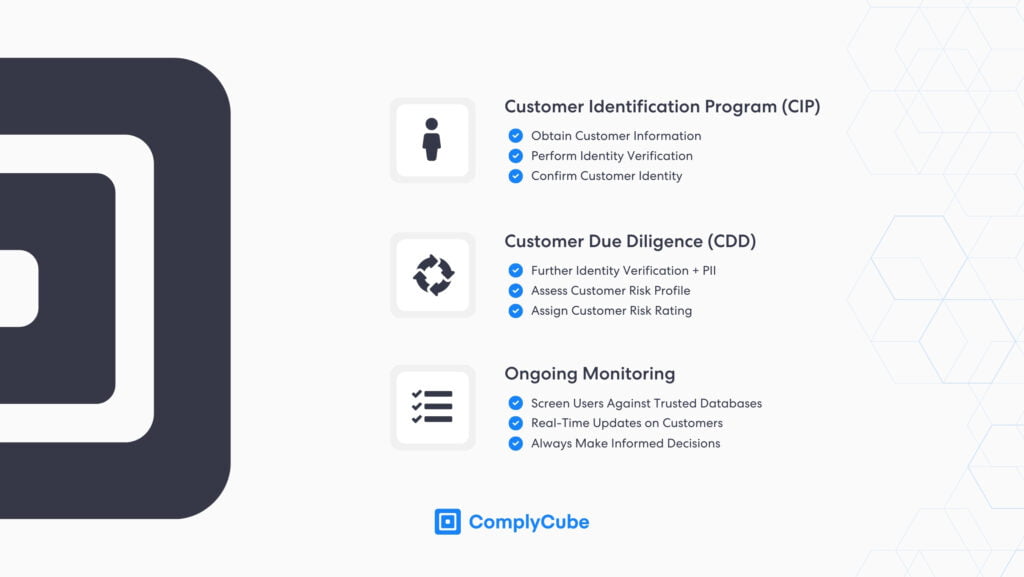
There is a critical difference between a Customer Identification Program and a Know Your Customer strategy. CIP is the identity-focused onboarding step. It’s where an institution gathers and verifies key details to form a “reasonable belief” it knows who it’s dealing with. On the other hand, KYC is broader. It builds on that verified identity to assess risk and keep evaluating the relationship over time:
- Customer Identification Program (CIP): FinCEN and the USA Patriot Act requires a financial institution to form a reasonable belief that it knows the identity of its customers.
- Customer Due Diligence (CDD): The due diligence process fosters a risk profile for each customer that compliance and KYC officers can use to make informed user decisions.
- Ongoing Monitoring: Institutions perform due diligence on an ongoing basis. This gives them real-time information to stay fully informed about their users.
What Information Must a CIP Extract?
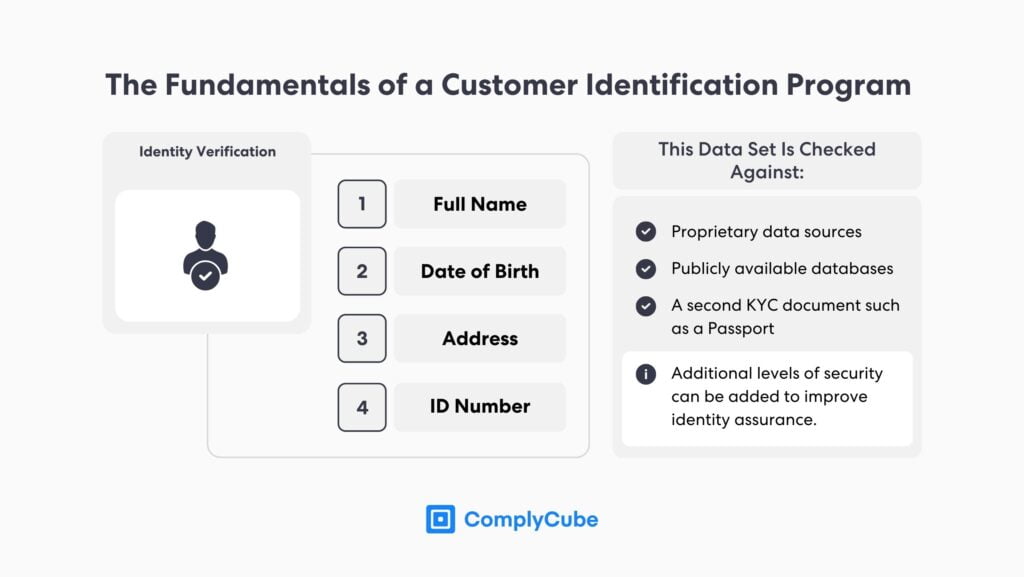
There are 4 essential requirements that must be obtained when an institution begins a CIP. They are:
- Full Name
- Date of Birth
- Address
- ID Number
Then, the data is verified against the documents supplied by the potential customer and third-party trusted databases. Then, businesses can paint a clear picture of who the user is to decide whether that individual can gain access or continue to use the service. Companies can add further layers of identity verification to increase security as dictated by the company’s Risk Base Approach (RBA) or regulatory bodies. When requesting information from an old or new account, an institution must provide adequate notice for the data or documents to be provided.
CIP Requirements for Financial Institutions
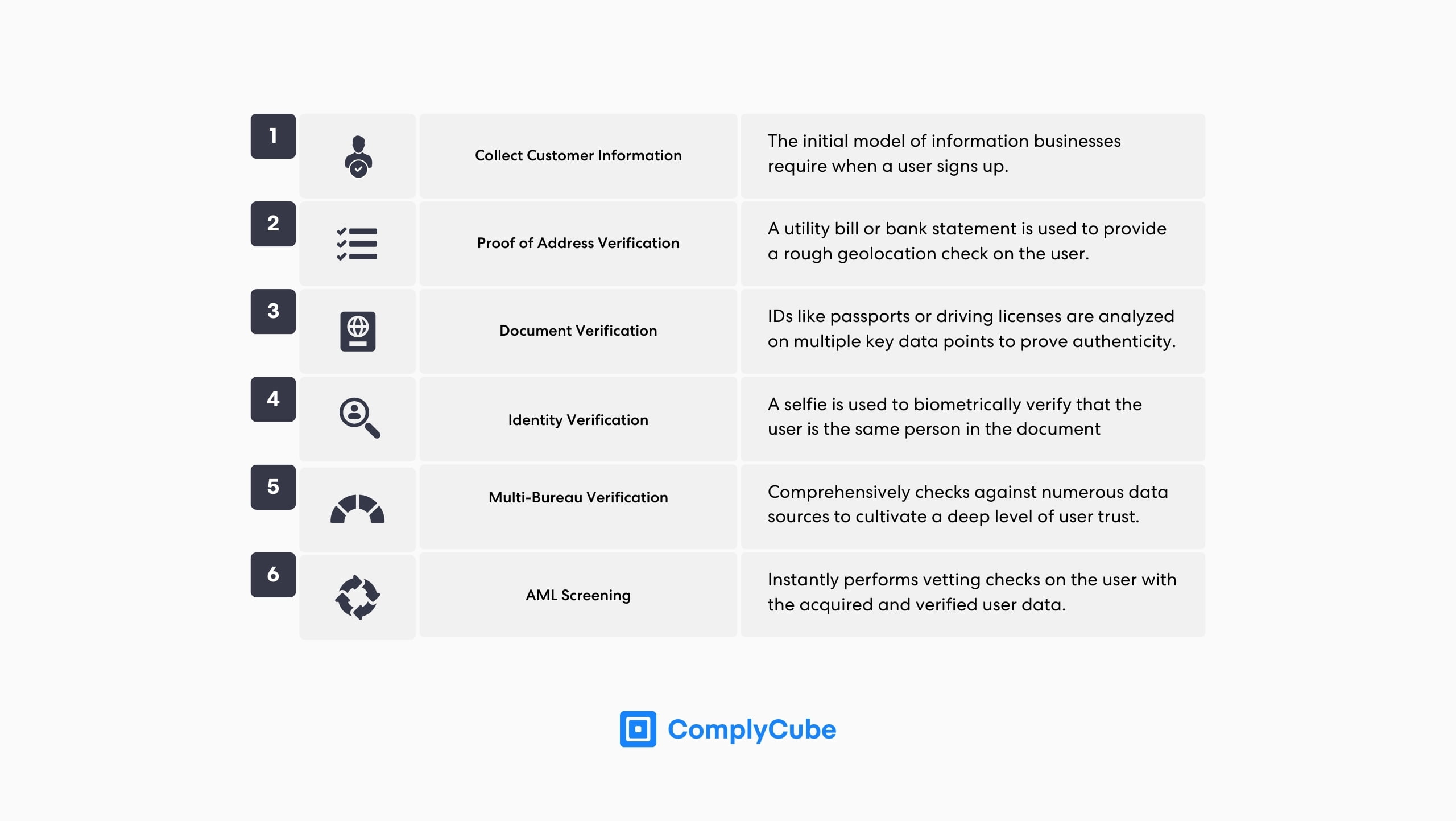
Although the Final Rule gives each company discretion, most firms follow a common framework. First, they collect customer information to establish a baseline for identity verification. This initial step gives the company verified data to compare against the user’s ID documents when they upload them.
Verifying important user documents such as a passport, driver’s license, or any other government-issued ID is essential for any Customer Identification Program. This helps any companies corroborate the information provided initially by users: Name, Date of Birth, Address, and ID number (such as a taxpayer identification number or social security number in the US).
Companies then verify this information against a trusted third-party database, such as a credit bureau, postal service, or financial institution. Depending on their risk tolerance, they may also request proof of address, typically through a utility bill or bank statement, to add another layer of identity assurance.
Once a business is content with the level of identity assurance, it runs an AML screening. This verifies that the user is not involved in illegal activities and helps the government fight against financial crime. Leading KYC/AML solutions provide multiple AML screening services including, but not limited to, Sanctions & PEP Screening, Adverse Media Checks, and Watchlist Screening.
Identity Verification (IDV) Procedures
Once user information has been acquired, their true identity must be verified. This can be done in several ways, depending on industry-specific regulations as well as a company’s corporate risk-based approach. KYC services provide a host of solutions that are indispensable in extracting reliable customer data and innovating customer onboarding processes. The solutions can be customized and tailored to fit the needs and operations of a business.
Proof of Address (PoA) Check
Identity verification checks for Proof of Address leverage state-of-the-art optical character recognition (OCR) and decision-making engines to extract relevant information from Proof of Address documents in seconds. These documents include any bank statements, utility bills, driving licenses, and tax documents that are checked for the following 2 criteria:
- Data on the PoA document is matched against the details provided by the client upon registration.
- The geolocation of the provided document is tested for proximity to the IP address of the upload.
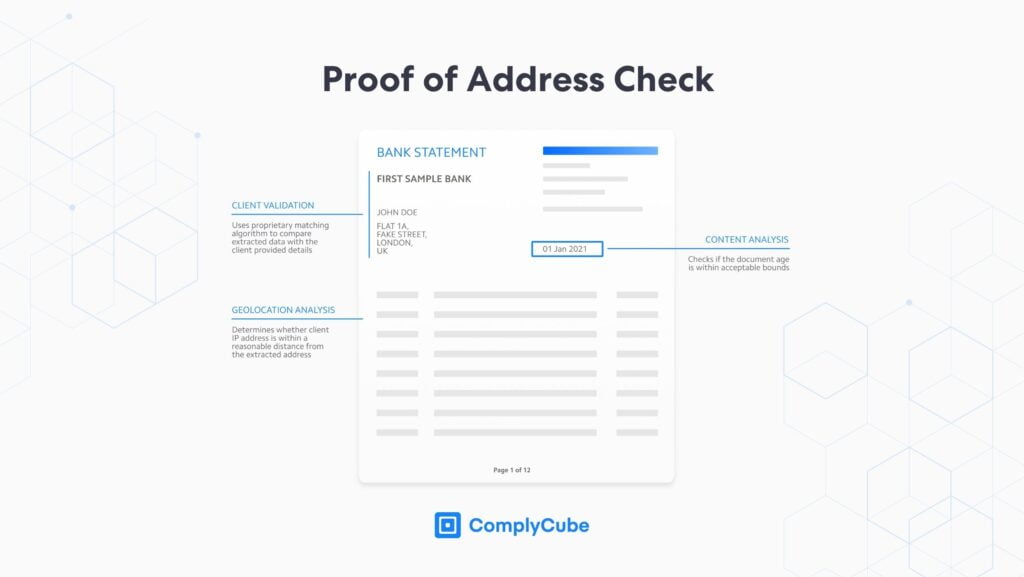
PoA verification takes less than 15 seconds to complete on average, making it a seamless yet reliable method to strengthen customer authenticity. Discover more about PoA Verification here: A Robust Guide to Proof of Address Checks (PoA).
Document Verification
In some circumstances, Document verification can pertain to the remit of PoA. However, where high levels of identity assurance are required, such as financial services, any other identifying documents, including a passport, are required. Using bespoke AI-powered analytics technologies, these checks can analyze multiple integral data points instantly, including:
- Forensic Analysis
- RFID Analysis
- Format Analysis
- Content Analysis
- MRZ Analysis
- Front & Back Analysis
- Consistency Analysis
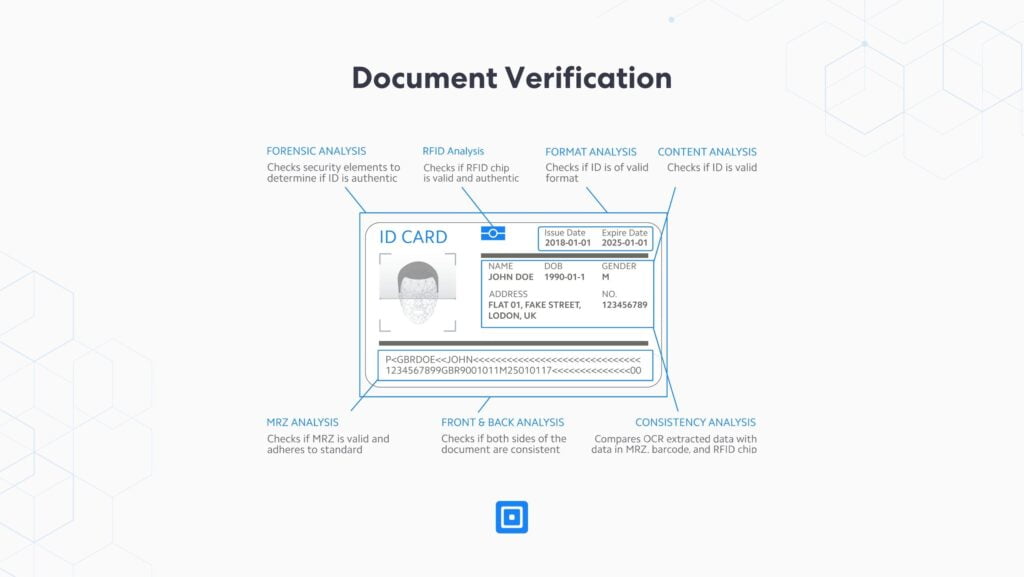
These checks auto-redact any sensitive information, such as images on minors’ passports, MRZ codes, and more, ensuring both the service provider and the business adhere to all jurisdictional data privacy laws. For more information on the nuances of a document verification process, read: What is Document Verification? An In-Depth Look at ID Verification.
Biometric Verification
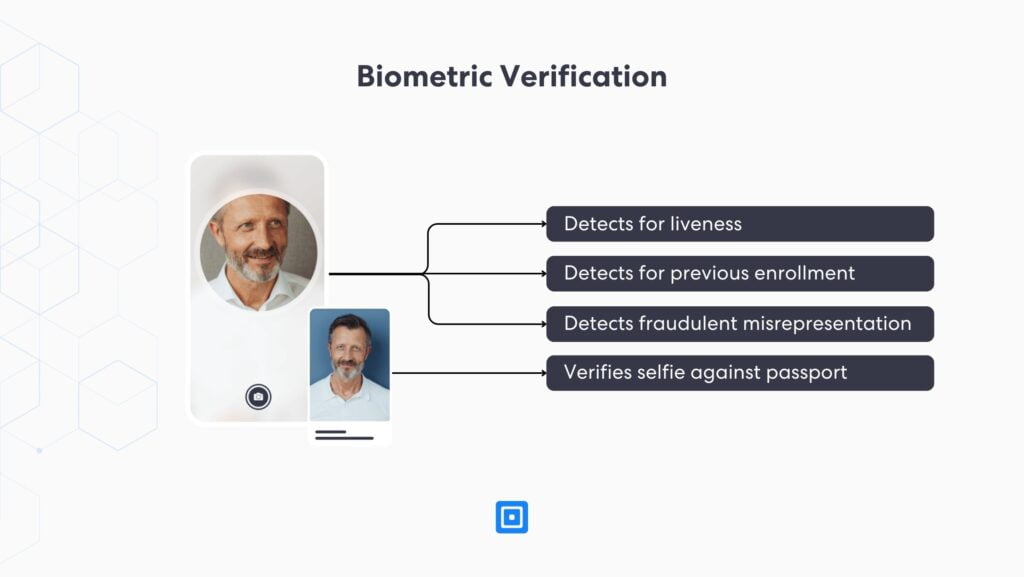
Biometric verification is the final piece of the identity assurance puzzle and is swiftly becoming a modern CIP requirement. Once completed, financial institutions should have sufficient confidence that the user is who they say they are, and an account can be opened. This process matches a person’s live selfie against the image in their ID document. Leveraging machine learning technologies, biometric verification detects the liveness of a selfie via certain innovative and advanced technologies, including Presentation Attack Detection (PAD).
PAD technology is unique because it constructs 3D facial maps, conducts detailed analyses of skin texture and micro-expressions, identifies pixel tampering, and recognizes various disguises, including masks. This ground-breaking technology instantly detects any fraudulent attempts with precision at a speed that would be impossible for a human to mimic.
This accuracy at such a vast scale mitigates the number of false positives that come back from checks as well as increase the volume at which companies can onboard new clients. To learn more about Presentation Attack Detection here: ComplyCube Bolsters ID Verification with Liveness Layer.
Multi-Bureau Check
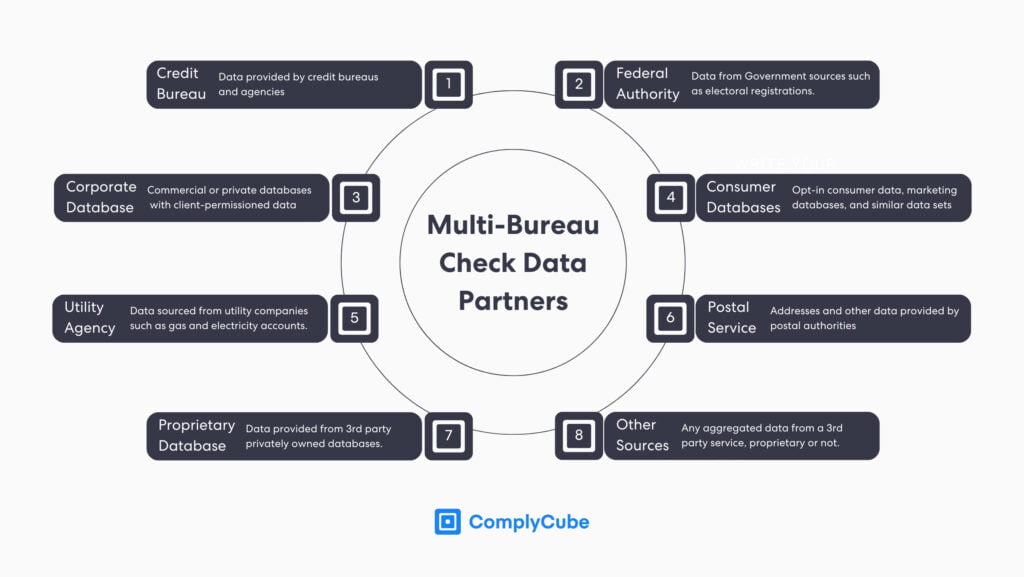
A Multi-Bureau Check offers a comprehensive layer of financial and informational background verification, cultivating deeper trust between the user and the service. It synchronously examines various bureaus and databases, thereby performing a multifaceted vetting of a user’s background. This identification method usually amplifies an existing level of identity assurance. For example, if a user were to apply for a loan after having opened an account with a bank. Typical partner databases can be viewed below.
Which Institutions are Bound by the CIP Rule?
FinCEN created the CIP requirements and Final Rule for financial institutions, but businesses across many sectors now use them as a benchmark for Know Your Customer (KYC) processes. For any institution that needs to verify customer identities, the CIP rule provides a useful reference point. As the global economy becomes more digital and interconnected, businesses need trusted identity checks to support secure growth.
This is why firms beyond financial services can apply FinCEN’s Final Rule as a practical identity assurance framework. Businesses should scale their CIP process according to their size, regulatory obligations, industry risk, and internal risk appetite. Some online sectors may not legally need a formal KYC process or Customer Identification Program, but many still adopt one to reduce fraud, strengthen trust, and protect their platforms.
Case Study: Apple Distribution International’s Russia Sanctions
In March 2026, the Office of Financial Sanctions (OFSI) imposed a £390,000 penalty on Apple Distribution International Limited (ADI), and Ireland-based subsidiary of Apple Inc. This penalty was related to Russia sanctions exposure.
Cross-Border Sanctions Risk Exposed
Firms that use UK banks or process payments through UK-lined systems must conduct sanctions screening, ownership checks, and do third-party due diligence. This way teams have risk protocols strong enough to detect restricted activity.
Outcomes
ADI received a £390,000 penalty from OFSI.
ADI conducted payments connected to Russia sanctions exposure.
OFSI reinforced that non-UK firms can fall within UK sanctions enforcement.
How a Thorough CIP Helps Prevent Money Laundering
A Customer Identification Program is instrumental in helping financial institutions curb money laundering activities. Federal law requires these programs to collect a customer’s identifying information, including full name, identification number, date of birth, and address. This foundational step is critical in preventing money laundering and other financial crimes.
There is every possibility that a user’s situation, and therefore associated risk, will evolve throughout their relationship with a business. For example, a customer might open a bank account with no initial political connections but, over time, could develop associations with influential political figures.Financial institutions can form a sufficient belief in their customers’ identities and act accordingly by adhering to the stringent measures discussed in this guide, coupled with a detailed broader KYC strategy.
A report on money laundering in the British property industry found an increasing need for technology-assisted Identity Verification and that more traditional methods were quickly becoming outdated.
These methods [manual KYC and AML checks] alone are no longer enough.
This represents a shifting landscape across a wide array of industries, where AI and machine-powered IDV solutions will become common practice across multiple industries. Money laundering in the real estate industry is nothing new, but reports show the increasing aptitude of the UK, particularly London, for real estate money laundering activities. This is, however, an escalating issue across multiple industries over the globe.
A thorough investigation of a client’s identifying details is essential, as it allows businesses to comply with regulatory policies and fortifies the financial system against the perils of illicit activities. This ensures that each account opened is based on a foundation of trust and verified identity.
CIP for Customers vs Businesses
The Customer Identification Program rule sets a strong standard for verifying customers, and institutions can apply the same framework when forming new business relationships. This process, known as Know Your Business (KYB), helps firms verify business entities, identify their owners, and assess risk before entering a new partnership agreement.
Companies must collect an equivalent data set, including the business name, registration address, incorporation date, and government-issued business licence or employer identification number. They must also identify the Ultimate Beneficial Owners (UBOs), which adds the key layer of ownership transparency to the business verification process.

Business ownership checks can become challenging when company layers, owners, and proprietors sit behind complex or deliberately opaque structures. In many cases, bad actors hide ownership because they want to avoid scrutiny from government and regulatory bodies. This makes thorough due diligence essential, helping businesses identify the real owners, operators, backgrounds, and motivations behind a company.
Key Takeaways
A customer identification program (CIP) verify customers before onboarding.
Know Your Customer (KYC) compliance is a core part of CIPs.
Strong CIP checks help lower fraud and overall Anti-Money Laundering (AML) risk.
Risk-based workflows improve compliance accuracy.
ComplyCube automates CIPs with Identity Verification (IDV), biometrics, and AML screening.
Choosing a CIP and KYC Verification Service
Refining a Customer Identification Program (CIP) as part of a wider KYC (Know Your Customer) strategy is vital for businesses aiming to comply with Anti Money Laundering regulations and prevent fraud. This requires meticulous attention to detail and a deep understanding of regulatory requirements and customer profiles.
ComplyCube’s solutions include an all-in-one, user-friendly portal that is swiftly becoming an essential tool for compliance officers. This platform features advanced automation toggles and fast-fail thresholds, which streamline the client acquisition process and refine internal operations with efficiency-enhancing tools.
Automated KYC solutions alleviate businesses from the stress of monitoring shifting regulatory landscapes while providing seamless user experiences. A strong CIP and KYC service will do this without forsaking the integrity and security of the extracted data. ComplyCube’s AI-powered KYC services could help relieve your business’s trepidations over regulatory compliance. If this is a subject of concern, get in touch below.

Frequently Asked Questions
What is customer identification program (CIP)?
A customer identification program (CIP) is a group of procedures that verify customer identity well before an account is opened or a regulated service begins. This helps companies confirm that customers are real by collecting and checking identifying details.
What does CIP require?
CIP requires businesses to collect key customer information. They need to be able to verify that information through reliable documents or data sources. Additionally, they can keep records of the checks performed. CIP needs risk-based procedures that help form reasonable beliefs around customer identities.y
What is the difference between CIP and KYC?
CIP is not the same as Know Your Customer (KYC). CIP looks at identity verification during onboarding. On the other hand, KYC includes Customer Due Diligence (CDD), Anti-Money Laundering (AML) screening, risk assessment, and ongoing monitoring.
Who needs a CIP?
A CIP is needed for many financial institutions such as banks, credit unions, lenders, and other regulated firms. CIP-style checks are needed to reduce fraud and meet compliance expectations. It covers several other additional sectors such as fintechs, payment firms, crypto platforms, and marketplaces.
How can ComplyCube help with CIP?
ComplyCube helps businesses automate Customer Identification Program checks through Identity Verification (IDV), document checks, database checks, and Anti-Money Laundering (AML) screening. Its APIs, SDKs, hosted flows, and no-code workflows support faster onboarding while keeping CIP processes consistent, scalable, and audit-ready.