TL;DR: Perpetual KYC, or pKYC, replaces periodic, time-based customer review with continuous customer risk monitoring. For compliance teams, perpetual KYC due diligence ensures a proactive approach to risk management. It supports quicker, more accurate, and more efficient financial crime prevention, reducing compliance gaps in traditional KYC processes.
The Hidden Compliance Blind Spot
Traditional Know Your Customer (KYC) or legacy KYC processes are time-bound and calendar-based, usually requiring review every 1 to 5 years based on risk, company, or country policy. However, between those reviews, customer data can be untouched. As such, traditional KYC can miss crucial changes in customer risk profiles. This blind spot comes with measurable cost.
Take CCV Netherlands, for example. The firm was fined $3 million for failing to load over 4000 merchant profiles into its monitoring system for 23 months. According to authorities, CCV did not meet Anti-Money Laundering (AML) and KYC requirements for continuous compliance, not just a point-in-time fix.
Another example is UBS Monaco, which was fined $6 million for deficiencies in its ongoing monitoring framework. The company failed to capture and update evolving customer risk in response to changes in transaction behavior, Politically Exposed Person (PEP) exposure, and source of wealth information.
For many financial institutions, the consequences can extend beyond fines. This is particularly true in this era of quick payments, sophisticated fraud, and rapidly shifting sanctions landscapes. This guide explores pKYC systems, their benefits, challenges, and how to implement them successfully.
What is Perpetual KYC (pKYC)?
Perpetual KYC updates customer information continuously and is driven by specific event triggers. These event triggers can include changes to sanctions lists, new beneficial ownership structures, or unusual transactions. Instead of waiting for a particular date, customers are automatically flagged for review when there is a change in their risk profile.
Thus, perpetual KYC closes the blind spot that exists in legacy systems. Since teams are notified of changes in real-time, they can detect and act on suspicious activity immediately. This makes pKYC important, particularly for regulated entities that face evolving regulations or heightened financial crime risk.
Perpetual KYC runs on Artificial Intelligence (AI) and machine learning models. These technologies connect data feeds from internal systems, company registries, and external data sources, such as PEP, sanctions, and adverse media databases. Additionally, it enhances regulatory compliance by improving detection of real, high-risk scenarios, dramatically reducing false positives and manual re-verification.
The Shift from Periodic to Perpetual KYC
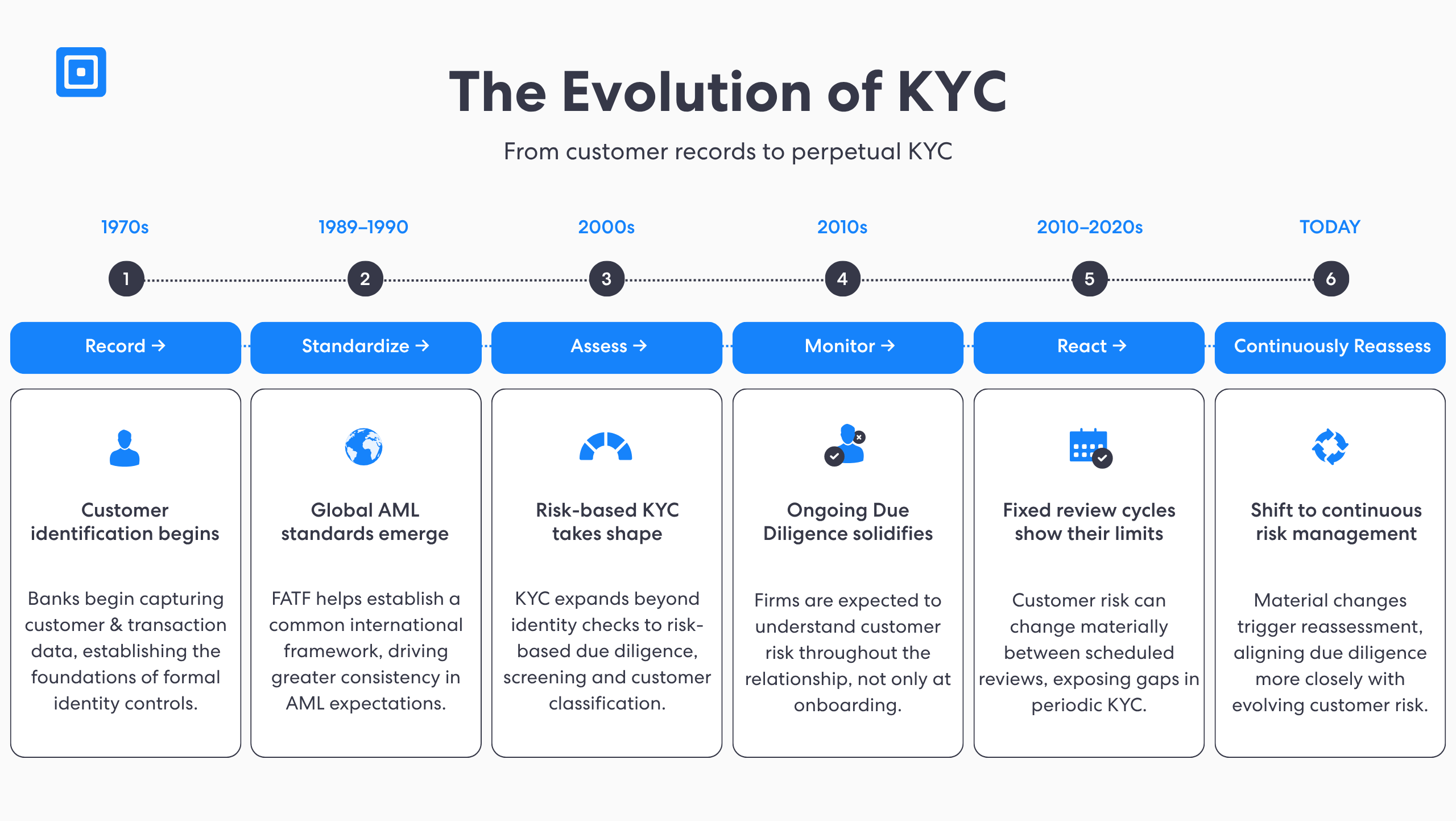
Know Your Customer (KYC) principles can be traced back to 1970, when it was introduced as a document collection exercise. Regulatory bodies implemented it for banks to track and record customers and transactions. In 1989, the Financial Action Task Force (FATF) solidified KYC compliance guidelines, with leading jurisdictions, such as the Bank of England, following suit.
This model held for nearly two decades. As transactions grew in volume and speed globally, it became clear that periodic KYC could not sustain large changes in customer risk. Large banks were grappling with thousands of customer files that had gone stale, and enforcement actions continued to multiply.
In the late 2010s, global financial institutions, together with regulators, pushed toward adopting ongoing customer due diligence. This marked the shift from fixed-interval KYC checks. Today, leading jurisdictions, including the U.S. Bank Secrecy Act (BSA), the UK Financial Conduct Authority (FCA), and the EU AML Regulation, explicitly mandate dynamic, real-time risk assessments.
In the same timeline, cloud infrastructure, API-driven data providers, and AI-based entity resolution support the technical feasibility of continuous monitoring. These changes drove the demand for pKYC solutions, shifting KYC regulatory requirements from a filing exercise to a risk management discipline.
What pKYC Really Is and Isn’t
Perpetual KYC due diligence aligns with the risk-based approach to ongoing Customer Due Diligence (CDD). Using automation, customers are routed to further review, lightweight review, or full Enhanced Due Diligence (EDD) flows based on predefined criteria set by companies themselves.
These criteria and triggers require human judgment to maintain well-governed data, explainable risk models, and documented trigger catalogs. So, we can say that the distinction between pKYC and legacy KYC is its event-driven logic.
Perpetual KYC vs Traditional KYC
Traditional KYC is the one-off identity verification and risk assessment approach to customer due diligence. It relies on some form of periodic review and low ongoing monitoring effort, typically via manual processes. Perpetual KYC is an always-on process that goes beyond onboarding and reflects current risk changes, with low human intervention.
Perpetual KYC vs Periodic KYC
Periodic KYC is a subset of traditional KYC and refers to the practice of reviewing customers at predefined intervals. Typically, these KYC refreshes occur every 1 to 5 years. In practice, a customer that onboards in 2023 will not face a review until the next scheduled cycle, which can be in 2026. Perpetual KYC detects changes and triggers a review at that point-in-time.
Perpetual KYC vs Ongoing Monitoring
Ongoing monitoring is a component of pKYC. It refers to the real-time screening of customers against sanctions, PEP, and adverse media lists. However, perpetual KYC goes further by monitoring all relevant sources for a variety of risk signals. This can include behavioral anomalies and changes in identity data that help firms promptly identify what warrants further review.
What Triggers Perpetual KYC?
A perpetual KYC review is triggered when new information materially changes a customer’s identity, business relationship, or risk profile. It should not simply generate more compliance alerts. Instead, it needs to ensure that the level of due diligence applied to a customer continues to reflect their current risk, rather than the risk they carried when the relationship first began.
Common pKYC risk indicators include:
- Corporate or regulatory changes: legal status shifts, new disclosure requirements, new ultimate beneficial owners (UBOs)
- Identity information changes: name, address, expired documents, jurisdictions.
- PEP, sanctions, and adverse media hits: negative press on customer or related parties, new designations
- Behavioral anomalies: change in customer behavior such as unusually large volumes or multiple account openings
Implementing Perpetual KYC Processes
Implementing pKYC does not involve just adding ongoing monitoring to an existing KYC process. In reality, many factors need to be considered during implementation. Businesses need to define which changes actually matter and what action must follow to meet compliance measures.
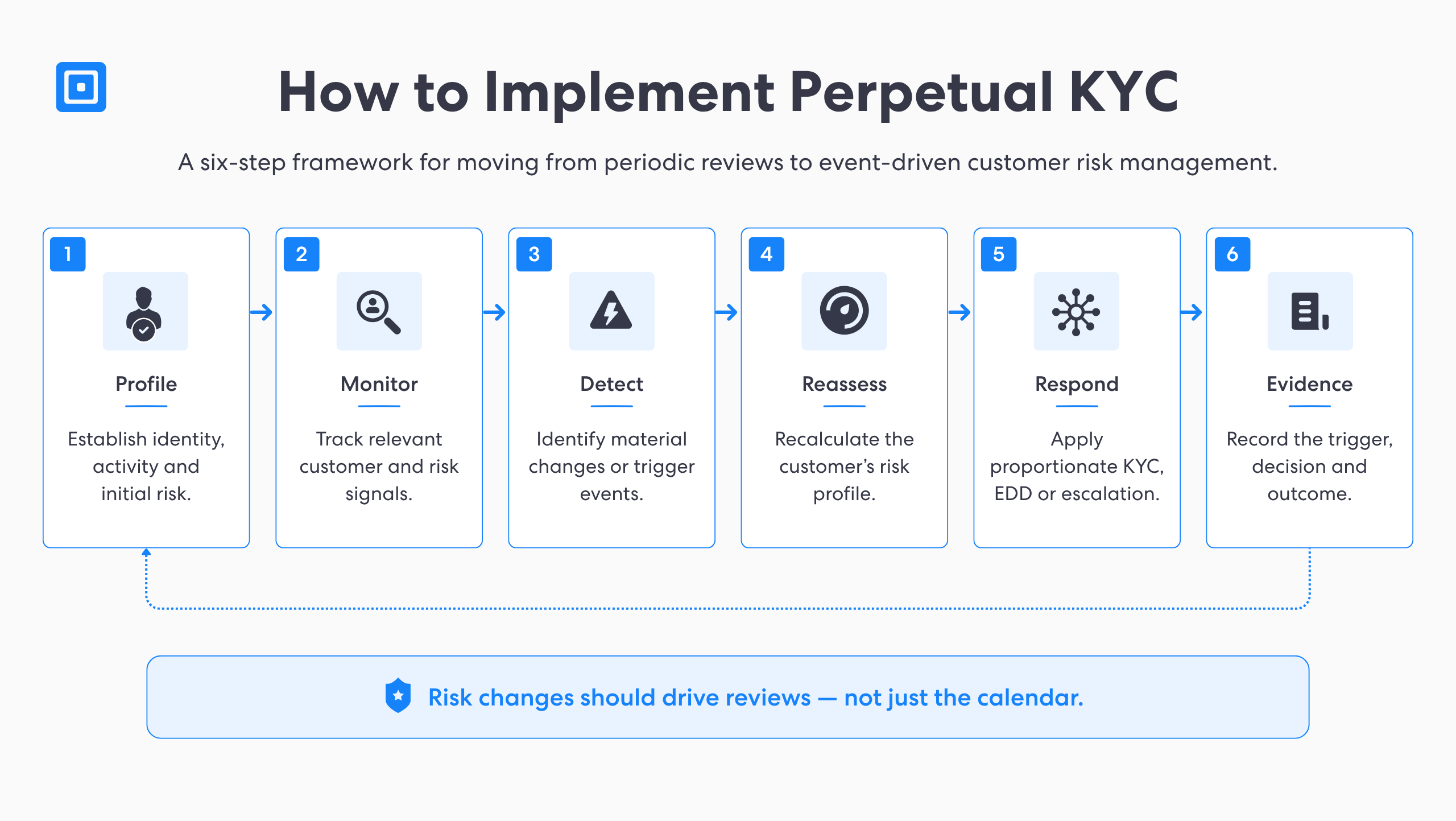
In Summary, A Strong pKYC trigger framework includes:
- What changed: A material update to the customer’s risk profile is identified.
- Why the change matters: Does the update change the company’s exposure to financial crime risk or affect AML/KYC compliance?
- Which customer-risk factors are affected: Identify specific risk drivers, such as geographic, channel, and customer risks.
- Whether the customer’s risk classification should change: Determine if the customer’s risk rating should be reassessed, increased, or decreased.
- What additional due diligence, if any, is required: Depending on the new risk rating, determine the appropriate follow-up measures.
- Who needs to review or approve the outcome: Map out the appropriate level of compliance ownership for any changes or review.
- How the decision is recorded: All steps, from the trigger event to the necessary steps taken, must be fully documented to meet regulatory reporting obligations.
Case Study: Risky Customers After Successful Onboarding
In 2026, Singapore and Malaysian authorities dismantled a cross-border money-laundering network. Operations detected multiple bank accounts opened under different identity credentials. 83 mobile phones and 45 bank security tokens were seized during a raid.
Weakness of Point in Time KYC
This case highlighted a critical compliance gap. In particular, it showed that an account holder can pass identity, biometric and AML checks at onboarding but later become involved in, or lose control of their account to a money-laundering network.
Outcomes
- Successful onboarding does not mean a customer remains low-risk forever.
- Ongoing behavioral and device signals can identify and alert firms when risk changes.
- pKYC supports continuous reassessment of customers, triggering verification where new risks emerge.
Benefits and Challenges of Perpetual KYC Solutions
Perpetual KYC does not have to exist as a mere compliance obligation. Instead, it acts as a strategic lever for risk mitigation, operational efficiency, and customer retention. However, successful implementation requires overcoming some very common challenges.
The Key Advantages of pKYC Include:
1. Support KYC and improve AML compliance: Perpetual KYC enhances ongoing due diligence, data security, and fraud prevention. It supports businesses in identifying, acting on, and reporting suspicious activity more rapidly, including account takeover and identity theft.
2. Operational and cost impact: Since pKYC is driven by automated systems and advanced analytics, it can significantly lower manual effort and cost. It uses smarter flows to reduce false positives and the time spent on low-risk customer KYC reviews.
3. Customer experience and satisfaction: pKYC cuts compliance noise by alerting companies to the risk changes that actually matter. It provides a remote, non-intrusive method of re-verification, boosting customer satisfaction and retention.
The Key Challenges of pKYC Include:
1. Legacy technology: Adopting legacy systems with narrow automation or integration capability, including limited API feeds, can create fragmented processes. Additionally, relying on multiple third-party vendors can create data silos and inconsistent customer profiles.
2. Data quality: Incomplete or inconsistent records, especially during previous manual data collection processes, can create false triggers if not integrated robustly. Data gaps can also occur if a pKYC solution cannot support large customer bases.
3. Privacy and governance: Businesses operating across borders must ensure compliance with specific jurisdiction data protection laws. Since pKYC relates to continuous customer data monitoring, it can raise data privacy concerns and must thus involve legal review.
Key Takeaways
Perpetual KYC is an event-driven due diligence model that updates client risks in real-time.
Event-driven KYC closes the gaps that traditional KYC leaves open between scheduled reviews.
pKYC uses AI and machine learning to automate processes, lowering manual effort and cost.
Successful pKYC implementation requires clear governance, event triggers, and documentation.
ComplyCube’s pKYC solution lowers false positives while introducing long-term cost savings.
Enhance Compliance with ComplyCube’s pKYC Solutions
When choosing KYC and AML providers, compliance teams are recommended to ask specific questions around perpetual KYC due diligence model validation, jurisdiction alignment, and how risk information flows between identity verification, monitoring, and case management.
Additionally, compliance and governance considerations, such as configurable risk rules aligned to internal risk appetite and local AML guidelines, as well as strong audit trails, are crucial for regulatory alignment. ComplyCube’s KYC solutions address the core dimensions:
- Enhanced security: Aligned with global industry standards for data protection and security, including GDPR and NIST compliance, as well as being ISO 27001 certified.
- Coverage: Provides end-to-end compliant and customizable KYC solutions, tailored to businesses of all sizes and over 250+ territories.
- Integration depth: Offers full SDK and API feeds to core CRM, sanctions lists, registries, and case management tools, enabling seamless integration with current infrastructure.
- Intelligence: AI- and machine learning-powered risk scoring, anomaly detection, and entity resolution with clear audit trails ready for regulators.

Frequently Asked Questions
Which companies require perpetual KYC?
Regulated institutions exposed to stringent KYC regulations and high financial crime risks typically require continuous KYC solutions. Examples include banks, fintechs, and crypto firms that regularly face fast-changing customer profiles or cross-jurisdiction exposure.
How does perpetual KYC support AML compliance?
Perpetual KYC enables compliance teams to identify and review genuine, high-risk scenarios faster and more accurately. As such, it strengthens fraud prevention and aligns with regulatory ongoing customer due diligence obligations.
Does perpetual KYC reduce compliance costs?
Yes, perpetual KYC uses automated systems to identify risk changes, update customer information, and route customers to the next re-verification step without human intervention. It reduces human error, manual steps, and false positives, introducing cost savings.
Is perpetual KYC and AML ongoing monitoring different?
Yes, typically AML ongoing monitoring involves continuous customer screening against PEP, sanctions, and adverse media databases. Perpetual KYC models capture risk signals that fall outside this scope, including behavioral and transactional anomalies.
Does ComplyCube offer pKYC solutions?
Yes. ComplyCube combines continuous AML screening with dynamic risk scoring, trigger‑based workflows and central case management. This lets firms move from fixed periodic reviews to event‑driven, always‑on KYC while keeping a full audit trail of checks and decisions.