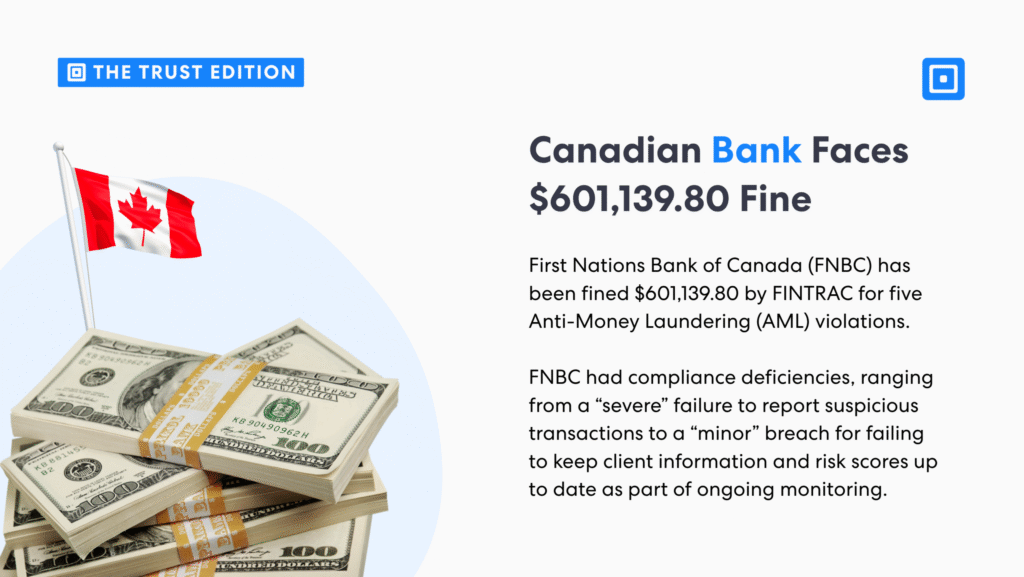
The Financial Transactions and Reports Analysis Center of Canada (FINTRAC) penalized First Nations Bank of Canada (FNBC) $601,139.80 for five different Anti-Money Laundering (AML) violations. The breaches were discovered during a compliance examination by FINTRAC. FNBC, is a Canada bank fined based in Saskatoon, specializes in providing financial services to the Indigenous community.
According to the Criminal Intelligence Service Canada (CISC), approximately $45 billion to $113 billion is laundered in Canada per year. The country operates under its Anti-Money Laundering and Anti-Terrorist Financing (AML/AFT) regime. Under this regime, 13 federal partners, including FINTRAC, the Canadian Security Intelligence Service (CSIS), and the Office of the Superintendent of Financial Institutions (OSFI), work together to combat domestic and transnational crime.
Details of the Canada Bank Fined Case and FINTRAC’s Findings
Under the regime, the Proceeds of Crime (Money Laundering) and Terrorist Financing Act (PCMLTFA) acts as Canada’s primary AML law, under which FINTRAC exerts oversight. According to FINTRAC, FNBC violated five rules under the PCMLTFA, which resulted in enforcement action. Of these violations, one is classified as a “very serious” breach, three are “serious” failures, and the last is a “minor” weakness.
Canada’s AML/ATF Regime operates on three interdependent pillars: policy and coordination, prevention and detection, and, lastly, investigation, prosecution, and disruption.
The “very serious” breach involved FNBC’s inadequate identification and reporting of suspicious transactions. Among the files examined by FINTRAC, 31% involved transactions for which no suspicious transaction report was submitted despite reasonable grounds to suspect suspicious activity. This violation exposed critical gaps in FNBC’s AML controls, potentially enabling suspicious transactions to be sent and received via their services.
Specifically, FNBC did not implement further investigations on scenarios where customer transactions were inconsistent with their financial status, where transactions were structured to avoid reporting threshold alerts, and where there was evidence of dishonesty from clients.
FINTRAC works with businesses to help them understand and comply with their obligations.
In terms of the violations deemed “serious,” FINTRAC found several gaps. First, FNBC did not keep its compliance policies up-to-date with evolving laws. Furthermore, these policies were not approved by a senior officer as required under the PCMLTFA. Second, the bank did not have robust customer-based risk assessments. Third, FNBC did not implement ongoing monitoring for high-risk clients. In its final violation, FINTRAC found 5 cases where FNBC failed to assess customer risk scores or keep their information updated.
FNBC’s penalty highlights a broader trend of Canadian regulators ramping up enforcement actions for AML failures. Most notably, this week, Canada’s Finance Minister François-Philippe Champagne announced an ambitious plan to introduce a national anti-fraud strategy alongside a new financial crime agency to further strengthen the country’s capacity to crack complex financial crimes.
For more on this story, click here.