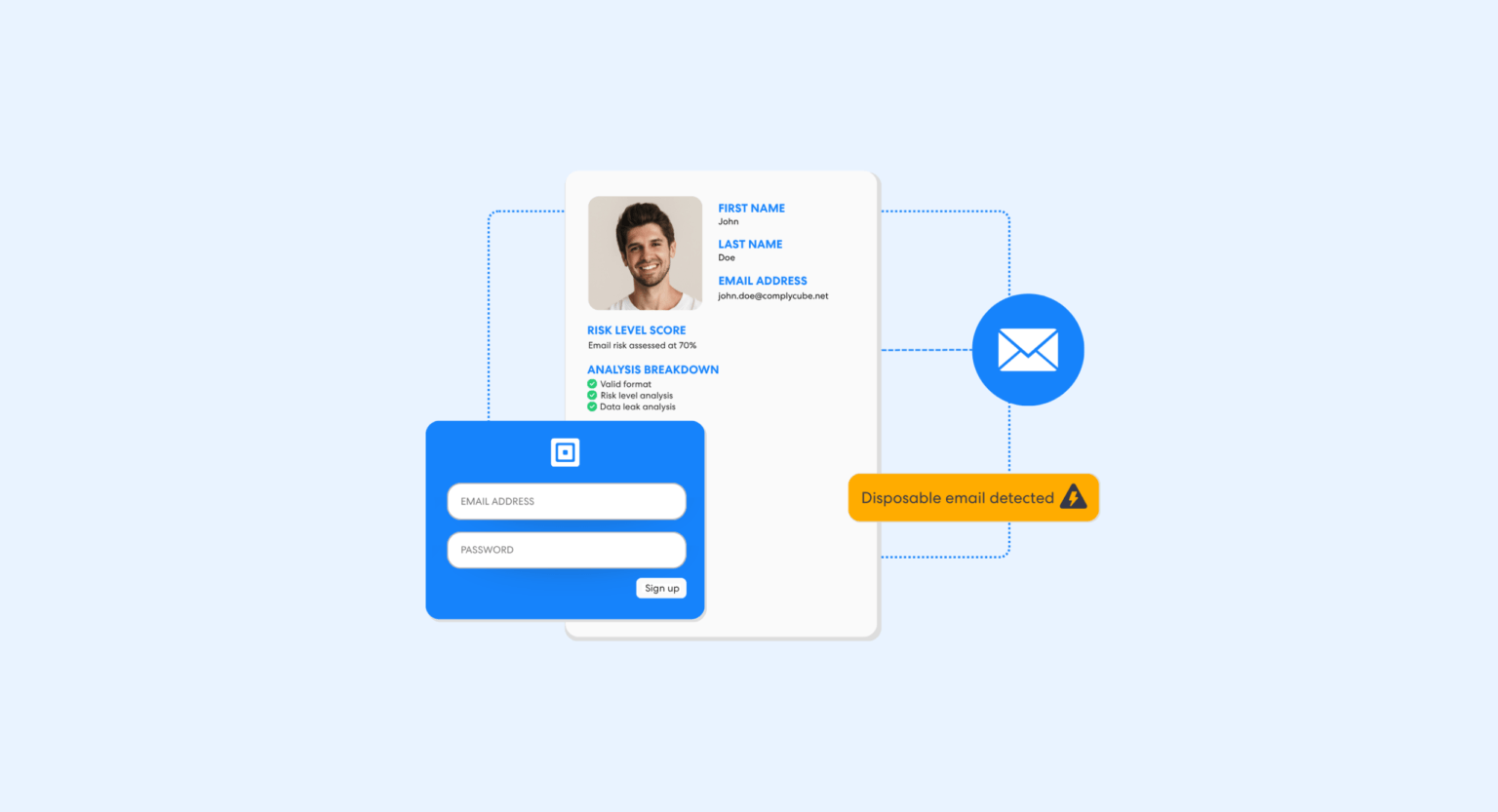
What is Email Risk?
Today, most online journeys start with an email address. People often use it to create social media accounts, confirm access, receive updates, or communicate with businesses and individuals. With over 4.7 billion email users globally, email is one of the most common identifiers. However, email goes beyond just the address. For many fraud, compliance, and security teams, it offers insights or additional context about the person, account or business behind a transaction. Email risk measures how likely an email address is in connection to suspicious, fraudulent, or high-risk activity.
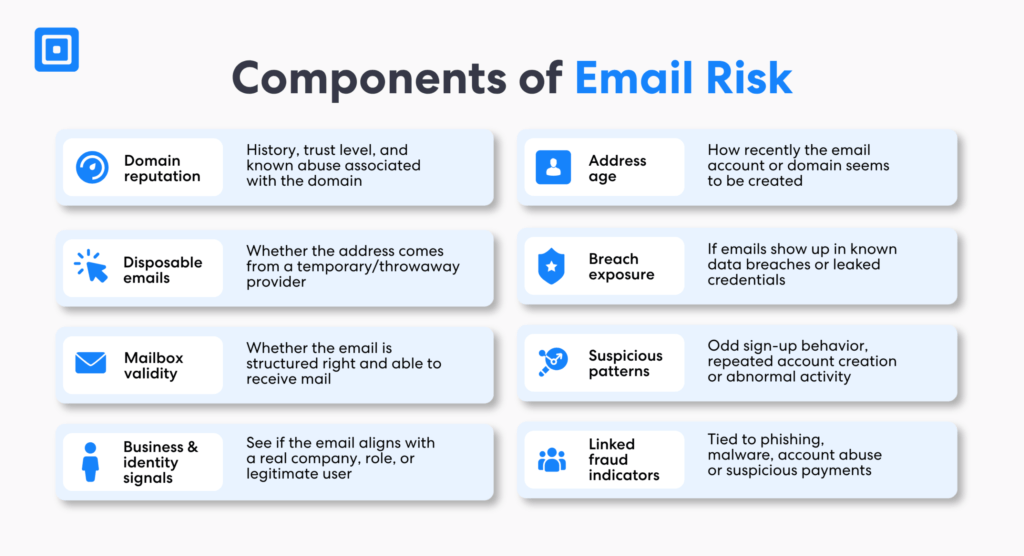
For instance, risky emails can come from a disposable inbox, a domain with less history, or a business email with weak signals. These addresses may also connect to phishing, malware, account abuse, or suspicious access attempts. However, this does not mean every odd email is fraud. A new domain may belong to a valid company or job title, while a low profile online for a user may simply indicate that they value privacy. It is important to make a commitment to not judge risks from one data point, but rather a fuller picture from behind the email.
Learning More about Email Identity
This is where email intelligence comes in. It is the practice of implementing data analysis and collection specific to email addresses, mail activity, and other wider fraud indictors. It determines if an email log should be trusted. So, instead of looking into whether an email is valid, an email risk assessment asks about the information revealed about the user, account, or businesses behind it.
This includes information about domain reputation, suspicious usage patterns, and breach exposure. Additionally, email intelligence helps teams understand if a company domain, recipient pattern, or communication network looks consistent with legitimate activity. This is especially important for providers handling onboarding, payments, or regulated services. If a business can determine email risk early, they can prevent fraud right away.
The Email Fraud Environment Has Changed Email Security
In the past, most users associated email risk to clicking on the wrong link in chain mail or other obvious spam from fake accounts. Now, email sits at the centre of many different threats such as account takeover, ransomware, and payment fraud.
Email is not just a communication channel, it’s a common thread.
Solutions Consultant at ComplyCube, Milosh Caunhye, states, “The same email can be used to make fake accounts, launch phishing attempts, or redirect payments”. This makes email one of the earliest risk signals for businesses everywhere. Moreover, people are also more susceptible of fake account creation and business email compromise. Some examples of email fraud are:
- Disposable inboxes: Fraudsters use a disposable inbox setup to create “throwaway” email addresses to conduct scams anonymously.
- Bots: Automated programs are used to test stolen credentials from legitimate users to use across multiple platforms and trick people out of money or data.
- Malicious links: Employees and customers alike are targeted by phishing emails where criminals pretend to be trusted organizations or individuals.
- Ransomware: Software that blocks access to your device or data using encryption and in turn demands a payment or threaten to leak data.
How Email Risk Scoring Reduces Risk
To reduce risk and vulnerabilities, companies must implement email risk scoring. Today, an email address is an early fraud signal. Email risk scoring assigns a risk level based on many different signals instead of relying on a single check.
Fraud prevention services assess transaction risks associated with email addresses before a user are subject to the more sensitive aspects of the customer journey. For example, with email risk scoring, a low-risk email can go through a streamlined onboarding flow. Teams can route higher-risk emails into monitoring, manual review, or blocked access.
According to a report by AtData, disposable email domain rates had fraud rates that exceeded 70% across several industries. Email addresses created just days before a transaction were 25 times more likely to be linked to fraud. These email risk scoring signals are powerful indicators when looked at alongside wider risk analysis.
Email Verification vs. Email Intelligence
There is an important distinction between email verification and email intelligence. Often confused, they solve completely different issues. Verification looks at whether or not an email is valid where email intelligence goes even further. Email intelligence assesses whether an email address deserves trust by analyzing suspicious behavior and possible links to abuse.
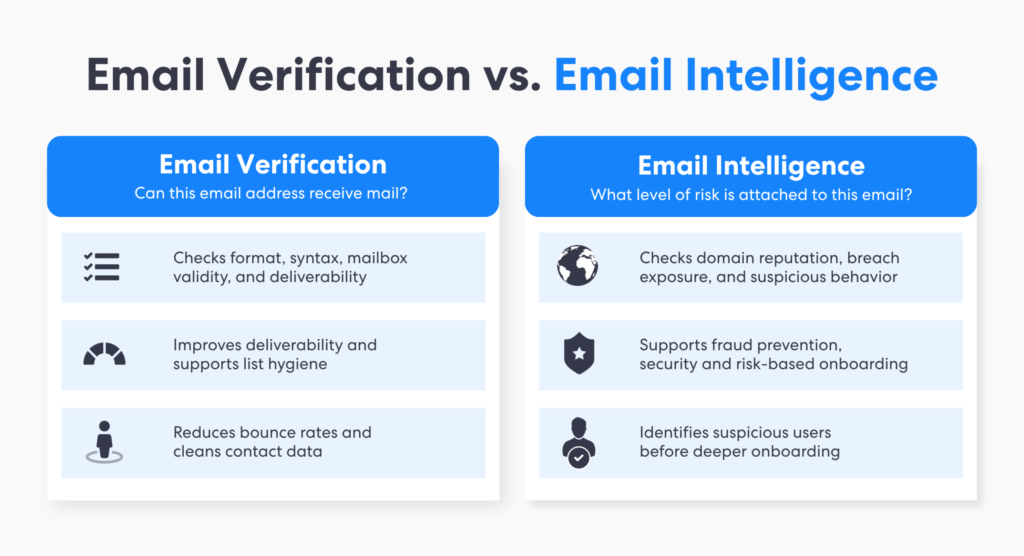
This matters due simply to the fact that a fraudster does not need an invalid email address to add friction. They only need an email that helps them move through onboarding, claim a promotion, test stolen credentials or get access to something before the business has enough context to respond.
Prevent Fraud in Email Intelligence Use Cases
However, email intelligence is only valuable when companies need to learn about user risk at an early stage. For example, in fintech and payments, this solution can help find fake accounts and search for suspicious activity before users access high-risk services.
Similarly in crypto, email risk assessments support onboarding by flagging emails, domains or risky accounts before a user can trade, deposit, or remove funds. On the other hand, in marketplaces and digital platforms, email risk scoring can help find repeat offenders, fake sellers, fraudulent buyers, or users looking to return under new account details.
How The Right Tools Improve Email Intelligence
In regulated industries such as fintech, crypto, and marketplaces, using the right tools can improve email security. By using artificial intelligence or machine learning, email intelligence can analyze large volumes of addresses, domains, account, and behavioral data. You can learn more here: Why Identity Verification AI is Crucial
These types of technology can find patterns or attacks that are far too difficult for human teams or analysts to find through manual review. It matters because fraud changes fast. Rules that are in place now, might not work tomorrow. AI can improve accuracy, speed up response, and help more efficient risk decisions.
How Email Intelligence Builds Email Data Security
The most important component here is that email intelligence helps build email data security. It supports businesses make better decisions earlier in the onboarding process. Not only can it confirm if an email address is valid, but it can determine if emails carry risk.
Additionally, it helps businesses avoid two common mistakes, under-screening and over-screening. The first easily allows risky users to move through the journey before being flagged. The second forces every customers including low-risk users through a friction-heavy process. Putting in email intelligence controls helps teams find the right balance between both. Trusted users will be able to move faster, while suspicious individuals receive added checks.
Key Takeaways
The purpose of email intelligence is to turn an email address into an early risk signal for fraud prevention.
Email risk scoring supports businesses with approving, challenging, monitoring, or blocking a user.
Email risk assessment looks deeper into disposable emails, fake account abuse, and phishing risks.
Using artificial intelligence and machine learning can help with pattern analysis and detecting risk at scale.
ComplyCube’s email intelligence helps prevent fraud earlier while keeping onboarding seamless.
Verify Email Identities with ComplyCube
Organizations need email intelligence in order to assess risk as part of a larger identity verification and fraud prevention strategy. By analyzing various signals such as domain validity, disposability, and digital risk indicators, they generate and assign an email risk score. Email risk assessments and scoring provides clear insight into if an email is linked to a real user. From here, businesses can build much smarter workflows depending on risk level. To learn how ComplyCube can help verify email identities, get in touch with our team today to learn the value of email intelligence.

Frequently Asked Questions
What is email intelligence?
Email intelligence analyzes email addresses by looking at their domain signals, breach history, and other related data points such as date of opening to country of origin to assess trustworthiness and overall fraud risk.
What is email risk scoring?
Email risk scoring or email risk assessment assigns a risk level to an email address based on factors such as domain reputation, address age, breach exposure, disposability, and suspicious behavior.
What is email risk assessment used for?
Email risk assessments are often used to find out whether an email address may be linked to fake account creation, account takeover, phishing, bonus abuse, payment fraud, or other malicious activity.
How does AI improve email intelligence?
Artificial Intelligence (AI) improves email intelligence by analyzing large volumes of email, domain, account, and behavioral data to identify patterns, predict risk, and trigger automated actions during signup.
How does ComplyCube’s Email Intelligence help businesses?
ComplyCube’s email intelligence software solution helps businesses assess email risk in real time. It looks at signals such as domain validity, breach history, disposability, and other digital risk indicators to prevent fraud.