TL;DR: A biometric verification API links biometric checks such as face matching and liveness to a much wider identity verification journey. This guide shows how compliance and engineering teams can request evidence, understand what to test, and learn the warning signs before selecting a provider for a biometric check.
Trusting in a Biometric Verification API
An account can be opened from anywhere. A customer can take a picture of their document, take a quick selfie, and get approval just moments later. To them, the experience is effortless. Yet behind that interaction, there are many difficult questions being answered by the system.
A biometric verification system assesses document authenticity, facial features, and liveness. They check for clear signs of manipulation. Once those signals are reviewed, compliance and engineering teams need to decide if there is enough confidence to allow the customer to move to account creation or account recovery.
A flashy presentation about feature availability can say a lot of things. It can show an API returns a result, but it does not show why that result can be trusted. For compliance officers, they need to understand if the decision can be understood, governed, or defended during an audit. Engineering teams need to understand if the technology can be integrated securely, operate reliably, and recoverable when something goes wrong.
Industry leaders must not buy biometrics APIs based on a polished demonstration from any one provider because it is incredibly risky. The best place to start is by understanding what a biometric verification API does and what it proves.
What Is a Biometric Verification API?
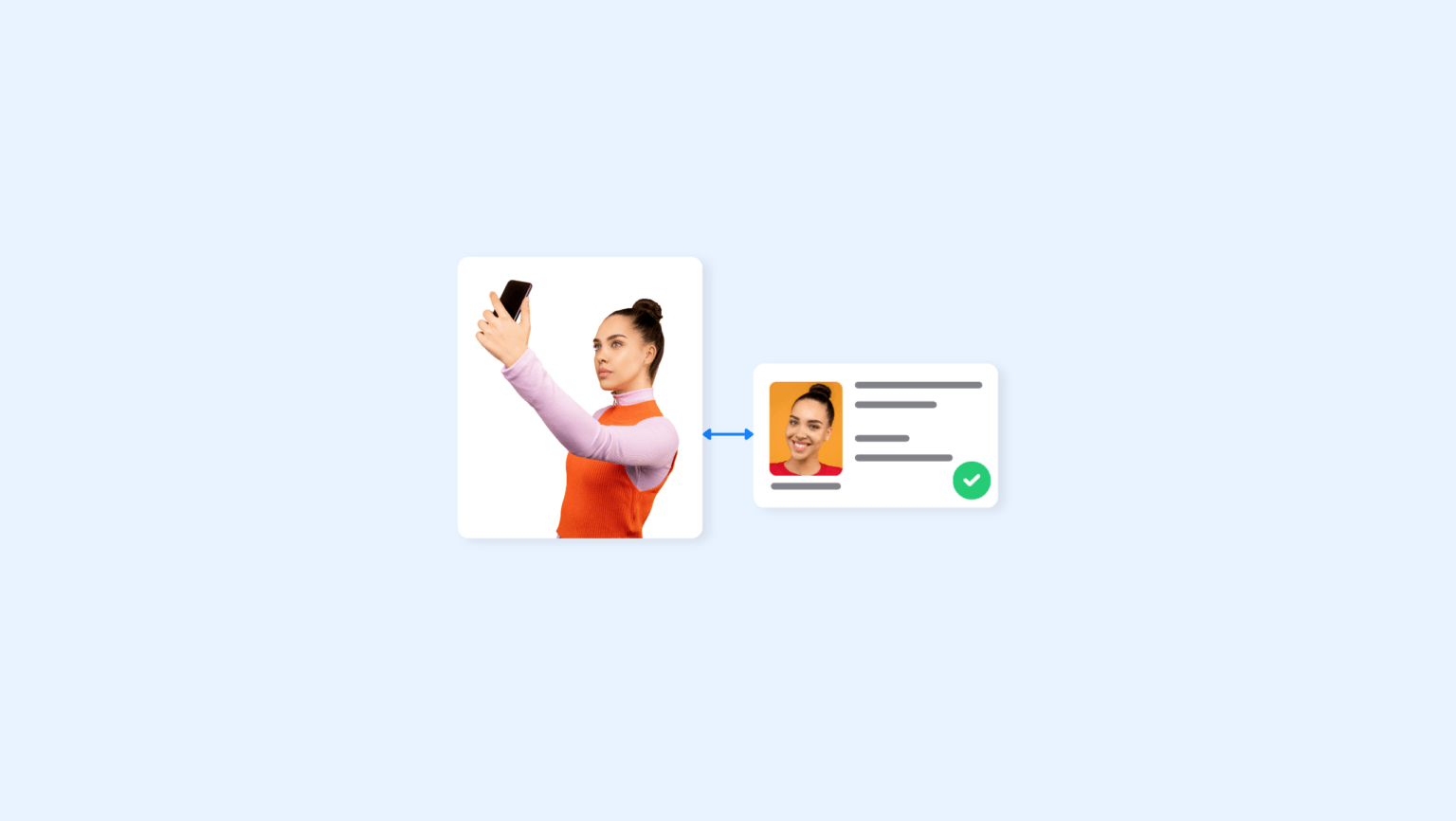
A biometric verification API helps an application compare biometric characteristics such as face images, voice recognition, or other biometric modalities with a trusted reference point. The purpose is to establish that they belong to the same person. For remote facial verification, a trusted reference often looks like a portrait that is extracted from an identity document. Facial verification is common because most users can provide a facial sample using a camera-equipped device.
In identity and access-control contexts, biometric verification refers to a one-to-one comparison between a live biometric sample and a previously provided reference. The system is often trying to determine if the person who filled out the application is the same as the one whose identity is being presented.
Face Verification vs Face Recognition API
It is important to note that the terminology around biometric verification APIs is often confusing. Face verification is not the same as face recognition even though they are used broadly. There are two types of facial biometric identification:
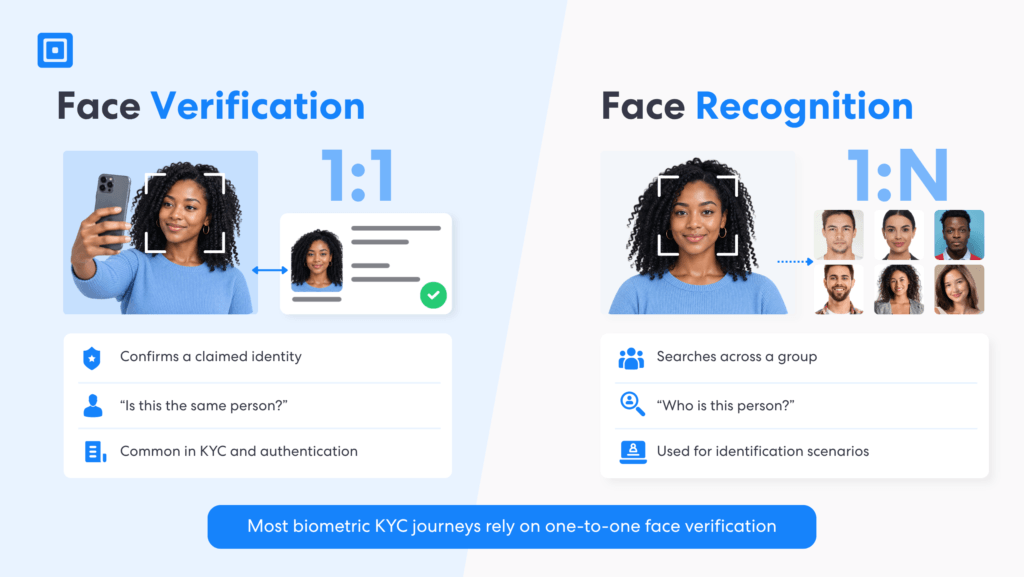
- Verification: A live capture might be compared with the portrait contained in the passport supplied.
- Recognition: A live capture is checked against various biometric templates from the larger population.
Though both sit under cloud-based face recognition, they help with completely different problems. Identification and verification often lead to the wrong technology being assessed together. Additionally, there is another distinction between authentication and verification. Though verification is associated with establishing someone’s identity, authentication is about re-establishing if a returning person is the same as the person who was previously enrolled.
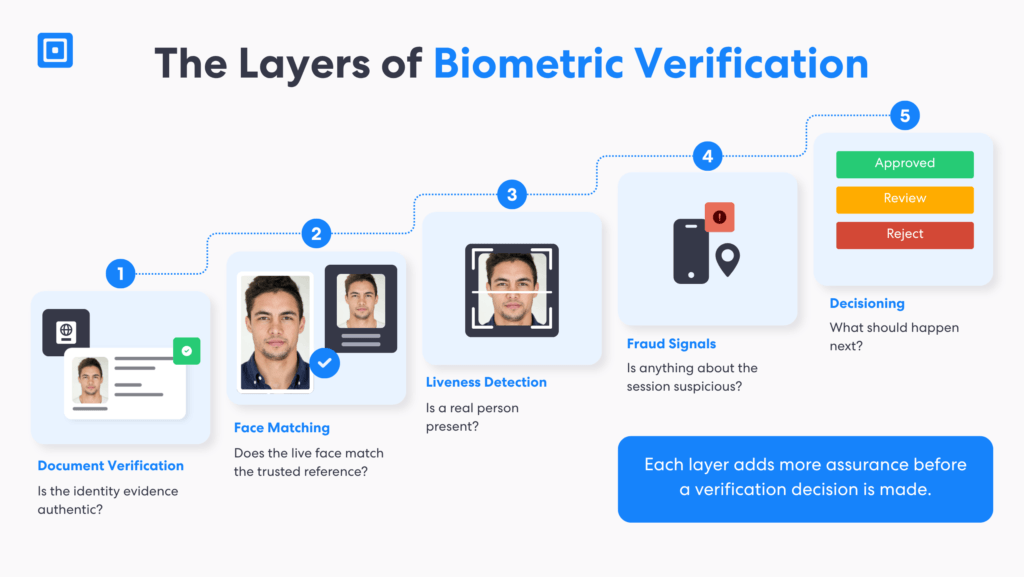
A biometric verification API can support both types of journeys, but it is only one part of identity assurance. There are many points at which fraud can happen. For example, someone’s face could match a document portrait, but the document could be fraudulent. This is why biometric verification is much more useful when considered as a connected set of controls instead of a one-time face-matching event.
How Does a Biometric Verification API Work?
There is no such thing as an “isolated” biometric check between the user opening their phone camera all the way through to receiving a decision. There are many processes that would likely happen sequentially or in parallel.
Reference and Capture
Often, verification needs something trusted to compare against. During identity onboarding processes, systems extract an image from a passport, driving license, or identity card. In biometric authentication, the reference point may come from a previously verified enrollment. The user then provides a new biometric sample such as a selfie or video.
Quality Assessment and Feature Extraction
However, before matching begins, the biometric verification system needs to understand if the sample is usable. There are many factors that can impact the sample such as poor lighting, unusual positioning, obstruction, and low image quality. The process behind these advanced algorithms is much more intricate than comparing two pictures pixel by pixel.
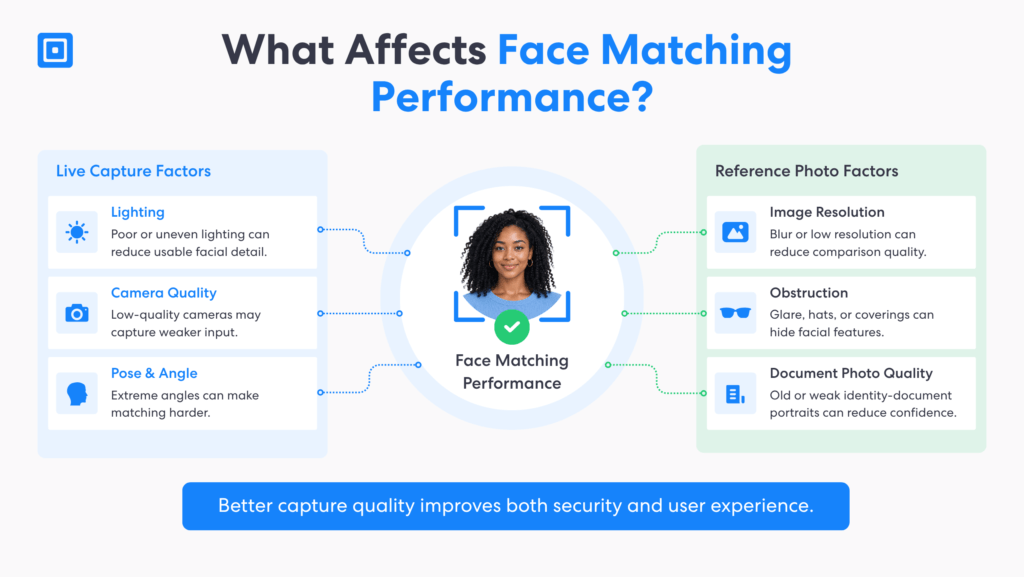
Many biometric recognition systems extract specific characteristics from the capture and create a machine-readable representation that can be compared with the reference. The UK’s Information Commissioner’s Office (ICO) describes biometric recognition as automated recognition using biological or behavioral characteristics. Where biometric data is processed to uniquely identify someone, the ICO treats it as special-category biometric data under UK data-protection rules.
Face Matching and Thresholds
At this point, the live biometric sample will be compared with the trusted reference. The system then At this point, the live biometric sample will be compared with the trusted reference. The system then generates a similarity score. Also known as a confidence score, it assesses the score against an operating threshold.
This threshold is incredibly important because biometric matching is not binary.
Liveness and Capture Integrity
A high facial similarity is not certifiable proof that a real person is physically taking part in the onboarding journey. Attackers and fraudsters can attempt to use a printed photo, screen replay, or mask. In some cases, they also use sophisticated spoofing attempts with synthetic videos or other manipulated input.
This is where liveness and Presentation Attack Detection (PAD) play a crucial role. It helps assess if an attack is being presented to the capture sensor. These techniques help find defined presentation attacks, and depending on the system and test scope, certain forms of manipulated or artificially generated input.
Decisioning
The last step is arriving at a decision once the verification results come through. One organization might automatically approve a strong result. Another might blend biometrics with document, device, or other fraud signals to meet compliance requirements before arriving at a decision.
Many uncertain customer journeys will be retried, escalated for additional verification, or referred for manual review. The biometric verification API’s real value is not just returning a face-match score. It is enabling a business to make a controlled identity decision from multiple pieces of evidence.
What Each Identity Verification API Check Proves
Every check must be assessed based on what it actually establishes and what is outside of the scope. This is one of the most important considerations in biometric procurement for secure and seamless verification.
This is why face matching on its own is not true identity verification. The Financial Action Task Force (FATF) digital identity guidance makes a similar point at a broader level. They believe that regulated organizations must understand whatever assurance is given by a digital identity system.
Similarly for EU financial institutions, the European Banking Authority (EBA) expects firms that use remote onboarding to review the reliability of all of the tools that they choose. They must understand how well each tool performs. Once customers understand what each check is meant to do, the next step is to understand how those controls stand up against the attacks they are designed to detect.
Evaluating Liveness and Presentation Attack Resistance
The next hurdle is understanding whether the camera is capturing the person in real time. That is the point of liveness detection. According to the European Network and Information Security Agency (ENISA), photo attacks, user-video replay, and 3D masks, as well as deepfake or replay attacks, are the most serious threats that face remote facial identity-proofing systems.
Liveness detection helps determine the difference between a real-life capture and a presentation attack. For Know Your Customer (KYC) and remote onboarding, it plays an important role. High accuracy in face matching does not provide assurance if an attacker can control what the system sees. There are two common approaches to liveness detection:
Active Liveness Detection
Active liveness detection needs intentional interaction from the user. People may need to do specific actions such as turn their head, blink, or follow another instruction. Some processes need users to alter their expression or complete another type of challenge.
These techniques provide additional evidence that someone is physically interacting with the whole capture process. However, every instruction brings in a layer of friction. If the journey becomes incredibly difficult for no reason, legitimate users may abandon verification, especially if they have difficulties because of their device, environment, or accessibility requirements.
Passive Liveness
On the flip side, passive liveness works without needing the customer to deliberately complete a challenge. This analysis happens during the whole capture process, allowing an experience closer to ordinary selfie verification. This makes passive liveness detection incredibly helpful for high-volume customer journeys where seamless experiences matter.
However, passive does not automatically mean secure. Buyers must ask which attacks have been tested and how biometric verification API technology performs in various environments. Verification platforms need to show what happens if their processes cannot arrive at a confident conclusion.
What Does ISO/IEC 30107-3 Establish?
ISO/IEC 30107-3:2023 sets out principles and methods for testing or reporting a system’s PAD protocols as well as their performance. This is valuable evidence. It is incredibly important to understand its limits.
This ISO focuses on presentation attacks that occur at the biometric capture device. A great example is when an attacker presents a photograph, replayed video, or mask to the sensor. Any other system-level assessment and other attack routes will sit outside the scope. This makes the next part of the buyer assessment critical.
Injection Attacks, Deepfakes, and Capture Integrity in Facial Biometrics
If at any point, content is being injected into the camera during the capture process, it is considered an injection attack. This includes any case where attackers bypass cameras, or introduce a recorded or generated stream that appears to come from that camera. Typically, a presentation attack takes place in front of the sensor. On the other hand, an injection attack manipulates what enters the verification pipeline.
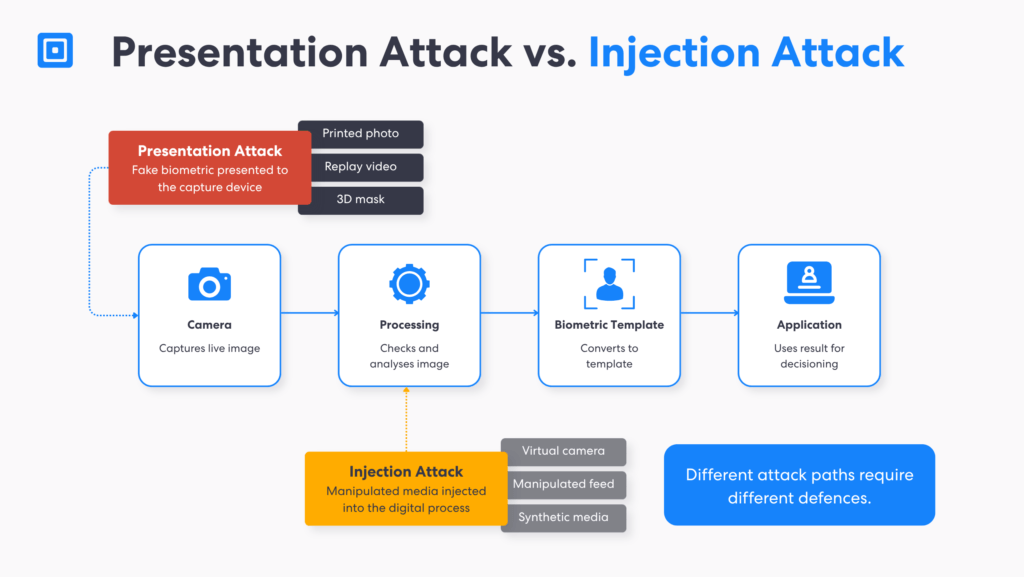
This distinction is important because PAD testing gives evidence about defined presentation attacks within the tested configuration. It should not be treated as evidence that the wider capture pipeline is protected against all injection, malware, deepfake, emulator, or account takeover scenarios.
The specification from the European Telecommunications Standards Institute (ETSI) distinguishes presentation attacks from injection attacks. It also includes requirements related to recorded or AI-generated video streams.
Evidence to Request for Secure and Seamless Verification
It is important to ask providers of identity verification APIs what evidence they can provide. Asking questions about an SDK, capture source, and session integrity helps enhance security and fraud detection. It helps confirm how suspicious signals can influence the final identity decision. Teams must look for evidence about:
- Presentation attacks
- Injection attacks
- Recorded and artificially generated media
- Capture-source integrity
- The SDK or product version that is being tested
- How suspicious signals impact downstream decisioning
Here is where a Presentation Attack Detection (PAD) test is incredibly valuable. It should not be stretched beyond the deployment model that it actually tests. This helps detect deepfakes and provide robust security in the Biometric Verification API process. You can learn more here: Presentation Attack Detection: A Comprehensive Guide
Biometric Verification APIs for Compliance Teams
Compliance teams need not understand the mathematics inside every biometric model or liveness checks. They must know if the organization can rely on the evidence provided and understand if it supports the identity decision.
For many UK organizations, biometric data that has been processed to identify a person receives special protection under UK data-protection laws. They need to identify a lawful basis under Article 6 and a separate condition under Article 9 of the UK General Data Protection Regulation (GDPR). This means they must be able to assess data residency or location, international transfers, retention, access, and deletion as separate governance considerations.
The UK Digital Verification Services (DVS) Trust Framework requires relevant providers to explain which Good Practice Guide (GPG) 45 requirements that their service must support. They also need to outline how the service communicates failure reasons. Buyers must ask for evidence instead of relying on a general statement that a platform is just “GPG 45” compliant.
Compliance teams must understand which biometric data is collected, why it is needed, and where it is processed or stored. They also need to outline who can access it, any applicable subprocessors, as well as retention and deletion controls. This is crucial when auditability becomes important.
For example, if a customer challenges an identity decision six months later, the compliance team should be able to reconstruct what happened. The product configuration should enable compliance teams to see exactly which checks happened, what their outcomes were, and if a journey was approved, failed, or escalated to manual review. For most compliance teams, the ability to explain their decision-making is a practical buying criterion instead of a technical luxury item.
Biometric Verification APIs for Engineering Teams
For engineering teams, their journey begins when many product demos end. Today, a strong biometric match says little about what happens when technical issues arise. For example, what is the protocol when a network disappears halfway through a sample capture process?
The integration of biometric verification APIs can vary depending on the model that the developers are putting in place. Implementation time can depend on many variables and can change based on deployment model. Buyers must ask biometric verification API providers for a realistic timeline for a thorough rollout.
Most product demos do not explain how the verification retries will work or what happens when a webhook fails. Many engineering teams are also keen to understand how biometric verification API versions are managed. Strong integrations need predictable responses with clear error handling and secure authentication. Engineers want to understand more about observability, versioning, and rate controls.
The Open Worldwide Application Security Project, also known as OWASP, highlights many risks for engineering teams such as broken authentication, broken object-level authorization, unrestricted resource consumption, and improper API inventory management. Security cannot begin and end with the biometric algorithm.
How to Assess Customer Experience and Operational Performance
Security is often only half of a remote identity journey. The system needs to let real customers prove who they are. This means that compliance, engineering and product teams must evaluate operational performance together. It is important to measure the entire journey and understand some useful metrics such as completion rate, verification time, and abandonment.
If these metrics are measured against representative users and realistic operating conditions, teams will have a good sense of the key features of a biometric verification API. The verification experience that is seamless on the newest smartphone may look and act completely differently on older hardware, poor connectivity or difficult lighting.
Another part to assess is the recovery process. At some point during the onboarding process, users might experience a loss of connection, move out of frame, or upload a poor image resulting in a failed first attempt. Some users may even close the journey and return later on. This is a regular part of the verification process. It is important then for systems to have four types of journeys:
- Successful: Does the standard journey work well?
- Failed: Is there a next step for a real failure?
- Interrupted: Can the user recover without any additional friction?
- Suspicious: Are risk controls responding when the behavior needs it?
Case Study: Remote Identity Verification in the UK
Most applicants to the EU Settlement Scheme need to confirm their identity remotely for the UK Home Office. Their goal is to be able to confirm their identity without routinely posting identity documents or travelling to an office. Their service needs to work across many consumer devices while keeping any other alternative routes accessible for users.
Reading Biometric Identity Documents to Access Control
Some apps, such as the EU Exit: ID Document Check app, allow applicants to use Near-Field-Communication (NFC) enabled devices to access certain supported biometric documents. This allows users to prove their identity completely remotely. These systems validates supported documents remotely, while post and in-person processes remain available.
Outcomes
- 95% of users successfully used the EU Exit App to prove their identity remotely.
- 75% were able to complete the identity proofing process in under 10 minutes.
- These document checks came from 987 devices across 92 different manufacturers.
What Does a Biometric Verification API Really Cost?
The price of a REST API only tells part of the story of KYC flows. A usage-based commercial model may charge per biometric verification, face authentication, completed workflow, or individual checks. However, operational costs can add up through retries, additional customer support, manual review, and alternative verification routes.
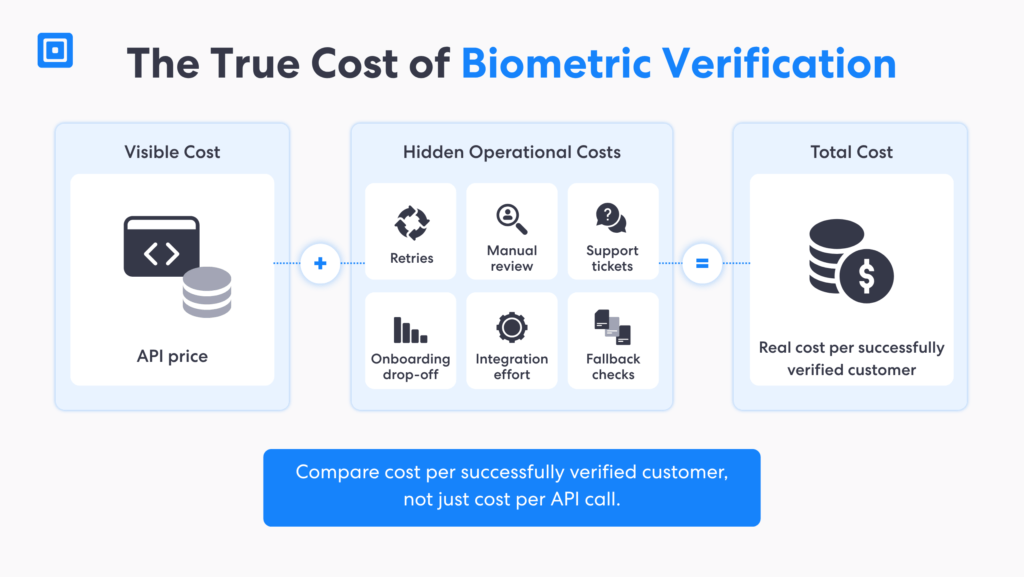
It is necessary to start with the visible charges, then look at implementation, and finally consider operations. Each one of those parts of the journey can change the economics of a biometric verification API. Both compliance and engineering teams must look at what it takes to successfully verify a customer. You can learn more here: Top 5 Biometric Fraud Detection Platforms of 2026
A better measure of success is the cost per successfully verified customer. The verification should also meet the assurance level required for the organization’s use case. It is important to include lost conversion, because the value of a lost customer can vary dramatically between businesses.
Biometric Verification API Buyer Checklist
Before the whole procurement process closes, it is the responsibility of the compliance and engineering teams to be able to answer a couple of questions about their biometric verification API. They need to have these in place before granting access to users in the verification process. They need to be able to answer the following:
- Facial biometrics and face matching: How does biometric performance hold up? What thresholds are they measured at for your company or organization? What similarity or confidence thresholds are they matched at? What false-positives and false-negative rates are readily available?
- Liveness detection in fraud prevention: Does this platform offer active liveness, passive liveness, or both? Which manipulation risks is the provider’s security architecture able to manage?
- Document verification for identity evidence: In what ways does document verification link to selfie verification and face comparison? Can the system show if a person has the same credentials as the real holder?
- API and onboarding deployment: Are the necessary APIs, SDKs, hosted, and webhook options available to us? How do authentication, retries, and duplicate events work? Does the system consider user timeouts, process versioning, and abrupt service interruptions?
- Biometric data, security, and compliance: Where is data stored, and how does it move from the capture stage all the way through to deletion? Which retention tools, safeguards, and restrictions are available to us? Where does the data reside, and what are the platform’s audit capabilities? Does it meet international data protection standards?
- Operational performance: How does the platform support genuine customers who cannot complete a biometric check? What does the retry process look like? Can they move to another verification or enter a review process without starting their session all over again?
The whole objective for engineering and compliance teams is not to buy the strongest biometric algorithm, but rather to build a strong verification process. They want to make fraudulent access virtually impossible without making real users hard to verify. The pilot version of the system must try to break the journey by testing every possible issue. Only considering successful users is not truly testing the product capabilities.
Key Takeaways
- A biometric verification API must show identity similarity and genuine presence.
- The wider security model looks at manipulations across the data capture chain.
- Face matching must account for false matches, image quality, and performance.
- Biometric data needs controls for processing, security, retention, and deletion.
- The best identity verification has compliance assurance, controls, fraud prevention and a seamless customer experience.
Biometric Verification APIs Built for Real-World Identity Risk
In short, biometric verification APIs work best when many different processes such as document verification, face matching, security, and decisioning operate as one connected process. ComplyCube is designed around that same principle. ComplyCube’s web SDK supports document and selfie capture, including biometric liveness capabilities, and capture-quality checks on the biometric samples that users take.
If you are evaluating biometric verification for your own onboarding or authentication journey, explore ComplyCube’s biometric verification API. Get in touch with our team to discuss assurance, fraud, and integration requirements that your team needs to solve.

Frequently Asked Questions
What makes biometric verification reliable for KYC?
Strong biometric verification blends trusted identity evidence, facial matching, and liveness detection. Systems also look at capture integrity and the appropriate fraud controls. Teams need to understand thresholds and what happens when verification is not clear. No singular biometric score must carry the entire KYC process.
Why is liveness detection important?
Liveness detection can help determine whether a biometric capture comes from a real person instead of a photo, replay, or any other form of presentation attack. Active methods include user interaction, and passive methods happen behind the scenes of a normal capture. It also must address manipulation elsewhere in the capture chain.
What is the difference between face verification and face recognition?
Face verification is normally a one-to-one comparison between a current biometric sample and a previously known reference template. On the other hand, face recognition describes a one-to-many comparison across a larger subset of biometric templates. Remote KYC uses one-to-one verification to figure out if the person presenting matches their claimed identity.
How should biometric data be protected?
Any collected biometric data must be securely transmitted, protected in storage, and retained for a specific purpose and period of time. Biometric verification API buyers need to examine their protocols around data deletion, access controls, sub-processors, and auditability. Any applicable privacy requirements completely depend on their respective jurisdiction and processing purpose.
How does ComplyCube support biometric verification?
ComplyCube’s award-winning biometric verification API brings facial biometrics, liveness detection, and document verification. Today, businesses can build biometric verification into a much wider KYC workflow instead of treating facial comparison as a standalone check. It allows teams to have a connected approach to secure remote verification.