
TL;DR: On 1 October 2026, the new right to work legislation comes into force. This is one of the biggest changes in workforce compliance in the UK in recent years. This article shows what changes with the 2026 right to work legislation, why the reforms matter, and how employers, contractors, and digital identity providers should prepare for UK right to work changes.
The Biggest UK Right to Work Legislation Reform in Years
Most coverage of the reforms has focused on the importance of expanded right to work checks, tougher civil penalties, or the inclusion of more working arrangements. However, this is only part of the bigger picture. The biggest change is how organisations are expected to demonstrate compliance.
The reforms place greater emphasis on evidencing compliance through stronger record-keeping, greater accountability, and the use of trusted digital identity verification when carrying out checks. As a result, many employers are revisiting long-established hiring processes rather than making a few administrative tweaks.
Additionally, the consequences of getting this wrong have also grown. Home Office enforcement is focused on demonstrating whether organisations followed the correct verification process rather than simply whether documents were collected. Employers that knowingly employ someone without the right to work may also face criminal sanctions, temporary business closure notices, or the loss of their sponsor licence under certain circumstances. These risks apply to large organisations and basically any business of every size that is looking to recruit or engage workers in the UK.
What is Right to Work Legislation in the UK?
Although the phrase “right to work” has different meanings in different countries, in the UK it refers to immigration compliance and an employer’s legal duty to verify that an individual has permission to work. The number one goal of the UK’s right to work legislation is to stop illegal working. This legislation requires employers to verify that every individual has the legal right to work before their employment period starts. You can learn more here: Employer’s Guide to Proof of Right to Work in UK with Certified IDSPs
The basis of the current UK government framework stems from Asylum and Immigration Act 1996, the subsequent amendments in the Immigration, Asylum and Nationality Act 2006 as well as the Immigration Act 2014. Together, these Acts and the latest Home Office guidance form the foundation of the UK’s right to work regime.
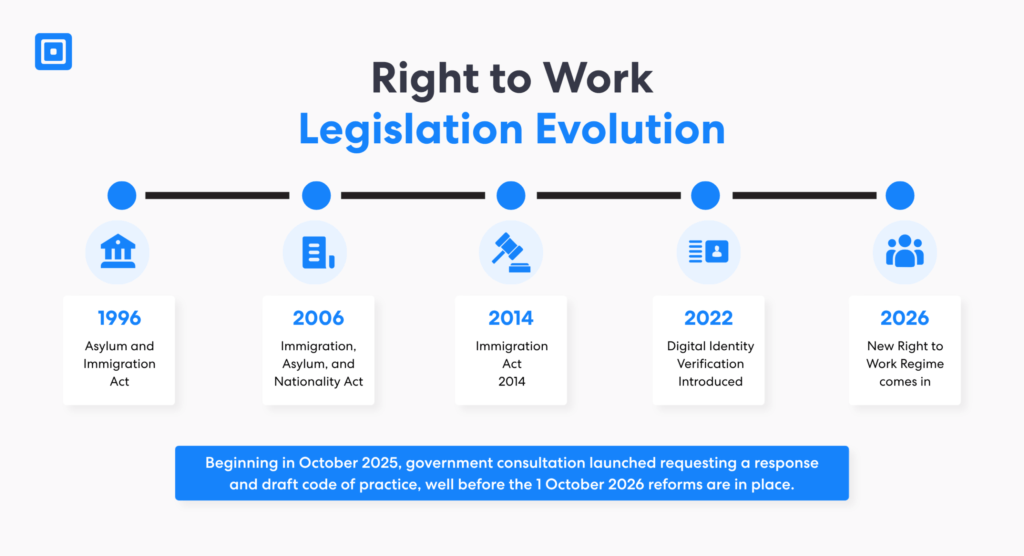
The legislation gives employers a thorough legal defence, also known as a statutory excuse. This protects employers from civil penalty liabilities if they carry out compliant right to work checks before employment begins They also must retain evidence for the necessary period. Without that statutory excuse, employers may become liable if an individual is later found to have been working illegally. Right now, there are three recognised ways to complete right to work checks:
- Employers can conduct online Home Office checks for eligible individuals such as non-British nationals.
- A digital identity verification route using an approved Identity Service Provider (IDSP).
- Manual checks using acceptable documents where digital or online routes are not available.
Although these routes already exist, the UK right to work changes taking effect will significantly expand the scope of the rules and who they apply to.
Why Is The Government Updating Right to Work Legislation?
Many organisations no longer rely solely on traditional employment relationships. Moreover, with flexible hiring, agency work, outsourcing and digital labour platforms, the UK’s labour market is dramatically changing. Employers now engage workers through complex contractual arrangements, outsourced teams, and labour supply chains. This creates new challenges in identifying a person’s immigration status and maintaining consistent work compliance with right to work.
The Home Office recently published figures showing more than 17,483 visits, and made more than 12,322 arrests between July 2024 and December 2025. This helps explain why the UK government is extending this regime now. The UK government believes existing legislation is not a reflection of how people actually deliver services today.
These changes close gaps in the current framework.
Alex Norris MP, The Minister for Border Security and Asylum went on to say that the 2026 right to work legislation updates, “…ensure that responsibility of illegal working sits appropriately across modern labour market structures.” The updated rules give enforcement agencies more visibility into a broader range of working arrangements.
The UK Home Office consulted employers and other stakeholders around how the scheme should extend into gig work and other working arrangements. This also supports wider government priorities around border security, reducing illegal working, tackling exploitation, and strengthening confidence in digital identity services.
What Actually Changes in Right to Work Legislation on 1 October 2026?
Some of the new UK right to work changes in October 2026 focus on expanding the scope of those who need proof of a right to work. Other updates aim to strengthen compliance enforcement or further modernise digital verification journeys as part of the right to work process.
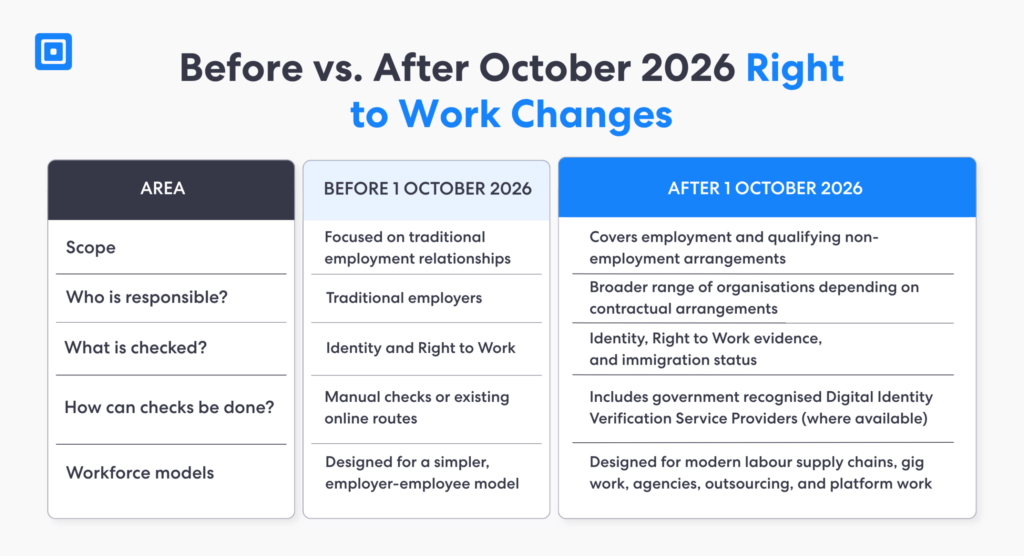
However, when looking at these UK right to work changes together, it seriously points towards a huge shift. The Home Office guidance is looking for organizations to move away from basic document checking to evidence-based workforce compliance.
The Scope of the Right to Work Legislation Are Expanding
One of the most significant reforms is the expansion of who falls within the right to work regime. In the past, organisations often linked compliance with the recruitment of employees. However from October onwards, certain non-employment working arrangements are now subject to right to work legislation where there is a direct contractual relationship.
Contractors, subcontractors, and specialist service providers play a more crucial role in the delivery of business operations. The government’s intention is to ensure compliance keeps up with those changing workforce models instead of allowing responsibility to disappear through more layered contractual structures.
Enforcement Is Becoming More Aggressive About Non-Compliance
With the new rules, if employers fail to conduct compliant right to work checks, they can face civil penalties of up to £60,000 per illegal worker. This is potentially alongside criminal sanctions where illegal working is carried out knowingly. Businesses may also risk losing sponsor licenses or facing temporary closure notices in serious cases.
Those penalties are intended to encourage organisations to treat workforce verification as an ongoing governance issue rather than a one-time onboarding task. But interestingly, stronger penalties are not the bigger story. The most important point is how the UK government expects organisations to prove that they have in fact, done the right thing.
Why Digital Verification Suddenly Matters
As more recruitment takes place remotely, employers need reliable ways to verify identity before employment begins. Yet, at the same time, organisations are expected to complete compliant right to work checks before employment starts, while maintaining evidence. Employers establish a statutory excuse by carrying out compliant checks before employment begins and retaining evidence that can be relied upon if challenged later.
Manual checks remain an important verification route where digital or online checks are not available. This is particularly important where digital or online routes are available. With hiring moving more online, the UK government has recognised that digital identity verification must also meet a consistent trusted standard. However, who decides if a digital identity check is trustworthy?
Why Trusted Digital Verification Matters
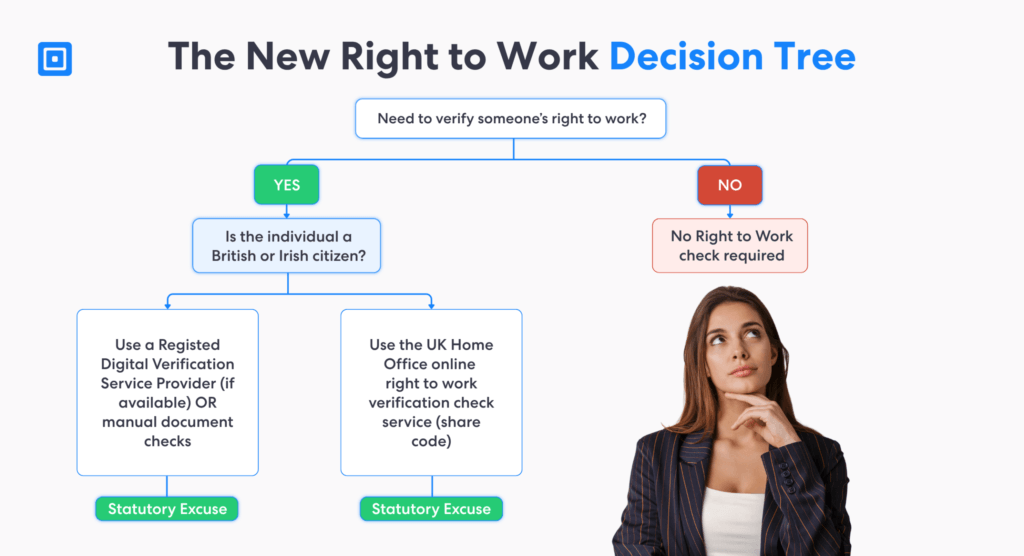
To support secure digital identity verification, the UK government has established the UK Digital Identity and Attributes Trust Framework (UK DIATF). Providers assessed against this framework can offer compliant digital right to work checks for eligible individuals. For eligible British and Irish citizens, employers can use a Digital Verification Service Provider (DVSP) to complete digital UK right to work checks. This route is only available where the provider has been assessed against the UK government’s trust framework and is authorised to perform these checks.
However, this is an important distinction. Purchasing identity verification software alone is not enough. The whole digital verification process must line up with the standards that are set out by the UK government to support compliance. Keeping up with regulatory standards is a necessary part of an organisation’s full compliance strategy.
Government Registration Is Now a Legal Requirement
Employers using digital verification should confirm that their provider is authorised to perform compliant right to work checks under the UK government’s framework. In order to perform UK digital right to work checks under the government framework according to updated guidance, a service provider must be recognised under the UK DIATF. Government recognition provides employers with greater assurance that a provider meets the required standards for identity proofing, fraud detection, governance, and record keeping.
The framework is intended to create greater consistency across employers, labour supply chains, and digital identity providers. When employers use an authorised provider and follow the prescribed process for initial checks, the resulting evidence can help establish a statutory excuse.
When evaluating an identity verification provider, organisations should consider compliance capabilities alongside implementation, user experience, scalability, and ongoing support. However, the reforms introduce another important consideration. Now, they must also check whether their provider supports compliance with the latest Home Office guidance.
Why Certified Identity Profiles Matter for Right to Work Legislation
Typically, government recognition confirms that an identity verification provider has met the required baseline needs. However, organisations need to consider how many certified identity profiles that provider can support. A certified identity profile is a structured combination of identity checks and evidence scores under UK government guidelines. This provides a specific level of identity assurance.
Different organisations or even different worker journeys need different profiles depending on the verification scenario. Most providers often support a small number of certified profiles which might be suitable for some and not others. An IDSP with a much wider range of profile coverage gives employers much greater flexibility to provide consistent digital onboarding. This covers different worker populations without switching verification methods for follow-up checks or repeat checks.
Case Study: Recent Home Office Enforcement Statistics
Recent Home Office enforcement data illustrates the scale of ongoing compliance activity. From the period of 1 October to 31 December 2025, Home Office enforcement powers recorded 525 civil penalties and identified 620 illegal workers without either pre-settled status or settled status through the EU settlement scheme. As a result, they issued penalties with a combined value of £26.47 million.
Stronger legislation backed by stronger enforcement and civil penalties
Under the new UK right to work changes, employers need to complete compliant checks around working status before employment begins. Organisations are also required to retain records including physical documents for at least two years after employment ends. This helps build a valid statutory excuse through the prescribed work procedures for new and existing contracts.
Outcomes
- 525 civil penalties issued by the Home Office in one quarter.
- 620 illegal workers identified during enforcement activity.
- £26.47 million in gross civil penalties, illustrating the financial impact of non-compliance.
Preparing for The New Rules Enforcement on 1 October 2026
As the rules apply, the reforms go beyond updating a policy or revising an onboarding checklist. Enforcement actions depend truly on whether the check was completed using the correct process, with the correct evidence, and recognised verification methods.
For many employers, the 2026 right to work legislation creates an opportunity. Companies and organisations have the chance to modernise their verification processes. This makes those work schemes better positioned to change and grow as regulations evolve rather than amending every time new guidance is published. There are five steps to take to prepare for the October 2026 right to work reforms:
1. Review your workforce, not just your employees.
Map every individual carrying or providing services to your organisations. According to employment law, this includes contractors, consultants, agency workers, and outsourced teams with worker’s contracts. This updated right to work legislation addresses a broader range of working arrangements. Understanding the workforce model is the right first step towards understanding your obligations.
2. Revisit your verification procedures.
Confirm when manual checks, Home Office online checks, and digital verification should be used. Each verification route has its own requirements. This includes share codes, expiry dates, etc. As a result, applying the wrong process can completely undermine your statutory excuse.
3. Strengthen your record-keeping.
It is important for an online matching service or employer checking service to carry out compliant right to work checks. Employers should retain verification records in accordance with Home Office guidance. This includes the evidence of how the check was completed and whether it took place within the grace period.
4. Evaluate your identity service provider.
If digital identity verification forms part of the onboarding process your online matching service provides, it is important to ensure that your provider is authorised for compliant digital right to work checks in the UK. This can support verification journeys as needed in the future that your organisation requires.
5. Prepare for future change.
These UK right to work changes are unlikely to be the final iteration of the country’s digital identity landscape. Building flexible verification processes today will make any future legislation changes or modifications much easier to accommodate for organisations everywhere.
Choosing the Right Digital Verification Service Provider
It is important to choose the right IDSP for digital verification as it becomes more linked to compliance strategies. It requires more than comparing basic features or overall implementation times. Employers should assess if an IDSP supports any long-term goals or objectives for the organisation. They should also consider the overall direction of UK right to work changes. Ask some important questions to determine if a provider is right for you:
- Is the provider authorised to support digital Right to Work checks as recognised by the government?
- How many certified identity profiles do they support in their verifications?
- Can they provide evidence for supporting a statutory excuse?
- How quickly do they adapt to or implement changes according to Home Office guidance updates?
- Can they support future needs or requirements without huge disruption to services?
These types of assessment questions help move the conversation beyond technology and towards a more resilient compliance strategy. This is an increasingly important consideration as UK right to work legislation requirements continue to evolve over time.
Key Takeaways
- The 2026 reforms expand Right to Work obligations beyond traditional employment.
Digital identity verification is now a core part of modern workforce compliance.
Government-recognized IDSPs play a crucial part in compliant digital checks.
Certified identity profiles can directly affect how organisations onboard different worker types.
Preparing helps employers build verification processes that remain resilient as regulation evolves.
How ComplyCube Supports The New Right to Work Landscape
As workforce verification continues shifting towards trusted digital identity, choosing the right provider becomes a long-term compliance investment rather than a short-term implementation. ComplyCube is a government registered DVSP. They are authorised to support compliant digital right to work checks under the UK DIATF. Moreover, they support 23 certified identity profiles, one of the broadest certified profile portfolios available in today’s market.
So whether your organisation is reviewing existing onboarding processes or preparing for the upcoming UK right to work changes, our team can help you build a verification strategy that is ready for what’s next. Learn how ComplyCube can help prepare for right to work legislation changes in October 2026.

Frequently Asked Questions
Do the October 2026 right to work legislation changes apply only to employers?
No. October 2026 right to work legislation changes include certain qualifying non-employment working arrangements. Whether the legislation applies depends on the nature of the contractual relationship and if there is relevant Home Office guidance.
Can employers still carry out manual Right to Work checks?
Yes. Manual checks often remain a valid verification route where appropriate. Employers need to ensure they review and retain the correct physical documents in accordance with Home Office guidance. They may also require a manual check to be reviewed and recorded to establish a statutory excuse.
What is a Digital Verification Service Provider?
A Digital Verification Service Provider also known as DVSP is an organisation that is authorised to perform compliant digital identity verification for eligible Right to Work checks. This is updated terminology that replaces Identity Service Provider (IDSP) under the UK DIATF.
Why do certified identity profiles matter?
Certified identity profiles define how identity is verified and the level of confidence that can be achieved with acceptable proof. Maintaining a much wider or broader range of certified identity profiles can create room for more verification scenarios while keeping up with UK government standards.
Why does ComplyCube support 23 certified identity profiles?
ComplyCube has invested in supporting on the UK’s broadest portfolio of certified identity profiles because organisations rarely have the same verification requirements. These profiles help employers take reasonable steps to deliver more consistent, compliant, and scalable journeys.