
👋 Welcome to July’s CryptoCubed edition. This month, regulators are under pressure to respond faster and more effectively to growing crypto fraud and crime. We explore the formal Dunamu sanctions proceedings, the global crypto scam seizures in the U.S., the alleged $14.8M crypto pool fraud by Argent Management, and more.
The latest cases highlight why KYC, device intelligence, and cross-functional escalation are no longer optional. Unpack the key crypto developments below.
More than $25M Detained in Global Crypto Scam
United States, July 21, 2026 🇺🇸: The U.S. Cyber Fraud Task Force seized over $25 million in cryptocurrency through five separate investigations into international fraud schemes. These investigations are still ongoing, and they include romance, investment, and recovery scams.
Reports by the U.S. Attorney’s Office for the District of Columbia suggest that the five cases were traced back to alleged money laundering networks operating mainly in Southeast Asia. Interestingly, not all those cases were reported by victims.
In one case, a private-sector partner reported to authorities on multiple suspicious transactions it saw. In another, Canadian authorities informed Secret Service agents about large suspicious virtual currency wallet addresses that were transferring illegal proceeds.
Compliance Takeaway:
For crypto companies, successful KYC signals should not be translated to genuine transactions. Fraudsters can easily manipulate users to transfer funds. Instead, controls must assess behavior, payment, and counterparty signals. Additionally, device intelligence should be used, as it can expose VPN usage, IP risks, and account-access changes that cannot be identified with KYC alone.
For more information, click here.
Dunamu Enter Sanctions Review After $30M Hack
South Korea, July 19, 2026 🇰🇷: South Korea’s Financial Supervisory Service (FSS) enacts a formal sanction review against Dunamu, the operator of the leading crypto exchange, Upbit. The proceedings followed a ₩44.5 billion (USD $30M) wallet breach that happened in November 2025.
The FSS sent Dunamu an inspection report following its seven-month-long investigation into the company. Interestingly, South Korea’s current crypto laws do not specify clear penalties against crypto firms for security breaches.
Now, regulators will examine whether Dunamu’s wallet-security controls, incident response, and disclosure practices meet the required standards. This case could encourage South Korea to introduce clearer penalties and security requirements for crypto firms.
Compliance Takeaway:
A wallet breach can turn into a wider AML and sanctions problem if stolen funds move through exchanges or high-risk criminal networks. As such, businesses operating in the crypto space are recommended to feed cybersecurity alerts into AML and sanctions monitoring, so stolen assets can be identified, escalated, and disclosed at a unified pace.
For more information, click here.
US CFTC Alleges $14.8M in Crypto Pool Fraud
United States, July 7, 2026, 🇺🇸: The Commodity Futures Trading Commission (CFTC) sues Argent Capital Management and its founder, Trevor Vernon, for allegedly raising $14.8 million from more than 60 investors through an unregistered commodity pool.
Complaints from investors showed that over $8.6 million was lost through trading. Despite this, they received emails and statements from the company that showed profits that supposedly did not exist.
The CFTC also suspects that over $3 million that was returned to investors replicated Ponzi-type payments rather than genuine investment returns. Vernon claimed the funds were profitable despite having zero supporting records to prove his point.
Compliance takeaway
Regulated businesses should verify that investment managers are registered and that independent records can support returns. This prevents firms such as Argent Capital from using personal accounts and false performance statements to conceal losses and access financial services.
For more information, click here.
Persistent Financial Crime Risk Despite Travel Rule Adoption
Global, July 16, 2026 🌍: The latest report from the Financial Action Task Force (FATF) shows a promising outcome: 83% of surveyed jurisdictions have enacted the Travel Rule, up from 73% last year. Additionally, 11 other jurisdictions have implementation underway.
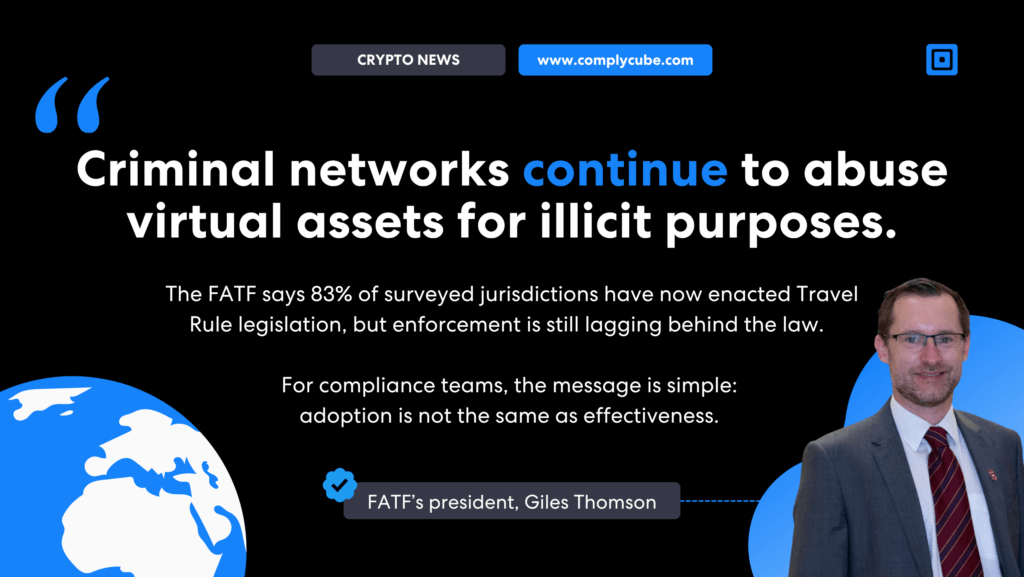
However, the FATF notes that legislation is still outpacing enforcement. Many jurisdictions struggle to effectively identify, supervise, and take action against Virtual Asset Providers (VASPs) that breach Travel Rules.
Criminal networks continue to abuse virtual assets for illicit purposes.
The introduction of the Travel Rule means VASPs can capture, retain, and report information about specified originator and beneficiary information alongside virtual-asset transfers. FATF’s president, Giles Thomson, mentions, “This year’s targeted update makes clear that criminal networks continue to abuse virtual assets for illicit purposes.”
Compliance Takeaway:
The FATF is shifting Travel Rule adoption from legislation to operational effectiveness. VASPs and financial institutions must prioritize demonstrable accuracy in customer data and how it is used to inform risk decisions. This means moving away from just applying and instead on how businesses can identify, review, and investigate suspicious activity related to sanctioned or high-risk activity.
For more information, click here.
Australia’s VASP Regime Reaches Final Registration Window
Australia, July 2026, 🇦🇺: By July 29th, virtual-asset services must enroll and register with the Australian Transaction Reports and Analysis Center (AUSTRAC). Failure to apply can lead to limitations in operations and service offerings.
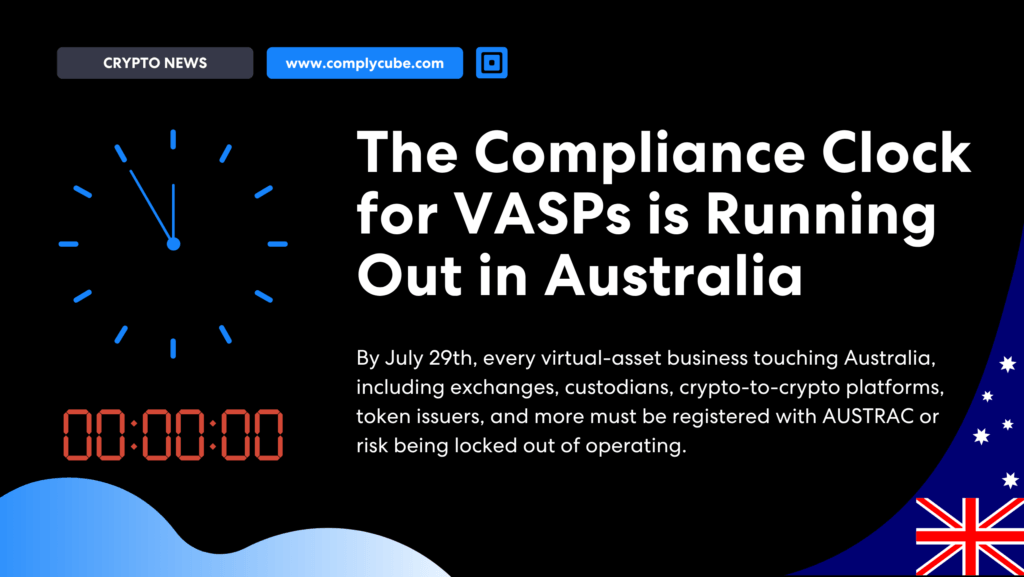
Australia’s reforms expand its previous regime beyond digital currency exchanges. The wider scope now includes crypto-to-crypto exchanges, virtual-asset transfers, custody and private-key management, and certain token-offering services.
As such, more crypto businesses now fall under Australia’s AML and CTF law; this means more rigorous requirements around identity verification, transaction monitoring, and suspicious activity reporting mechanisms. The intended outcome is to close further regulatory gaps that criminals exploit to move assets through crypto-to-crypto platforms, custodians, or transfer services with less scrutiny.
Compliance takeaway
For VASPs, it’s crucial to move away from treating AUSTRAC registration as a one-off. Instead, firms need to demonstrate a strong AML/CTF program, risk assessment, and suspicious-matter reporting controls. Applicants are encouraged to provide details such as ownership, key personnel, business activities, relevant overseas operations, and how they manage money laundering risks.
For more information, click here.
Time for Some Light-Hearted Creative Criticism?
So you’ve made it to the end of our newsletter. It’s time to enjoy a little satire, worthy reader, you’ve earned it.
🔥THE CRYPTO CUBED POEM: JULY🔥
Scams hide through illegal crypto flows,
Allowing stolen funds to move fast and low.
But strong controls can help us see,
The risks that KYC may miss.
Watch the patterns, trace the trail,
So fraud and crime are less likely to prevail.
With careful checks and eyes that stay keen,
We make the crypto world safer and clean.
Stay tuned for our August newsletter, and have a great month!