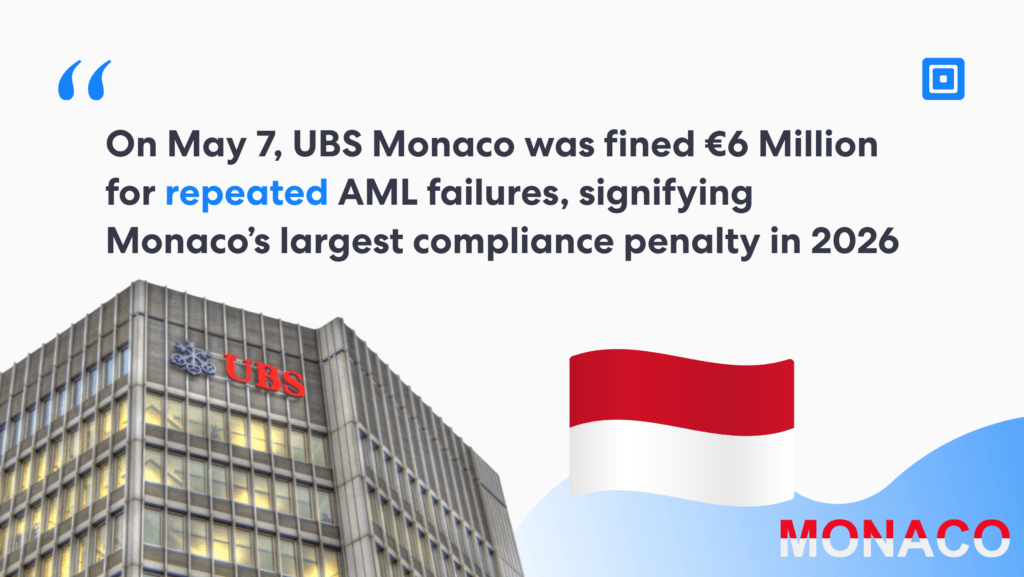
On May 7, 2026, Monaco’s Autorité Monégasque de Sécurité Financière (AMSF) issued the UBS Monaco fine, penalizing the bank €6 million (USD $7 million) for Anti-Money Laundering (AML) failures. UBS Monaco is a small division of UBS Group AG, the leading Swiss global financial services firm.
Fun Fact: The bank’s name, UBS, comes from its historical merger between the Union Bank of Switzerland and the Swiss Bank Corporation in 1998. Following its acquisition of Credit Suisse, UBS Group AG is one of Switzerland’s largest banks, dominating with over 40% of market share.
What Led to the UBS Monaco Fine?
The AMSF is Monaco’s Financial Intelligence Unit that oversees AML and Counter-Terrorist Financing (CTF) compliance. During the investigation, the AMSF found that UBS Monaco breached the country’s AML obligations from 2018 to 2023. The violations included deficiencies in Customer Due Diligence (CDD) and ongoing monitoring processes mandated under Monaco’s regulatory framework.
UBS Monaco repeatedly breached compliance obligations, including:
- Weak source of wealth assessments for high-risk clients
- Failure to identify and verify beneficial ownership in complex corporate structures
- Incomplete Politically Exposed Persons (PEPs) screening in 5 out of 25 reviewed cases
- Insufficient scrutiny of large international transfers across high-risk jurisdictions
The bank also failed to document the nature and purpose of high-risk financial transactions. This is in particular to PEPs with close ties to government entities. This was shocking, as it is a gap that bad actors can exploit easily to move illicit money.
Some notable gaps that led to the multi-million euro fine include:
- Enabling a PEP to make a €6m transaction without comprehensive enhanced due diligence
- Delayed suspicious transaction report by up to 253 days
- Over USD $800,000 were transferred from insufficiently verified real estate firms in Saudi Arabia and Lebanon
- Took on a new client based on old documents and mostly untranslated Russian language, implying a lack of due diligence
Monaco’s Inclusion in the FATF Grey List
The AMSF’s call was a significant move in reinforcing its role in combatting money laundering and other financial crime. This is especially important, since Monaco was listed in the Financial Action’s Task Force (FATF) grey list in 2024 and the European Commision’s high-risk third country list in 2025.
Fun Fact: The grey list was first formalised by the FATF post-2007. The list puts a country under increased monitoring due to strategic deficiencies in AML and CTF controls. Some of the countries included in the grey list in recent years are Bolivia, Kuwait, and Venezuela.
Moreover, the AMSF noted that UBS Monaco was unable to provide them with the required details on the nature and purpose of multiple business relationships, pointing to systematic gaps in its internal audit function. Ultimately, the €6 million fine accompanied reputational consequences, as the AMSF will publish the enforcement decision for up to five years.

Subscribe to ComplyCube’s Trust Edition newsletter, where we explore the top developments across identity verification and AML globally. Plus, we share valuable insights on compliance with the latest regulations.