TL;DR: Database verification supports businesses in verifying an individual without requesting for document uploads. It relies on trusted external sources to verify that a customer is legitimate. This guide explores how identity database checks work and how an automated bureau check helps fast-track secure customer onboarding.
Why is Database Verification Important?
Database verification, also known as multi-bureau verification, is critical because it verifies that a customer or business is genuine. It works by cross-referencing key identity attributes, such as full name or date of birth, against authoritative databases, including credit bureaus and government records. As businesses shift to the digital world, the importance of identity database checks cannot be overlooked.
Database check accelerates time to onboard without sacrificing a high standard of identity assurance.
According to the World Bank’s Global Findex Report, 79% of adults have an account with a bank, financial institution, or mobile money provider. To further illustrate the scale of online services, the GSMA noted over 2 billion registered accounts and 500 million monthly active users of mobile-first financial services in 2024.
As such, companies require remote identity verification methods to verify users more quickly, consistently, and remotely. The Chief of Product at ComplyCube, Harry Varatharasan, echoes this statement. He notes, “Multi-bureau database verification supports this need by remotely validating identity attributes across more than one trusted source. This accelerates time to onboard without sacrificing a high standard of identity assurance.”
How Database Verification Lowers Identity Fraud Risks
While the move towards the digital world has increased convenience and access to online services, it has also seen a negative rise in fraud. For example, the U.S. FBI’s Internet Crime Complaint Center notes the exponential growth of cyber-enabled crime as our lives become more digitally integrated. In 2024, it saw over $16.6 billion in losses, particularly in fraud and ransomware.
Additionally, UK Finance reports a 12% increase in fraud case volumes to 3.31 million in 2024. These statistics highlight the significant scale and impact of fraud across various markets. As a result, firms are increasingly feeling the pressure to strengthen identity checks while maintaining a frictionless online experience for users.
With today’s technology, it can take mere taps on a keyboard to hijack networks, cripple water systems, or even rob virtual exchanges.
Since identity database checks do not require document submission, it also supports inclusion. According to the World Bank, over 800 million people do not have official proof of identity. Database verification supports flexible onboarding flows as it reduces over-reliance on document checks during identity verification. As a result, those excluded from essential online services due to document requirements can instead access them in an alternative, secure manner.
How does Database Verification Work?
Database verification processes involve several core components to cross-check submitted information against these external data sources. The key steps include data collection, matching, and risk-scoring. Modern identity database checks include the use of artificial intelligence and machine learning for an automated process.
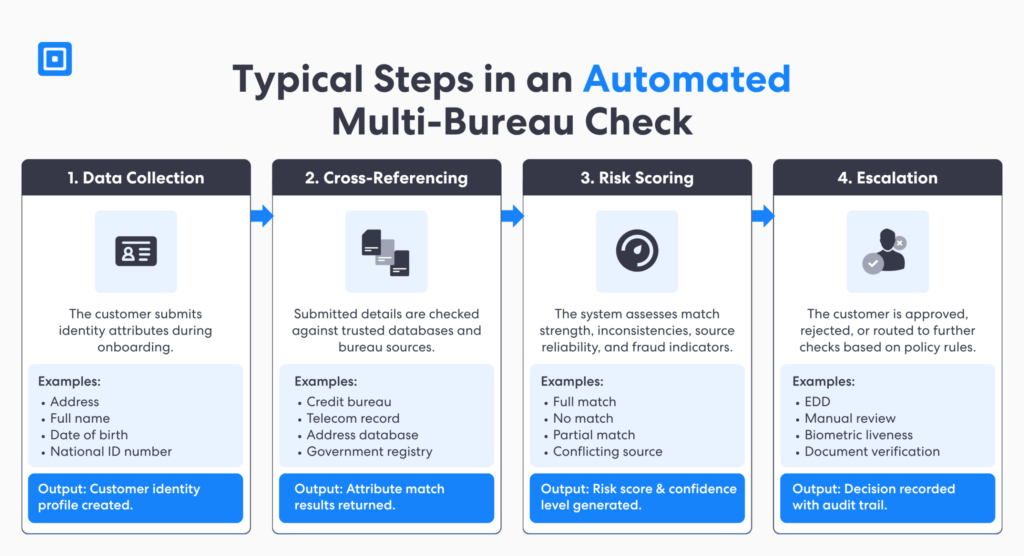
1. Data collection
During the first stage, a customer or entity will submit the relevant identity details required, typically via a form. For customers, common personal identifiers are full name, date of birth, nationality, or address. As for businesses, this may include details such as the company registration number, tax code, or registered address.
2. Cross-Referencing
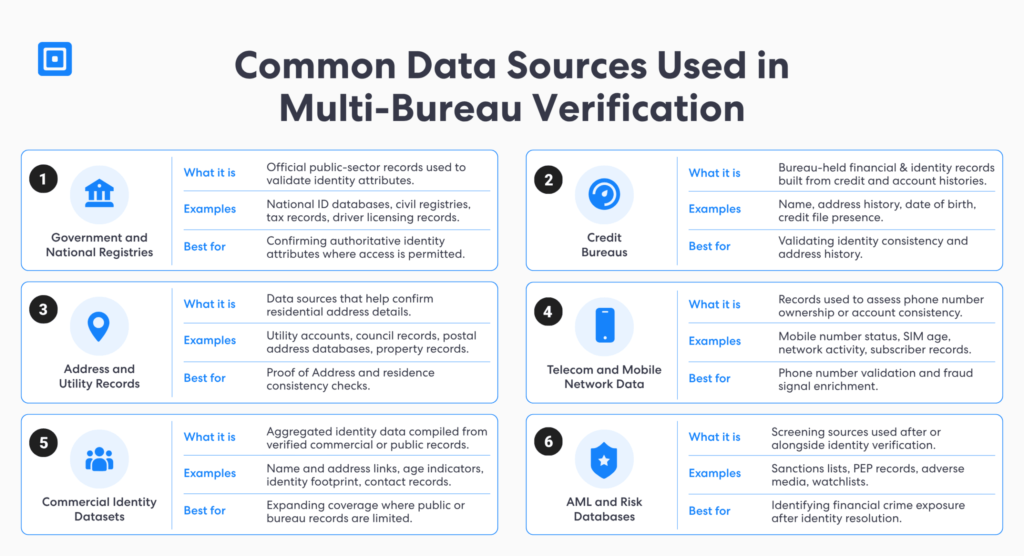
Next, the verification system will run the submitted information through independent, trusted data sources. Some examples are utility or mail agencies, government registries, and credit bureaus. At this stage, hundreds of risk signals are analyzed to identify any inconsistencies in the submission phase that may indicate that an identity is not genuine.
3. Risk-Scoring
According to a business’s risk appetite, match logic will determine the relevance and severity of potential matches identified during screening. This logic includes exact, partial, and fuzzy matching rules that will point to whether a match is a true positive, possible match, or false positive. Based on this assessment, each alert will then be assigned a risk score.
4. Escalation
Lastly, this stage determines the next steps for compliance teams. Alerts that meet predefined risk thresholds are typically escalated for further verification. However, this largely depends on a company’s escalation logic, which details whether an alert will route to human review, enhanced due diligence, or immediate regulator reporting.
In practice, automated database verification offers a streamlined way to reduce customer drop-offs, lower manual effort, and enhance operational efficiency. For example, vendors such as ComplyCube offer businesses the ability to run an accurate, secure, and automated bureau check in under 3 minutes.
Does Database Verification Support AML and KYC Compliance?
Multi-bureau database verification enables businesses to strengthen Know Your Customer (KYC) and Anti-Money Laundering (AML) compliance obligations. For instance, the Financial Action Task Force (FATF) explains how digital IDV can support Customer Due Diligence (CDD) when they are sufficiently reliable, independent, and use a risk-based approach.
A reliable digital ID can make it easier, cheaper, and more secure to identify individuals in the financial sector.
In the U.S., the Customer Identification Program (CIP) rule permits non-document verification, in which customer information is comprehensively cross-referenced against trusted data sources. However, database verification works best as a layered identity verification strategy. For example, firms can expect to detect suspicious mismatches through multi-bureau checks, while biometric verification helps prevent deepfakes. It can also support higher-risk cases, where Enhanced Due Diligence (EDD) is required.
Technological developments and progress in digitalisation can facilitate the remote performance of customer due diligence.
In the EU, Regulation (EU) 2024/1624 recognizes eIDV solutions in secure remote or electronic identification and verification of prospective and existing customers. As such, leading companies integrate other electronic identity verification (eIDV) methods to further support secure, remote, and compliant onboarding. These methods include biometric and liveness checks, device intelligence, and document verification.
Multi-Bureau Verification versus Single-Source Checks
Unlike single-source checks, where a customer’s details are cross-verified against only one data source, multi-bureau checks verify identity attributes across multiple other trusted data sources. As a result, multi-bureau verification increases data coverage and can return higher risk accuracy and security.
Multi-bureau verification also creates a resilient approach to IDV. For instance, if a data source has an outage or is temporarily taken down, multi-bureau can route to other data sources. This eliminates single-source dependency and strengthens risk-based logic.
1+1 versus 2+2 verification
A 2+2 check is a popular term to describe a type of match logic whereby at least two or more identity attributes are compared with at least 2 or more separate data sources. For instance, a customer’s name and address are cross-verified against a telecom agency and government registry. In a 1+1 check, only one identity attribute is matched to one data source.
Why and when to use a 2+2 check?
- Pros: Reduces fraud risks by making it harder for bad actors to falsify two identity details across two unique data sources.
- Cons: Might lead to higher friction during onboarding as it requires more identity data from a customer.
- When to use: Suitable for higher-risk scenarios, such as for regulated businesses or stricter jurisdictions
Why and when to use a 1+1 check?
- Pros: Creates a quicker and more cost-effective onboarding journey due to lower data collection and higher pass rates.
- Cons: Can lead to less defensible fraud controls due to weak evidence, especially if the second identity attribute has been altered.
- When to use: Suitable for lower-risk situations, including opening and accessing low-value accounts or services.
Database Verification versus Electronic Identity Verification Services
Database verification is not a substitute for every eIDV method. Rather, these methods should complement one another. To do this, businesses must map each eIDV method to a firm’s CDD policy. This must include when each method is required, what match thresholds apply, what evidence is retained, and which outcomes trigger EDD or manual review.
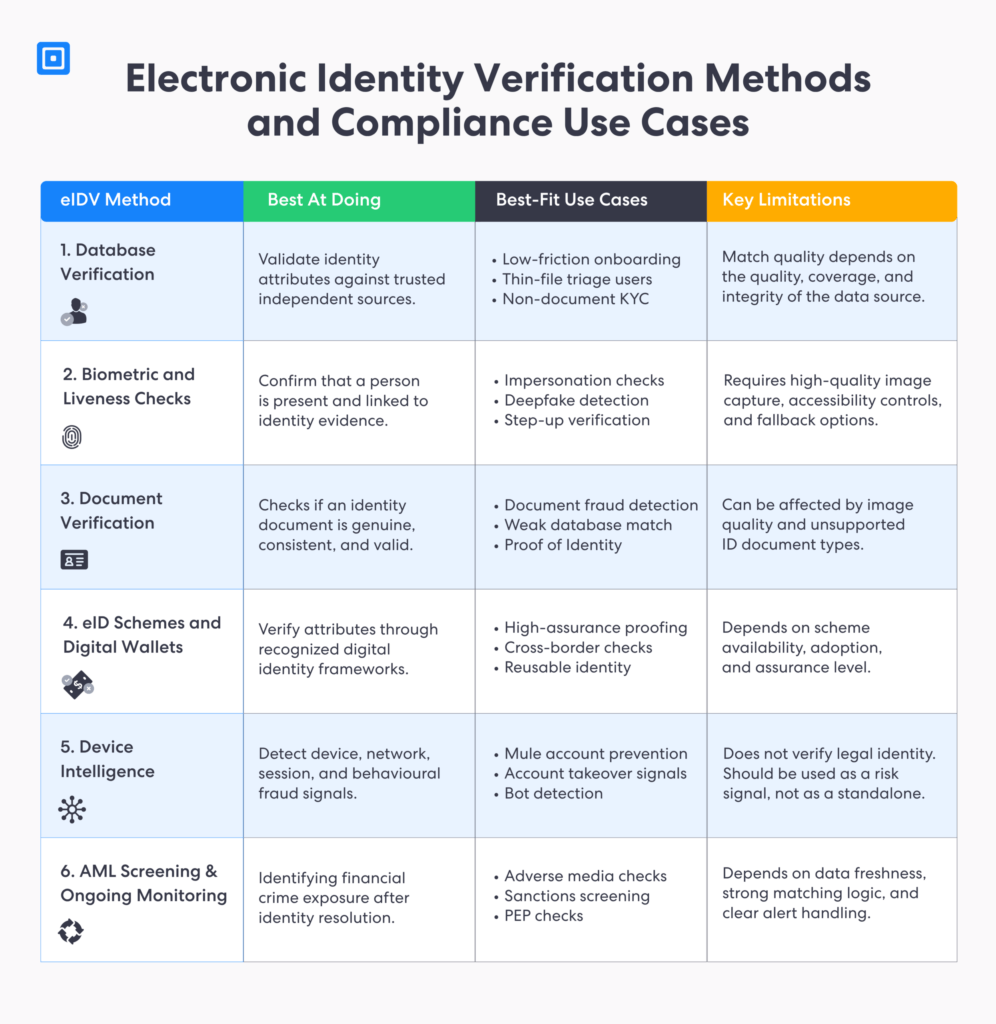
Some of the common eIDV methods and when they should be used include:
1. Biometric and liveness
Biometric checks match a selfie or video against a trusted image, typically in an identity document. Liveness detection confirms that a person is physically present during a session. This includes passive and active liveness checks that distinguishes if a capture is a deepfake, synthetic, or replayed video.
Best used for:
Biometric and liveness verification are crucial in combatting the scale of deepfakes, replayed video, and synthetic identity fraud. It proves that a customer submitting information or accessing a service is a legitimate holder. It addresses the possession and presence risk in remote onboarding.
You can learn more here: Liveness Detection Software for Digital Trust
2. Document verification
Next, document verification combines authenticity, consistency, and template validation to confirm that a document is valid and genuine. It uses advanced technology, including Near Field Communication (NFC) chip reading, to identify tampered, forged, expired, or synthetic documents.
Best used for:
Document fraud represents the backbone of most identity fraud. Document verification can identify tampering of fonts, layouts, and formats in crucial documents, such as bank statements, driver’s licenses, and passports, providing identity evidence beyond self-declared data.
You can learn more here: Document Verification in the End-to-End KYC Process
3. eID schemes and digital wallets
Electronic Identification (eID) schemes are a government-backed form of IDV. It enables firms to authenticate and verify identity attributes through a nationally recognised digital identity framework. Some of the popular schemes include India’s Aadhaar, MitID in Denmark, and BankID in the Nordics.
Best used for:
In the EU, the Electronic Identification, Authentication and Trust Services (eIDAS) is recognized for secure and trusted customer identification. It provides recognized Levels of Assurance (LoA), empowering a risk-based approach to remote CDD.
You can learn more here: A Digital Europe: Introducing the EUDI Wallet
4. Device intelligence
Device intelligence analyzes multiple risk signals such as session velocity, browser integrity, and IP address to identify fraud risks that identity documents might miss. This is particularly crucial for risk detection, ensuring that an onboarding session looks consistent with a genuine customer journey.
Best used for:
For compliance teams, device intelligence solutions detect suspicious patterns and activity linked to a user’s device. A customer may pass a database check using real stolen details, but with device intelligence, it can distinguish if a customer’s device, IP, velocity, or behavioural pattern suggests fraud.
You can learn more here: What is Device Risk Assessment?
5. AML screening and ongoing monitoring
While eIDV confirms identity attributes, AML screening goes beyond to detect if a customer presents a financial crime risk. This includes checking verified customers against sanctions, Politically Exposed Person (PEP), and adverse media lists. Ongoing monitoring detects changes in risks beyond onboarding.
Best used for:
For businesses across regulated markets, a strong AML program must be treated as a separate control to IDV. It focuses on the prevention of money laundering and terrorism financing by analyzing deeper risk signals that can change well after a user or entity onboards.
You can learn more here: The best AML software solution for compliant firms
Case Study: Barclays Scrutinized for Weak AML Controls
In 2025, the UK’s Financial Conduct Authority (FCA) investigated the UK unit of Barclays and whether the bank had violated Anti-Money Laundering (AML) laws. This followed a prior two-year enforcement examination, where authorities reviewed its transaction monitoring controls.
Historical Oversight and Continued Scrutiny
Regulators focused on historical oversight and looking into how high-risk customers were being verified and screened. Later that year, the bank faced enforcement action, amounting to £42 million in fines for financial crime risk management failures.
Outcomes
The case highlights the importance of strengthening and connecting identity verification with AML controls.
- Barclays was fined a combined £42 million, with Barclays Bank PLC fined £39.3 million and its UK unit penalized £3.1 million
- A strong KYC and AML program combines robust database verification solutions with other eIDV methods, such as PEP screening and ongoing monitoring.
How to Choose the Best Multi-Bureau Verification Solutions?
While database verification can contribute to stronger KYC and AML controls, it largely depends on the quality, breadth, and coverage of the data sources. Additionally, auditability and configurability of risk scoring mechanisms are critical to supporting regulatory reporting needs and a risk-based CDD process.
In practice, the best multi-bureau verification solution also depends on an organization’s specific business needs and risk profile. The technical capabilities to look out for include customizable matching and 2+2 match logic. On the other hand, some features to consider to ensure the solution aligns with the business goals are risk appetite and scalability.
Technical factors to consider when choosing the best multi-bureau solution:
- Multiple trusted sources: Use a service with various authoritative data sources, which can include but should not be limited to government registries, commercial databases, and telecom agencies.
- Country and data coverage: Solution must support the jurisdiction where your business operates and where your customers are to remove blind spots.
- False positive reduction: Exact, partial, and fuzzy name matching supports customizable risk tuning thresholds to reduce false positives.
- 2+2 match logic: Offers stronger identity assurance and evidence by verifying two distinct identity details, supporting stronger fraud detection.
- Auditability: Real-time decision logs support stronger and transparent evidence, decisions, and timestamps to meet regulatory reporting needs.
Business factors to consider when choosing the best multi-bureau solution:
- Costs: Map out the cost of automation, budgeting, and how it can reduce long-term manual review in the long-term.
- Risk appetite: Evaluate sector-specific and product risks to indicate what type of risk threshold to tune to.
- Scalability: The solution should be equipped to manage volume spikes or expansion across borders without requiring complex add-ons or weakening risk scoring mechanisms.
- Data privacy rules: To ensure complete compliance, decide to invest in a solution that aligns with high standards of data privacy laws, such as EU GDPR and U.S. NIST.
- Regulatory compliance: Choose the service according to the specific jurisdiction your business requires, as CDD and AML obligations can vary across different markets.
Key Takeaways
Database verification is the process of identity verification by cross-checking a customer’s identity attributes against external, trusted data sources.
The benefits of multi-bureau identity database checks include quicker remote onboarding without the need for document uploads.
A layered electronic identity verification process strengthens KYC compliance by detecting potential fraud via seamless digital methods.
Automated bureau check accelerates cross-verification with multiple data sources, protecting legitimate customers from complex steps.
High-growth businesses across e-commerce, fintech, and banking use identity database checks to reduce drop-offs and enhance customer satisfaction.
Database Verification for Financial Institutions and Regulated Businesses
For companies spanning regulated markets, the benefits of multi-bureau database services cannot be disregarded. It enhances fraud prevention controls while streamlining the onboarding process for customers. Unlike manual IDV, eIDV layers various methods to provide faster and stronger identity confidence. Reach out to ComplyCube to explore the benefits of automated bureau check today.

Frequently Asked Questions
Is database verification the same as a credit check?
No. Database verification is broader than credit checks. Credit checks use credit bureau data to analyze a user’s financial history and creditworthiness. However, database verification focuses on analyzing whether a user is genuine using a broader range of external trusted data sources, not just financial databases.
Can database verification work for customers with no credit history?
Yes. Identity database checks can work for customers with no credit history, as they can use other sources, such as utility files, telecom records, and address databases, for identity verification. Strong database verification sources will depend on country coverage, sources, and data integrity.
Why do regulated companies use multi-bureau checks?
Regulated businesses use multi-bureau checks because they create a stronger defense against AI-powered fraud and account takeover beyond document or biometric verification alone. It validates whether a customer’s identity details exist and are consistent across independent sources.
Does database verification replace document and selfie checks?
No. Database verification, document, and selfie checks should be layered together, rather than treated as substitutes. Identity database checks if a customer’s details exist and if they are consistent across multiple data sources. Document verification helps determine if a document is valid and genuine, while selfie checks confirm a user presenting the identity is present.
How does ComplyCube’s multi-bureau database check support KYC and AML?
ComplyCube’s automated multi-bureau solutions support KYC/AML compliance via secure and trusted identity verification. The company is a certified Identity Service Provider under the UK DIATF framework and aligns with global regulators, such as the FATF, UK FCA, US FinCEN, and UAE TRA. Its database services empower non-document verification, streamlining onboarding.