
TL;DR: Right to work checks for contractors all depend on the working relationships. It is necessary for UK businesses to classify the working engagements before they verify contractor identity and working permissions. Learn how contractor right to work obligations extend to qualifying worker arrangements and individual subcontractors from 1 October 2026.
Right to Work Checks for Contractors Are Important in 2026
UK businesses that are using contractors, subcontractors, and labour providers are facing a very big problem. Sometimes, the person named in the contract may not always be the person who actually does the work. This is especially important when illegal work is discovered.
In 2026, Immigration Enforcement made 7,270 illegal-working visits which resulted in 4,756 arrests. Over 1,200 businesses received civil penalties worth over £74 million and construction visits went up 150% in comparison to the same period in 2025. Today, current civil penalties start from £45,000 per illegal worker for a first breach, and £60,000 for a repeated breach. Knowingly employing someone without the right to work in the UK can result in up to five years in prison and an unlimited number of fines.
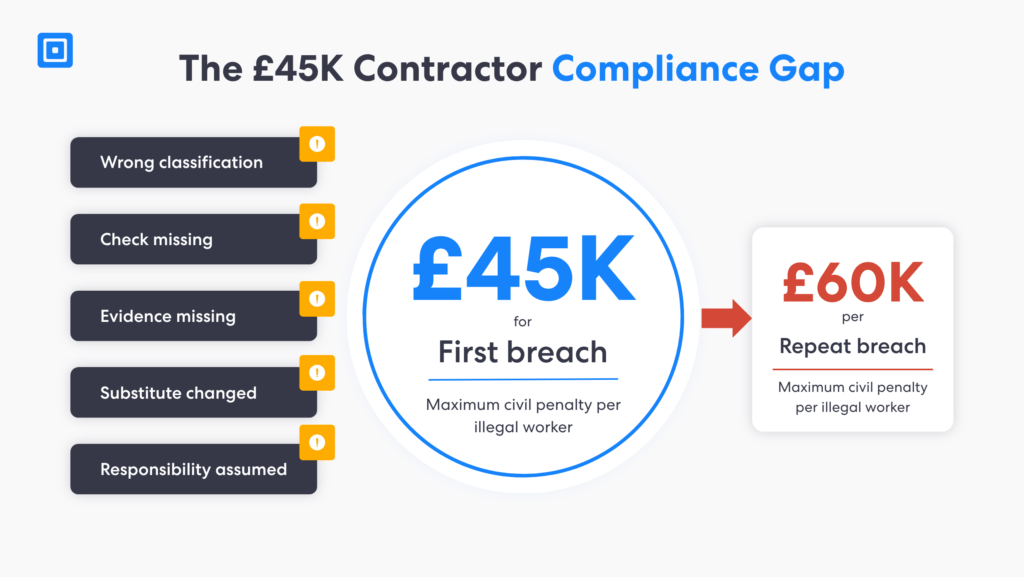
However, from 1 October 2026, section 48 of the Border Security, Asylum, and Immigration Act 2025, will broaden employer liability regarding right to work checks. Right now, statutory checks mainly apply to employees and apprentices, but by extending the framework, UK Home office will be accounting for other working arrangements as well.
It is important for many businesses to look at their list of contractors now well ahead of the new work rules being implemented. Typically, there is no grace period that allows newly in-scope work to start without the right process in place after the implementation date.
How Do You Check Employee Right to Work?
In order to conduct a compliant right to work check for contractors, the process must begin with the relationship instead of the passport. It is important for businesses to establish who will provide work and decide if current legislation puts that person within scope. Only then will companies be able to conduct the prescribed right to work checks. Here are steps that must happen during a right to work check:
Understand if the person is genuinely self-employed
The first step is to understand if a contractor is genuinely self-employed or working for a company. For example, individual subcontractors are often sole traders operating in their own name. As a result, a written contract does not define the status of a worker by itself. It is important to find out the real nature of the relationship between the person and business.
Establish whether the Right to Work scheme applies
When a working arrangement falls within the scheme, businesses need a statutory excuse well before the work starts. From October onwards, this analysis needs to account for any subsequent arrangements under a worker’s contract instead of assuming that every contractor will fall outside of the rules.
Implement the correct work checks
Depending on the person’s circumstances, companies and employers may take advantage of a Home Office online check. They can also use permitted manual check using acceptable documents, an eligible certified digital service, or the Employer Checking Service. These work checks need to be completed through the right prescribed process. Commercial credentials do not replace the evidence of a legal right to work.
Retain evidence in a secure manner
It is important for businesses to retain evidence around people that underwent a check. This includes the date when it happened, the process used, the subsequent result, and any relevant restrictions. Under the existing employer’s guide, right to work check documentation needs to be kept over the duration of employment as well as two years post-engagement. Failure to keep the necessary information will leave an employer in a tough position. They will then be unable to show any defense in the midst of a Home Office investigation or review.
Why Contractor Status Comes First in Employment Law
Employment law is important because the word “contractor” does not sit as one legal category. For instance, a person can be self-employed, have worker status or, depending on the actual relationship to the company, be an employee.
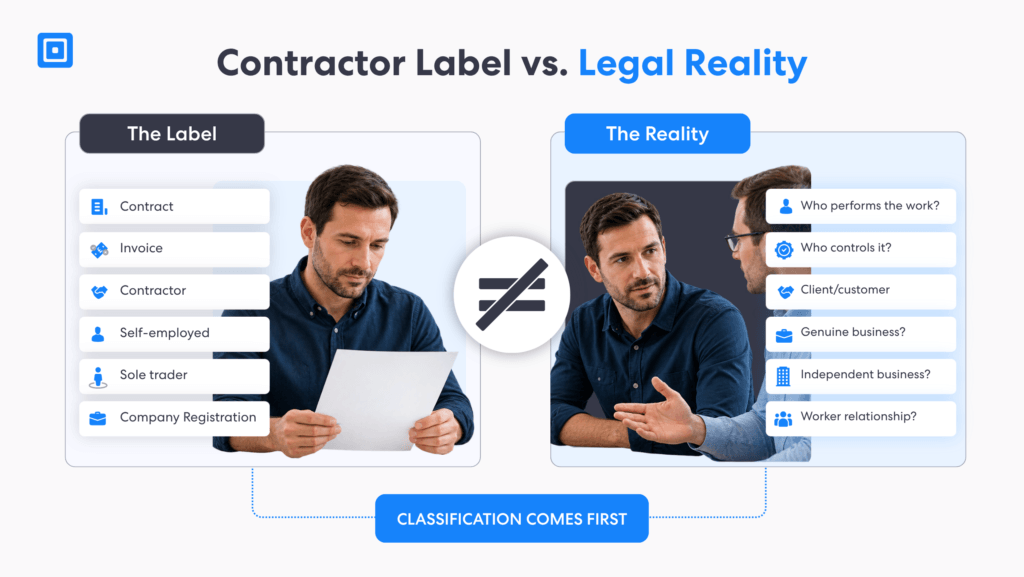
Someone who is genuinely self-employed may deal with many clients, carry financial risk, and control the ways in which they deliver their services. This is very different from an indiviual who is taking on work when the other party is not simply a customer of an independent business. The label of contractor cannot provide a proper right to work permission on its own. The classification allows teams to determine which compliance question they need to focus on next.
Self Employed Contractors and Right to Work Evidence
Many contractor files contain tax and commercial documents that look authoritative but do not prove any relation to immigration permission. In this case, teams must look to a National Insurance number, Unique Taxpayer Reference (UTR), UK bank account, or Companies House registration. Even then, it does not establish a person’s right to work in the UK.
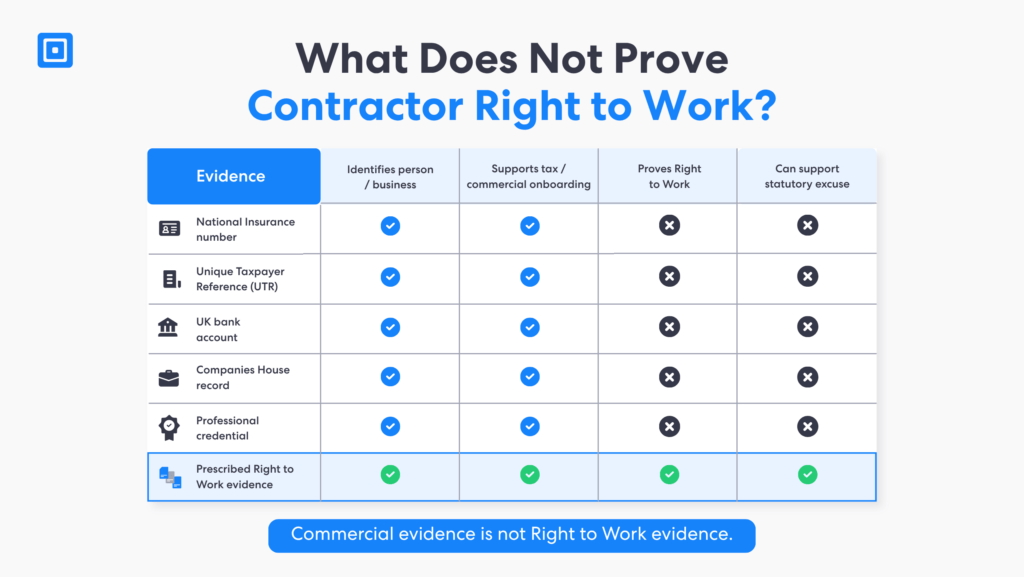
The UK Home Office has found several cases where businesses assumed that another government agency or previous employer may have already checked an individual just because such records existed previously. However, the best practice is to obtain any prescribed evidence through the appropriate route instead of inferring right to work permissions from unrelated records.
The Employer’s Guide To Applying Right to Work Checks
Currently, the UK Home Office employer’s guide asks employers to conduct right to work checks before employment begins. It also explains how those checks provide a strong statutory excuse. The checks must be applied consistently instead of based on assumptions about nationality. This lowers discrimination risk while helping prevent illegal working.
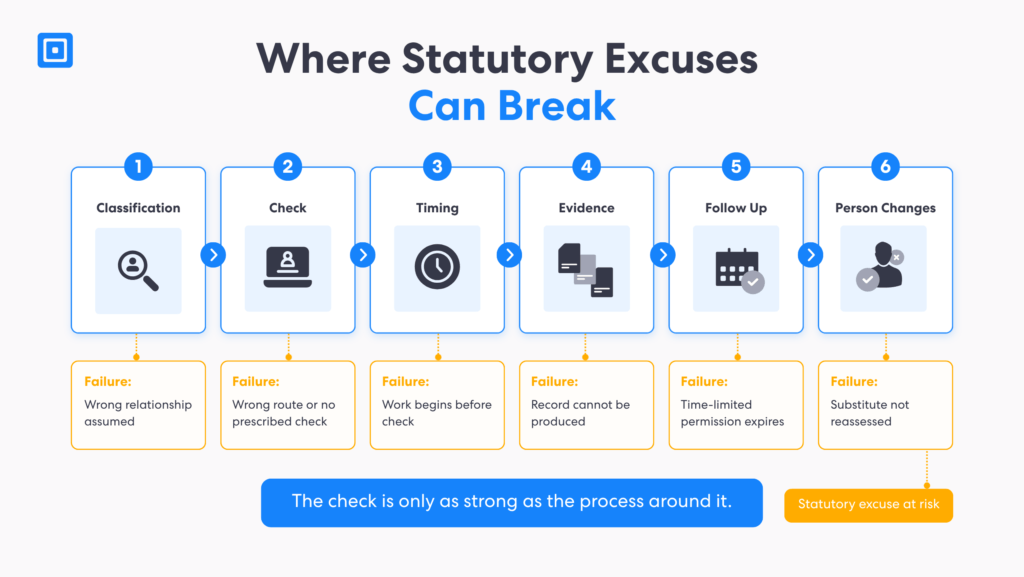
Though evidence is temporary, ongoing work compliance involves keeping strong records and completing future right to work checks at the appropriate date. As a result, onboarding will not be treated as a one-off event.
Agency Workers, Agency Staff and the Supply Chain
Risk is much harder to see when contractors are sitting inside a wider labour supply chain. In some cases, a business may contract with labour providers who deploy agency workers, agency staff, or individual subcontractors.
More often than not, labour providers carry out checks. However, the end user must understand which party has the statutory responsibility. Certain contractual terms can ask labour providers to carry out the appropriate checks and retain evidence. They cannot transfer an obligation that current legislation places directly on another business. You can learn more here: How UK Recruitment Firms Can Check Employee Right to Work
Sponsor Licence Holders and Sponsor Duties
Sponsor license holder must keep sponsor duties separate from the wider contractor changes. A UK business immigration team may manage sponsored employees while procurement might manage independent contractors.
Those two functions should share enough workforce information to identify gaps without assuming the two compliance regimes are identical. European Economic Area (EEA) and Swiss nationals who need sponsorship are subject to the necessary immigration and sponsorship requirements. Any further guidance on sponsorship duties need dedicated time and treatment.
Gig Economy and Online Matching Service Models
The new right to work framework also covers specified online matching service arrangements. This is particularly important for those who are participating in the gig economy. The legislation addresses businesses that link service providers with any potential clients or customers for a specific fee or cut.
However, this does not mean that every single gig worker somehow becomes an employee. The most important change here is that the law can extend way beyond what is considered to be conventional employment to more flexible labour models.
Case Study: 36 Arrests at Belfast Construction Site
In March 2025, the Home Office made 36 arrests connected to a Belfast Titanic Quarter construction site. This involved people working for a subcontractor. The list of suspected offences included breaches of visa conditions and working without permission.
Labour and Supply Chain Controls in Right to Work Checks for Contractors
The issue is that public reporting does not identify the subcontractor or prove which specific controls failed. The best course of action is to maintain visibility over individuals deeper within the supply chain. The goal is to define checking responsibility contractually and conduct the prescribed process correctly.
Outcomes
- 36 people were arrested during the UK Immigration Enforcement operation.
- Majority of the arrested were reported as working for a subcontractor.
- This shows the commercial risk of limited workforce visibility between the end user and worker.
Right to Work Supply Chain Risk When Contractors Use Substitutes
Substitution is one of the clearest contractor-specific risks. A business may check on one contractor’s permission, but instead another person can arrive later on to prove the actual work. The statutory excuse or evidence for the first person cannot establish the permission for the substitute. The Home Office enforcement policy looks at transparency across the whole labour supply arrangement.
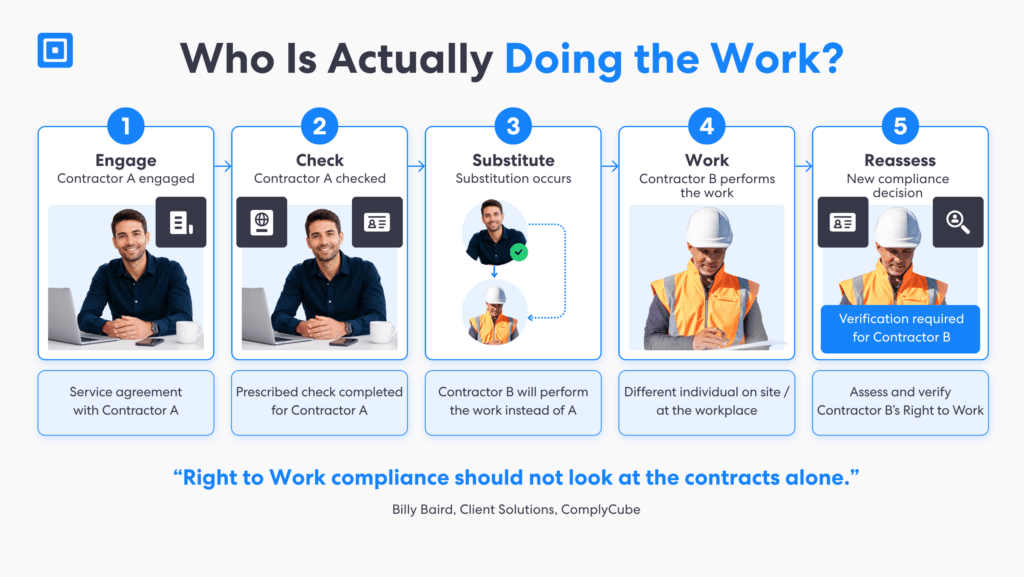
Right to work compliance should not look at the contracts alone.
Billy Baird, Client Solutions at ComplyCube, adds, “The practical question they are trying to answer is around who is doing the work. That is why compliance requirements for contractors must follow the person that provides the work.” The best right to work processes link the person, their classification, their evidence, and any later substitution.
Key Takeaways
Contractor labels cannot prove if someone is self-employed or covered by the right to work scheme.
Professional documents cannot replace the prescribed Right to Work evidence.
Labour providers, agency staff and substitutes need clear ownership and visibility.
Businesses must have classification, checks, evidence, and follow-ups in one process.
In October, the framework adds qualifying worker arrangements, individual subcontractors, and specified online matching services.
Conduct Right to Work Checks for Contractors Through ComplyCube
With legally required right to work checks extending to non-employee worker contractors from 1 October 2026, it is important for businesses to manage flexible labour at scale in a compliant manner. ComplyCube can support right to work checks for contractors through certified digital identity capabilities, document and biometric verification, configurable workflows, APIs, SDKs and audit-ready records.
These controls can help standardise verification while keeping employment-status decisions and statutory responsibility with the organisation. Contact ComplyCube to discuss contractor Right to Work compliance for your business.

Frequently Asked Questions
Do Self Employed Contractors Need Right to Work Checks?
Before 1 October 2026, genuinely self-employed contractors generally sit outside the existing statutory excuse scheme. From October, organizations should verify credentials directly to avoid operational disruption or penalties. Employers are liable for checks on agency workers in certain conditions.
What Happens if a Contractor Has No Valid Right to Work?
Where a prescribed check applies and permission cannot be established, the in-scope work should not begin. Knowingly allowing illegal work can expose a business to civil penalties and potential criminal liability.
What Happens if a Contractor Uses a Substitute?
If a different person performs the work, the original contractor’s Right to Work evidence does not automatically apply to the substitute. Businesses should reassess who is actually providing the service and whether a new check is required.
Are Businesses Liable for Checks Conducted by Labour Providers?
The liability wholly depends on the relevant legal relationship. Contractual requirements can strengthen any supply chain practice. However, they do not automatically transfer a statutory duty that is imposed directly on another organisation.
How Can ComplyCube Support Right to Work Checks for Contractors?
ComplyCube supports eligible digital Right to Work verification, document and biometric checks, configurable workflows and auditable evidence. These capabilities help businesses standardise verification while retaining control of contractor classification and compliance decisions.