TL;DR: Accounting firms need to compare AML KYC vendor effectively to support frictionless onboarding and compliance obligations. This AML KYC platform comparison guide looks at the top 7 vendors for accountants. It evaluates key features and workflows, as well as client reviews, for accounting firms to use in their AML KYC software comparison matrix.
What is an AML KYC Platform Comparison?
An AML KYC platform comparison is the methodology used to choose the best Anti-Money Laundering (AML) and Know Your Customer (KYC) for a business. It involves evaluating vendors according to specific feature offerings, verification coverage, and reporting capabilities to ensure compliance.
Today, modern compliance systems have evolved significantly. Vendors not only build these KYC and AML technology solutions to prevent money laundering and financial crime risk. Instead, they are designing a unified compliance ecosystem to make ongoing compliance simpler and smarter.
As such, while many AML and KYC solutions may seem similar to those used by many regulated institutions at first, key differences will emerge in terms of scalability, flexibility, and automation. This guide jumps straight into comparison criteria and specific platforms. It supports accountants actively seeking top AML software vendors for their business.
KYC and AML Compliance Processes for Accountants
The UK’s 2025 National Risk Assessments deem accountancy services high risk due to their broad exposure to money laundering. This is because accounting firms are often exploited through complex corporate structures, trusts, and cross-border transactions used to layer and integrate illicit funds.
Accounting businesses, together with payroll, bookkeeping, insolvency, and tax advice are attractive spaces for money laundering.
As a result, regulators are expecting accountants to perform financial institution-style due diligence. A comprehensive solution should thus streamline compliance, meet local regulatory requirements, and integrate with existing systems. This includes strong mechanisms for fraud detection and ensuring compliance teams can evidence regulatory compliance. You can learn more here: KYC and AML Software For Accountants.
Criteria used to Compare AML KYC Vendor for Accountants
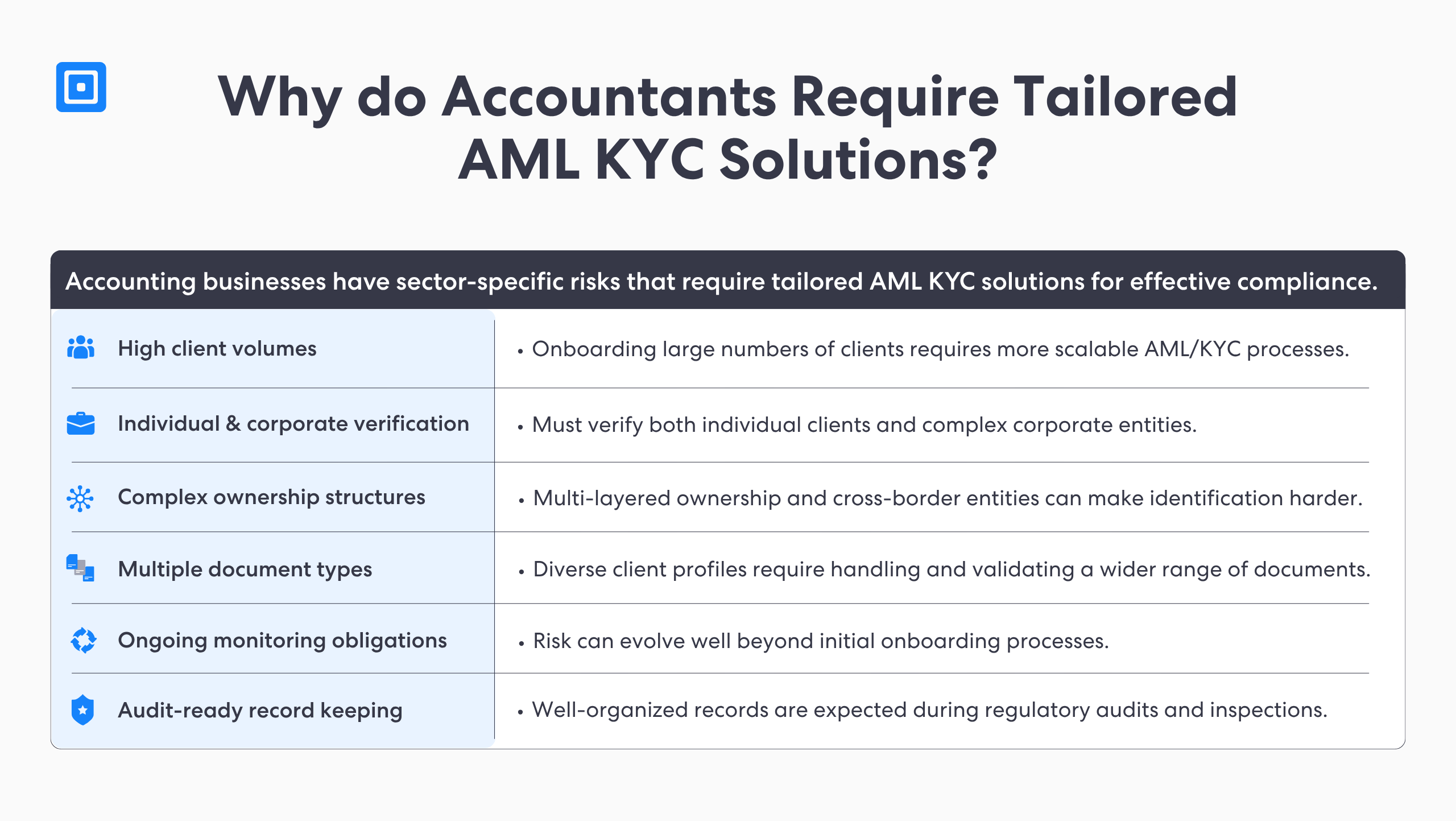
Unlike banks, accountancy services work with thousands of clients, each with varying ownership structures. Additionally, they manage hundreds of document types, including tax return forms, invoices, and other paperwork. Because of this, accounting businesses must take a targeted approach during AML KYC software comparison.
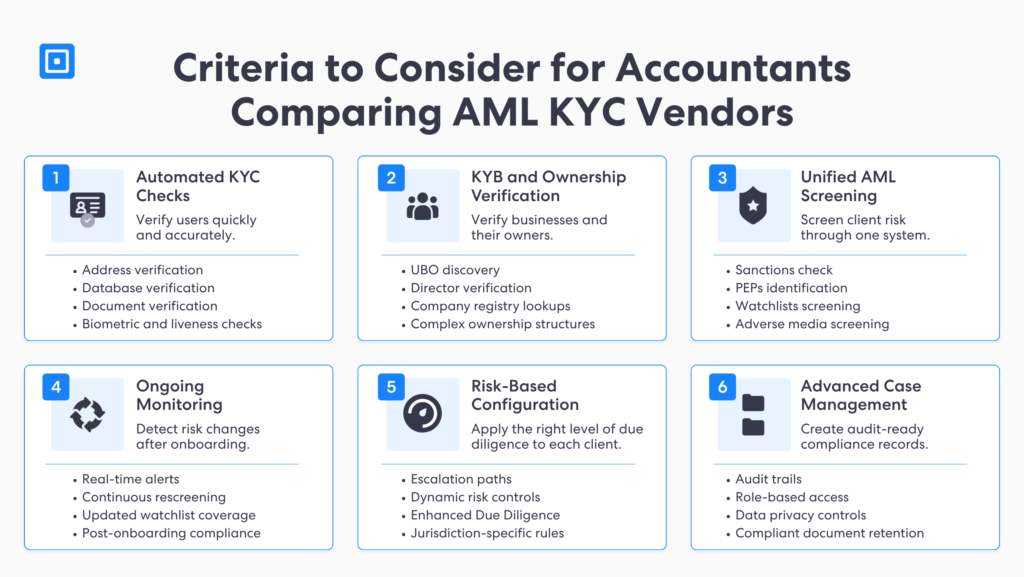
The right solution should fit their specific workflows and meet sector‑specific regulatory obligations. This section explores the most crucial solutions, features, and capabilities that accounting firms should consider when choosing KYC and AML systems.
Automated KYC Checks
When performing KYC checks, automation can make customer identification faster, more secure, and accurate. Modern accounting businesses use AI-powered identity verification to streamline KYC processes across large and diverse client bases. It combines document verification, biometric authentication with liveness detection, and address verification to authenticate a client’s identity.
Furthermore, it is critical to prioritize global identity verification solutions and non-document checks, such as database verification. This ensures accountants can verify customers or clients with varying identification needs, enhancing user experience, without compromising KYC compliance. As a result, accounting firms can speed up verified onboarding while reducing false positives and manual reviews.
KYB or Business Verification Depth
While KYC verifies customer identities to assess risk, Know Your Business (KYB) focuses on verifying corporate clients. Focus on vendors that have multiple, authoritative data sources for registry lookups, director and shareholder analysis, and Ultimate Beneficial Ownership (UBO) discovery. You can learn more here: What is UBO?
Unified AML Screening
To support compliance with AML regulations, accountants should focus on all-in-one software with robust Politically Exposed Persons (PEPs) and sanctions screening, adverse media monitoring, and watchlist screening. Consolidating these tools on one platform makes AML compliance consistent and simple to evidence in reporting.
Ongoing Monitoring
The most important feature when performing AML KYC platform comparison is ongoing monitoring capability. Ongoing monitoring is crucial in every compliance program. It enables continuous compliance with AML and KYC regulations, preventing financial fraud beyond the onboarding stage. You can learn more here:
Risk-Based Configuration
Global standards, such as the EU’s AML Directives and UK Money Laundering Regulations (MLR) recommend a risk-based approach to compliance. Accountants should prioritize software with flexible risk scoring, dynamic controls, and clear escalation paths, enabling them to efficiently focus on high‑risk clients and support Enhanced Due Diligence (EDD).
Advanced Case Management
To meet reporting obligations, accounting firms must use software with transparent audit trails and robust document retention. Ideally, regulators must easily understand every decision and reviews taken. Furthermore, leading AML platforms support Role‑Based Access (RBAC) and comply with global data privacy laws to protect sensitive customer data and boost trust.
Top 7 AML KYC Software for Accountants in 2026
The following platforms address different parts of the accounting lifecycle. Some provide niche features, such as sanctions screening and suspicious activity reporting for accountancy practices, while others focus on broader identity verification or enterprise support.
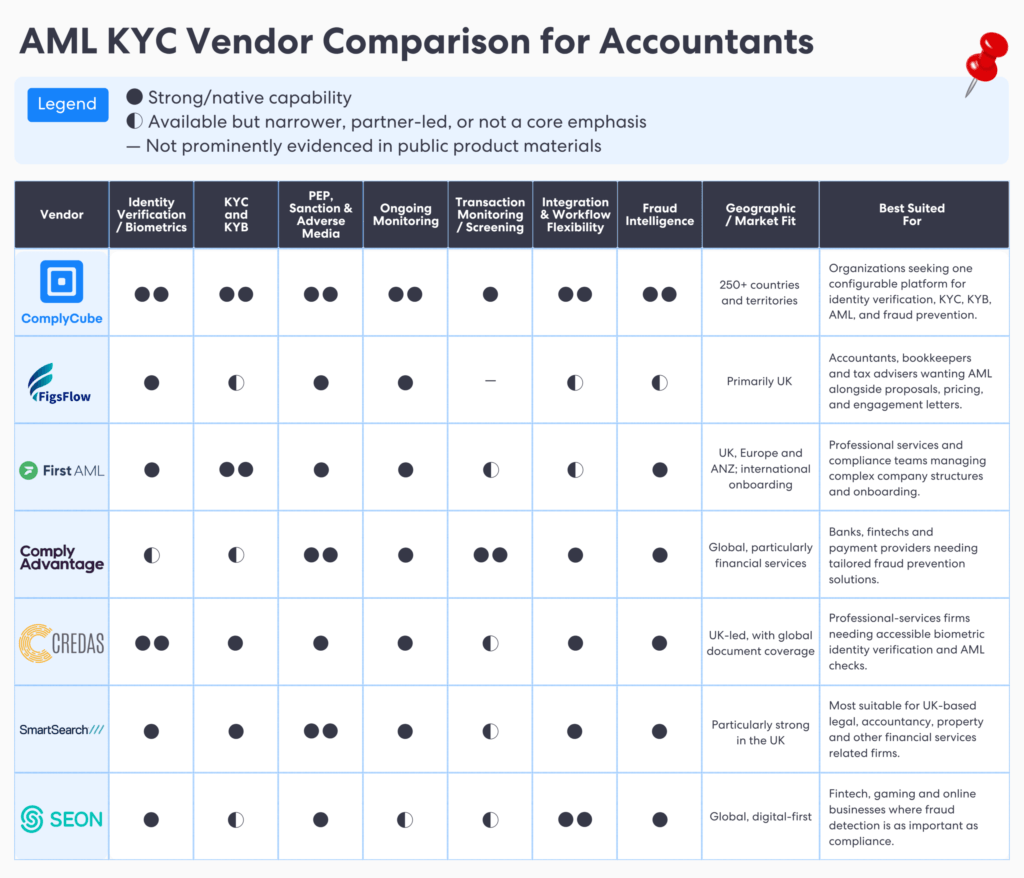
Accounting firms should also look for verified reviews from similar clients who already use this software. To support that, we include verified user feedback from each company’s G2 profile, the leading marketplace for software buying decisions based on active user reviews. We encourage accountancy firms to compare this feedback with reviews on other platforms, including Trustpilot and Capterra.
1. ComplyCube
ComplyCube is built for accountancy firms that want a simple, configurable system for automated identity verification, AML screening, ongoing monitoring, and risk assessment. As such, accountants reduce duplicate records, fragmented audits, and operational inefficiencies from moving between different tools.
The software uses a no-code configuration with deep API and SDK integration, making it straightforward to deploy and setup. Its risk controls and workflows have in-depth customization that can tailor to different client types, jurisdiction, and ownership structure.
Verified client review: I appreciate ComplyCube’s efficient AML screening and document verification processes, which allow us to verify clients quickly and securely. The platform’s user-friendly interface and responsive support team have made our experience exceptional.
Advantages
- Unified platform: Combines KYC, KYB, AML, and ongoing monitoring in one dashboard.
- Reduces false positives: Easily create and tailor onboarding workflows with risk-based controls.
- Regulator trust: Ready-made policy assurance templates and time-stamped records for reporting.
- Global coverage: Offers one of the largest jurisdiction scope, with over 250+ territories covered.
Potential consideration
ComplyCube appeals to accountants that want to automate and consolidate a meaningful part of their compliance process. Firms looking for a basic check in one country may not need its full breadth.
2. FigsFlow
FigsFlow is usually adopted due to operational convenience. Its platform is tailored for UK businesses, introducing identity verification and AML screening into the wider onboarding process. Firms can manage accounting proposals and engagement letters without needing another third-party vendor.
This means a large part of accounting practices can be combined with regular compliance activities. As such, the platform can appeal to smaller companies that want compliance checks integrated into other familiar accountancy-related activities.
Verified client review: I was looking for MTD ITSA & Identity verification engagement letter & pricing templates, and FigsFlow had them built-in. I am impressed with the volume of pre-built templates for our services, and also up to date with regulatory changes.
Advantages
- Familiar practices: Compliance processes sit atop existing administrative accounting workflows.
- Reduce operational fragmentation: Combine proposals and onboarding into a single dashboard.
- UK-specific: Made specifically for accounting firms in the UK.
Potential consideration
While FigsFlow can enhance day-to-day accounting operations, it may be less suitable for firms that require large global coverage, complex KYC workflows, or advanced risk controls.
3. First AML
First AML simplifies ownership and relationship identification. This can appeal to businesses that need to understand complex ownership structures and entity relationships. First AML offers rule-based verification, where businesses can apply different types of checks to diverse risk profiles.
As a result, First AML is useful for accounting firms that manage multiple trusts, corporate groups, or clients with many beneficial owners. A strong use case for First AML is likely for corporate onboarding and case management.
Verified client review: The integration of a single platform for all AML needs is a huge bonus. Their AML software automates a wide range of processes, including customer identification and verification, as well as continuous monitoring.
Advantages
- Reduce complexity: Focus on understanding corporate onboarding and ownership structures.
- Centralized data: Combines AML records and case information in one system.
- Align internal policies: Translates internal compliance policies into workflows.
Potential consideration
Accountants should assess whether the platform offers the depth of document, biometric, fraud, and identity verification alongside its corporate AML offerings.
4. ComplyAdvantage
ComplyAdvantage is known for its financial crime intelligence, helping accountants deter common challenges such as identity theft. Its software prioritizes the prevention of money laundering and terrorist financing, with features such as sanctions screening and PEP screening.
Its platform’s main advantage is access to risk intelligence and flexible risk controls. This is typically applicable for firms with established onboarding processes that are looking to strengthen financial crime detection in the accounting space.
Verified client review: Easy-to-use interface, with good communication and solid problem-solving. The rule logic is straightforward to understand and isn’t cluttered with unnecessary information.
Advantages
- Risk Intelligence: A large ecosystem to break down sophisticated financial crime activity.
- AML heavy focus: Offers sanctions, PEP, and adverse media screening.
- Enterprise firms: May be more suitable for large businesses in high-risk or complex environments.
Potential consideration
Accountancy firms seeking an end-to-end onboarding platform and corporate verification may need to consider additional providers for identity verification, document checks, and KYB.
5. Credas
Credas supports remote onboarding by combining biometric verification, document validation, and sanctions checks. Its user-friendly approach may appeal to smaller accounting firms that lack large technical implementation teams or complex global compliance needs.
The platform is simple to use for firms that require UK compliance without overly technical features. Buyers should consider how well the platform supports cross-border verification, configurable risk models, and integration with broader AML. Additionally, number of supporting documents can be limited.
Verified client review: Credas offered us exactly what we needed and the software is so simple and user friendly. Our business development manager is friendly, knowledgeable and sorted everything out for us.
Advantages
- Seamless onboarding: Simple remote onboarding experience for non-technical teams.
- UK-focused: Aligned with UK professional-services workflows and compliance.
- Quick deployment: Can be set up and introduced quickly for smaller firms.
Potential consideration
While Credas offers straightforward UK verification needs, buyers may need to compare it with highly configurable, international, or API-led compliance programs requirements.
6. SmartSearch
SmartSearch is known for its electronic identity verification solutions. It offers biometric authentication, document verification, and multi-bureau checks designed to support compliance in the UK. Its platform also offers individual and business checks across regulated professional services.
Thus, the platform is typically used by accountants who prefer remote database verification and access to large, multi-bureau data. Buyers are recommended to consider whether the platform can support flexible global document verification, developer tools, or more advanced fraud detection.
Verified client review: SmartSearch is easy to use and provides all the information we need. Auditing is now simple, their reports are laid out in a straightforward way and we’ve had great customer service.
Advantages
- Large presence in the UK: Used particularly by UK-regulated industries.
- Access to multi-bureau data: Strong database-led identity verification.
- Familiarity: Can be an easier option for professional-services firms that want familiar workflows.
Potential consideration
For accountancy firms with large global clients, consider whether SmartSearch can meet complex digital onboarding requirements or provide sufficient flexibility in API workflows and geographic coverage.
7. SEON
SEON provides AI-driven tools for AML and KYC compliance. The company focuses on fraud and financial crime prevention by helping businesses detect suspicious users and transactions. It’s an AML compliance solution that combines screening, transaction monitoring, and case management.
The platform is most useful for companies where fraud detection is as important as regulatory onboarding. It supports large organizations in reducing the need for additional systems to combat fraud and money laundering easily.
Verified client review: SEON enables businesses to access all the required features and information in one place. It’s also beneficial to have anti-fraud features and AML combined in the same platform.
Advantages
- Fraud intelligence infrastructure: Deters fraud from the customer lifecycle journey.
- High-risk support: Can be especially useful for firms with high-volume, cross-border transactions.
- Breadth of risk indicators: Uses digital and behavioral signals to assess diverse risk.
Potential consideration
SEON might be broader than the typical needs of smaller accounting practices. Firms should confirm that their corporate onboarding and accountancy-specific workflows meet the required standards.
Compare AML KYC Vendors Beyond Features
Aside from product features, accounting firms should consider ease of setup, the integration process, platform interface, pricing, and vendor support. These elements are important because they help accountants determine whether a solution can be adopted successfully or abandoned due to poor support.
- Regulatory Coverage: Ensure the vendor you choose explicitly supports the AML/KYC rules your firm must follow in the jurisdiction you cover now and in the future.
- Integration Process: Ensure the vendor offers API, SDKs, and other integration tools that fit your accounting and CRM tools, with a written estimate of integration time and effort.
- Platform Interface: Choose a system where teams can run checks and review results easily, such as vendors that offer a no/low-code workflow which can reduce manual effort and extensive training.
- Pricing: Get a full breakdown of per-check fees, platform fees, maintenance, and coverage rules, and confirm how costs change if your client volume grows to avoid hidden fees.
- Security & Data Residency: Verify if the software offers end-to-end encryption, independent security certifications, including ISO 27001, and where your client data is stored and backed up.
- Vendor Support: Require a named account manager, clear response times for compliance issues, and documented help with rule tuning, audits, and regulatory updates.
This approach helps accounting firms pick a solution that will work day-to-day rather than a feature-rich tool that becomes too costly or complex to use. It supports seamless onboarding, business expansion, and operational efficiency in the long-term. You can learn more here: Hidden Fees in AML Compliance.
Key Takeaways
- ComplyCube, SmartSearch, and ComplyAdvantage are vendors commonly cited for robust AML/KYC offering.
Prioritize automated identity verification and AML screening to reduce manual reviews and accelerate onboarding.
A unified platform combining KYC, KYB, and ongoing AML simplifies and supports continuous compliance.
Workflow automation, global coverage, and depth of integration ensures scalability with business growth.
Beyond feature quantity, accounting firms should ultimately choose a vendor based on operational fit.
Accelerate Customer Onboarding with Accounting KYC and AML Solutions
An effective AML KYC platform comparison framework supports accounting firms in choosing the best software for their operations and regulatory requirements. By following a structured evaluation framework, firms can strengthen money laundering and fraud prevention, effectively protecting today’s financial system. Get started with ComplyCube’s real-time AML and KYC platform today.

Frequently Asked Questions
What should accountants prioritize when they compare AML KYC vendor?
Accounting firms should prioritize software based on operational fit rather than the number of features. To reduce compliance complexity and support end-to-end compliance, accountants should choose a unified platform with automated identity verification, ongoing AML screening, and case management.
What are the top 5 companies for accounting AML KYC platform comparison?
The top 5 companies that are often mentioned for their accounting AML KYC solutions are SmartSearch, FigsFlow, ComplyCube, First AML, and ComplyCube. This is due to the platform’s depth of feature, global coverage, and level of customization made for frictionless onboarding and scalable compliance.
What is the difference between an AML KYC platform and standalone AML software?
An AML KYC platform consolidates identity verification, customer due diligence, PEP and sanctions screening, ongoing monitoring, and risk scoring on a single platform. It uses APIs to integrate these systems, supporting the full customer journey. Standalone AML software focuses mainly on AML screening, with little to no KYC features.
Do accountants need ongoing or just onboarding checks?
Accountants need ongoing KYC, not just a one-off identity check during onboarding. Leading regulators, such as the UK’s HMRC, the EU AML Authority (AMLA), Canada’s FINTRAC, and Singapore’s MAS, mandate updated client information and risk assessments. This means accounting firms must perform ongoing monitoring with documented steps when risk changes.
Is ComplyCube’s AML/KYC solution tailored to accountants?
ComplyCube provides tailored KYC and AML solutions for accounting businesses of all sizes. The platform offers automated PAD-Level 2-certified liveness checks, document verification, and address verification. Additionally, it provides real-time AML screening and risk scoring. These solutions align with global accounting-specific regulations.