
TL;DR: With rapid innovation in the digital financial services industry, fintech compliance has moved from just being a “check box” exercise to proactive fintech risk management practices. This guide covers the importance of compliance for fintech companies and best practices for navigating evolving regulations.
The Birth of Fintech Companies
Fintech, also known as Financial Technology, is an emerging sector that aims to revolutionize financial services. Fintech companies pride themselves on adopting the most advanced technological tools to disrupt the infrastructure found in traditional banking sectors and financial institutions. Although the financial, technological, and fintech sectors are distinct in their purposes, they remain intricately connected.
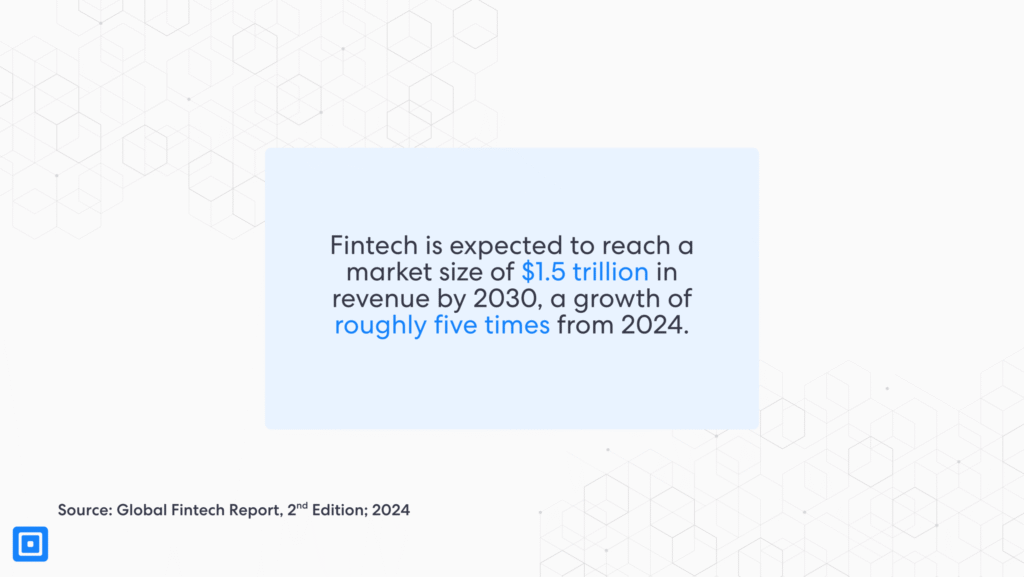
Fintech is expected to reach a market size of $1.5 trillion in revenue by 2030, a growth of roughly five times from 2024.
Conventional financial systems typically rely on physical functions, emphasizing client-customer relationships. On the other hand, technological firms drive the development of digital tools and platforms to move traditional banking into a digital space. Fintech takes the center stage, leveraging state-of-the-art technology such as Artificial Intelligence (AI), blockchain, and real-time analytics to make financial services faster, cheaper, and more tailored than ever before.
While this emerging sector picked up momentum relatively quickly, the immense growth opportunities for fintech companies were also met with complex challenges. This was particularly in building a flexible and agile compliance program that satisfied evolving regulatory standards while enabling scalability.
Increasing Scrutiny of Fintech Firms
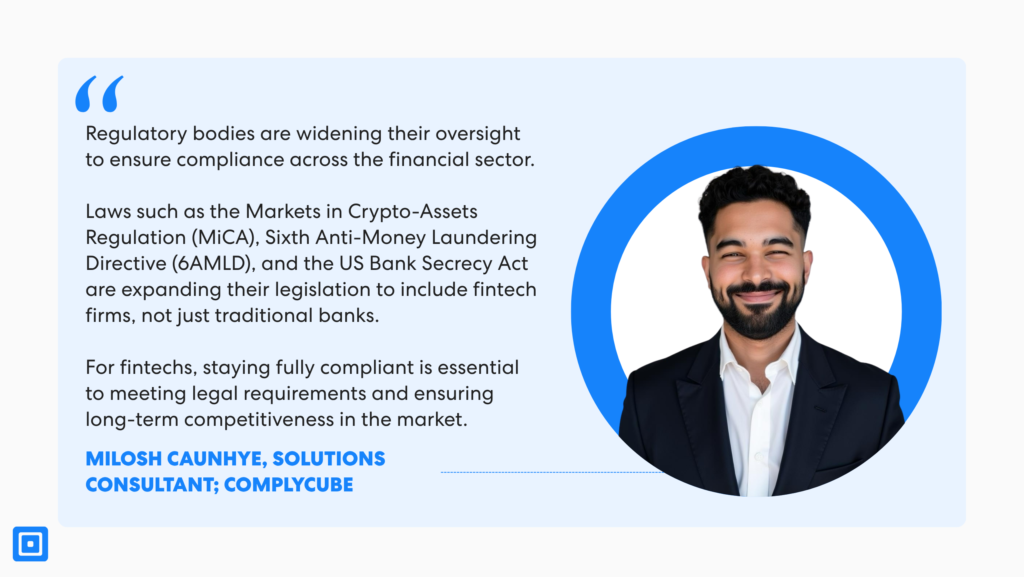
The distinction between fintech and traditional financial industries will wear off as regulatory bodies extend oversight and compliance expectations across a wider financial ecosystem. This means that now, any companies involved in working with other financial institutions or providing financial transactions must align with new regulations and implement security measures to actively combat terrorist financing, money laundering, and unfair or deceptive acts.
Fintech organizations that fail to adapt to these expanded regulations could face significant penalties, reputational damage, and loss of consumer trust in an increasingly competitive marketplace. The factors that drive this heightened scrutiny towards fintech businesses include:
1. Gaps in the regulatory environment
The acceleration of fintech growth has often outpaced regulatory frameworks. This has created compliance difficulties in data protection and consumer protection laws, forming a breeding ground for financial crimes like money laundering and fraud. As a result, regulatory authorities implement stringent compliance requirements for fintech firms to abide by to ensure compliance and financial stability.
2. The rise of threats and failures
As we know, financial service providers commonly have inadequate compliance processes, with the Financial Conduct Authority (FCA) imposing over £176m in fines just last year. The fintech sector is not immune.
In 2023, 86% of fintech respondents said their organization paid over $50,000 in compliance fines last year, with more than 37% paying over $500,000.
Fintech compliance practices and poor risk management have increased over the years, prompting increased regulatory oversight of fintech companies and their partnerships with other financial institutions to safeguard the financial system.
3. Data processing and Artificial Intelligence (AI) concerns
Due to their extensive contact with sensitive financial data, fintech businesses now face stricter data protection laws. Legislation such as the General Data Protection Regulation (GDPR) and the California Consumer Privacy Act (CCPA) mandates higher privacy rights and customer protection. Companies must adopt compliance programs that include regulatory reporting and risk assessments to satisfy regulatory compliance.
4. Prioritising Growth Through Investment
Companies that fail to keep up with the complex regulatory environment can face devastating consequences from federal regulators. Reputation damage, financial losses, and even the shutdown of business activities are not unheard of. Fintech firms prioritizing compliance-first models, syncing with international regulations like the Bank Secrecy Act and Anti-Money Laundering (AML) standards, are more likely to garner the interest of investors and customers.
5. Evolving global regulatory developments
AML and Know Your Customer (KYC) regulations are now being enforced on wider sectors globally. Regulatory bodies such as the Financial Action Task Force (FATF) are now given more decisive power to drive harmonized compliance standards to ensure fintech compliance and financial market stability. Companies that fail to adapt to the new regulatory landscape will fall behind with increased financial penalties and potential exclusion from key markets.
Case Study: Canada Penalizes Cryptomus Landmark $177 M
In 2025, Cryptomus, the crypto focused FinTech landed itself a $177 million fine from Canadian regulators for violating critical AML and CTF controls. This penalty is one of the largest enforcement action by Canada’s watchdogs in recent years.
Suspicious Transactions Traced to Darknet Markets
According to Canada’s regulator, the firm violated the country’s AML Act in 2,593 instances. 1,068 of those instances were traced to suspicious criminal activity, such as darknet markets and child abuse trafficking, which the firm did not report.
Outcomes
Cryptomus was penalized a historic $177 million for major violation of Canada’s Proceeds of Crime (Money Laundering) and Terrorist Financing Act.
Despite operating in a sector with high financial risks, the company failed to implement strong AML screening and due diligence solutions.
- This case emphasizes the importance of real-time risk scoring and continuous monitoring to detect high-risk cases beyond intial onboarding.
The Swift Uptick of Fintech Compliance
Although faced with increased scrutiny, fintech companies have been quick to integrate compliance technology, outpacing conventional financial institutions due to their digital-native operations. A majority of fintech companies view new regulations not just as a regulatory requirement but as a competitive advantage for boosting financial innovation and growth.
The swift integration of fintech compliance is driven by:
- Technological Intelligence: Fintech companies are familiar with advanced AI, machine learning, and blockchain technology for real-time monitoring, automated risk assessments, and robust compliance programs. This enables them to pick up regulatory technology more easily than the traditional financial services industry.
- Proactive Culture: The competitiveness in the fintech space means that most fintech companies need to be proactive in winning consumers’ trust. This has led to rapid alignment with risk management practices, consumer protection laws, and compliance requirements in their product roadmaps.
- Competitive Advantage: Implementing strong security enhancements and regulatory standards from the start enables fintech companies to address operational risks and differentiate themselves from big players in the financial markets.
- Huge Risk of Non-Compliance: Operating in a saturated market, fintech companies need to be agile and swift to respond to the complex regulatory landscape. Any wrong mistake, such as poor compliance expertise and unfair business practices, can negatively impact their financial innovation, setting them back.
- Customer-First Principle: Lastly, fintech firms view customers as the beating heart of their operations. As a result, ensuring financial stability for their users through anti-money laundering (AML) efforts and alignment with data protection laws is a priority.
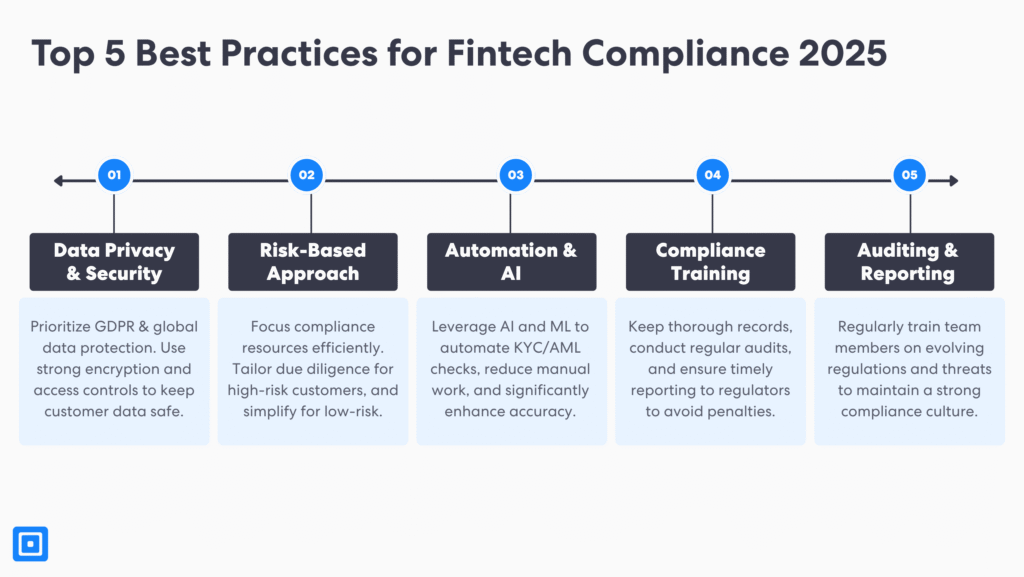
Top 5 Best Practices for Fintech Compliance 2025
As regulations evolve, keeping up with new standards in anti-money laundering and risk management frameworks is key. But how can businesses get ahead of regulatory compliance, especially as regulatory bodies continuously monitor and change legislation? This section will explore the best practices for fintech companies to adopt to ensure agility and flexibility in the face of changing regulatory requirements.
Step 1: Maintaining Priority of Data Privacy and Security Measures
Fintech companies must strictly adhere to fundamental data protection laws like the General Data Protection Regulation (GDPR). Initially, implementing strict security measures, such as access controls, will significantly reduce the likelihood of bad actors and illegitimate users gaining sensitive information.
Step 2: Implementing a Risk-Based Approach (RBA)
In a compliance program, RBA refers to allocating resources to higher-risk situations and clients. With RBA, fintech companies can streamline compliance activities by focusing on enhanced due diligence and ongoing monitoring for high-risk customers to prevent financial crimes and money laundering. In contrast, low customer risk profiles benefit from simplified compliance steps.
Step 3: The Importance of Using Automation Capabilities
Advanced technology, including machine learning algorithms and proprietary AI, helps fintech companies rapidly satisfy compliance requirements. These tools can replace manual compliance tasks, such as filling in customer data and building reports, saving time and costs. Additionally, it can learn from historical patterns to make fraud prevention and AML more accurate.
Step 4: Compliance Training as an Asset
Whether you create an in-house compliance team or choose to integrate a compliance vendor, compliance training cannot be ignored. Staying abreast of new regulatory requirements, financial regulations, and threats in the regulatory environment is key in the financial services industry.
Step 5: Auditing, Documenting, and Reporting Diligently
Lastly, with robust auditing and documentation records, fintech companies can ensure they fulfill regulatory reporting obligations to satisfy compliance regulations and avoid penalties. Moreover, having an internal process to submit regular audits and risk assessments helps rectify gaps in your regulatory frameworks.
Key Takeaways
Fintech compliance is a core risk management infrastructure that requires proactive and risk-based KYC and AML controls.
Businesses in the fintech sector face increasing regulatory scrutiny, including stronger oversight, penalties, and reputational consequences.
For scalable compliance, fintech firms should prioritize a risk-based approach, which can drastically streamline onboarding and operations.
Automation via AI-driven screening and identity verification supports financial services in meeting compliance obligations more accurately and rapidly.
Strong KYC and AML programs are strategic advantages for fintech organizations as they boost customer loyalty, investor confidence, and regulator trust.
Strengthening Fintech Compliance Solutions
From this guide, we learnt that meeting compliance regulations in the fintech industry is critical for safeguarding the financial system and avoiding fines for financial crimes, money laundering, or terrorist financing. Most importantly, meeting compliance standards pays dividends in building trust through consumer protection and resilience within modern payment systems in financial sectors. Fintech companies must take a proactive and agile approach to fulfill compliance requirements and satisfy regulatory authorities.
Get started with advanced AML and KYC solutions today. Learn more from a member of the team.

Frequently Asked Questions
Do fintech companies need to comply with AML laws?
Yes. While the exact AML obligations may vary by jurisdiction, fintech companies are legally mandated to comply with Anti-Money Laundering (AML) laws. These firms must have a strong compliance program to combat the risks of money laundering, terrorist financing, and other criminal activity. Non-compliance can lead to million-dollar fines and reputational damage.
What does fintech compliance include?
Fintech compliance can include Anti-Money Laundering (AML), Know Your Customer (KYC), and data privacy regulations. These regulations are mandated by global authorities, including the UK’s FCA, the U.S. FinCEN, and the EU’s AMLD. While exact requirements vary, the FATF recommends robust customer due diligence, suspicious activity reporting, and a risk-based model.
What are the biggest fintech compliance risks?
The biggest fintech compliance risks include money laundering and identity fraud risks, weak data protection, and AI governance challenges. The pace of technology and large transactions in the sector acts as an attractive space for fraudsters to exploit. As such, firms across fintech should implement strong, robust, and risk-based AML, KYC, and data integrity infrastructures.
How can FinTech organizations apply a risk-based compliance program?
Fintech companies can build a risk-based compliance program by analyzing and categorizing common risks in the sector, including customer, product, geography, and channel risks accordingly. This will enable them to allocate compliance resources, such as stronger due diligence to higher-risk users or scenarios, while streamlining processes for low-risk customers.
Why is automation important for fintech compliance?
Automation is important for fintech compliance because it reduces reliance on slow, error-prone manual reviews. It can support quicker, more accurate identity verification while ensuring that compliance processes remain scalable and flexible with growing business needs. Consequently, it enables real-time risk scoring and auditing, streamlining operations.