TL;DR: Anti-Money Laundering (AML) screening software helps regulated firms within the United Arab Emirates (UAE) screen customers, businesses, and beneficial owners. Buyers comparing UAE AML screening software should test lists, name matching, monitoring, and integrations. This guide explains what strong AML KYC screening software in UAE should achieve in 2026.
Why Some AML Screening Software Can Leave UAE Firms Exposed
Nowadays, a customer can easily pass onboarding within seconds. They can clear an automated check and still trigger an alert that compliance teams wish they had caught earlier. That is often the issue with modern AML screening software because speed is easy to show, but effective fraud detection is much harder to maintain.
For instance, having a weak transliteration match, a sanctions update that arrives far too late, or thousands of low-quality alerts can turn a complex AML compliance program into a massive blind spot. Having no kind of system is dangerous, but trusting a system that seems somewhat effective until a regulator proves otherwise is even worse.
That is why the Central Bank of the UAE (CBUAE)’s May 2026 thematic review was incredibly important. The regulator tested millions of UAE bank customer records against the UAE Local List and the United Nations Security Council (UNSC) sanctions data for proof . The CBUAE checked to see whether these confirmed matches had actually been detected, frozen, and reported.
For financial institutions, Designated Non-Financial Businesses and Professions (DNFBPs), Virtual Asset Service Providers (VASPs), and other regulated entities, the buyer question changes. The question moves from whether teams have an AML screening process in place to whether their AML tools work when data is difficult, risk changes, and the consequences are dire.
What Is AML Screening Software in Compliance Operations?
The key functionalities of AML screening software look into people and organizations to determine if they are a financial crime risk. This includes sanctions, politically exposed persons (PEPs), and adverse media information. In reality, the software is not meant to find names. It should surface reliable context for a compliance team to decide whether a potential match matters.
Modern screening software supports customer screening at various stages. From the onboarding stage to continuous monitoring, the right software can link alerts with verified customer data. This helps compliance officers gather strong evidence for risk assessment, due diligence, and further investigation. It also reduces the time spent on chasing irrelevant alerts. An AML solution supports regulatory compliance because accountability for decisions and AML obligations stays within the regulated business’sscope of responsibility.
Why UAE AML Compliance Raises the Bar for AML Screening Software
Currently, Federal Decree-Law No. 10 of 2025 anchors the federal AML framework, along with Cabinet Resolution No. 134 of 2025. The Dubai Financial Services Authority (DFSA) and the Financial Services Regulatory Authority (FSRA) updated these frameworks in 2026. Still, CBUAE guidance emphasizes the importance of effective controls, Customer Due Diligence, and a strong Risk-Based Approach (RBA). You can learn more here: What is a Risk-Based Approach (RBA)?
These UAE AML insights and laws apply differently across activities. However, UAE regulators expect relevant reporting entities to maintain key system and control functionalities proportionate to their respective risk exposure. Non-compliancewith AML laws can result in serious supervisory and enforcement consequences. Therefore, effective AML compliance software is a business-control decision, not a feature comparison between vendors.
How AML Screening Software Works Across the Customer Lifecycle
Customer verification and identity verification determine who someone is. After that, AML screening checks their identity against risk sources and flags any possible matches. Similarly, transaction monitoring analyzes financial activity to detect suspicious activity, unusual patterns, and behavior that may indicate increased risk. Finally, API integration can lower any manual processes. It can also improve customer experience and lower compliance workload by automatically moving verified information between these controls.
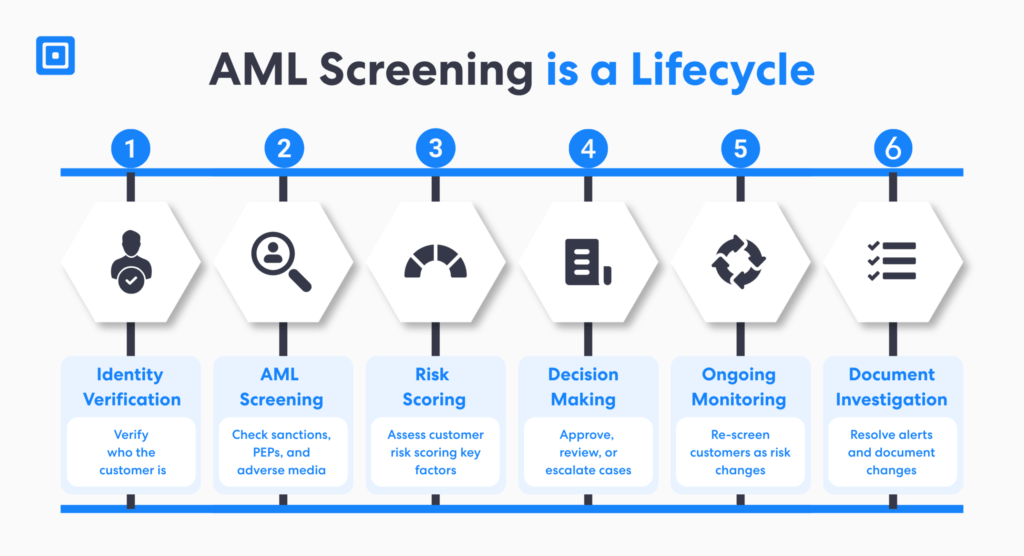
Good AML software links Know Your Customer (KYC), automated screening, risk scoring, and monitoring instead of forcing compliance operations across multiple software solutions. Each check stage needs to inform the next, instead of creating another isolated queue.
Who Must Meet UAE AML Regulatory Requirements?
AML software is mandatory for VASPS, banks, and DNFBPs in the UAE. The UAE adheres to Financial Action Task Force (FATF) standards for AML compliance. They must also comply where this legal framework applies.
Typically, DNFBPs include sectors with distinct exposures, such as real estate professionals and dealers in precious metals and stones. They are usually organizations or professions where transactions and ownership structures will elevate risk exposure.
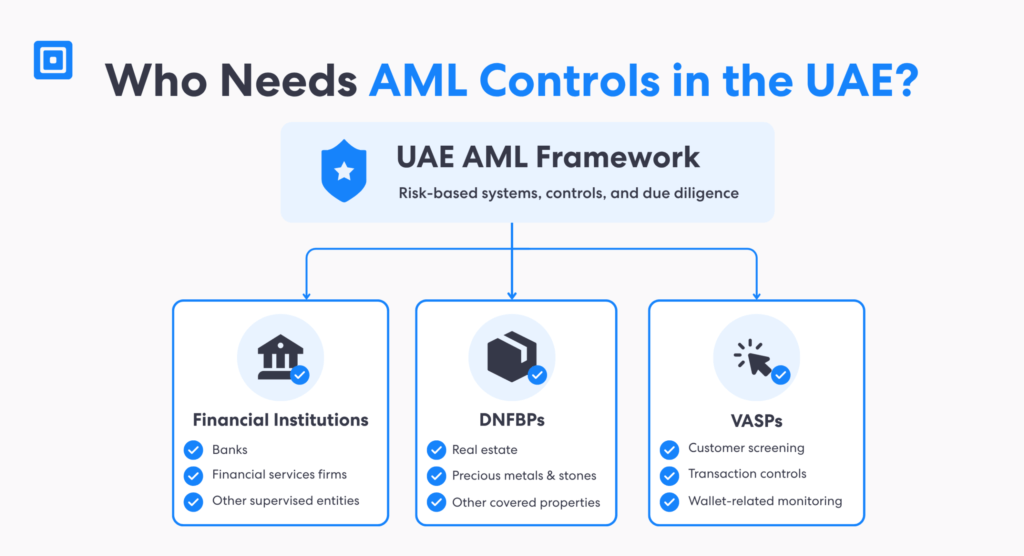
Therefore, AML controls are mandatory even though UAE law does not recommend one specific commercial AML software product for every firm. The requirement is to ensure compliance through effective systems, policies, and controls. They need to be suited to individual firms’ risks, customers, products, and supervisory frameworks.
Banks and Financial Institutions
For UAE banks and other financial institutions, customer screening should continue over the course of the relationship, not stop after the initial onboarding and risk assessment. According to the CBUAE guidance, they require ongoing due diligence, risk-based controls, and proactive detection of financial crime risks.
The best AML systems support financial transparency and economic stability. Systems like this can help institutions find suspicious relationships faster than normal, well before risk can grow. Buyers need to assess how integration, risk analytics, and governance work together, along with the raw speed of an AML screening API.
Designated Non-Financial Businesses and Professions (DNFBPs)
Non-Financial Businesses face unique AML compliance challenges in the UAE. Customer volumes, transaction patterns, and compliance resources can change significantly from traditional banking. For example, real estate firms and dealers in precious metals may need to carefully examine beneficial owners, source information, and complex ownership structures.
For many businesses, AML services support standardized due diligence, identify high-risk customers, and surface risk factors without creating unmanageable manual processes. Therefore, before adding any additional AML software, firms must ask if a platform actually streamlines operations or adds another disconnected queue for reviewers.
Virtual Assets Service Providers (VASPs)
Dubai’s Virtual Assets Regulatory Authority (VARA) requires VASPs to screen clients and transactions against applicable UNSC and federal sanctions frameworks. Moreover, they recommend that providers use regularly updated automated systems and that automated sanctions controls operate in real time. This is why real-time screening is incredibly important for this regulated segment of the UAE market.
For VASPs, customer screening is just one part. Adding on transaction monitoring and wallet-related controls may be needed to prevent financial crimes and manage more risk exposures. The strongest AML architecture links those signals with case management instead of treating each alert as a singular event.
Case Study: CBUAE’s May 2026 Thematic Review of AML Screening Software
The CBUAE examined whether UAE banks are effectively screening customers against the UAE Local List and the UNSC Sanctions List. They then froze and reported confirmed matches as needed. This exercise covered roughly 15 million records against the UAE Local List and 15.72 million against the UNSC list, creating a large-scale effectiveness test.
Combine Name Screening with Identity Evidence
The review used fuzzy name matching to meet regulatory demands. Then, they validated potential matches against any additional attributes such as birth details, nationality, passport information, and trade licenses. Banks with confirmed batch screening matches provided evidence showing detection, freezing, and reporting. That is why thorough metadata and decisions that can be properly traced matter.
Outcomes
15 UAE Local List matches with eight entity matches and seven individual matches.
5 UNSC entity results with three confirmed matches and two partial-name matches.
Controls worked overall; however, two reporting delays were identified after freezing action.
Global Watchlists Are Useless If They Update Too Late
An important factor is whether AML software provides timely access to relevant updates in UAE and global sanctions lists. Clear information about the sources covered and the update process is very helpful. Real-time updates matter where the regulatory framework requires rapid action. However, buyers must distinguish API response time from the speed of data ingestion and re-screening.
Ask providers how their data licensing works, which lists are direct or aggregated, and how quickly a new designation is available for production screening. The best answers explain the whole control chain instead of using “real-time” as an undefined marketing claim. A faster API means little if the underlying list change reaches the AML platform hours later.
PEP Match Is Not a Sanctions Match
PEP screening should provide context for a risk-based decision. A political exposure is not always equivalent to a sanctions prohibition. Compliance teams should test relatives, close associates, historical PEP information, and the supporting evidence available when a potential match appears.
Those match results must feed customer risk assessment and Enhanced Due Diligence (EDD) where necessary. This is especially important when other risk factors also increase overall exposure. Dynamic risk scoring also updates a customer risk profile whenever behavior, status, or new information changes the underlying assessment.
More Adverse Media News Does Not Mean Better Screening
Similarly, adverse media screening reviews news and other credible sources for information that indicates corruption, fraud, money laundering, or other related financial crime risk. However, the value of adverse media depends on its relevance. For example, duplicate stories, weak sources, and namesakes can create false positives without giving useful investigative context for compliance teams.
UAE buyers must ask providers how they assess source quality, language, recency, entity resolution, and the relationship between a story and the screened subject. Effective adverse media screening aims to enable proactive detection without letting news volumes overwhelm human reviewers.
Complexity in UBOs and Complex Ownership Structures
Business screening should extend beyond a legal entity name. Often, beneficial owners, directors, and controllers may introduce separate AML compliance concerns. Therefore, identifying ultimate beneficial owners can be complex and challenging, even more so when ownership spans multiple jurisdictions, holding companies, or other complex ownership structures.
As a result, an integrated AML solution can connect Know Your Business (KYB) data with beneficial-owner screening, risk profiling, and ongoing due diligence in one review path. That gives compliance officers a clearer view of ownership risk instead of having separate tools with disconnected customer data.
Where Exact Matching Breaks Down in AML Screening Software
Name screening is extremely important in the UAE market. This is because Arabic-to-Latin transliteration can produce multiple valid spellings for the same individual. Aliases, reordered name components, common names, and incomplete records can further complicate both automated screening and analyst review.
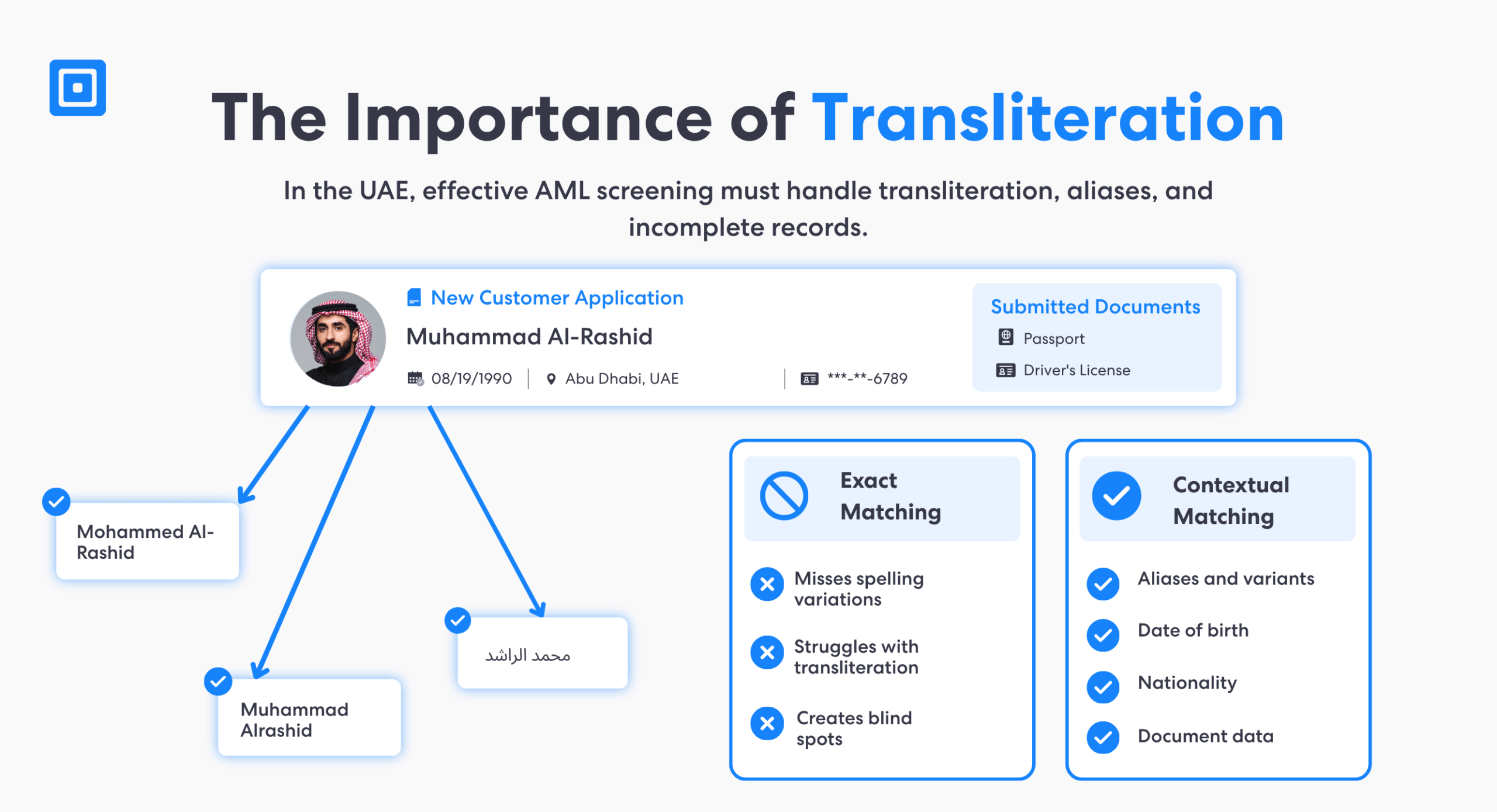
Fuzzy logic matching helps identify variations and typos. However, artificial intelligence or fuzzy algorithms alone do not guarantee an accurate result. Test realistic Arabic and Latin variants, along with dates of birth, national documents, and other useful metadata. So, if a provider cannot show how it handles the names your customers actually use, claims of”global coverage” deserve closer scrutiny.
The False-Positive Trade-Off Buyers Discover Too Late
A major challenge in AML screening is false positives. Excessive alerts increase operational costs and can seriously distract analysts from genuinely material cases. However, an overly restrictive threshold creates the opposite danger by suppressing true risk. The most effective systems balance detection sensitivity with false positives.
Ask providers how thresholds can be calibrated. Learn how secondary identifiers can impact matches, and whether previous review decisions can influence repeated alerts. The goal is to lower false positives without weakening the institution’s ability to identify relevant financial crime exposure. Remember, having a quiet alert queue does not automatically mean that it is a good alert queue.
The Case Management Alert Is Only the Beginning
Case management functionalities can help compliance teams greatly. They can track alerts, evidence, ownership, escalation, and investigations all the way through to resolution. Generally, alert generation must flag suspicious or potentially relevant events for human review. They also need to preserve enough context to support a defensible decision.
Automation stops being a screening feature and becomes part of the overall compliance operations process. Finding a name is useful, but proving why a case was cleared, escalated, or reported makes a control truly defensible. Similarly, strong case management helps prevent unresolved alerts from disappearing into inboxes, spreadsheets, or other manual processes.
The best anti-money laundering solutions will not remove human judgment.
ComplyCube CEO and Founder, Tarek Nechma, goes on to say, “The right AML screening software will give compliance teams better signals, clearer evidence, and more defensible decisions.” That is exactly the role that technology must play. Automated systems, risk analytics, and artificial intelligence can help prioritize information. However, humans remain responsible for material decisions.
The most credible AML-compliant software makes that judgment easier to explain. There is no hiding behind an opaque model. As a result, audit logs should provide tamper-resistant or otherwise protected records. They must outline what screening was, what evidence was found, and how the team arrived at a decision.
For verification, buyers must learn to test if historical screening events, reviewer actions, and later sanctions screening, politically exposed persons, or adverse media monitoring can be reconstructed reliably. Strong evidence can help show regulatory compliance, particularly to UAE regulators who scrutinize the effectiveness of systems and controls.
Being “audit-ready” means that teams must be able to reproduce evidence, demonstrate clear accountability, and have records aligned with applicable retention requirements. If a reviewer cannot do this later, the original screening result has limited evidential value.
Key Takeaways
- AML screening software must detect relevant risk and support timely action.
Local requirements, Arabic names, UBOs, and sector-specific exposure should shape testing.
It is crucial to blend onboarding with monitoring, due diligence, and dynamic risk assessments.
Case management and audit logs should make important decisions reproducible.
Use realistic customer data to measure matching, false positives, integrations, and escalation.
How ComplyCube Supports AML Screening Software for the UAE
Non-compliance with AML regulations can lead to severe penalties. That is why the best AML screening software providers must have accurate customer screening, proportionate risk assessment, reliable monitoring, and defensible decisions across your compliance operations.
ComplyCube supports UAE businesses in connecting identity, risk, and monitoring without relying on fragmented tools. Their proprietary AML screening software solution helps individuals and businesses with multilingual matching, entity resolution, continuous monitoring, and coverage across international, regional, and local lists.
For UAE firms, that integrated model can reduce fragmentation between customer verification, screening, risk assessment and ongoing due diligence. Learn how ComplyCube aligns with your regulatory requirements, customer population, workflows, and risk factors. Talk to our team today.

Frequently Asked Questions
Which sanctions lists matter most in the UAE?
In the UAE, financial institutions such as banks, and DNFBPs and VASPS, must prioritize UAE and UN sanctions requirements. Then, they must add other global sanctions lists where customers, transactions, counterparties, or internal policies make them relevant..
How often should customer screening happen for due diligence?
Customer screening should continue after initial onboarding. This can be done through periodic, event-driven, or configured re-screening on a daily basis, where appropriate, based on the firm’s needs and applicable regulatory requirements.
Can AML screening reduce false positives?
Yes, better metadata, fuzzy matching, secondary identifiers, calibrated thresholds, and analyst feedback can lower false positives in batch screening, where entire customer databases can be reviewed at once. This allows teams to preserve sensitivity and identify real financial crime risk.
Why does Arabic name screening matter?
Sometimes, Arabic names can show up in multiple valid Latin transliterations. Therefore, multilingual name screening, combined with aliases and secondary identifiers, is crucial in the UAE. Now, compliance teams distinguish real matches from their namesakes.
Why choose ComplyCube for UAE AML screening and a risk-based approach?
ComplyCube’s award-winning platform brings KYC, KYB, and AML screening with multilingual matching together. With strong entity resolution and ongoing monitoring, their AML screening platform helps UAE firms build more integrated, risk-based compliance workflows for customers.