
TL;DR: KYC fraud detection helps compliance teams link identity, biometric, behavioral, and contextual signals across the financial system. If the evidence, applicant, and surrounding risk signals form a credible story, that is completely different altogether. This guide covers overlooked fraud signals, why they matter, and how AI-powered KYC fraud detection can close gaps.
KYC Fraud Detection As A Fast-Moving Public Fraud Problem
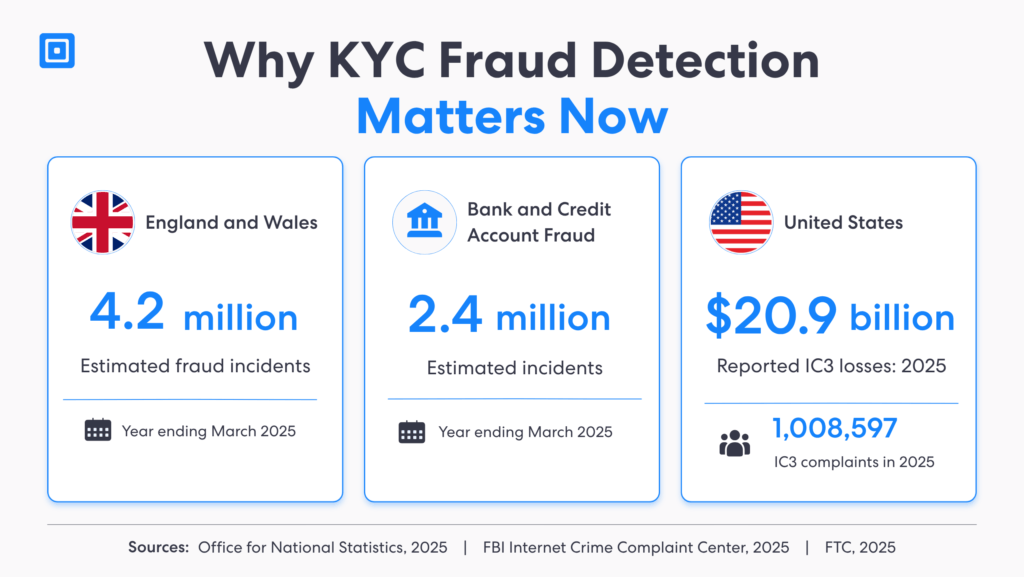
Fraud is a compliance issue that impacts millions of people. The Office for National Statistics estimated that 4.2 million fraud incidents in England and Wales took place in 2025. This is 31% more than the previous year. Similarly, bank and credit account fraud accounted for almost 2.4 million incidents.
The picture of fraud and emerging threats is actually quite similar in the United States. For example, the Federal Bureau of Investigation (FBI) has a Crime Complaint Center that received 1,008,597 complaints in 2025. This accounted for $20.87 billion in reported losses. The Federal Trade Commission (FTC) also separately received three million consumer fraud reports in 2025, with consumers reporting $15.9 billion in losses.
This pressure is twofold. Financial institutions and other regulated businesses must prevent fraud without hindering legitimate customers. They also must maintain regulatory compliance with Anti-Money Laundering (AML) requirements. As a result, acquiring modern KYC fraud detection systems are necessary for compliance teams as well as fraud, risk, product, and customer onboarding teams.
Fraudsters can now test identity combinations, documents, devices, and application patterns at scale. This makes a single successful document or biometric data check act as a weak endpoint for fraud decisioning. This is especially important as fraudulent activity and financial crime tactics evolve.
Fraud is Much Easier to Scale
INTERPOL’s March 2026 Global Financial Fraud Threat Assessment explains financial fraud as an ever-changing transnational threat. It thinks of artificial intelligence (AI) or advanced machine learning models, low-cost digital tools, and growing criminal collaboration as important factors in fraud expanding its scale and complexity. Secretary General of INTERPOL, Valdecy Urquiza stated,
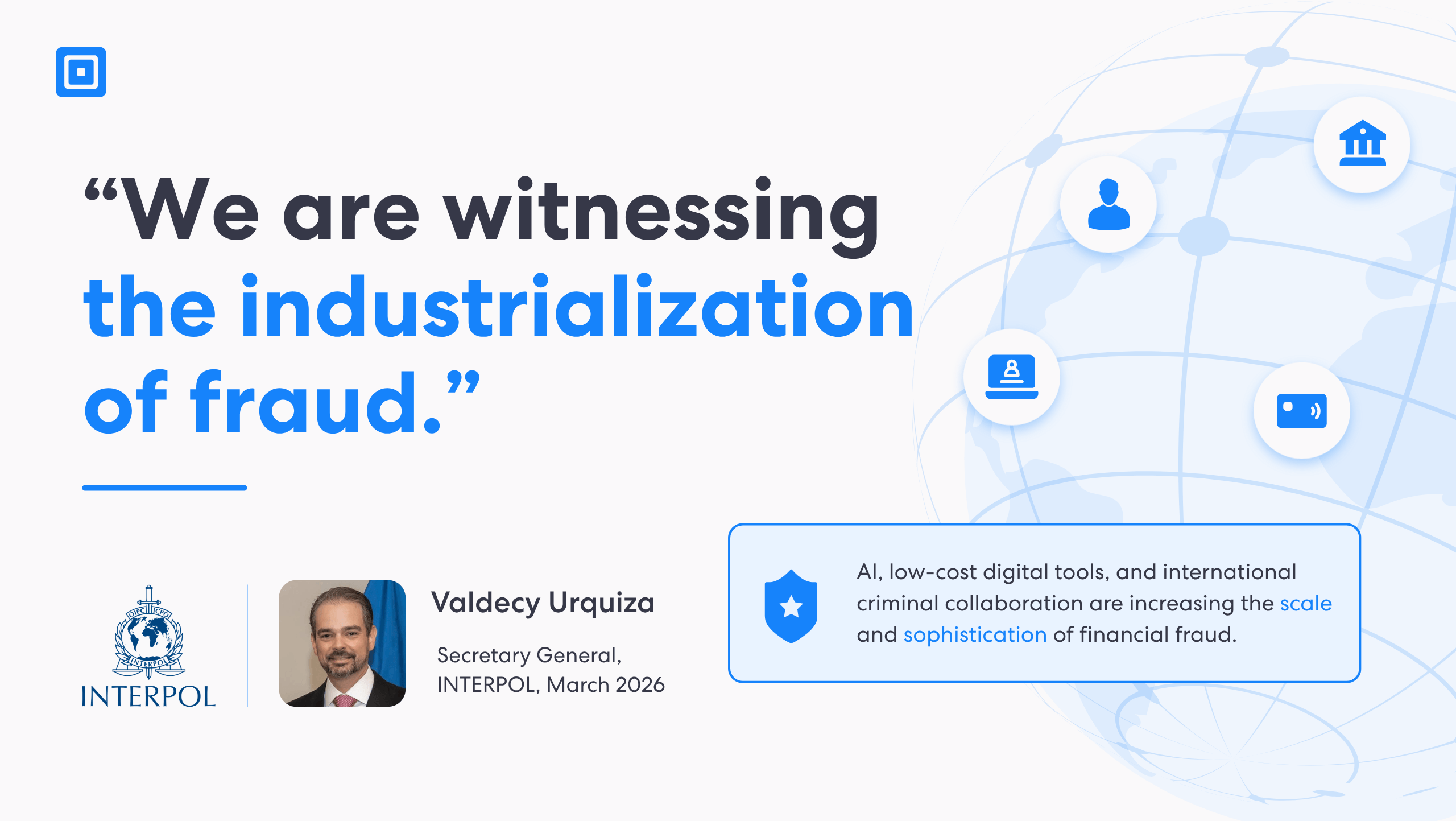
We are witnessing the industrialization of fraud.
He also said that, “It is vital to remember that the cost of financial crime is not just money. It is people’s life savings, their dignity, and in the worst case, their life.” A verification process can impact how we review identity theft attempts, unusual transaction patterns, synthetic identity profiles, and coordinated attacks.
What is KYC Fraud Detection?
Know Your Customer (KYC) compliance began back with The Financial Action Task Force (FATF) in 1989. It was established to combat money laundering and other financial crime activity. As a result, the KYC process includes the use of identity, document, biometric, and contextual controls to determine a customer’s identity. This is especially important with customers who may be using misleading information or false, stolen, or manipulated identities.This supports the wider KYC fraud detection system by determining if evidence can be validated and the applicant presenting it can be trusted.
National Institute of Standards and Technology (NIST)’s 2025 Digital Identity Guidelines gives a helpful distinction between the two. Identity proofing considers identity resolution, evidence validation, attribute validation, and fraud mitigation as separate projected outcomes. A piece of evidence can be real without proving that the person presenting it is the rightful owner of that data.
Strong KYC fraud detection weaves those layers together to ensure regulatory compliance while reducing human error. Customer identity verification and fraud detection can help consider if other risk signals make the customer’s application suspicious even with a pass on the KYC verification result.
10 KYC Fraud Detection Signals To Look Out For
A KYC pass does not make an individual or organization immune from fraud risk related to terrorism financing or money laundering. For example, a document can be genuine but stolen from someone else. Sometimes, a face can match while other attributes remain inconsistent. Typically, an advanced fraud detection process blends government issued documents, databases, facial recognition, and biometric verification.
Different identity verification processes answer different important questions. Therefore, a successful answer to one, does not settle the other ones. The following 10 KYC fraud detection signals showcase where distinction matters the most:
1. Finding a genuine document in the wrong hands
The first and often most common blindspot is assuming that a genuine identity document means that there is a real applicant on the other side. For instance, consider a real passport being used by someone else. Document authentication will prove that the document is authentic, but identity theft is still happening in that moment. NIST’s identity verification requirement emphasizes confirming that the applicant is the real owner of the validated evidence. That is why identity verification needs to progress after the passport itself passes.
2. Learn to recognize synthetic identities
There is another challenge that comes with synthetic identity fraud. Often, individual attributes can look believable while the combined customer identity is false or misleading. As a result, criminals and fraudsters will look to exploit compromised personal information in order to secure financial transactions. They will use this along with fabricated or made up data to create coherent applications of customers.
Synthetic identities are hard to manage because individual attributes may pass validation separately while the combined identity never existed as a real person. NIST states that having an Identity Assurance Level 2 is meant to protect customer transactions against these synthetic identities and attacks. It needs identity resolution to find out that the claimed identity is actually linked to a real and unique person within the relevant population.
3. Go beyond basic biometric verification with liveness and presentation attack detection
Facial recognition helps determine if an applicant actually resembles the image or photo on an identity document. However, facial similarity cannot be the only proof that a biometric interaction is genuine during onboarding. Other variables to consider include liveness detection and presentation attack detection.
They add another layer by reviewing if the verification system is dealing with a real person instead of a fake image, replay, or other spoofing attempting. Many fraudsters leverage AI-enabled to commit fraud. As a result, biometric controls need to determine who the person appears to be and if the interaction can, in fact, be trusted.
4. Looking beyond document authentication for KYC fraud detection
Sometimes, even if a customer grants valid evidence, they can interact with a service in a weird way. An example is using devices, networks, or sessions that they would not normally. This factor adds additional risk signals that identity documents are incapable of providing.
Real customers can change devices, travel, or use different networks that could potentially cause a technical anomaly. However, the most important point to consider is whether several differing signals together generates enough risk for a profile to have more investigation. This layer reduces missed fraud attempts and false positives, thereby making risk assessments proportionate to the evidence available.
5. Detect identities, devices, and attributes reused across applications
Sometimes, a single onboarding attempt may look real. However, patterns reveal more when applicants use the same device, phone number, document details, or other attributes that appear across many different unrelated customers. This is where machine learning, AI systems, and graph-based analysis can come into play. They help identify clusters and recurring relationships that would be hard to find with individual checks. These outputs should bolster defined fraud policies and investigations.
6. Watch for unusual onboarding velocity
A high application velocity can be indicative of automated or coordinated fraud especially when the same device, network, identity attributes, or contact information shows up over and over again within a short amount of time. However, in shared households or workplaces, applicants can also create overlapping signals that might be flagged as suspicious behavior. Instead of using strict velocity rules, KYC fraud detection should blend application frequency with various types of evidence before raising risk.
7. Test whether geographic signals are consistent
Cross-border activity is not normally suspicious. For example, a customer might have a passpor from one country, live in another, and finish onboarding while travelling elsewhere. This is where geography becomes useful especially when several signals conflict. Several pieces of information such as a declared address, document country, IP location, device history, and later transaction destinations can be assessed together. It helps determine whether the whole customer story is credible.
8. Corroborate identity claims with independent evidence
Customer-supplied information does not prove that the applicant owns or controls the identity being claimed. Important identity attributes should therefore be corroborated through reliable and independent evidence where appropriate. For individuals, that may include authoritative identity data and validated documents. The key question is whether independent sources support the same identity story rather than whether each individual data point merely exists.
9. Combining weak risk signals for strong KYC fraud detection
Fraud signals look weak when looked at alone. For instance, a new device may be real, a foreign IP, and recently issued phone number too. Yet, when those signals come together along with repeated verification attempts or reused identity attribute, it changes the risk picture. AI-powered analysis can find these combinations at large scale. This is why compliance and fraud teams are still responsible for how the resulting risk score impacts the customer.
10. KYC fraud detection must not end at customer onboarding
Fraud risk can emerge after a customer has successfully passed onboarding. Account takeover, behavioral changes, new adverse media or politically exposed persons (PEPs) information, unusual transactions, or changes in customer circumstances can all alter the original risk assessment. Continuous monitoring connects those later signals back to the customer information collected during onboarding. Transaction history, expected behavior, and updated KYC information can help teams recognise when the original customer risk assessment needs to be revisited.
Where KYC Fraud Detection Fits Across the Customer Lifecycle
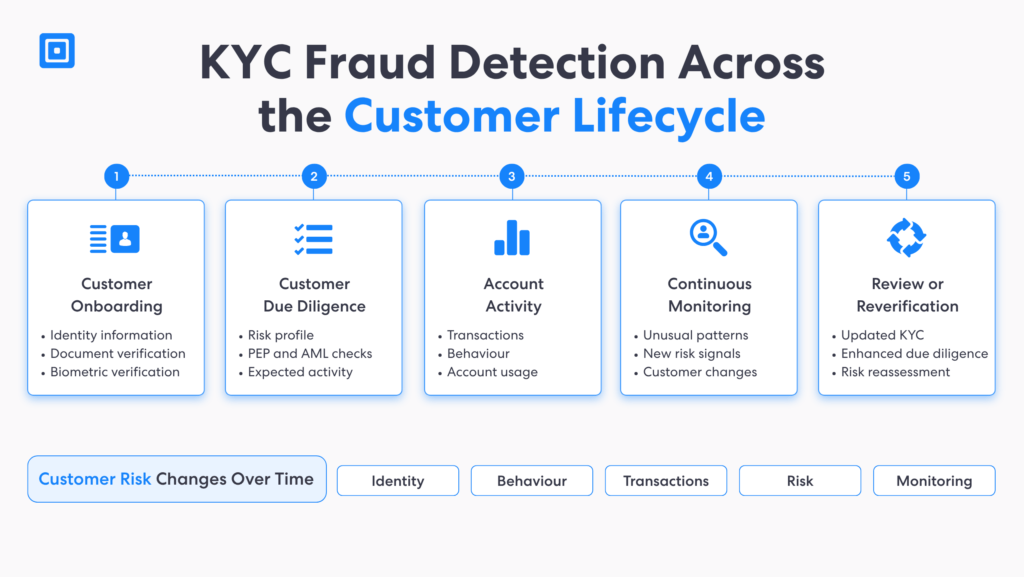
KYC fraud detection must change with the nature of the customer relationship. It must not be a one-time onboarding control because it increases in riks over time. Therefore, different stages of the process will answer different questions about identity assurance, expected behavior, and changing financial crime risk.
Establish an Identity Baseline at Onboarding
At first, customer identification and verification sets the foundation. For example, this could happen at the start of customer onboarding or with the opening of a bank account. Here, identity information, documents, biometric data, and other evidence helps teams understand who a customer really is, and if the applicant can be reasonably linked to the identity that is presented.
Use Customer Due Diligence to Understand the Customer’s Risk Context
The next layer is Customer Due Diligence (CDD). The CDD process often adds context around the purpose of a relationship, geography, and business activity. It also provides further details around ownership, expected transactions, PEP, and other relevant financial crime factors. This context is much needed later on when fraud signals are more meaningful. These unusual transactions or change in behavior could be the key to understanding what normal customer activity should look like. You can learn more here: What is Customer Due Diligence (CDD)?
Apply Enhanced Due Diligence When Risk Increases
Similarly, Enhanced Due Diligence (EDD) adds more protection when customer or transactional risk needs it. This typically involves gathering more evidence and reviewing ownership structures and business licenses. It also considers source information as well as applies much more intensive monitoring. The goal is to create risk-proportionate friction. Higher-risk customer profiles often justify deeper review, but applying those same enhanced AML controls to every customer impacts operational costs, customer abandonment, and rates of false positives.
Reassess Risk and Financial Crimes Through Continuous Monitoring
Ongoing monitoring helps identify when customer behavior, transactions, ownership, or other risk factors no longer align with the original profile’s financial behavior. Rather than treating onboarding as the final KYC decision, firms can use monitoring to determine when customer information needs updating, risk needs reassessing, or additional due diligence is required.
Case Study: Real Identities, Fraudulent Documents
In June 2025, eight people in Puerto Rico were charged with alleged fraud and an aggravated identity-theft conspiracy. The defendants seemingly stole identifying information from victims and created hundreds of fraudulent Puerto Rico driver’s licenses. They contained different combinations of victims’ names, dates of birth and licence numbers along with photographs of members of the alleged conspiracy.
Link the Presenter to the Claimed Identity
The alleged scheme did not depend entirely on invented identities. Prosecutors said real victim information was mixed with fake driving licenses containing photos of alleged conspirators. That demonstrates the distinction at the center of KYC fraud detection. Valid identity data does not prove that the person presenting it is the rightful owner.
Outcomes
Eight people were indicted on charges including conspiracy and aggravated identity theft.
Prosecutors alleged that hundreds of fraudulent licenses were created.
This scheme combined real victim information with different photographs.
Protecting The Customer Experience
More fraud checks are not indicative of creating better fraud prevention. Applying the same level of scrutiny to every applicant can result in more false positives, manual review, abandonment, and operational cost. Moreover, it reduces overall customer satisfaction.
Better risk segmentation and a proactive approach creates smarter friction. Low-risk customers can continue through automated checks, uncertain cases can receive step-up verification, and higher-risk cases can be routed for deeper investigation. The goal has the proportionate amount of friction based on the evidence presented.
KYC Fraud Prevention Works Best as a Layered Framework
The best and most thorough frameworks blend many different verification processes such as identity resolution, biometric verification, and due diligence processes. For example, documents can provide one type of confidence while biometric evidence establishes another. Similarly, CDD adds context and continuous monitoring finds risks that show up later on.
Having a layered KYC fraud prevention model that prevents terrorist financing helps businesses and other financial institutions to verify identities and financial statements. It also helps recognize any form of identity fraud, money laundering, or other illicit transactions or crimes that appear at many different stages of the overall customer lifecycle.
Key Takeaways
A real document does not prove if the applicant actually owns the identity.
Synthetic identities contain individually credible but collectively misleading data.
Weak fraud risk signals become more important when assessed together instead of separately.
KYC fraud detection must happen after the onboarding process with customer risk changes.
Better risk segmentation can strengthen fraud prevention without adding too much friction.
Strengthen KYC Fraud Detection With ComplyCube
In summary, ComplyCube helps businesses bring identity verification, document checks, biometric controls and AML screening into modular KYC processes. Learn to build a layered approach to KYC fraud detection that safeguards sensitive data to support customer onboarding.
Understand how fraud detection capabilities and regulatory requirements are met with ComplyCube while keeping friction proportionate to risk. Get in touch with our team to discuss how your organization can strengthen KYC fraud detection across the customer lifecycle in alignment with global AML regulations.

Frequently Asked Questions
Can a customer pass KYC and still commit fraud?
Yes. A genuine document, successful biometric match, or valid customer attribute does not guarantee that every element of the application is trustworthy. Strong KYC fraud detection assesses identity evidence alongside device, behavioral, contextual, and ongoing risk signals.
How AI-powered KYC improve fraud detection?
AI models can analyze large volumes of identity, biometric, behavioral, device, and application data to identify relationships and anomalies that fixed rules may miss while tracking transaction patterns. It works best when outputs remain explainable and operate within fraud policies and human oversight.
Why does KYC fraud detection need to continue after onboarding?
Customer risk can change after onboarding because of account takeover, behavioral changes, unusual transactions, or newly identified financial crime risks. Continuous monitoring helps firms reassess customers when later activity no longer matches the original risk profile.
How can financial institutions reduce KYC false positives?
Financial institutions can reduce false positives by combining multiple independent signals rather than treating individual anomalies as proof of fraud. Risk-based thresholds and step-up verification can focus deeper investigation on customers with stronger evidence of risk.
How can ComplyCube strengthen KYC fraud detection?
ComplyCube blends identity verification, various types of screening, and configurable workflows to help businesses determine fraud signals in onboarding and monitoring. This enables firms to apply strong controls that meet global regulatory frameworks where risk grows while keeping friction proportionate for real customers.