TL;DR: An electronic Know Your Customer (KYC) platform can accelerate digital KYC, strengthen eKYC compliance, and make customer onboarding a secure digital journey. However, buyers of an electronic KYC platform must demonstrate fraud resistance before choosing a provider.
What is an Electronic KYC Platform?
An electronic KYC or eKYC process uses technology to verify customer identity, assess risk, and collect evidence of verification. It replaces or supplements current traditional KYC processes that rely on physical documents, branch visits, and manual data entry.
A complete procedure combines various methods of verification, such as document checks, biometric authentication, and checking against trusted databases. Additionally, by incorporating Anti-Money Laundering (AML) screening, Customer Due Diligence (CDD), and workflow orchestration, teams can build out a more thorough digital process.
Choosing an Electronic KYC Platform Is a Risk Decision
In 2026, it is not a simple feat to buy an electronic KYC platform. Businesses must be able to find out the difference between real customers and stolen or artificially generated identities in less than a minute. This guide is for compliance leaders, risk officers, and product owners evaluating eKYC platforms for regulated industries. It talks though how to challenge vendor claims, run a realistic proof of concept, and identify weaknesses. Often a polished sales demonstration can conceal this information.
The real question here is if an eKYC system can conduct identity verification reliably across different markets, devices, profiles, and risk scenarios. They also must support and satisfy regulatory compliance requirements and customer expectations. Deepfakes and generative artificial intelligence (AI) are putting remote onboarding processes under a great deal of pressure.
How the eKYC Process Works
The eKYC process has five connected stages. This includes data collection, document capture, evidence validation, biometric data verification, and a final risk decision. However, AML screening and Enhanced Due Diligence (EDD) may be required. You can learn more here: Navigating the World of Enhanced Due Diligence.
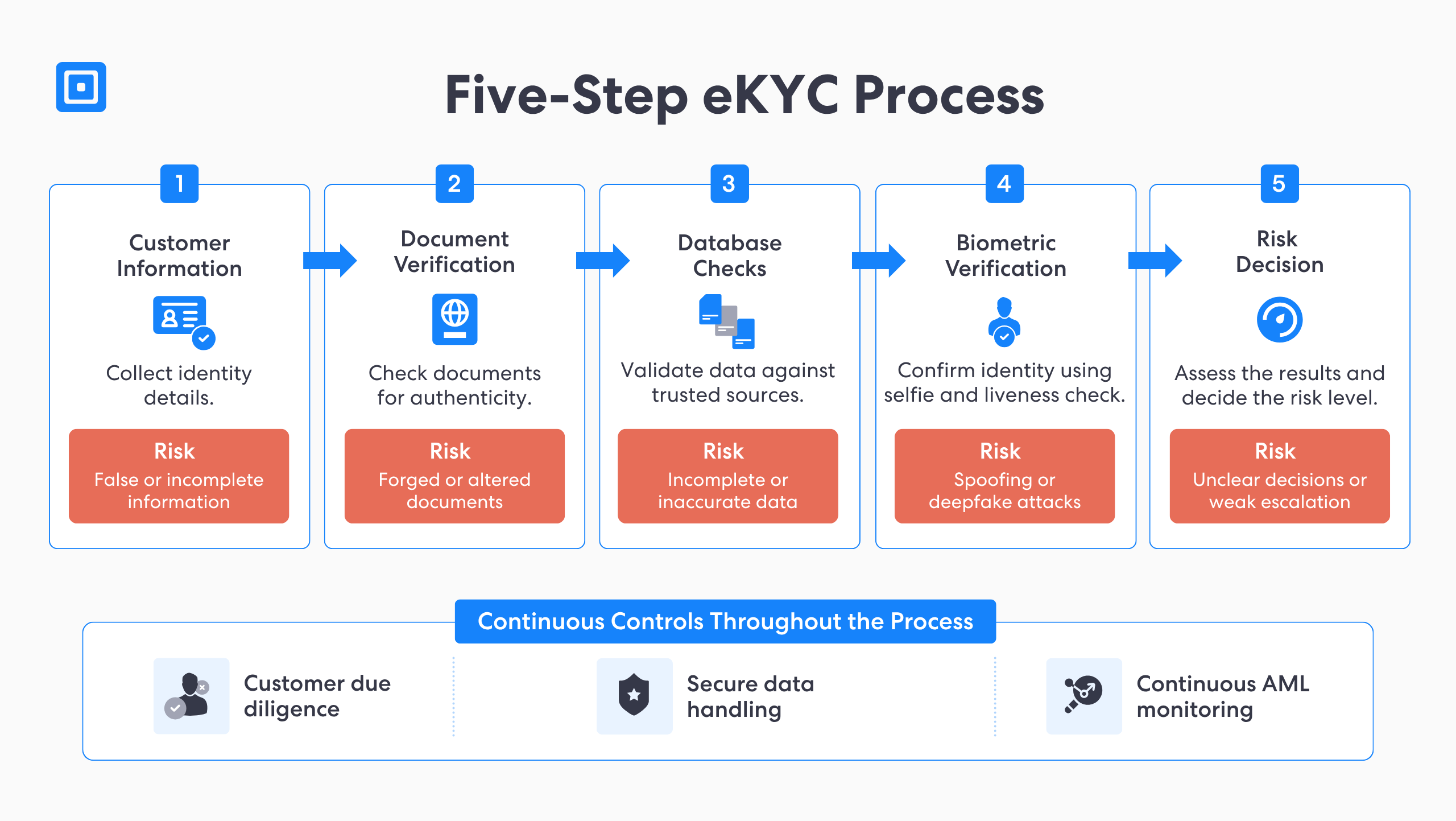
Customer Information Collection
In the first step of the identity verification process, a digital KYC platform collects personal details such as name, date of birth, address, and government identification numbers. An electronic KYC platform must be able to validate whether the information is correct, consistent, and appropriate in accordance with the necessary regulatory requirements.
Document Verification
Here, the goal is to capture a passport, national identity card, or driver’s license. Features such as Optical Character Recognition will be able to extract information from documents. Meanwhile, security checks can review the structure, data fields, and expiry dates to determine whether there were any signs of physical or digital manipulation.
Biometric Verification
Biometrics helps teams compare a customer’s face with the image within their identity (ID) documents. Facial recognition technology, and other facial biometrics, can figure out if the applicant is a real, present person rather than a photograph, mask, replay, or manipulated feed.
Digital Verification and Database Checks
After gathering all this information, an eKYC platform will attempt to validate the evidence against trusted databases or authoritative records. So, depending on the jurisdiction or risk level, this can include someone’s address, mobile phone number, government, or electronic identity data.
Risk Decisioning and Audit Trails in Due Diligence
In the end, electronic KYC platforms must combine verification results, fraud-detection signals, and due diligence rules to approve, reject, or escalate customers for manual review. Compliance teams need to record these results to show how KYC compliance propels identity verification.
The Buyer’s Electronic Know Your Customer Stress Test
To determine whether an electronic KYC platform is a good fit, teams should stress-test it against real-world conditions. The test should show how the platform handles damaged identity documents, weak internet connections, and manipulated content injected during onboarding.
An electronic KYC platform should be judged by the auditable evidence that informs its risk decisions.
Account Executive at ComplyCube, Billy Baird, goes on to say, “When evaluating eKYC platforms, it is not about the number of boxes it can check. The strongest eKYC solution should be able to explain how its checks work, what their limitations are, and how performance changes across different types of customers.”
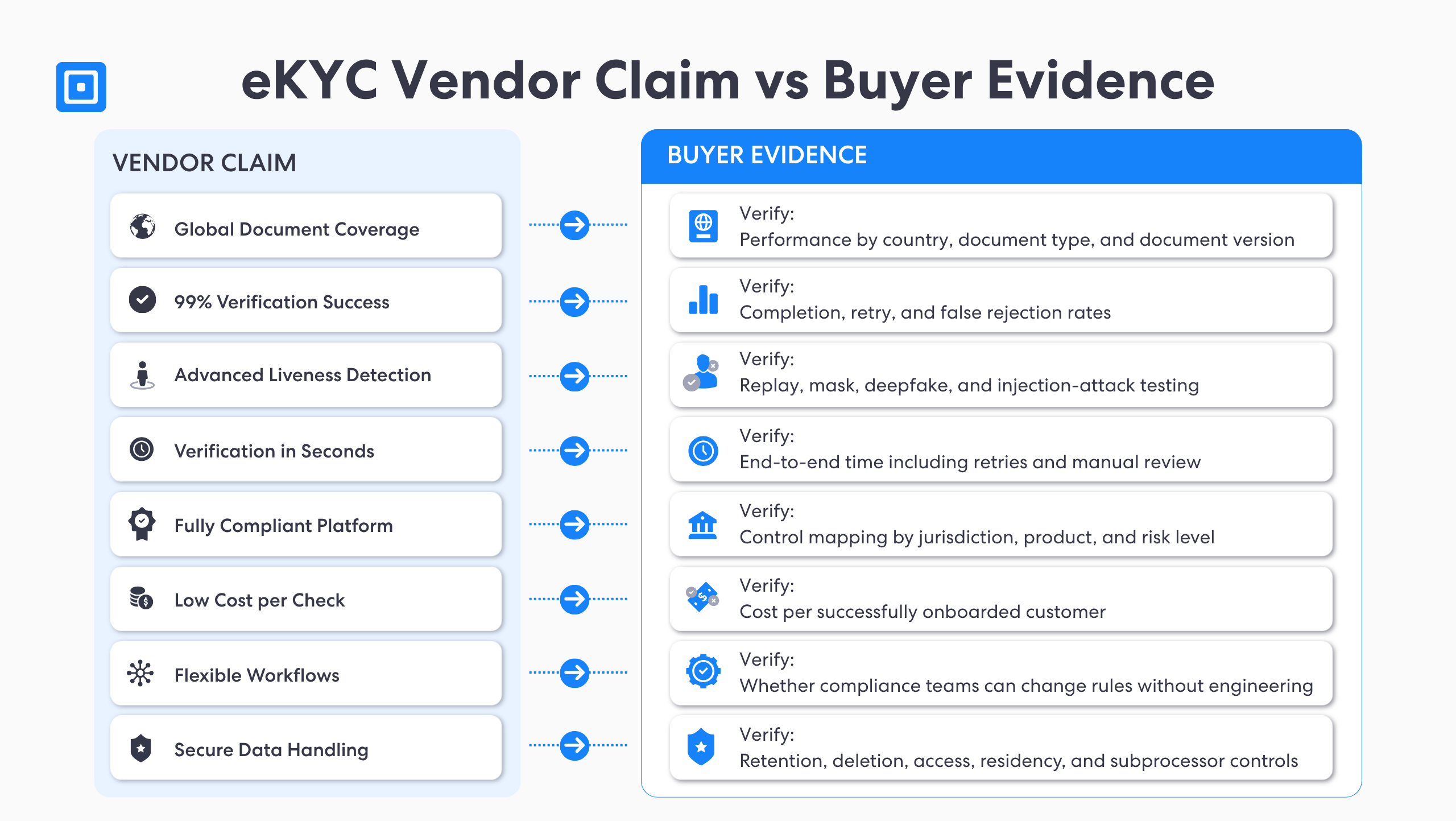
That is why buyers need segmented evidence with realistic testing. They also need a clear escalation process based on risk management appetite. Some of the most common vendor claims include document coverage inflation, and verification success metrics. Buyers need to evidence these claims.
Case Study: Rathbones Pauses High-Risk Client Onboarding
In June 2026, UK financial institution Rathbones announced that, following an engagement with the Financial Conduct Authority (FCA), it had identified areas requiring significant improvement in its compliance processes, oversight, and assurance arrangements.
Rathbone’s Two-Year Compliance Remediation Program
Rathbones launched a two-year program in response to address the Skilled Person Review recommendations. They conducted a targeted assessment of selected clients, and paused onboarding of new customers ensuring they completed an EDD review for up to 12 months.
Outcomes
- New clients were paused up to 12 months, affecting $370M in gross inflows.
- Rathbones expected its remediation and related actions to reduce profit.
- Their share price fell by 17%.
12 Electronic KYC Platform Red Flags
Most electronic KYC platform providers can highlight their features attractively, but the real differences show up in how those features handle pressure. Teams also assess how transparently results are measured and how well the platform adapts to regulatory, operational, and fraud risks. The following red flags give massive warning signs that buyers must look for and investigate before making any commitment.
1. Global Coverage Number
Today, many vendors may claim to provide support for thousands of different identification documents across various jurisdictions and authorities. However, the term “supported” could mean anything from simple image capture to detailed and thorough verification. Teams should identify which document versions, languages, and security features their platform has been tested with.
Teams should request performance data for the specific markets they serve. A driver’s license from one country may perform very differently from a passport issued elsewhere, and aggregate acceptance rates can conceal weak regional results.
2. Unqualified Success Rates
Another major red flag is when providers advertise a 99% success rate. They should be able to disclose the common denominator, sample population size, and the treatment of manual review. Without this context, that statistic only says so much about real eKYC identity verification performance.
Teams should request false acceptance, false rejection, completion, retry, and abandonment rates. Where sample sizes allow, they should also break results down by document type, country, device, capture channel, and customer cohort.
3. Data Extraction is Presented as Fraud Detection
Where OCR can extract text, it does not establish if the document is authentic. Strong document verification processes must examine evidence integrity, templates, security characteristics, and portrait substitution. This also includes field manipulation and digital injection.
The European Banking Authority (EBA) has guidance on remote onboarding that requires financial firms to determine whether their solutions can verify the validity and authenticity of official documents. Remote onboarding must be able to reliably bind the evidence to the person that is being verified in the moment.
4. “Liveness” is Left Undefined
Though biometric data can improve data security, it also brings privacy, performance, and presentation attack risks. To prevent fraud, a buyer must find out if the provider tests printed images, screen replays, or masks. Today, teams must also be able to test deepfakes, virtual cameras, and injection attacks rather than relying on a generic liveness label for a customer profile.
False positives and rejections can happen in biometric authentication. Many variables, such as lighting, camera quality, age, accessibility, and demographic variation, can impact verification results. The electronic KYC platform should explain when human review becomes necessary.
5. Speed Excludes Failure Handling
A provider may say that eKYC verification takes seconds while excluding capture retries, timeouts, manual queues, and unresolved cases. What should be measured here is the complete onboarding process from the customer’s first action to the final usable decision.
The goal is to promote a consistent customer experience while responding differently to varying levels of risk. For instance, low-risk customers do not need much friction. Still, any uncertainty should trigger the right checks rather than automatic approval during account setup.
6. The Platform Tests Yesterday’s Threats
Identity theft or other financial crimes combine breached customer information, synthetic attributes, forged evidence, and compromised devices. Fraudsters are not relying just on physical documents. They can create convincing customer relationships and applications all over an online environment.
According to the NIST Digital Identity Guidelines, expanded fraud controls for identity proofing include measures that address injection attacks and forged media. It is the buyer’s responsibility to ask whether the provider tests for these attacks and how quickly they adapt their traditional KYC practices when new fraud techniques emerge.
7. “Compliant” is Treated as a Feature
There is no digital KYC platform that can make a business compliant with various compliance authorities and government regulations in a single setting. Minimum requirements change on a case-by-case basis between regions and industries.
The Financial Action Task Force (FATF) Guidance on Digital Identity states that regulated organizations need to understand if a digital identity system is reliable, independent, or appropriate for the relevant customer due diligence risk.
8. Onboarding and Monitoring Are Disconnected
Initial onboarding only establishes what a firm knows about a customer at the beginning of the business relationship. However, when sanctions exposure, political connections, and other risk factors change, compliance teams must update the customer’s profile accordingly.
Initial customer identification and ongoing due diligence are two separate functions. Buyers need eKYC systems to link their ‘customers’ information to ongoing monitoring, investigations, and case management, rather than treating KYC as a one-time check.
9. Sensitive Information Has No Clear Lifecycle
KYC requirements involve collecting a range of personal information, including documents, facial images, and biometric templates. If a breach were to happen, it could expose a lot of sensitive identity data that customers might not be able to replace as easily as a password or login.
The UK Information Commissioner’s Office (ICO) biometric data used to identify a person is special category data under the UK General Data Protection Regulation (GDPR). The ICO advises that organizations consider data minimization, storage limitation, and biometric template protection. This prevents any breach risks and determines if a Data Protection Impact Assessment is required.
Encryption, retention periods, and deletion processes play a critical role in eKYC compliance. Buyers should also assess breach response procedures and evidence portability. Automated verification can support consistent privacy controls, but it does not by itself prove that customer data is processed lawfully or securely.
10. Every Applicant Follows One Journey
Banks should not apply every verification method identically to every customer. A rigid onboarding process creates unnecessary friction for low-risk applicants while failing to apply sufficient controls to higher-risk cases.
A risk-based approach applies assurance levels and controls based on the customer’s money-laundering and terrorist-financing risk. Teams can adjust verification measures when simplified or enhanced due diligence is appropriate. An effective digital KYC process uses customer profiles, evidence quality, fraud signals, and regulatory requirements to determine which checks are necessary.
11. Configuration Requires Engineering
Teams should be able to easily respond to changes in KYC regulations, fraud practices, or internal processes. However, when every workflow needs a vendor development or internal engineering release, companies can struggle to keep their controls aligned with growing risks.
Digital identity requires continuous risk management, not a one-off implementation project. Buyers should confirm that authorized users can safely update thresholds, workflows, rules, and policies, with every change controlled, versioned, approved, tested, and recorded in the audit trail.
12. The Headline Price Hides the Real Cost
Finally, the cheapest solution could exclude a variety of features such as document retrieval, biometric checks, or implementation support. A headline unit price should be one input instead of evidence regarding the platform’s total commercial value.
The red flag here is based on total-cost-of-ownership analysis. The commercial evaluation should look at contract exit costs, access to verification evidence, and migration assistance. A low-cost eKYC solution can become expensive when other factors, such as rigid workflows or high volumes of manual review, come into play. Lastly, consider that the cheapest solution may exclude features such as document retries, biometric checks, or implementation support.
Key Takeaways
- All modern eKYC platforms should be evaluated based on proven performance.
Buyers must test verification controls against real customers and attack scenarios.
Strong compliance needs adaptable workflows, audit trails, and ongoing monitoring.
The true cost of an eKYC solution includes integration, support, and abandonment.
The best eKYC platform balances regulatory compliance, fraud prevention, operational efficiency, and customer experience.
Implement eKYC Verification Around Trust with ComplyCube
The best electronic KYC platform must help your business prevent fraud, meet KYC compliance, reduce operational costs, and create a smoother experience for legitimate customers. Explore how a risk-based verification process can support customers, markets, and compliance programs. Get in touch with ComplyCube to discuss your electronic KYC needs.

Frequently Asked Questions
How should a business compare electronic KYC platforms?
Businesses need to look at various factors before deciding upon which electronic KYC platform they should choose. They must look at document coverage, regulatory alignment, data security and integration effort.
Can eKYC be completed in under one minute?
Yes, some eKYC checks can be completed in under one minute when evidence quality is high and escalation is not needed. Actual completion time does depend on document capture, biometrics, device quality, and risk rules.
Does eKYC replace traditional KYC entirely?
eKYC can replace many time-consuming, branch-based traditional activities. However, business still require risk-based policies, CDD, escalation, record keeping, and ongoing monitoring. For some customers and regions, they need alternative options for verification.
What are the biggest risks when businesses implement eKYC?
The biggest risks for business in implementing eKYC are weak document authentication, biometric false results, deepfake or injection attacks and more. Effective governance and realistic KYC testing are just as important as automation.
How does ComplyCube support electronic KYC?
ComplyCube’s all-in-one platform brings identity verification, document analysis, biometric checks, and AML screening. With configurable workflows, and ongoing monitoring, businesses can create strong verification journeys required by eKYC compliance programs.