
TL;DR: Anti-Money Laundering (AML) processes turn regulatory requirements into repeatable workflows. Financial crime moving faster than ever and AML compliance software must keep up. The right AML compliance solution should identify when trust needs to be reassessed and clearly justify the decision it makes. This guide shows how AML compliance solutions help firms decide who to trust.
What is AML Compliance Software?
According to The United Nations Office on Drugs and Crime (UNODC), 2-5% of global GDP is laundered annually through financial crimes such as counter terrorism financing, money laundering, and sanctions violations. Anti-Money Laundering (AML) compliance obligations protect customers, detect financial crimes, and help institutions avoid huge financial penalties. AML compliance solutions find, review, monitor and provide evidence for money laundering risk across the customer journey. In 2026, AML compliance programs need to be more comprehensive than just screening customers against lists.
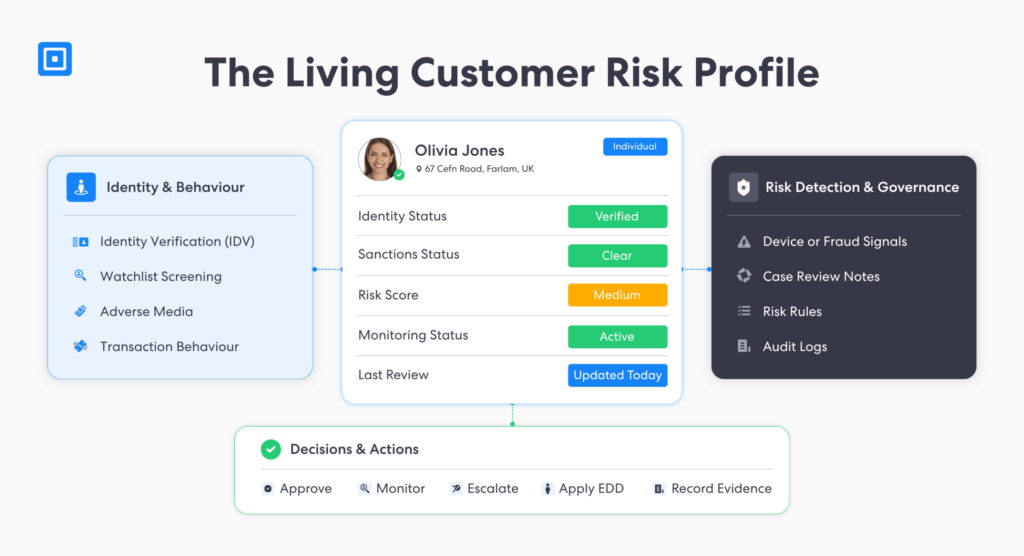
The original purpose of AML compliance software was risk management. While involving many moving parts, AML compliance solutions also gave firms a way to standardize compliance processes and reduce the reliance on manual review. But, as financial crime moves faster with evolving threats across various regulated ecosystems, compliance software needs to support a more strategic approach to help organizations meet requirements.
Point-In-Time AML Software Is No Longer Enough
Traditional AML check services are still relevant, but the problem is that they are not sufficient on their own. They only seem to capture financial crime risks at one moment in time. However, customer risk does not stay still after that moment passes. Often, a customer can pass onboarding checks, then later become linked to emerging threats, new global sanctions exposure, and terrorist financing. In this case, the right AML solution helps compliance teams gain a deeper understanding of what has changed, why it matters, and what should happen next.
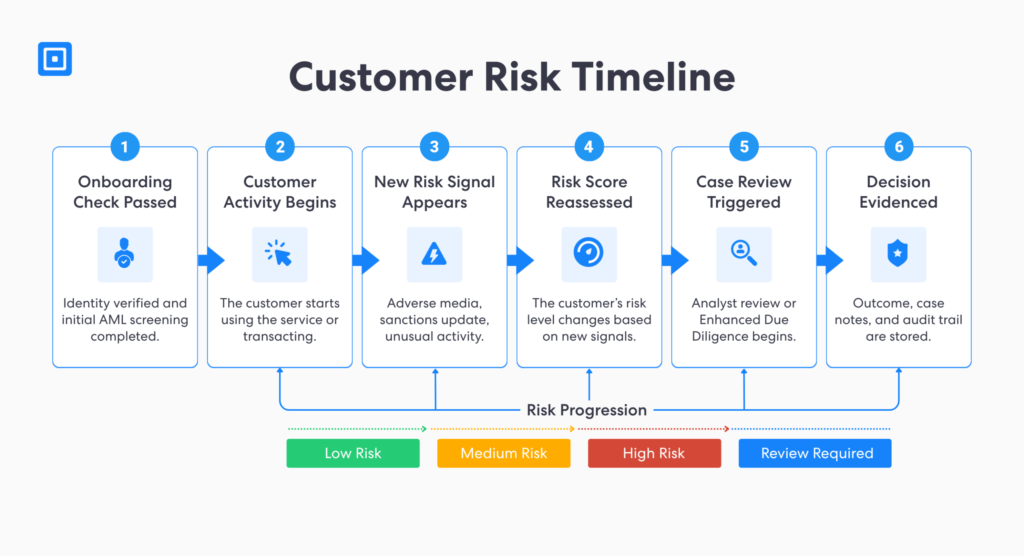
The original compliance model presents potential risks when it is difficult to monitor evolving threats across existing systems that are fragmented. For example, watchlist screening may sit in one workflow, while customer risk scoring is in another. Without connecting this information across different flows and generated reports, firms lack a holistic view of how customer risk is changing over time.
According to INTERPOL’s 2026 Global Financial Fraud Threat Assessment, connected views of AML processes are much better for warnings of financial fraud. This type of view is central to navigating polycriminality, the involvement of an individual or crime group in a variety of different criminal activities instead of one type of offense.
This report also states that AI-enhanced fraud is 4.5 times more profitable than traditional methods. For instance, agentic AI systems are now more capable of planning and executing fraud campaigns. AML programs must help firms notice when customer trust begins to change. As AI makes fraud easier to scale, it needs to become easier to identify unusual activity, or links to suspicious networks before trust breaks down. You can learn more here: Evaluating Anti-Money Laundering Software Beyond Monitoring.
AML Compliance Solutions as Trust Infrastructure
Compliance solutions need a much wider role when AML risks become dynamic. An AML compliance solution must become a part of a trust infrastructure. A trust infrastructure is a shared digital system, policy, or standard that allow various organizations, devices, and people to safely share data and verify identities. It helps guarantee integrity while allowing data, transactions, and other digital interactions to flow smoothly.
This shift is subtle, but incredibly important. A tool typically helps complete one task, whereas an infrastructure supports an operating model. A future-ready AML compliance solution helps firms answer a few practical risk questions throughout the customer journey such as:
- Is this customer who they claim to be?
- Have they been exposed to sanctions, politically exposed person (PEP), or adverse media risk?
- How has their risk profile changed since onboarding?
- Does their behavior still match their expected activity?
- Does this case need human review?
- Can firms or financial institutions prove why a risk decision was made?
The above questions demonstrate a targeted approach for AML compliance solutions. Customer trust is built, monitored, challenged, and consistently evidenced over time to keep up with reporting obligations and compliance needs.
Case Study: Wise’s Compliance Failure Investigation
On June 1st, 2026, authorities in Belgium announced that Wise, a British financial technology company focused on global money transfers, was reportedly engaged in money laundering. According to reports, criminals used several company accounts to move illicit funds into fraud.
Suspicious Activities, False Positives, and Customer Risk Assessments
The sheer size of this case points to a much wider systematic issue. This risk exposure was due to a lack of oversight and consistency in verifying high-risk users, businesses, and transactions. Wise could have better managed risks with a proactive approach with a strong AML program.
Outcomes
Wise supposedly moved $580M in suspicious transactions across 30 European countries.
The Brussels prosecutor and Wise are working together to investigate further details.
The fine shows the importance of comprehensive fraud detection software. It highlights how even established banks can enable high-risk users to bypass critical controls.
AI and Machine Learning in Regulatory Compliance
Today, advanced AML solutions incorporate machine learning for real-time detection. It is easy to assume that the answer to meeting AML regulations is more automation. If external risk exposure such as sanctions risks or third-party dependencies move fast, becomes well-connected, and harder to detect, it would make sense that artificial intelligence (AI) must take over more of the process. With the use of AI, AML solutions automate identity verification and watchlist screening.
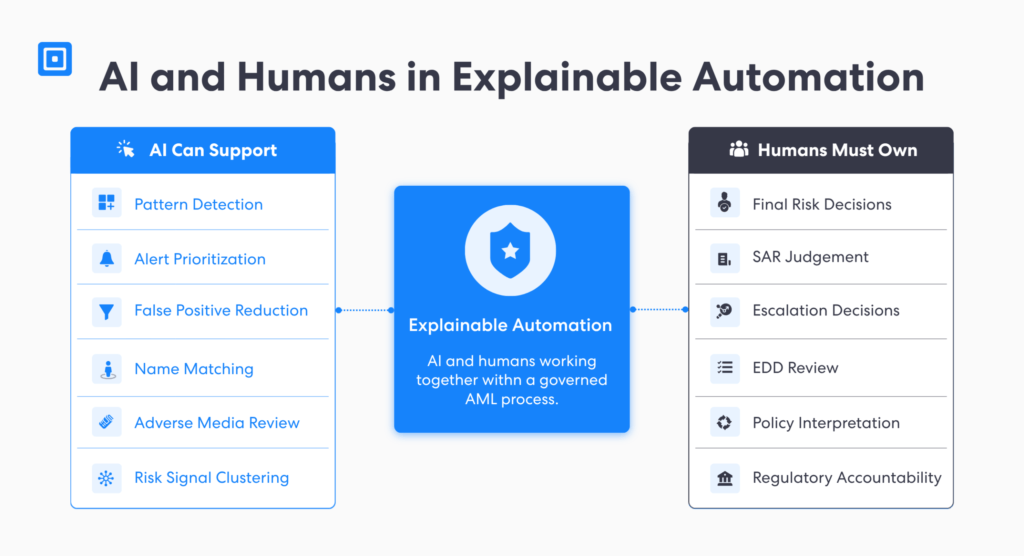
However, it is only partially true that using more automation for AML is the right solution. Of course, AI-driven solutions can help find risk factors, reduce false positives, and increase operational efficiency. Additionally, automated reporting assists in documenting suspicious activities for regulators. Yet, firms must not outsource accountability to a compliance model that they cannot properly explain.
Insights on AI in AML Compliance Software
In practice, the future is not fully autonomous AML solutions. Decisions need to be explainable to regulatory bodies. So if an AML compliance software changes a risk score, suppresses a low-value alert, or prioritizes one investigation over another, teams must be able to clearly understand why. Evidence must show how data was used, which analyst reviewed the case, and what financial crime prevention decisions were made.
The best anti-money laundering solutions will not remove human judgement.
CEO and Founder of ComplyCube, Tarek Nechma adds, “The right AML compliance solution will give compliance teams better signals, clearer evidence, and more defensible decisions”. Additionally, the Financial Conduct Authority (FCA) supports this more mature view of AI and innovation. This updated view uses synthetic data, artificially generated information that mimics the statistical patterns and characteristics of real-world data. Moreover, it does not contain real personal or historical records.
The 2026 synthetic data AML project developed alongside the Alan Turing Institute and Plenitude Consulting, generates a synthetic data set that can support innovation in money laundering detection. Synthetic data helps test AML typologies, risk model performance, and alert quality without exposing real customer records. Real financial crime data is hard to share as it can contain sensitive customer data. Additionally, privacy, legal, or confidentiality obligations prevent firms from sharing data.
Advanced Analytics and Testable AML Software
So, if the future is focused on being more explainable than fully autonomous, how can firms know if their AML compliance software is working? This is where testing comes in. Future-proof AML compliance solutions need to have an intuitive interface that is configurable. They also need to be tested against realistic examples of financial crime scenarios.
Firms need to be confident in their risk-based approach, screening logic, and workflows. The right anti-money laundering solution will detect important patterns without relying on live incidents. Overall, advanced analytics improves risk scoring and customer assessments. Regulated firms can look into what an AML compliance solution can automate and ask how risk controls are tested, governed, and further improved.
Features of The Right AML Compliance Solution
AML compliance software that acts as a trust infrastructure needs a completely different evaluation framework in the buying stage. AML compliance solutions must be assessed as a system. This system must link customer identity, risk signals, human decisions, and audit evidence.
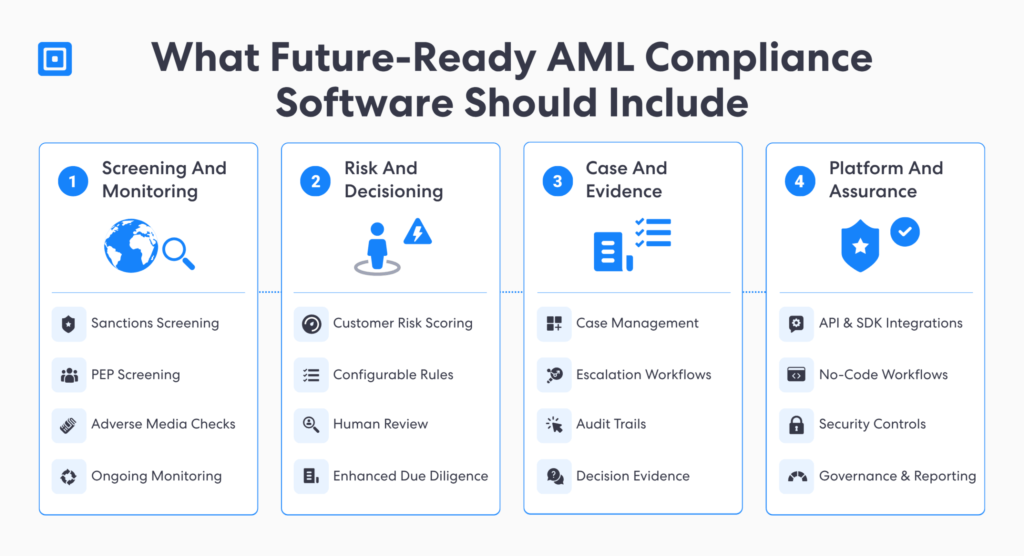
Seamless integration of AML risk signals from these key software features helps reduce false positives within the process. Regulated firms should look for AML compliance solutions that include the following aspects:
- Continuous sanctions screening, PEP, and adverse media screening
- Customizable risk scoring capabilities, and configurable risk rules
- Case management and escalation workflows
- Audit trails and decision evidence
- Real-time monitoring and alerting
- Identity, fraud, and AML signal orchestration
- Strong privacy, security, and governance controls
Finally, security and assurance are core buying criterion. AML compliance solutions handle some of a firm’s most sensitive data. If data is exposed, altered, or unavailable, it impacts customer trust, regulatory reporting and operational continuity. IBM reported that the global average cost of a breach stands at $4.44 million, while the United States average reached $10.22 million. Breaches can compromise regulated data and disrupt operations, but also weaken the confidence in a firm’s risk controls.
Key Takeaways
AML compliance software improves efficiency by moving toward a trust infrastructure.
An AML compliance solution must support explainable and evidence-ready decisions.
AI can improve fraud detection, but AI-enabled fraud will increase financial crime complexity.
Future-proof AML regulations compliance has smooth integration of varying fraud checks.
A strong AML compliance solution will help firms move faster with regulatory changes.
Choosing the Right Solution for AML success
While AML compliance software began as a means to organize checks, alerts, and records, it is changing rapidly. It is becoming the trust infrastructure that regulated entities need to build trust across the full customer life cycle. Integrated systems enhance collaboration across departments in AML efforts.
Financial crime does not wait for scheduled review. It can show up through synthetic identities, fraud networks, or a cross border investigation. The future of compliance will be measured by better decisions, clearer evidence, and strong control. Explore ComplyCube’s AML compliance software services and learn from our team about how to prove trust with our platform.

Frequently Asked Questions
How does AML compliance software work?
Anti-Money Laundering (AML) compliance software works by screening customers, scoring risk, monitoring, and helping teams review suspicious alerts. It links checks such as global sanctions, Politically Exposed Person (PEP), adverse media, case management, and audit reporting.
Why is AML compliance software becoming trust infrastructure?
AML compliance software is becoming trust infrastructure because risk is changing. Modern AML compliance solutions should verify who to trust, monitor that trust over time, and prove how compliance teams arrived as risk decisions based on the audit-trails and evidence presented.
Why are one-time AML checks no longer enough for case management?
One-time AML checks are not enough because customer risks change after onboarding. New sanctions exposure, additional adverse media, unusual activity, or new fraud signals can emerge later on, pushing firms to implement ongoing monitoring into the overall AML process.
What should the right AML compliance solutions include?
The right AML compliance solutions include many different checks such as sanctions screening, PEP screening, adverse media checks and more. It should also support configurable no-code workflows and secure, seamless integrations.
How does ComplyCube support business needs with AML compliance software?
ComplyCube combines screening, monitoring, and fraud checks as well as risk profiling, and case management in one platform. Its APIs, SDKs, hosted flows, and no-code workflows help compliance teams scale AML compliance with efficiency without adding unnecessary friction.