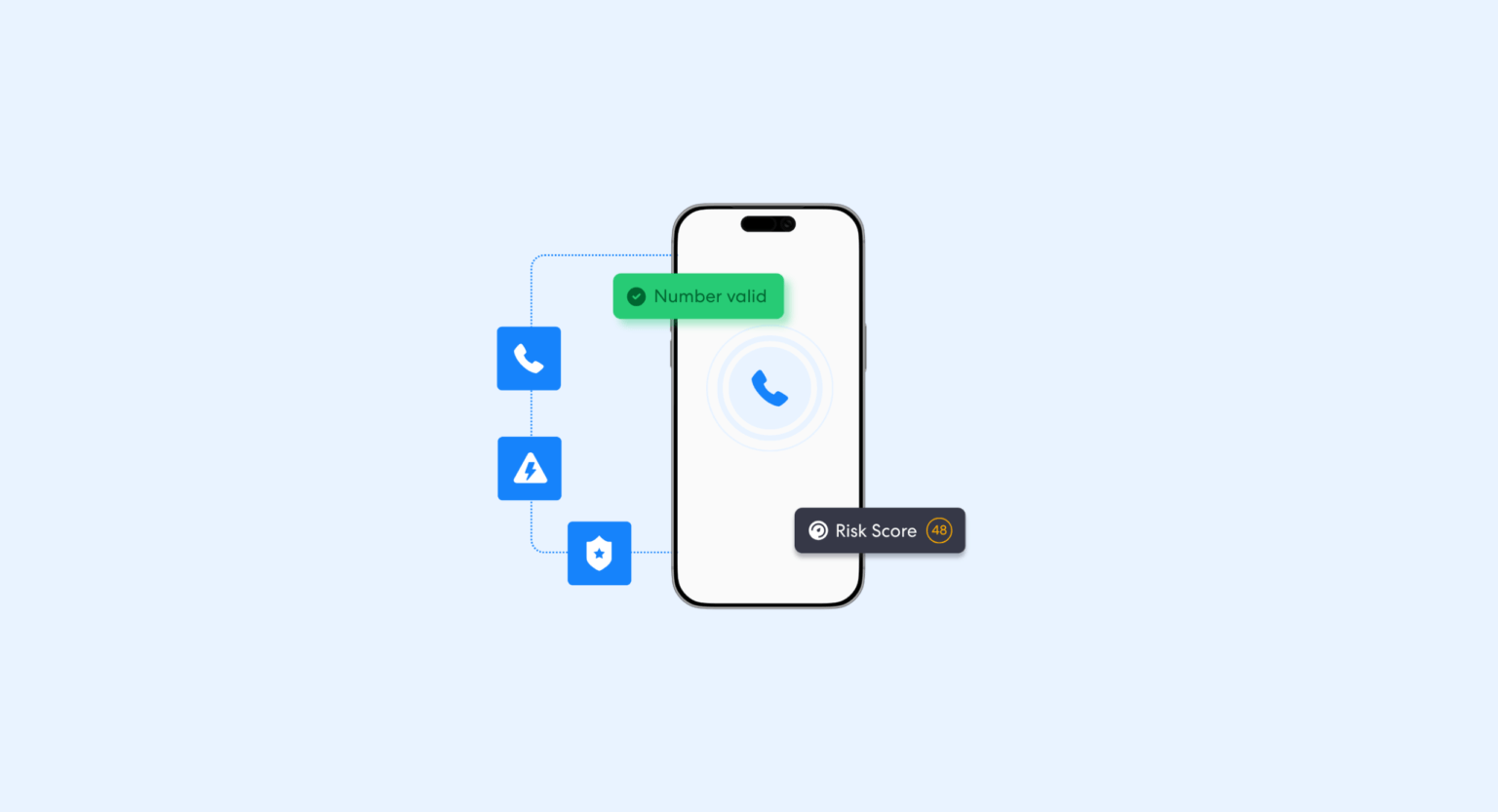
TL;DR: Mobile intelligence detects suspicious activity tied to a customer or business mobile number. It aggregates a phone risk score by gathering behavioral signals, including previous abuse and account takeovers. A mobile check strengthens fraud prevention, onboarding, and KYC decisions.
Mobile Phones Have Become a New Fraud Battleground
Mobile phones have become critical in accessing services, including opening a bank account, sending money, and renting a flat. Additionally, it provides a secure way to send and receive important text messages, such as an authentication code.
Although it led to convenience, it also created gaps for scammers to exploit. Fraudsters increasingly make use of compromised or stolen phone numbers for identity fraud, scams, and account takeover attempts.
Criminals are exploiting vulnerabilities in the system to assume control of victims’ mobile identities, with terrible results.
According to Cifas, unauthorized SIM swaps have increased by 1,055% in 2024, along with identity fraud in the telco sector rising by 87% in the last 12 months. As such, mobile intelligence has turned into a critical fraud intelligence layer, turning deep risk insights into trust.
Simon Miller, the Director of Policy, Strategy, and Communications at Cifas, echoes this urgency, “Criminals are exploiting vulnerabilities in the system to assume control of people’s mobile identities, with devastating consequences.”
What is Mobile Intelligence?
Mobile intelligence or phone intelligence assesses the risk linked to a phone number using of a variety of signals, including carrier, abuse analysis, network status, and number hygiene. It goes one step further than normal phone verification to determine if a phone number is real, trustworthy, and active.
Mobile intelligence can detect common red flags, including:
- Phone lines that become invalid or unreachable
- High-risk line types, such as disposable or recycled numbers
- Carrier or country mismatches
- Recently changed or ported numbers
- Repeated numbers across unrelated accounts
- Numbers linked to unusual velocity patterns
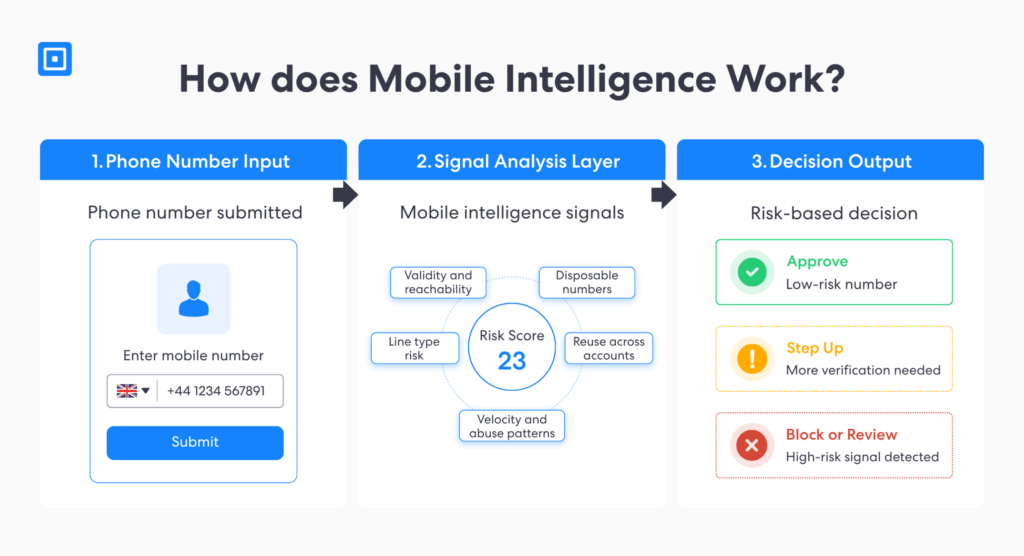
Typically, mobile intelligence aggregates a phone risk score based on these contextual and behavioral signals to block, approve, or step up verification, simplifying compliance decision-making. Many organizations make use of mobile intelligence solutions to support Identity Verification (IDV).
Since a phone number is typically the first information a user provides, a mobile check can accelerate sign-ups without making onboarding complex. As such, businesses can reduce fraud earlier in the onboarding process without adding friction to the customer journey.
Why Traditional Phone Verification is Not Enough
While traditional phone verification can be useful, it can have several blindspots. For example, a One-Time Passcode (OTP) verification flow can show that a customer has access to their number at a single moment. However, it does not show that the number is authentic or belong to the right person.
The Federal Bureau of Investigation (FBI) warns consumers and businesses alike on the increasing exploitation of phone numbers to commit identity fraud and scams. Social engineering techniques enable criminals to hijack a phone number, steal one-time passcodes, and bypass authentication.
The UK Finance reports £213.7 million losses to Authorised Push Payment (APP) fraud, with 35% initiated through telecom channels. As such, the need for mobile intelligence solutions in preventing fraudulent phone calls and SMS can no longer be ignored.
Mobile Intelligence vs Phone Verification
Phone verification checks whether a customer has possession of a device at a point in time, typically via OTP. On the other hand, mobile intelligence confirms whether a phone number in itself is real and safe by analyzing carrier and network signals in the background.
Mobile Intelligence vs Device Intelligence
Mobile intelligence specifically looks at phone number signals to assess risk and verify identity. Device intelligence instead looks at the device itself to assess session risk and spot fraud. Device signals include browser session, VPN usage, and IP location.
How does Mobile Intelligence Work?
When performing mobile intelligence verification, data sources from telecom providers, carrier signals, and network data are extracted. Next, artificial intelligence and machine learning models use this data to learn whether it is reliable by analysing behavioral indicators and historical events such as SIM swaps and port-outs.
A simple flow typically replicates the following:
- A person enters a phone number during login, signup, or payment.
- The system checks phone numbers, carrier status, device, location, and account history.
- The model creates a risk assessment and returns a risk score.
- The app allows access, asks for stronger authentication, or blocks the request.
For compliance teams, mobile check adds an early risk signal, supporting quicker decision-making before an onboarding journey starts. Advanced mobile intelligence solutions provide additional context on user intent, helping teams spot suspicious patterns, such as using the same numbers across multiple accounts.
Key Use Cases for Mobile Intelligence
Regulated companies make use of mobile intelligence in their flows where the phone number is a core identifier. For example, when clients open a savings account via a banking app, mobile intelligence flags potential inconsistencies before they escalate to fraudulent checks or fake check claims.
As a result, mobile check can protect funds and support secure contact by phone or in-app calls. Additionally, with strong data encryption, businesses can assess a wide range of risk signals without compromising personal data. Some examples of key use cases in different sectors include:
1. FinTech and Digital Mobile Banking
Financial services use mobile intelligence to verify that a phone number is genuine and active during account opening, enriching Know Your Customer (KYC) processes. A phone risk score is generated by confirming line type, carrier, and fraudulent history to reduce fake account creation and prevent account takeover. As a result, it solidifies verification for fund transactions, credit decisions, and client communications.
2. Insurance Companies
Insurers use mobile checks to confirm identity consistency during insurance claims. Mobile intelligence supports insurance firms in detecting common fraudulent patterns in staged-accident claims or duplicate claim submissions, where the same number is used across multiple policies or claims under different names. By identifying high-risk numbers, insurers can prevent identity takeover during policy servicing and stop fraudsters from exploiting mobile channels to submit false claims.
3. Cryptocurrency Providers
Crypto exchanges and Virtual Asset Providers (VASPs) face increasing losses to fraud every year, with the FBI’s Internet Crime Report noting over 181,565 complaints costing more than $11 billion in 2025. Mobile intelligence supports these platforms by detecting SIM swap attacks, number recycling, and accounts tied to known fraud operations. When layered with one-time password (OTP), it reduces unauthorized fund transfers from intercepted SMS codes and strengthens account security.
4. Healthcare and Medical Industry
Healthcare providers use mobile check to verify a patient’s phone number before sharing medical record downloads, sending appointment reminders, or processing medical claims. In the medical industry, common fraud can include using stolen personal phone numbers to bill for services or collect prescription drugs. Mobile intelligence can detect previous fraud claims, recent port-outs, or multiple identities across different patient records. Thus, sensitive patient records are safeguarded.
5. Telecommunications
Modern mobile intelligence solutions can flag high-risk registrations in real-time. This is crucial, especially in telecom firms, where fraudsters open large prepaid accounts with synthetic identities to route premium-rate calls or bypass interconnect fees. For telcos, mobile check can also prevent number spoofing and fake account abuse. Consequently, this prevents targeted social engineering attacks on susceptible victims, lured by fake phone numbers.
Key Takeaways
Mobile intelligence uses risk signals, including carrier and user behavior, to verify identity and assess fraud risk.
- Automated mobile checks use these signals to aggregate a phone risk score in real-time, streamlining decision-making.
While mobile phones have led to convenience in accessing digital services, it also caused the rise in identity fraud.
Banks, fintechs, and e-commerce companies use mobile intelligence to reduce fraud risks in onboarding and payments.
Mobile intelligence provides a security layer before onboarding, preventing fraud before full KYC verification.
Reduce Fraud and Enhance Customer Experience
In summary, mobile intelligence helps businesses strengthen fraud prevention by verifying legitimate phone numbers. However, the important thing to note is that mobile intelligence is not a standalone solution. Instead, it is combined with other verification solutions for a multi-layered KYC process. This includes, but is not limited to, OTP verification, proof of address checks, ongoing monitoring, and strong case management to meet reporting requirements.
Contact a member of the ComplyCube team if you are interested in learning more about our award-winning KYC and Fraud Intelligence solutions.

Frequently Asked Questions
Which companies need mobile intelligence solutions?
Businesses that regularly work with digital, remote customer interactions, transactions, and connected devices use mobile intelligence to verify identity and prevent fraud. Common examples include banks, insurers, telecommunications, marketplaces, and fintechs.
How does mobile intelligence prevent fraud?
Mobile intelligence prevents fraud by verifying that a phone number is real, authentic, and active. It uses risk signals related to a customer’s phone number, such as the line type and carrier, to detect suspicious behavior intent or prior fraudulent history.
Does phone intelligence replace SMS one-time passwords?
Not always. OTP verification and phone intelligence are used together to strengthen fraud prevention. OTP verifies that a user is who they say they are through real-time authentication codes. On the other hand, phone intelligence runs in the background to verify behavior intent and historical usage.
Can phone intelligence help with KYC compliance?
Yes. Mobile intelligence supports KYC compliance by enhancing customer authentication and identity assurance before full onboarding. When layered with other checks, including sanctions screening and document checks, it offers a robust method to verify genuine users.
What risk signals does ComplyCube’s mobile intelligence use?
ComplyCube’s mobile check analyzes multiple risk indicators to identify inactive or spoofed numbers. This includes usage activity and abuse history, number formatting, and carrier and network reputation. Next, the signals are used to generate a phone risk score of 0 to 100, to indicate the potential of it being inactive or linked to fraudulent behavior.