
The Central Bank UAE (CBUAE) imposed a $5.4 million (AED 20 million) AML fine on the UAE branch of a foreign bank. They were lacking in Anti-Money Laundering (AML), Counter-Terrorist Financing (CTF), and sanctions compliance failures. Though CBUAE did not name the institution, the message is clear. Foreign banks operating in the UAE are expected to show that they have financial crime controls that are effective. Documentation is simply no longer enough.
This AML fine enforcement action goes beyond the foreign bank. The CBUAE also fined the bank’s Head of Compliance and Money Laundering Reporting Officer (MLRO) $81,700 (AED 300,000). The MLRO failed to meet the responsibilities of their role. CBUAE’s decision demonstrates an importance in regulatory adherence, not only from an institutional standpoint, but also from an individual standpoint. Accountability is paramount, signaling that there is shared responsibility between institutions and their senior executives to oversee AML crime controls.
Why Does The CBUAE Fine Matter?
The CBUAE enforcement action reflects the UAE’s broader efforts to strengthen its AML framework. This is an effort to reinforce confidence in its financial system and a reminder that effective compliance must be shown through evidence rather than policy.
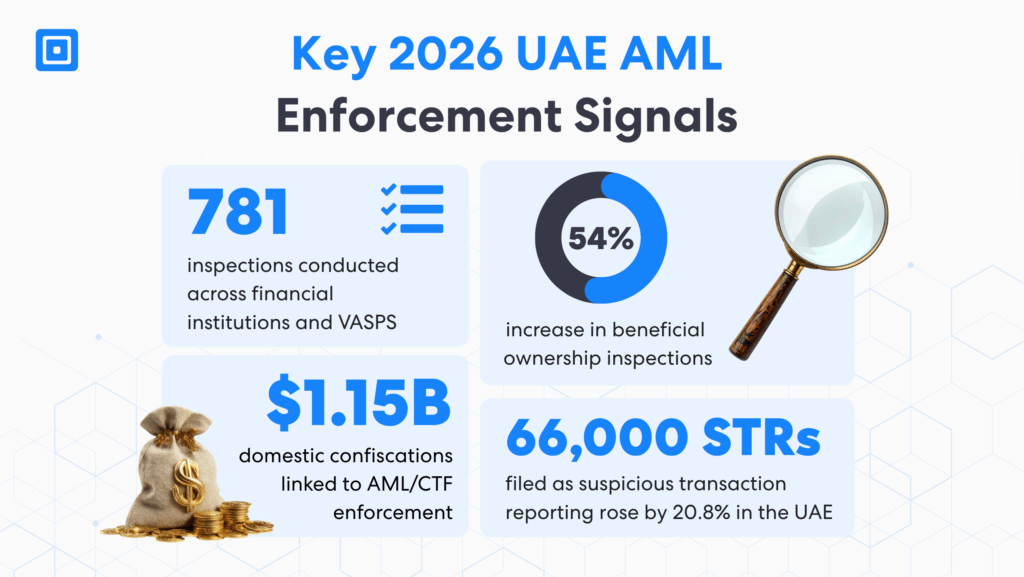
Assessing written policies, yearly reviews, and screening are only part of the picture. Firms are expected to show Customer Due Diligence (CDD), sanctions screening, and other AML controls as well as their escalation processes. Regulators need to understand that these systems are working correctly and on an ongoing basis.
The regulatory expectations are relevant for foreign bank branches. Global compliance programs or frameworks set the precendent for baseline controls. However, local regulators look to firms to show that those controls also operate well within the UAE’s regulatory framework. In that context, the CBUAE AML fine is less like an isolated enforcement action and more like another step in a larger more assertive approach to the UAE’s AML supervision.
The Bigger Picture For Central Bank UAE and Other Institutions
In summary, the UAE has invested heavily in strengthening its financial crime framework in recent years. Regulators are placing greater emphasis on effective AML governance, sanctions compliance, and risk-based supervision. Against that backdrop, enforcement actions such as this one are likely to become increasingly important indicators of regulatory expectations.
Rather than focusing solely on whether firms have compliance policies in place, supervisors are examining whether those policies identify risk, support timely intervention, and create clear accountability across the organisation. For banks, the Central Bank UAE message is straightforward. AML compliance must be operational, evidence-based, and continuously monitored.

Subscribe to ComplyCube’s Trust Edition newsletter, where we explore the top developments across identity verification and AML globally. Plus, we share valuable insights on compliance with the latest regulations.