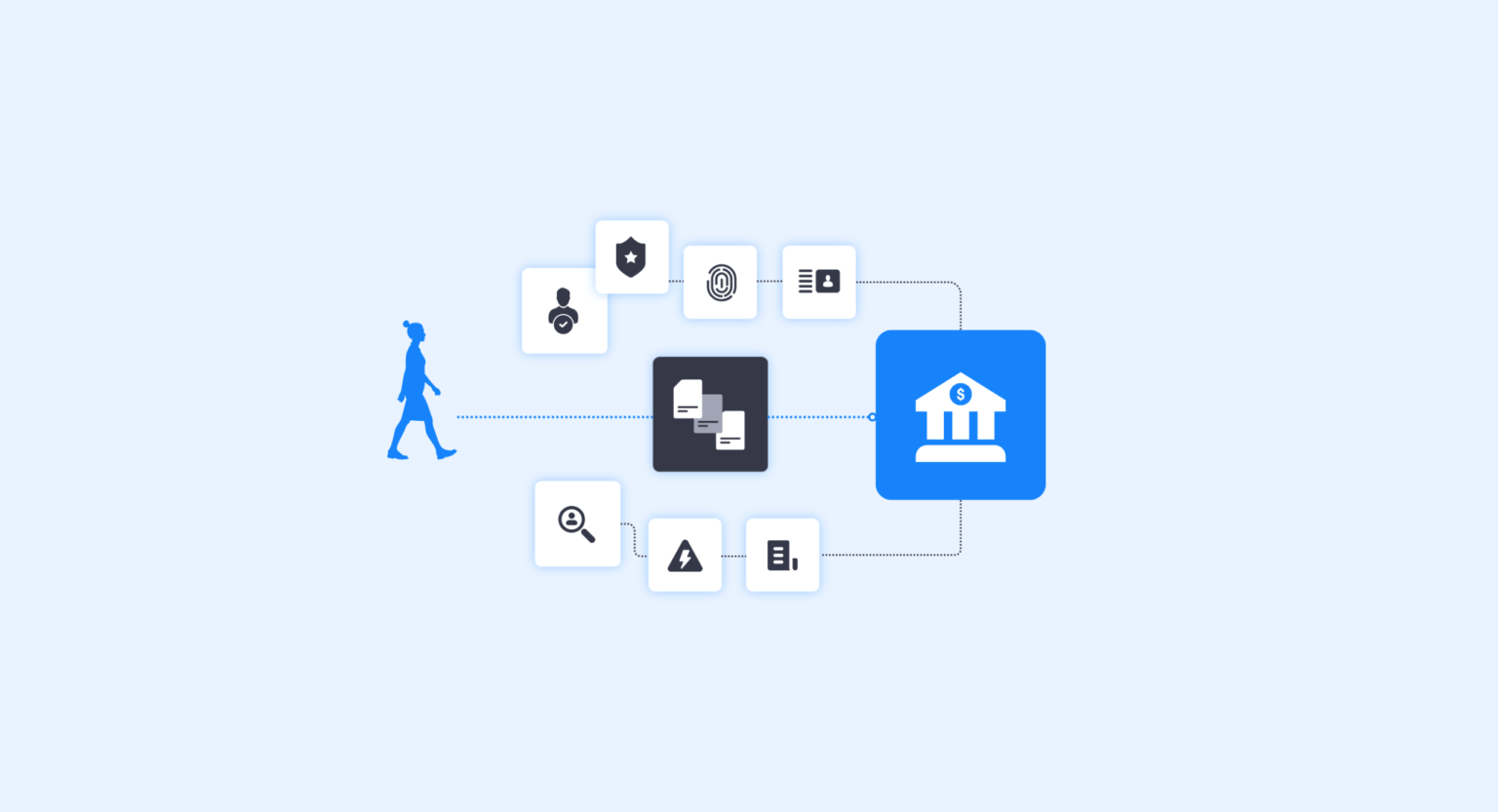
TL;DR: Customer onboarding KYC for banks help institutions verify real customers. Banks typically need to meet regulatory requirements and prevent fraud without forcing all applicants through the same checks. This guide is for banking compliance leaders looking to understand how onboarding KYC software for banks can improve risk journeys.
Customer Onboarding is a Compliance Priority
In 2026, the challenge around customer onboarding KYC for banks centres around completing the process fast to meet rising expectations. This must be done without weakening Anti-Money Laundering (AML) controls.
Industry research suggests that one in five onboarding applications are abandoned primarily due to Know Your Customer (KYC) and AML friction. Additionally, the average KYC review took 95 days in 2023, up from 84 days in 2022. These types of delays are often associated with repeated data collection, manual data entry, and disconnected systems.
However, compliance teams want to identify the applications needing more intense scrutiny and review. On the other hand, product and operations leaders want to create a seamless digital onboarding journey that is fast. That way real customers can move through easily and more rigorous protocols can be triggered for when crime risk signals appear.
What is Customer Onboarding KYC for Banks?
Customer onboarding KYC for banks is the process where a bank gathers customer data, verifies their identity, and decides if starting a business relationship creates a great deal of financial crime risk. This process involves risk assessment and Customer Due Diligence (CDD) and ultimately leads to an account-opening decision. However, when risks are high, Enhanced Due Diligence (EDD) may be the next step.
These protocols are important for compliance across various regulatory bodies as they help prevent fraud, identity theft, money laundering, and terrorist financing. This also allows banks to determine who they are serving and why the customer needs a certain product.
Establishing the Customer’s Identity
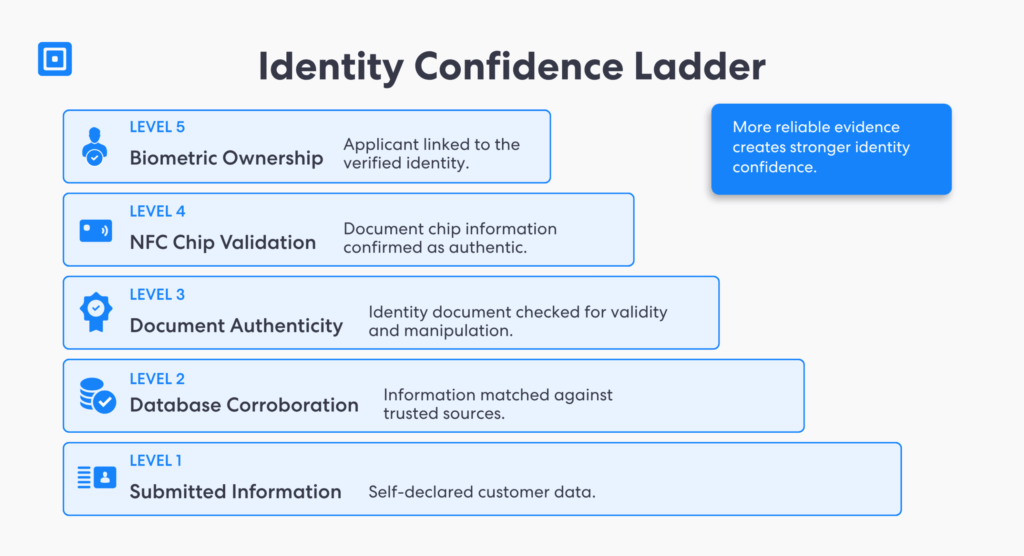
The first stage of customer onboarding KYC for banks is to establish a reliable identity profile using information and evidence proportionate to the product, channel, and customer. Every verification method provides a different type of assurance, so banks should assess the combined evidence rather than rely on a single result.
Customer Data Collection
At first, most banks start by gathering a customer’s legal name, date of birth, residential address, contact details, and identification number. In the US, Customer Identification Programs (CIPs) may need specific identity information before an account can be opened. You can learn more here: How CIP Requirements Impact U.S Banks
That data collected should be enough to build the customer’s identity and support the overall compliance process. Moreover, collecting unnecessary data can, in turn, create more friction without improving the quality of the risk decision. The correct onboarding data is also important after account opening. Incomplete client data can lead to false alerts, repeated requests, and costly remediation throughout the customer lifecycle.
Identity Verification
Identity Verification (IDV) determines if the supplied identity data relates to a real person and if the applicant is actually in control of that identity. Typically, a digital customer can be identified in authoritative databases using official proof of identity, document verification, or a combination of these methods. Other accepted evidence could be a passport, national identity card, or driver’s license.
The right method of data verification also depends on the product, region, customer type, and required assurance level. Banks should typically not assume that a single IDV route will work equally well across all regulatory frameworks and for every applicant.
Document Verification
For document verification, KYC onboarding platforms must assess the security features, expiry dates, data consistency, and signs of physical or digital tampering. It is also important to note that a readable document image does not prove that the document is genuine or that it belongs to the person presenting it.
By combining checks with facial comparison, liveness detection, or biometric authentication, banks can ensure thorough KYC compliance. Additionally, Near Field Communication (NFC) chip data can strengthen data verification. They help compare information stored in the document with its visible identity data. You can learn more here: What is NFC ID Verification in KYC and AML?
Biometric Verification
Similarly, biometric verification links the person completing the application to the identity document or trusted identity record. Facial comparison allows teams to determine whether a bank account applicant resembles the portrait on the document.
On the other hand, liveness and Presentation Attack Detection (PAD) help differentiate a real-life person from a photograph, a replay, a mask, or an injected image. The level of biometric authentication should be right for the user. A strong electronic identity match may be sufficient for one journey, while a higher-risk application may require both document and biometric evidence.
Connecting Identity with Fraud Prevention
The next step is for the bank to verify whether the person submitting the application is the real identity holder. They also need to check if the application environment contains signs of manipulation. For example, a person committing identity fraud may use real stolen information, an authentic identity document, or a synthetic profile assembled from several sources. Fraud prevention should assess both how the application is submitted and what information it contains.
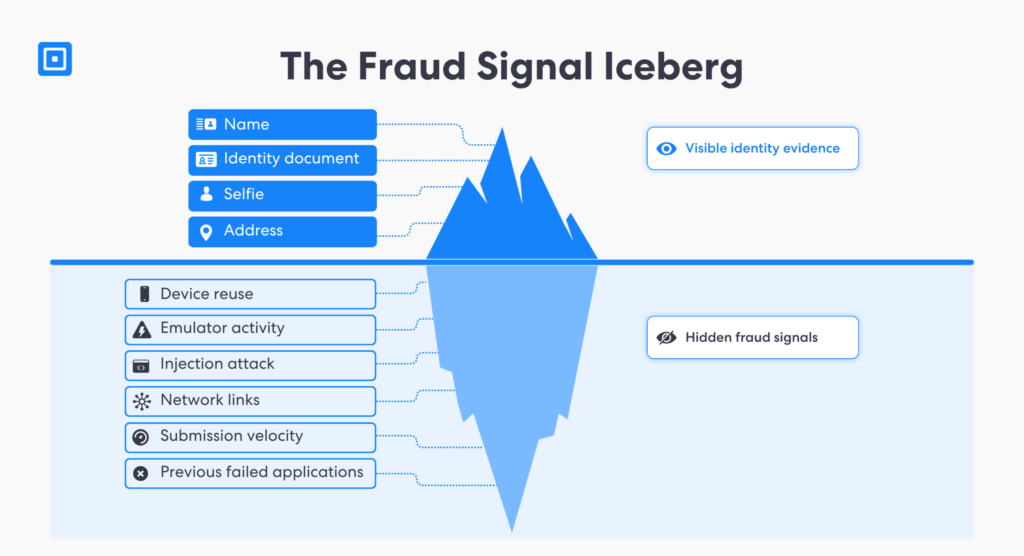
Another way to prevent fraud with new customers is device intelligence. This solution can examine IP location, device integrity, and emulator use. Moreover, they can decipher if bad actors are using virtual cameras, submission velocity, and links to previous applications. These device risk signals allow teams to determine if any suspicious behavior is taking place. Unfortunately, this is not normally visible in customer data or identity documents.
Yet, not every failed verification attempt is linked to fraud. Sometimes, due to poor lighting, a damaged page, or an unreliable internet connection, a legitimate customer may struggle to complete a full verification.
As a result, the onboarding journey should be able to understand the difference between a technical failure and real identity fraud. Real customers must receive a clear recovery route, while material fraud indicators should trigger stronger verification workflows or manual review instead of passing straight through.
Applying Customer Due Diligence
Another important aspect of customer onboarding KYC for banks is ensuring that, once identity has been verified, financial institutions are responsible for the financial crime risks that may arise from the customer and the proposed business relationship.
That is where CDD comes into the equation. This compliance check looks at why commercial clients may want the account, how the product or service will be used, and whether the customer relationship increases the risk of money laundering, sanctions, corruption, or terrorist financing.
Building the Digital Customer Risk Assessment
It first starts with a strong customer risk assessment. This process reviews customer information, such as occupation, residence, nationality, and more. From this check, banks are in a position to evaluate if the applicant is linked to a higher-risk jurisdiction, unusual commercial activity, or an existing internal risk record.
The Financial Action Task Force (FATF) places the risk-based approach at the epicenter of AML controls. As a result, financial services must understand their risks and implement appropriate regulatory compliance measures to ensure safety and prevent fraud. It allows banks to balance KYC compliance and customer experience.
Screening Sanctions and Politically Exposed Persons
Then, banks must screen potential customers in the KYC onboarding process against sanctions lists and identify politically exposed persons. Regulatory frameworks and risk policies require this. Similarly,, adverse media can provide more context about any alleged corruption, fraud, organized crime, and other relevant activities for KYC compliance requirements.
Enhanced Due Diligence
Finally, EDD is necessary when a customer, product, ownership structure, or jurisdiction creates elevated risks. Additional checks include determining the source of someone’s wealth, verifying that their funds come from a legitimate source, and requesting further evidence of ownership or obtaining senior approval.
This extra due diligence for banks should address any concerns that were due to case escalation. Asking every higher-risk customer for the same set of documents can increase workload for compliance teams, without necessarily resolving the underlying risk.
Client Onboarding for Companies
Client onboarding is becoming more complex with every passing day, especially when the customer is a company rather than an individual. Banks and other financial institutions must establish their identities and conduct entity and identity verification for the people who own or control them.
Business verification involves checking incorporation information, trading status, registered addresses, directors, and the organization’s stated commercial activities. As a result, the banks must also determine whether the relevant owners and ultimate beneficial owners are subject to the compliance requirements applicable to that specific relationship.
Complex ownership structures and dynamics should influence the course of risk assessment. However, it should not make a customer unacceptable. The goal here is to learn who controls the entity and whether the structure presents risks that require a more thorough KYC process.
Those organizations with cross-border operations, layered ownership, or higher-risk activities require EDD, senior leadership approval, or more frequent continuous monitoring that flags updates immediately.
Static Customer Onboarding Underperforms
To this day, many customer onboarding KYC for banks processes are static. Applicants are also receiving the same sequence of checks, broadly speaking, even if they carry varying levels of risk. Though it is consistent and aligned with customer onboarding best practices for their institution, it creates two problems.
Real customers experience significant friction even when strong identity evidence is already available. On the other hand, complex or higher-risk applicants may still receive insufficient scrutiny. Assuming friction ensures compliance is a misconception.
Applying every possible check to every person could damage overall customer satisfaction without improving the bank’s understanding of its own risks and risk appetite. A strong risk-based approach will allow banks to modify the onboarding journey based on identity confidence, product exposure, individual customer characteristics, and institutional risk appetites.
How Adaptive Digital Onboarding Works
Adaptive digital onboarding solves the problem of underperforming customer onboarding KYC for banks. It uses the information gathered during a banking application process to determine the next step. So, instead of following a single fixed sequence, the journey responds to the available identity evidence, fraud indicators, and AML risk.
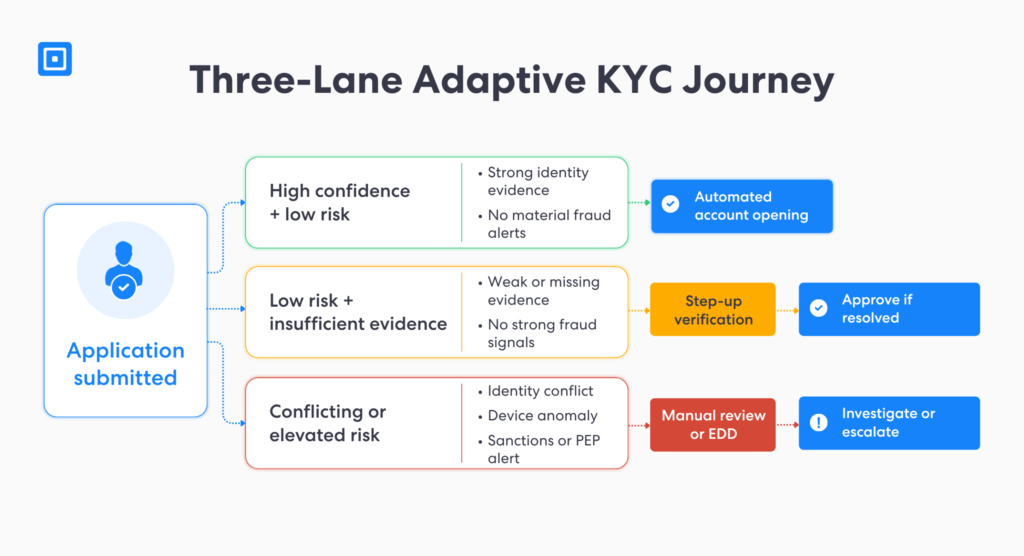
A straightforward applicant will likely experience a straightforward process with no hurdles. However, someone with insufficient identity evidence may enter step-up verification. Any conflicting information or elevated risks can trigger manual review from a compliance officer, or EDD.
High Confidence and Low Risk
A high-confidence and low-risk customer is the easiest type for banks to deal with. Imagine a new customer applies for a standard bank account. If their identity matches with reliable sources, there are no device risk signals, and compliance checks pass KYC rules resulting in no relevant alerts, they are good to pass through. The customer can easily open an account. Asking for more documentation or biometric checks adds friction without adding any information to strengthen the compliance decision.
Low Risk But Insufficient Evidence
The next type of customer presents as low risk, but doesn’t have enough evidence to support that claim. For example, an applicant may have recently moved, possess a limited credit history, or live in a market with restricted database coverage.
Though the initial data verification is inconclusive, the application does not show any actual strong fraud indicators. The verification workflow can request an identity document and biometric verification. If this additional evidence resolves any uncertainty, the customer can return to automated approval without entering a manual queue.
Conflicting or Elevated Risk
Finally, if an applicant submits information that directly conflicts with the document or uses a device associated with repeated applications, the bank should consider pausing the account opening. They need to require further evidence that addresses the specific concern or risk in the application.
This evidence could come from enhanced screening, biometric authentication, source-of-funds evidence, entity verification, or review by trained compliance teams. The purpose of adaptive onboarding is to implement checks that mitigate risk.
Customer Experience And Effective Recovery Routes
It is incredibly important to provide real customers with a clear way to recover if or when a check fails. Instances where a check could fail are poor lighting, damaged documentation, or unsupported devices, any of which can interrupt digital onboarding.
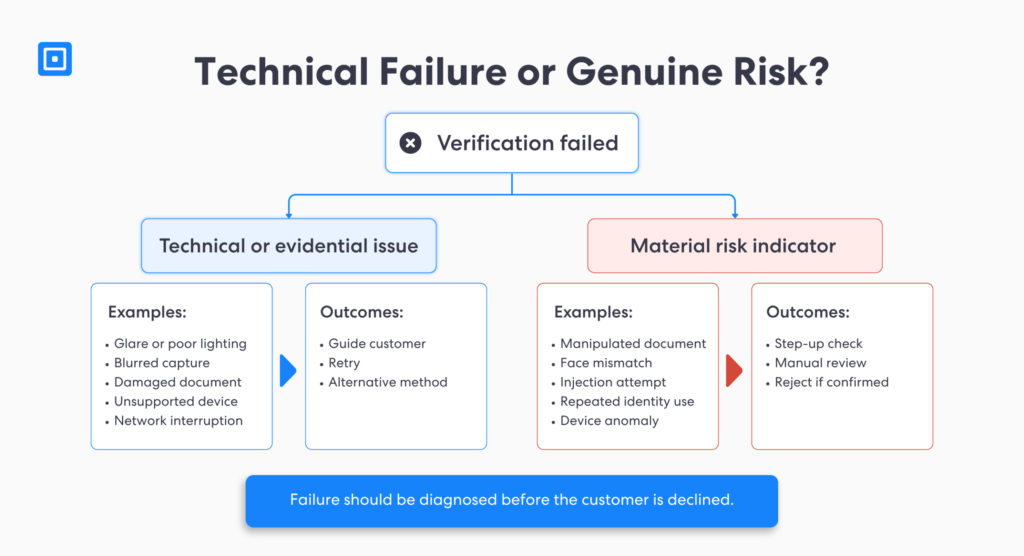
However, this is where a generic rejection email or message turns a technical issue into a lost customer. The best verification workflows allow users to explain what happened, allow another retry, and offer a different verification method if or when the policy allows it.
This greatly supports customer acquisition and experience without weakening KYC compliance requirements. Banks are now better able to distinguish between genuine risk and operational failure. This reduces unnecessary manual review for the compliance teams.
Onboarding Software And Operational Inefficiencies
Strong onboarding KYC software for banks must do more than conduct individual checks. They should interlink IDV, fraud prevention, CDD, and account opening into a single process. Financial institutions must be able to configure workflows based on product, customer, country, risk appetite, and risk signals. Effective onboarding software should support:
- Electronic identity checks
- Document and biometric verification
- Sanctions, PEP, and adverse media screening
- Business and entity verification
- Automated step-up checks
- Manual-review routing
- Decision records and audit trails
- Ongoing monitoring
- APIs, SDKs, and webhooks
Building out an automated onboarding process is what makes integration particularly important. Manual data entry creates several operational inefficiencies and inconsistent customer records. Additionally, KYC automation can help prevent $3.3 billion in annual losses from abandoned applications.
Case Study: Bank of London Onboarding Process Updates
In March 2026, The Bank of London made an arrangement with the UK Financial Conduct Authority (FCA) on formalizing restrictions on the bank accepting new customers without prior consent. The Bank of London paused its onboarding processes to improve its financial crime prevention controls.
Strengthening Financial Crime Controls for Digital Banking
The pilot shows that biometric technology is becoming incredibly valuable to various sectors when supported by the right oversight and human review. These principles could also apply to financial services, where biometric fraud detection can combine automation with explainable risk decisioning.
Outcomes
New-client onboarding restricted while control enhancements were undertaken.
Existing customer accounts and services were reported as continuing.
The FCA arrangement formalized the limitation on accepting new clients.
Account Opening is the Beginning of the KYC Lifecycle
Once a customer receives access to an account, the customer onboarding KYC process does not stop. What was discovered during onboarding must establish the basis for how the client relationship is managed over time.
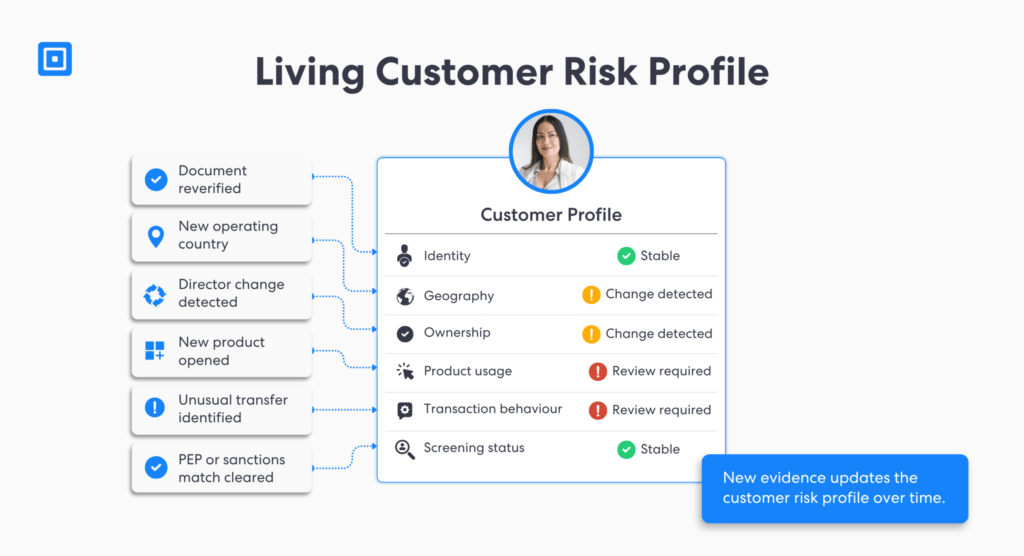
Ongoing monitoring supports financial institutions in identifying changes in financial transactions, sanctions exposure, adverse media, and ownership structures. For example, a new director or ultimate beneficial owner may alter the risk associated with the business relationship.
Perpetual KYC uses event-driven information to support near real-time risk monitoring rather than leaning on fixed review dates. Whether it be a new sanctions entry or a pattern of unusual financial transactions, it can trigger customer reassessment, further due diligence, or enhanced monitoring. This system allows banks to manage customer relationships based on the most current information rather than relying indefinitely on the decisions made during account opening.
Measuring the Digital Customer Onboarding Process
Speed is important, but it should not be the only metric to consider when onboarding customers for KYC at banks. Teams should look across customer experience, operational performance, fraud prevention, and regulatory compliance all at once.
Metrics Banks Should Monitor
The right measures to consider for a strong customer onboarding KYC for banks include application completion, abandonment, and straight-through processing. Moreover, teams must consider step-up verification rates and manual review volumes. Banks should also track false positives, confirmed fraud after account opening, and average decision time by customer or risk segment.
Another important data point is the recovery rate after an initial verification failure. This is valuable because it shows whether real customers stay after any technical or evidentiary problems. Having a fast customer onboarding KYC process for banks that admits fraud is not successful. A secure process that needlessly rejects customers is not either. There needs to be a balance. The goal is to improve decision quality and customer satisfaction at the same time.
Key Takeaways
Customer onboarding KYC for banks must include adaptable checks.
IDV, fraud prevention, and CDD should support one explainable risk decision.
Digital customer onboarding gives legitimate customers clear recovery routes.
Onboarding software lowers data entry and links verification with existing systems.
Ongoing monitoring extends the initial risk assessment across the customer lifecycle.
Customer Onboarding Best Practices at ComplyCube
In short, ComplyCube helps banks and other financial institutions connect IDV, document and biometric checks. They tackle AML screening, business verification, and ongoing monitoring all through configurable workflows. To learn how to build adaptive customer onboarding KYC for banks, get in touch with ComplyCube today.

Frequently Asked Questions
How can banks reduce KYC abandonment during customer onboarding?
Banks can lower KYC abandonment by asking for the evidence needed based on the customer’s risk level. Adaptive workflows allow real customers to move forward with weakening KYC compliance.
What information is collected during a bank KYC onboarding process?
Typically, banks collect a customer name, date of birth, address, and other identification information. Based on product and risk profile, teams may collect employment data, expected activity, and beneficial ownership information.
When should Enhanced Due Diligence be used during account opening?
Enhanced due diligence (EDD) is when the customer, product, region, or ownership structure or screening result creates elevated risk. Any additional evidence that is considered must speak to specific concerns that arose during account opening.
How does Ongoing Monitoring support Anti Money Laundering compliance?
Ongoing monitoring finds changes in client behavior, sanctions information, and other important risk factors. This allows banks to update the customer profile and apply further due diligence when circumstances change.
How does ComplyCube support customer onboarding KYC for banks?
ComplyCube’s award-wining platform links IDV, AML screening, workflow orchestration and ongoing monitoring. Banks can build onboarding journeys and escalation pathways around their regulatory requirements and risk appetite.