
TL;DR: Identity verification processes are essential for security, compliance, and fraud prevention across all sectors. An ID verification API, or a KYC verification API, enables firms to connect existing technology systems to compliance solutions. This article explores what an identity verification API is and how it works.
Why is Identity Verification API Crucial?
Businesses increasingly rely on automated systems to handle processes that were once done manually. One such process that’s essential for security, compliance, and fraud prevention across all sectors is Identity Verification (IDV).
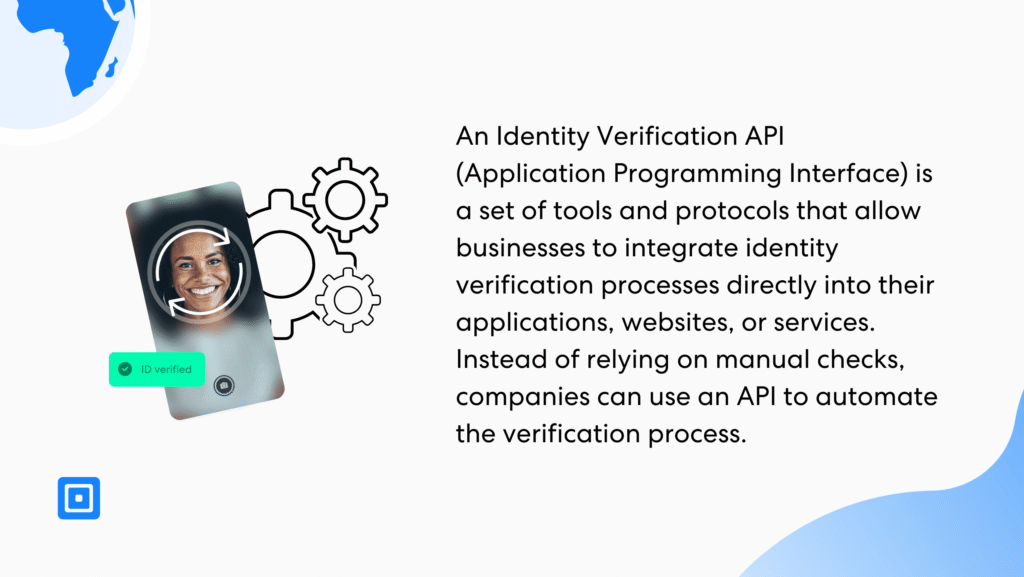
Businesses must accurately verify their clients’ identities during onboarding processes to ensure compliance with regulations and mitigate risks. Identity verification APIs enable firms to integrate Know Your Customer (KYC) and IDV solutions seamlessly into existing tech stacks.
ID Verification APIs allow businesses to make the verification process quicker, more reliable, and more secure. In this guide, we’ll explore not only what an Identity Verification API is and how it works, but also its benefits and how businesses can integrate it with their existing systems.
Understanding Identity Verification APIs
An ID Verification API (Application Programming Interface) is a set of tools that allow businesses to connect identity verification solutions directly into their applications, websites, or services. Instead of relying on manual checks, companies can use an API to automate the verification process. Identity Verification API can handle document scanning and biometrics to Anti-Money Laundering (AML) checks and KYC compliance in seconds.
Identity Verification is critical to ensure that individuals or businesses are who they claim to be. It is essential in preventing financial crimes such as money laundering and terrorism financing. Additionally, it is critical for KYC and AML regulatory compliance. Leading global and national regulatory bodies, such as the Financial Industry Regulatory Authority (FINRA) and the Financial Crimes Enforcement Network (FinCEN), oversee these processes to ensure that financial institutions adhere to strict guidelines. As such, non-compliance can lead to large fines and reputational damage.
How Does an Identity Verification API Work?
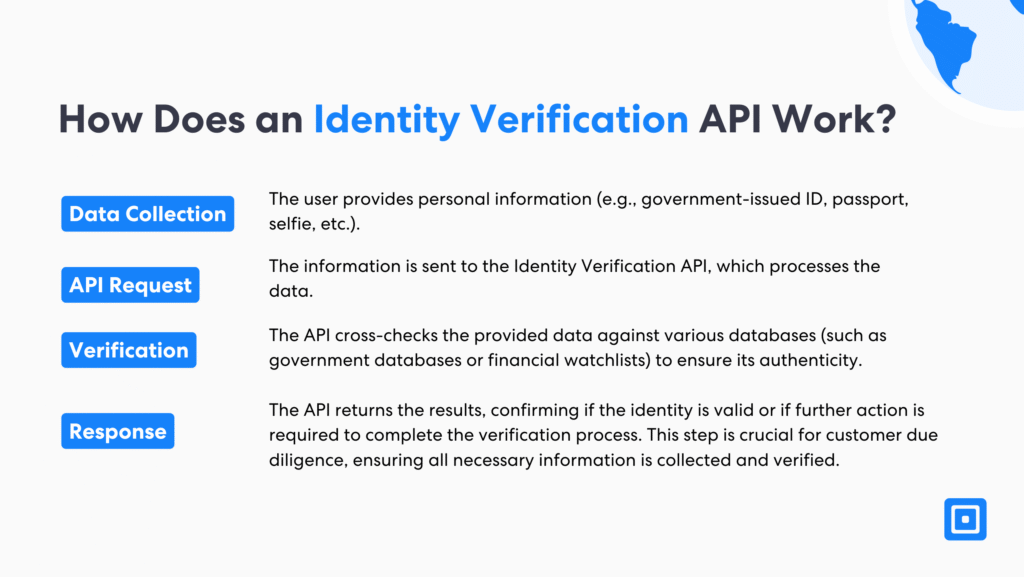
An ID Verification API is designed to integrate with an existing system seamlessly. As the entire process happens quickly, it reduces the risk of human error while ensuring that businesses comply with regulatory standards. Here is a simple breakdown of how it works:
- Data Collection: The user provides personal information (e.g., government-issued ID, passport, selfie, etc.).
- API Request: The information is sent to the Identity Verification API, which processes the data.
- Verification: The API cross-checks the provided data against various databases (such as government databases or financial watchlists) to ensure authenticity.
- Response: The API returns the results, confirming if the identity is valid or if further action is required in the verification process. This step is crucial for customer due diligence, ensuring all necessary information is collected and verified.
Key Features of ID Verification API
Speed and accuracy are key in the KYC process. Slow or complex verification processes can increase drop-off rates during onboarding. To combat this, top KYC platforms give real-time verification so you can verify documents, assess risk and complete the KYC process fast. This not only improves the user experience but also reduces operational delays.
In order to avoid high drop-off rates, onboarding has to be clear, simple, and quick. To achieve this, leading providers make use of advanced AI-powered technology. These AI tools can provide secure and accurate onboarding in under a minute per customer. For instance, KYC providers, such as ComplyCube, utilise market-leading technology to support robust liveness detection and advanced biometrics.
Understanding Know Your Customer (KYC) Requirements
KYC is a set of regulations and guidelines that require financial institutions to verify the identity of their customers and assess their risk profiles. The KYC process involves collecting customer identification information such as name, date of birth, and address, and verifying this information through various means, including KYC checks, document verification, and biometric verification.
A key component of KYC is the Customer Identification Program (CIP), which mandates that financial institutions collect and verify identity details from their customers. This program helps ensure that financial institutions know who their customers are, reducing the risk of fraud and other financial crimes. By implementing KYC processes, financial institutions can maintain the integrity of their customer relationships and comply with regulatory requirements. You can learn more here: What is CIP?
Anti-Money Laundering
Anti-Money Laundering (AML) regulations are designed to prevent the laundering of illicit funds and the financing of terrorism. These regulations require financial institutions to implement comprehensive KYC processes, monitor customer transactions, and report any suspicious activity to the relevant authorities.
Several jurisdictions mandate AML processes. For example, the U.S Bank Secrecy Act (BSA), the EU’s AML Directives, and the UK’s Financial Conduct Authority (FCA) set out guidelines for AML rules that businesses must follow. By adhering to AML regulations, financial institutions can safeguard their operations and maintain the financial system’s integrity.
Enhanced Due Diligence
Enhanced Due Diligence (EDD) is a more rigorous form of due diligence for high-risk customers or transactions. EDD involves collecting and verifying additional information, such as beneficial ownership details, business activities, and comprehensive risk profiles, to assess the customer’s risk thoroughly.
To ensure compliance with KYC regulations, financial institutions must conduct EDD on high-risk customers, including politically exposed persons (PEPs) and individuals from high-risk countries. EDD is essential for preventing money laundering, terrorism financing, and other financial crimes.
By implementing EDD, financial institutions can better manage risks and ensure compliance with regulatory requirements. You can learn more here: When Enhanced Due Diligence Requirements are Needed.
Benefits of Using an Identity Verification API
1. Improving operational efficiency with automation
Manual identity verification can be time-consuming and error-prone. Businesses can automate this entire process by using an Identity Verification API, improving efficiency and accuracy. The API can handle a large volume of requests in real-time, ensuring that your verification workflows are always up-to-date. Additionally, ongoing monitoring of customer accounts ensures continuous compliance and security. These solutions help businesses streamline their verification processes and improve overall efficiency.
2. Increase security by identifying fraud earlier
Identity theft and fraud are significant concerns for businesses, particularly in industries like banking, e-commerce, and healthcare. An Identity Verification API significantly reduces the risk of fraudulent activity. This is because it helps automate robust checks in real-time. Additionally, its usage in features such as biometric matching, document verification, and liveness detection makes it harder for malicious actors to fake their identities.
3. Meet compliance obligations at scale
Financial institutions, healthcare providers, and other regulated industries must follow strict KYC and AML regulations. However, with regulations evolving at such a quick pace, keeping up with compliance can be complex. An Identity Verification API helps businesses easily comply with these laws by automating checks and ensuring that only legitimate customers are onboarded.
4. Long-term cost savings
Building an in-house identity verification system can be expensive, requiring investment in software development, maintenance, and security. By using an external API, businesses can save on these costs while accessing cutting-edge technology provided by the API service. For more on the breakdown of AML and KYC costs, read “AML Check Cost: Hidden Fees in Compliance.”
5. Enhanced onboarding and user experience
Customers demand convenience and speed, and an Identity Verification API helps businesses streamline the onboarding process. Users can verify their identities quickly through the system, improving customer experience and reducing the chances of abandonment during sign-up or checkout. You can learn more here: KYC Checks For a Secure Onboarding Process.
Case Study: Boost Operational Efficiency with Automated KYC Checks
54% of identity checks are still manual. With manual verification, the likelihood of human error and data inaccuracies can increase significantly. As a result, customer drop-off rates and false negatives can occur. For regulated businesses, this can be fatal for compliance.
Enhance Customer Experience
Citibank, the leading financial services company, partnered with ComplyCube to automate its KYC compliance process. With broad API and SDK integration, Citi was able to significantly reduce manual verification, freeing up agents and boosting customer satisfaction.
Outcomes
Citi was able to reduce its acquisition cost by up to 73% by simplifying and automating its identity verification processes for its customers.
ComplyCube’s wide integration library and no-code workflows provide multi-layered security and compliance at an unprecedented rate.
The company reduced KYC onboarding rates significantly, from days to minutes, boosting customer satisfaction and conversion.
Fighting Fraudulent Activities
Fraudulent activities, such as identity theft and money laundering, pose significant risks to financial institutions and regulatory bodies. These activities can lead to substantial economic losses and damage a financial institution’s reputation. To combat these threats, financial institutions must implement robust Identity Verification processes, including KYC and AML programs, to ensure their customers are who they claim to be.
In addition to verifying identities, financial institutions must use ongoing monitoring and report suspicious activity to the relevant authorities. By adopting these measures, financial institutions can help prevent fraudulent activities and maintain the integrity of their customer relationships. KYC verification APIs are a convenient way to plug into cutting-edge technology to ensure financial safety and maintain cost efficiency through accurate verifications.
Choosing the Right ID and KYC Verification API Provider
With many Identity and KYC Verification API providers, how do you choose the right one for your business? Here are some factors to consider:
- Accuracy: Look for a provider that offers reliable and accurate verification services. Providers should be highly certified and should leverage cutting-edge technology, such as PAD Level 2 Liveness Detection, to ensure a high rate of accuracy.
- Compliance: Ensure the API complies with your region’s compliance requirements and regulations, especially if you’re in a highly regulated industry. Looking for industry acknowledgements, such as ISO certifications, is a step in the right direction.
- Integration: Choose an API that is easy to integrate with your existing systems and has clear documentation and support. This can help prevent inflated costs required to set up the API.
- Scalability: As your business grows, ensure the API can handle increasing verification volumes and provide timely responses. As a result, businesses can avoid painful technology migrations as they grow.
Key Takeaways
- Application Programming Interface (API) enables software applications to communicate with each other seamlessly.
- Identity verification API integration enables identity checks to seamlessly connect with current systems, websites, and CRMs.
- KYC verification API enables businesses to meet AML compliance rapidly by layering biometric, document, and NFC checks into current services.
- Firms can achieve faster, more secure, scalable, and cost-efficient identity and AML checks when utilizing API integration.
- To choose the right ID verification API provider, consider integration, accuracy, and compliance factors.
Leveraging Identity Verification for Financial Security
Securing user identities is more important than ever, and choosing the right solution can make all the difference. An Identity and KYC Verification API provides an automated, accurate, and secure way to confirm the legitimacy of your customers. Not only does it help businesses meet regulatory requirements, but it also reduces the risks associated with fraud and identity theft. Regular review of the verification processes ensures that they remain effective and up-to-date with the latest security standards.
By implementing an Identity Verification API, businesses can improve customer experience, save on operational costs, and ensure compliance with industry regulations. Whether in finance, e-commerce, healthcare, or any other industry, adopting this technology is essential to building trust and security in the digital world.
Contact our expert compliance team for more information on ComplyCube’s Identity Verification services and API.

Frequently Asked Questions
What is an identity verification API?
Identity verification (application programming interface) API supports firms in integrating identity checks into their services easily. As a result, businesses can perform document verification, biometric checks, and age estimation on their website or app to meet KYC compliance.
How do you verify a person’s identity with API?
The process of identity checks with an API is simple. Firstly, a customer’s data, such as passport information, gets sent to the API endpoint. Next, this data gets processed and cross-checked against various trusted sources. Lastly, the results, such as passing or failing verification, will be returned for simple customer onboarding decision-making.
What is the purpose of ID verification API?
ID verification API removes the need for manual intervention and data collection. By supporting real-time identity verification, businesses can achieve secure, seamless, and rapid customer onboarding. Thus, achieving higher customer conversion rates while lowering long-term costs from manual verification.
How to choose KYC providers with API integration?
To choose KYC providers with API integration, consider the ease of integration and the variety of integrations, such as CRMs and SDKs. Additionally, factors such as global coverage, accuracy rates, and compliance certifications, including data and privacy compliance with GDPR.
How does ComplyCube’s KYC verification API satisfy compliance?
ComplyCube offers wide integration capabilities, with the fastest omnichannel integration turnaround in the market. Businesses of any size and stage can adopt its KYC and AML solutions easily with its no-code solutions, APIs, mobile and web SDKs, client libraries, and CRM integrations.