TL;DR: Enhanced due diligence requirements are triggered by specific high-risk indicators. For regulated businesses, understanding when and how to apply enhanced due diligence measures is crucial. This guide examines the critical controls required to move from standard to enhanced verification and the benefits of automating enhanced due diligence.
Why is Enhanced Due Diligence Important?
Enhanced due diligence measures are important as they support businesses in having a comprehensive understanding of their customers and the risks they pose to the company. As a result, companies can better track and prevent money laundering and other financial crimes. Moreover, Enhanced Due Diligence (EDD) forms a core aspect of Anti-Money Laundering (AML) programs, making it a mandatory process that moves beyond simplified and standard due diligence processes.
In essence, enhanced due diligence deeply verifies a customer or client’s identity, background information, and source of funds. EDD is driven by the Financial Action Task Force (FATF) Recommendations to effectively combat money laundering and terrorist financing. Following the FATF’s enhanced due diligence requirements, jurisdictions worldwide, such as the European Union’s AML Directives and the U.S. Bank Secrecy Act, have followed suit. This will be covered in more depth below.
Understanding Enhanced Due Diligence Requirements
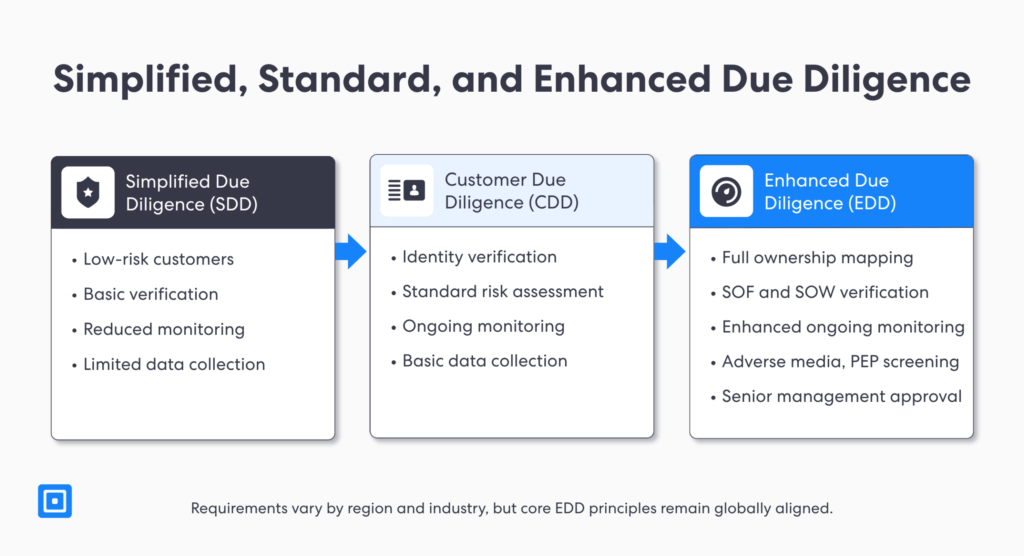
Simplified Due Diligence (SDD) is a low-intensity AML check used for customers with low risk, allowing less verification and monitoring. Next, Standard Customer Due Diligence (CDD) forms the norm baseline and focuses on confirming a customer’s identity through basic checks. You can learn more here: What is Customer Due Diligence (CDD)?
On the other hand, EDD goes much deeper, shifting from “who is this customer” to “why this customer, why this product, etcetera.” Enhanced due diligence measures are implemented when there is a heightened risk of money laundering, terrorist financing, or corruption.
However, enhanced due diligence requirements come from a combination of standards and national AML laws, such as those stated previously. Moreover, these requirements are further shaped by sector-specific guidance from regulators, including the Financial Conduct Authority (FCA), the Monetary Authority of Singapore (MAS), and the Australian Transaction Reports and Analysis Centre (AUSTRAC), to address further gaps in AML programs.
At a glance, standard customer due diligence versus enhanced due diligence:
- Standard or Basic CDD: Identity verification, basic customer data collection, standard risk assessment, continuous monitoring.
- EDD: Full ownership mapping, source-of-wealth proofs, adverse media checks, senior sign-off, enhanced ongoing monitoring.
Regulatory Drivers for Enhanced Due Diligence
Understanding enhanced due diligence requirements across major regulations is critical in building a defensible AML infrastructure. Moreover, it supports organizations in meeting regulatory compliance and, as such, preventing reputational damage or fines. For instance, notable fines in recent years show a common theme of businesses failing to implement adequate due diligence.
Notable examples include Cannacord’s $80 million fine for weak due diligence on high-risk customers, Louis Vuitton €500,000 fine for CDD failures on undetected, large transaction patterns, and even CaixaBank’s €30 million fine related to EDD lapses for a company it merged with. The examples below discuss the central regulations that shape enhanced due diligence requirements:
The Financial Action Task Force
The FATF, based in Paris, is an intergovernmental body set up by the G7 nations to establish global standards for preventing money laundering and terrorism financing. In particular, in Recommendations 9, 10, and 12, specific EDD requirements are mandated for high-risk business relationships, as well as for Politically Exposed Persons (PEPs) and their close family or associates. Moreover, it demands additional verification for countries connected with the FATF grey or blacklist. Suspicious transaction reporting from EDD analysis is also listed as crucial to meeting AML compliance.
The U.S. Patriot Act
The USA Patriot Act made an impact on strengthening U.S. AML regulations by amending the BSA to include strict requirements for US financial institutions regarding EDD. Notably, Section 312 mandates EDD for accounts held by foreign banks, especially those in high-risk locations. Plus, non-U.S. individuals who maintain large private banking accounts require deep source of funds checks. Furthermore, the Act calls for ongoing monitoring of EDD, ownership verification, and senior management approval to identify and prevent suspicious activity proactively.
The EU AML Directives
The EU AML Directive progresses from 4AMLD to 6AMLD. The 4AMLD, introduced in 2017, became a catalyst for automating EDD due to raising obligations for high-risk scenarios. Next, the 5AMLD extended these requirements, including the risk-based approach to EDD to crypto providers. The 6AMLD introduced higher penalties and reinforced PEP screening and ongoing monitoring for high-risk jurisdictions and high-net-worth individuals. The UK’s Money Laundering Regulations (MLR2017) mirror these obligations with EDD for suspected false ID and complex transactions.
Sectoral Guidance
Moving on, sector-specific guidance has shaped EDD standards. For example, the European Banking Authority (EBA) requires financial institutions to apply EDD for high-risk customers and transactions with high-risk countries. Another example is the UK Financial Conduct Authority (FCA), which introduces deeper identity and business purpose verification in EDD processes.
Case Study: Louis Vuitton €500K Fine for EDD Lapses
In February 2026, Louis Vuitton was fined by Dutch authorities €500K for violating the Netherlands’ Money Laundering and Terrorist Financing Act. Regulators noted that the company failed to implement enhanced due diligence despite suspicious customer activity.
Luxury Goods Laundering Scheme
According to reports, Louis Vuitton did not implement strong Know Your Customer (KYC) processes. This includes inadequate due diligence measures. As a result, a customer was able to make over €2 million in transactions under different aliases without intervention.
Outcomes
The Dutch unit of Louis Vuitton was penalized a €500K fine by prosecutors.
The case saw a woman spending large amounts on luxury goods to hide illicit funds from money laundering.
Dutch regulators introduced strict limitations on financial transactions of cash payments, with anything above €3,000 banned to curb money laundering.
Enhanced Due Diligence Requirements Triggers
For effective EDD, firms need to codify risk triggers in their AML program. These triggers will determine when compliance teams escalate from CDD to EDD. Additionally, EDD can be triggered by external signals beyond the customer onboarding process. For example, new adverse media coverage or law enforcement investigation can indicate a significant risk.
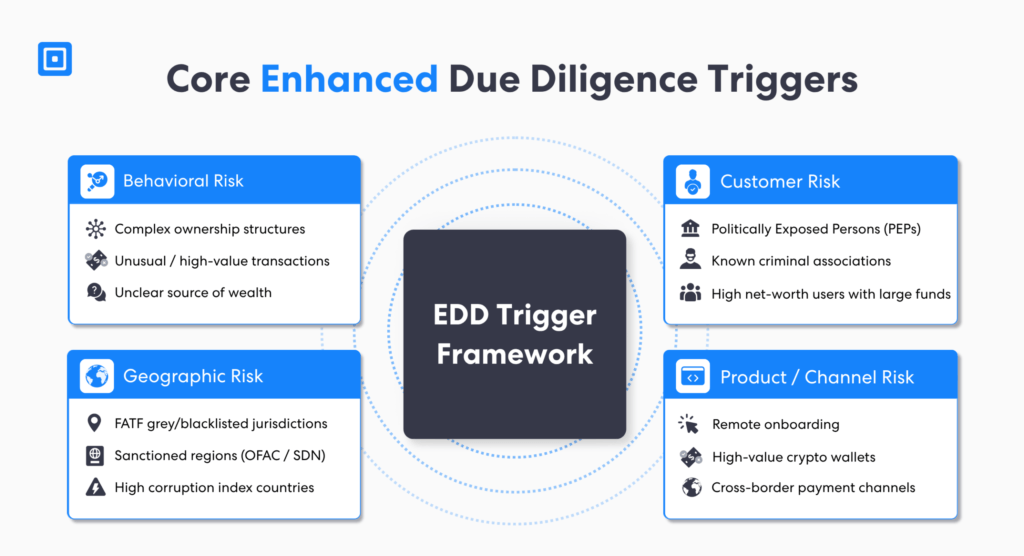
Core trigger categories to conduct enhanced due diligence:
- Behavioral Risk: Suspiciously complex corporate structures, large or unusual transactions without a clear rationale, an unexplained source of wealth, and more.
- Customer Risk: PEPs, their family and close associates, customers listed on Interpol, those with criminal activity, high net-worth users moving large sums, and more.
- Geographic Risk: Customers or entities residing in FATF grey or black-listed countries, sanctioned regions under the Office of Foreign Assets Control (OFAC) lists, and more.
- Product Risk: High-value crypto wallets, cross-border payment products, non-face to-face onboarding, and more.
Moreover, automating enhanced due diligence makes use of advanced Artificial Intelligence (AI) and Machine Learning (ML) to analyze vast datasets in real-time. EDD workflows can be triggered instantly for high-risk clients, customers, or transactions. As a result, the reliance on manual verification and human error is lowered, leading to quicker and more accurate enhanced due diligence measures.
Regulatory Compliance and AML Requirements
Enhanced due diligence requirements can look different in each sector. Despite overlapping themes, getting a better understanding of sector-specific examples is crucial for setting appropriate risk thresholds. For instance, the risks present in crypto companies can differ widely from those of insurance firms, which calls for tailored risk controls to detect anomalies.
For effective EDD, controls must be aligned with the specific company risks.
According to Harry Varatharasan, Chief Product Officer at ComplyCube, for EDD to be effective, controls and triggers must be calibrated to align with a company’s specific product, geography, and sector risks. Below, we detail common situations in varying sector that will require EDD under a risk-based approach.
Fintech and Digital Banking
Fintech and digital banking support remote onboarding and rapid account activation. While this increases customer conversion due to quicker onboarding, it can increase the risk of identity fraud. Additionally, shell companies and opaque ownership structures are particular red flags. Where sufficient confidence cannot be met, firms must escalate these cases and do full ownership mapping of both the client and their business partners to avoid blind spots.
Crypto and Virtual Asset Providers (VASPs)
For crypto firms, high transactions across borders can be particularly risky, particularly where compliance with the Travel Rule is weak. Customers exposed to mixers or tumblers, dealing with privacy coins, or making transactions with unhosted wallets require thorough EDD. For instance, this means higher scrutiny on the source of funds, with the EU’s Markets in Crypto-Assets Regulation (MiCA) demanding ongoing transaction monitoring across customer activity. You can learn more here: Crypto AML Compliance: Securing the Sector.
Property and Real Estate
Real estate can be vulnerable to money laundering risks, especially since opaque ownership structures, offshore entities, and unusual funding arrangements can easily hide the ultimate beneficial owner or source of funds. As a result, firms in this sector must adopt comprehensive EDD. Typically, this means higher scrutiny on the ultimate beneficial ownership, reasonable assurance of a customer’s real assets and wealth sources, and also deeper reviews of transaction rationale to bridge any potential risk gaps.
Gaming and Gambling
In 2025, the UK Gambling Commission found that companies had inadequate play-pattern monitoring as a common AML failure. The FATF includes casinos and gambling services within its AML framework, noting several risks that can be present in transactions. To meet AML compliance and avoid penalties, gaming and gambling firms must adopt EDD, whereby suspicious customer activity from transactions and play patterns must undergo a source of funds probe and ongoing monitoring.
Core Components of an Effective EDD Process
Businesses must model a consistent EDD workflow scaled to the risk level. To expand, core global regulatory frameworks emphasize a risk-based application of EDD, followed by clear documentation and audit trails. As a result, companies can maintain strong governance and build regulatory trust.
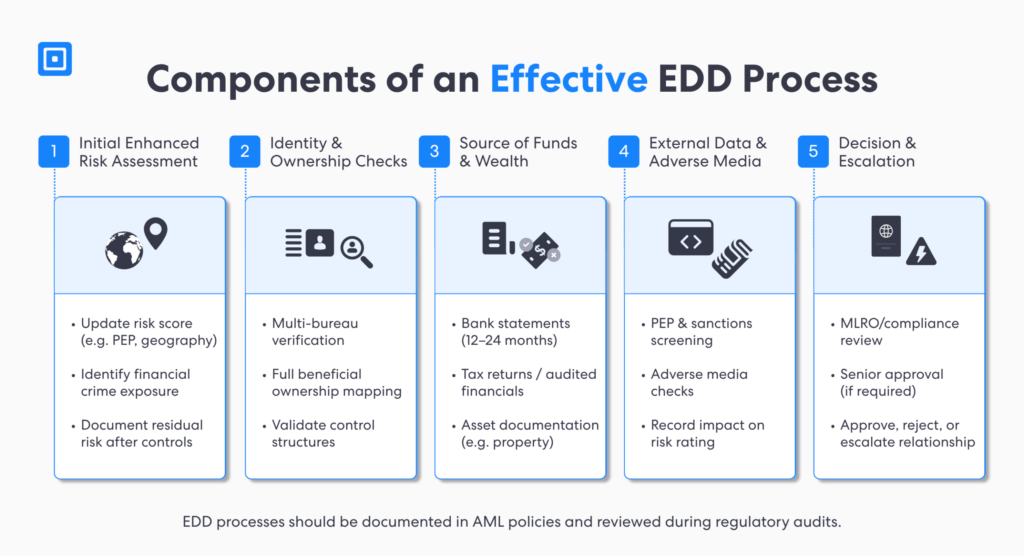
Furthermore, compliance teams record and evidence ongoing monitoring and senior management intervention for high-risk customers to meet reporting obligations. This includes the level of due diligence that each step requires and implements. Teams better understand how to build an effective EDD workflow when they know the core components involved:
Initial Enhanced Risk Assessment
Collect customer background information through document verification, proof of address, and selfie checks to confirm identity authenticity. Next, refine the customer’s risk scoring based on the information collected, which includes PEP status or any unusual activity patterns. Ensure to document why the relationship presents risks, noting specific risk indicators. You can learn more here: Document Authentication Services with ID Liveness.
Identity and Beneficial Ownership Verification
EDD demands verification beyond standard checks. To elaborate, it requires understanding who really owns and controls an entity. Thus, implement advanced checks, such as multi-bureau verification and sanctions screening, to verify customers against multiple trusted databases. Confirm full ownership structure mapping and challenge inconsistencies in documents.
Source-of-Funds (SOF) and Source-of-Wealth (SOW)
Gather proof of SOF to investigate how the money for a specific transaction was made. On the other hand, SOW checks enable organizations to analyze the total net worth of a customer. Together, these checks provide an understanding of whether transaction values align with the customer’s known occupation, income level, or declared assets. To evidence this, use a standardized template and record the evidence received and assessment outcome.
External Data and Adverse Media
Use reputable, global databases for accurate PEP, adverse media, watchlists, and sanctions screening. Document how hits of negative news coverage and listing influence the customer’s risk ratings. Automating enhanced due diligence supports quicker cross-referencing of this data from multiple sources. For best practice, keep a record of every alert reviewed and how it affected the risk rating.
Decision and Escalation
Each EDD case must lead to a documented decision. Regulators expect teams to record compliance reviews, obtain senior management approval where required, and clearly write imposed controls. Moreover, decisions to approve or to introduce step-up checks must be rationalised. A centralized case management system is recommended to maintain full, real-time audit trails.
Operationalizing Enhanced Due Diligence Measures
For high-growth companies looking to scale EDD, strong process design and governance are crucial. According to reports, a slow and duplicative process can cause high customer drop-offs. Thus, a well-governed framework supports a scalable EDD process and creates a single source of truth for high-risk client assessments.
- Documented Policy Thresholds: Define clear quantitative triggers, such as transaction volume thresholds. Additionally, you must record qualitative triggers, such as a criminal record.
- Cross-functional Alignment: Set clear compliance standards, share risk models, and introduce role-based controls to increase ownership over EDD decision-making.
- Cross-functional Alignment: Set clear compliance standards, share risk models, and introduce role-based controls to increase ownership over EDD decision-making.
- Training: Introduce real-world situations to train on when to recognize suspicious activity and escalation strategy. Create ongoing training and a thorough due diligence checklist.
- Regulatory Changes: Track updates to local and global regulations. For instance, monitor changes to FATF blacklists or customers’ risk profiles and promptly act on them.
In order to avoid complex onboarding, compliance teams must embed clear policy documentation, cross-functional team alignment, frequent compliance training, rigorous feedback loops, and ongoing monitoring for regulatory changes. Together, these create stronger compliance operations aligned with regulatory requirements.
Key Takeaways
EDD goes beyond CDD, requiring robust investigation of source of funds, source of wealth, PEP, and adverse media screening, ongoing monitoring, and thorough documentation.
A risk-based approach supports businesses in creating triggers in their AML program to decide when to escalate CDD to EDD while maintaining seamless onboarding.
EDD triggers include specific indicators, including politically exposed persons, unclear ownership structures, connections to high-risk countries, unusual transaction patterns, and more.
The FATF Recommendations set standards on EDD measures and shape global regulations, including the EU’s AML Directives and the U.S Bank Secrecy Act.
Companies in banking, cryptocurrency, gambling, and real estate must follow sector-specific EDD legislation due to varying levels of risk involved in the product.
Automating Enhanced Due Diligence
EDD involves assessing risks in the efforts to combat money laundering and other financial crime. As technology evolves, regulations become more stringent to effectively safeguard the financial system. By automating enhanced due diligence, businesses can expect accurate customer verification, quicker onboarding, and secure processes. Contact ComplyCube to learn more about how you can leverage automation technology to meet compliance obligations today.

Frequently Asked Questions
When is enhanced due diligence needed?
Enhanced Due Diligence (EDD) is needed when high-risk indicators of money laundering or terrorist financing are present. For instance, unusual transaction patterns or complex corporate structures require businesses to undergo deeper scrutiny through EDD processes.
How does enhanced due diligence differ from customer due diligence?
Customer Due Diligence (CDD) forms the standard baseline for verifying identity and assessing customer risk. Enhanced Due Diligence (EDD) is a more thorough investigation performed on customers or entities with a higher risk exposure, which mandates a higher depth and frequency of customer verification.
Which companies need enhanced due diligence measures?
Customer Due Diligence (CDD) forms the standard baseline for verifying identity and assessing customer risk. Enhanced Due Diligence (EDD) is a more thorough investigation performed on customers or entities with a higher risk exposure, which mandates a higher depth and frequency of customer verification.
What are the common Enhanced Due Diligence (EDD) triggers?
Common triggers that need EDD measures include customer risk, such as politically exposed persons, and associated risks from their family and close associates. Other risks include behavioral ones, such as unusual transactions, geographic risk, such as individuals linked to high-risk countries, and product risk, such as high-value crypto wallets.
How does ComplyCube’s automated EDD work?
ComplyCube’s automated EDD solutions verify identity, score customer risk, and automatically escalate high-risk cases for enhanced checks. Businesses can mitigate risks effectively with configurable risk thresholds and no-code workflows according to your regulatory needs.