TL;DR : An AML KYC SaaS platform helps reduce fragmented compliance operations. The best AML KYC solutions unify identity verification, screening, and monitoring. Regulated businesses can compare KYC AML solutions based on coverage, automation, and risk controls.
What Does Unified Compliance Mean?
When regulators mention unified compliance, it means combining together Know Your Customer (KYC), Anti-Money Laundering (AML), risk assessment, and monitoring processes into one single platform. This unified approach allows firms to manage AML and KYC compliance needs across the customer lifecycle via a connected flow.
An automated KYC solution can support client onboarding, while sanctions and politically exposed persons (PEPs) screening, risk-based checks, and AML transaction monitoring help identify changes after onboarding. When these signals feed into the same AML program, teams can apply controls more consistently to both new customers and higher-risk relationships.
As regulations tighten all over the world, this connected KYC and AML approach cannot be ignored. Therefore, for those buying compliance solutions, finding vendors that can effectively combine KYC and AML controls, while boosting operational efficiency, and supporting risk-based decisions is critical.
How to Evaluate AML KYC Solutions
To evaluate AML KYC solutions, businesses should use established AML and Counter Terrorism Financing (CFT) regulatory principles, as well as a practical criteria matrix to assess compliance technology. The Financial Action Task Force (FATF) Recommendations has over 200 countries committed to its AML and CFT guidance.
Therefore, this guide will use the FATF Recommendations as the regulatory baseline. In particular, it will evaluate a platform based on how well it applies the risk-based approach, Due Diligence Client (CDD), ongoing monitoring, and other controls to prevent money laundering and other emerging threats.
To reflect today’s regulatory landscape, it also considers the UK’s latest AML and Asset Recovery Strategy, the European Banking Authority (EBA) Risk Factor Guidelines, and also the US Bank Secrecy Act (BSA) Customer Identification Program (CIP) guidance.
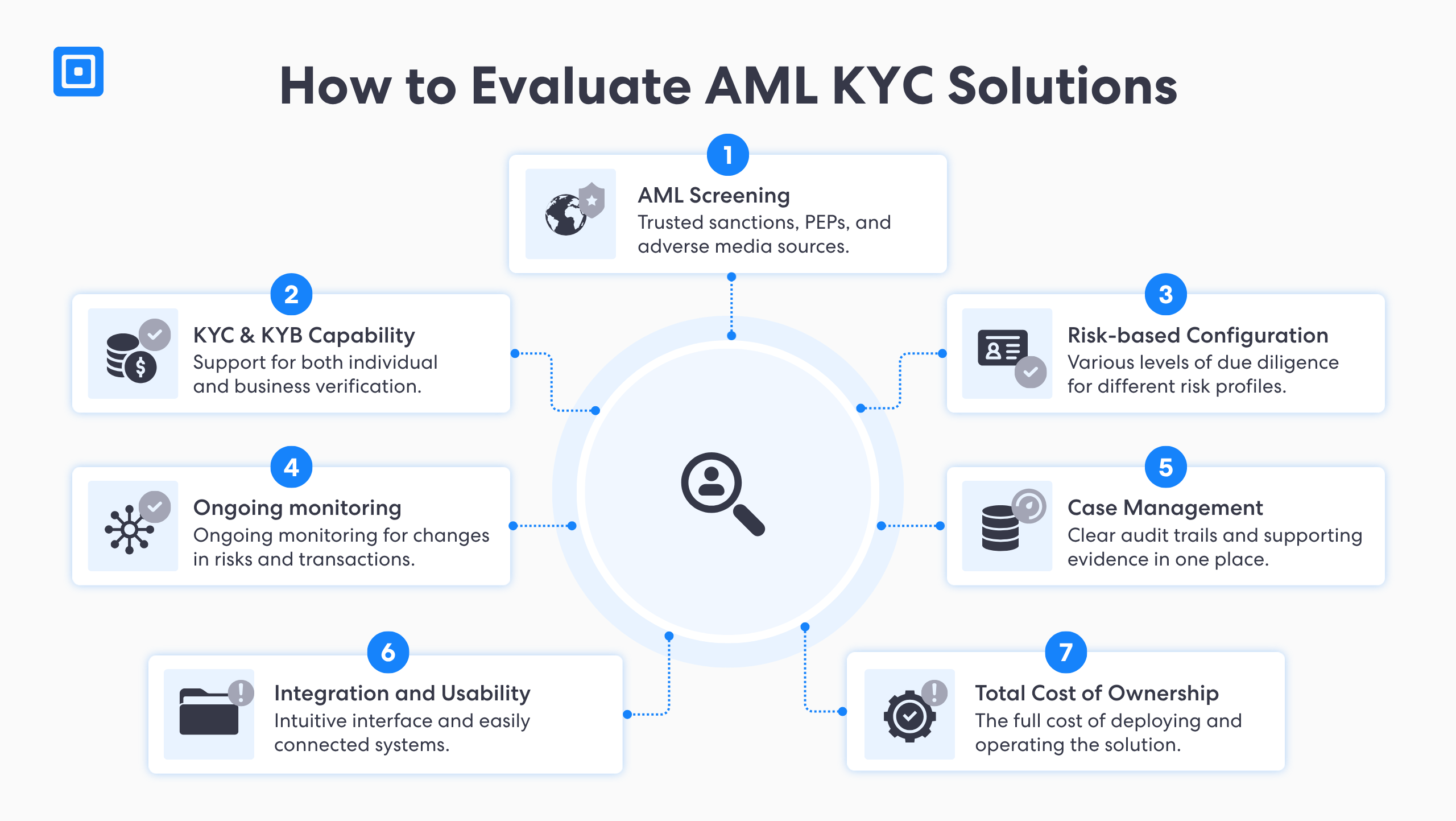
The factors taken into account when evaluating AML KYC solutions include:
- KYC and Know Your Business (KYB): Support for both customer and business verification, including document, détection de vivacité, and beneficial ownership verification.
- Dépistage de la LMA : Screening for sanctions, PEP, watchlists, adverse media, and other relevant financial crime risks.
- Risk-based workflow: How easily teams can customize checks and decisions based on the risk level present in a customer, jurisdiction, product, and channel.
- Transaction and ongoing monitoring: The ability to identify changes in a customer risk profile or suspicious transactions in real time.
- Gestion de cas : Allows teams to review any alerts, manage escalations, and maintain a time-stamped record of every compliance decision made.
- Integration and usability: How the platform integrates with existing systems via APIs, SDKs, and hosted workflows as well as how user-friendly it is to customers.
- Total Cost of Ownership (TCO): Cost, installation effort, internal resources, ongoing operational costs, and hidden costs.
Key Differentiators in AML KYC SaaS Platform
The best AML KYC solutions isn’t one with the most features, but the one that can support a risk-based compliance framework. However, several characteristics stand out in market-leading platforms. These solutions combine high-quality screening data, configurable risk scoring, and automation.
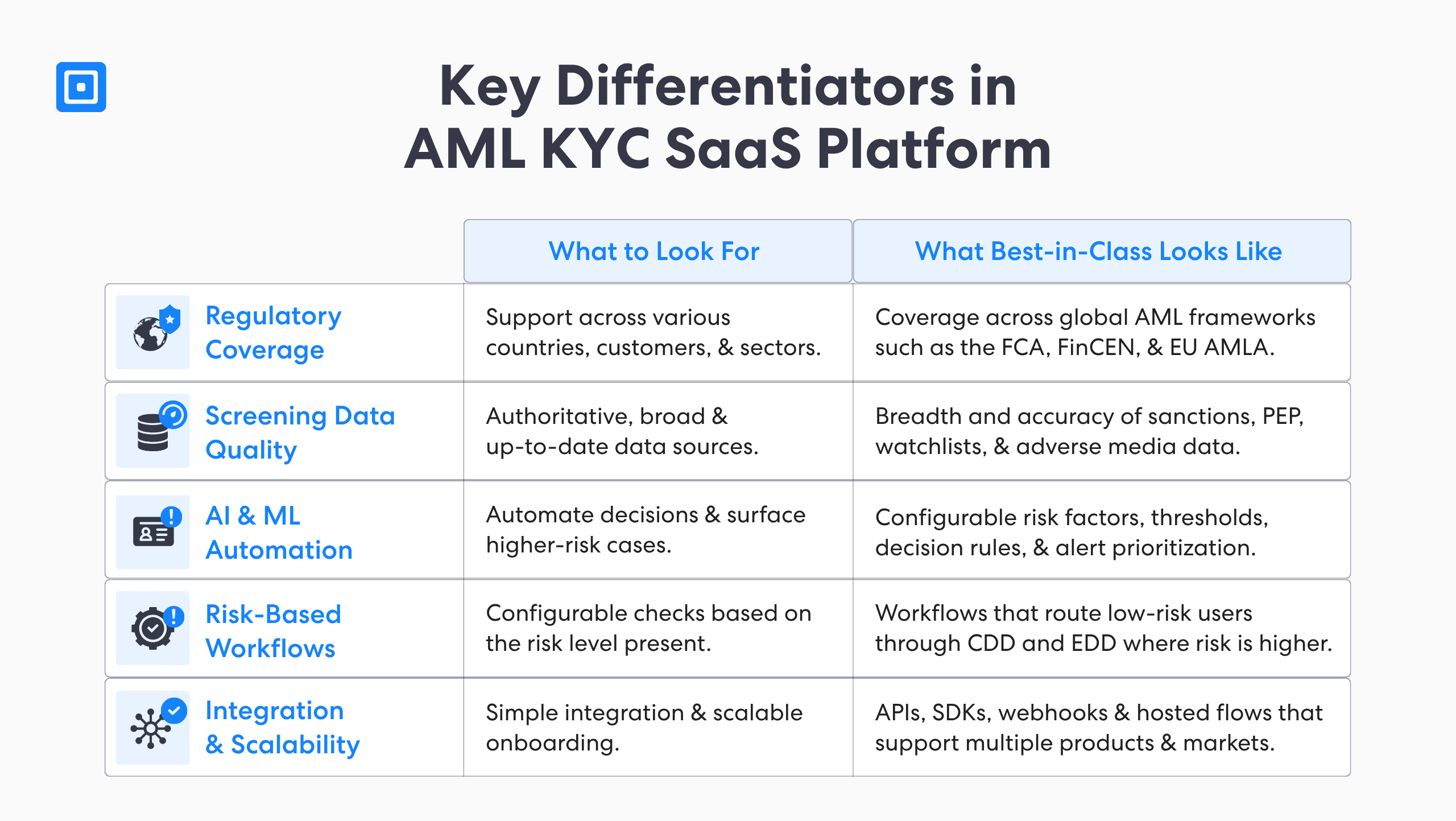
Consequently, the strongest AML KYC SaaS platforms connect multiple risk signals to trigger faster, proportionate due diligence, reviews, and escalation. Consider these key differentiators when evaluating KYC AML solutions.
- Regulatory and geographic coverage: How well the platform supports different geographies, customer types, data sources, and regulatory requirements.
- Screening data quality and freshness: Buyers should examine the accuracy, depth, and update frequency of the data sources used during AML screening.
- AI, machine learning, and automation: Automated KYC solutions can reduce manual effort by up to 94% and enable smarter alert prioritization, decisioning, and risk analysis.
- Risk scoring sophistication: The best platforms enable highly customizable risk controls, including weighting and thresholds rather than applying the same thresholds across the board.
- Scalability and performance: How the platform can manage any sharp increase in check volume, new markets, or complex requirements without operational blockers.
Case Study: New UK AML and Asset Recovery Strategy
This month, the UK’s Home Office and HM Treasury presented its UK’s AML and Asset Recovery Strategy. The aim of it is to establish smarter risk-based decisions, quicker recovery of illicit assets for victims, and to dismantle complex criminal networks.
Empower, Target, and Integrate
The strategy relies on three core principles. Namely, empower businesses and technology to boost AML intelligence, target resources on high-risk activity, and integrate synchronicity to take down large money laundering operations.
Résultats
- The strategy establishes risk-based programs as crucial, echoing many other leading regulations.
- A risk-based framework improves experience for low-risk customers, while increasing scrutiny where there are high-risk.
- Business should expect more documentation around the effectiveness of its risk-based framework, including evidence behind how decisions and escalations are made.
The 6 Best AML KYC Solutions Provider in 2026
Based on regulatory coverage, KYC and AML capabilities, risk-based workflows, ongoing monitoring, integration, and total cost of ownership, six providers stand out in 2026. ComplyCube offers a particularly broad combination of KYC, KYB, ongoing AML screening, risk decisioning, and compliance workflows.
Meanwhile, SEON, NICE Actimize, ComplyAdvantage, Sumsub, and Persona have different strengths across fraud intelligence, enterprise AML, risk data, transaction monitoring, and orchestration.
1. ComplyCube: Best for Unified AML KYC Solutions
When evaluating for unified AML KYC solutions, ComplyCube stands out. The company provides comprehensive coverage in more than 250 jurisdictions and support for over 14,000 different documents. The platform prides itself in ease of use and setup, providing identity verification, AML screening, and reporting needs within one workflow and without the need for coding expertise.
- Identity Assurance: Document verification, proof of address, liveness checks, age estimation, 2+2 multi-bureau, driver verification, right to work, eIDAS-compliant vérification d'identité électronique, and more for KYC compliance in every market.
- AML Screening: Sanctions and PEP screening, adverse media monitoring, watchlist checks, transaction and ongoing monitoring, and a highly bespoke custom risk engine to meet sector or company specific risk policy.
- Fraud Intelligence: Email, device, and phone intelligence which can detect high-risk users via granular behavioral and network analysis. Additionally, its OTP verification solution adds another trust layer, blocking fraudsters at the source.
- Operational Efficiency: No/low-code workflows, KYC smart forms, policy assurance, advanced case management, and the latest esignature feature allows businesses to gather critical identity attributes, adapt to evolving compliance mandates, and build regulatory trust.
ComplyCube also has a comparatively transparent TCO structure. Tarifs is $99/month for Starter and $299/month for Core, with no standard setup fees. Moreover, it maintains enterprise security and assurance credentials, including ISO 27001 certification and ISO 30107 PAD Level 2-certified liveness detection.
Idéal pour : Regulated firms that need a multi-layered unified AML KYC SaaS platform with high global coverage, tailored risk controls, no/low-code workflows, and transparent pricing.
2. SEON: Best for Fraud Intelligence
SEON is a key player in the fraud intelligence market. The company has also expanded its KYC suite with identity verification and AML compliance offerings. In particular, SEON has clients in regulated industries such as banking as it requires advanced financial crime tools. The platform supports customer, sanctions and PEP, médias négatifs, and payment screening.
These functions are tied to more than 1,100 real-time fraud signals, allowing companies to leverage both fraud and financial crime indicators in their risk decisions. SEON helps compliance leaders manage money laundering and terrorist financing risks. However, regulatory coverage and specific jurisdictional requirements are key factors to evaluate within their KYC checks.
Idéal pour : Digital businesses that want to combine fraud intelligence, AML screening, and transaction monitoring within a single risk environment.
3. NICE Actimize: Best for Large Financial Institutions
NICE Actimize is known for being an established financial crime platform for larger financial firms. It has a KYC and Client Lifecycle Management suite which support vérifications de diligence raisonnable, watchlist screening, and risk assessment in one go. Additionally, its wider AML stack has transaction monitoring and investigations.
The platform’s screening depth stands out. NICE Actimize integrates multi-dimensional customer risk ratings with sanctions and PEP screening, adverse media checks, and behavioral transaction analytics. However, that enterprise sophistication can also act as its main trade-off. NICE Actimize is designed for complex businesses, rather than those that need a quick, lightweight, and API-first KYC implementation.
Idéal pour : Large banks and financial institutions that need more advanced transaction monitoring, lifecycle management, and investigation tools.
4. ComplyAdvantage: Best for AML Risk Intelligence
ComplyAdvantage specializes in financial crime intelligence and performs strongly in les sanctions, PEP, watchlist, adverse media, and ongoing customer monitoring. It combines customer and payment screening, as well as ongoing and transaction monitoring in one AML environment.
One differentiator is its screening data. The company states that sanctions list changes can be seen in minutes. Its APIs also let organizations tailor screening parameters and risk controls to their risk appetite. ComplyAdvantage’s core strength remains financial crime intelligence, rather than identity verification. Its ecosystem includes partnerships with KYC providers for other checks.
Idéal pour : Financial institutions prioritizing high-quality AML data and screening. However, if a business plans to implement KYC, it may require additional technology.
5. Sumsub: Best for Transaction Monitoring and Full-Spectrum AML
Sumsub has a robust financial crime compliance stack, covering KYC, KYB, LBA, ongoing monitoring, and case management. Its Workflow Builder allows firms to create conditional verification journeys. Also, its case management solution connects screening alerts and suspicious activity to structured investigations.
For businesses where transaction-level AML controls are central, Sumsub has an advantage. However, the trade-off is commercial complexity. Sumsub’s Compliance plan starts at a $299 monthly commitment, with pricing increasing according to verification volume and additional products required. In 2026, the company integrated ComplyAdvantage Mesh to strengthen its financial crime risk intelligence hub.
Idéal pour : Enterprise payments, banks, and crypto businesses requiring KYC, AML screening, transaction monitoring, and case management within a broad financial crime stack.
6. Persona: Best for Highly Configurable Compliance Workflows
In terms of in-depth workflow customization, Persona stands out. Notably, its no-code and code-extensible Workflows product can combine internal information, risk signals, and external data before applying custom decision rules, triggering re-verification, or opening cases for investigation.
Persona offers AML tools with sanctions, PEP, custom-list screening, and automated Suspicious Reporting Activity (SAR) workflows. It includes a flexible case management layer with investigation templates and escalation queues. That flexibility is useful for advanced teams. However, firms seeking an immediate KYC policy model may spend more time configuring choices during implementation.
Idéal pour : Companies requiring highly configurable AML KYC solutions, flexible decisioning, and sophisticated case management for more complex customer journeys.
Which AML KYC Solutions Are Best for Your Use Case?
Different AML KYC solutions can be better suited to different operating models. The best compliance platform is therefore the one that aligns most closely with your primary compliance use case, while still giving you enough flexibility to support future markets, products, and risk requirements. This section categorizes the leading providers into three specialist compliance needs.
- Specialized fraud and orchestration needs: SEON is strong for fraud intelligence, ComplyAdvantage for AML risk data, and Persona for complex orchestration needs. These vendors act as specialist platforms for AML processes.
- Unified AML/KYC compliance: ComplyCube stands out because it supports end-to-end compliance within a single proprietary environment. It offers bespoke solutions and highly granular controls, so firms can confidently meet KYC and AML regulations globally on an ongoing basis.
- Complex financial crime: NICE Actimize, Persona, and Sumsub perform particularly well for larger financial institutions with complex company structures and high transaction volumes. These vendors are valuable where businesses need enterprise AML infrastructure.
Points clés à retenir
- Non-negotiable capabilities in AML/KYC vendors are risk-based flows and ongoing monitoring.
- Réglementaire and country coverage, screening quality, and automation differentiates top vendors.
- ComplyCube stands out for unified compliance due to its end-to-end AML compliance suite.
- SEON and ComplyAdvantage excels for firms that focus on building defensible fraud prevention
- Persona, SumSub, and NICE Actimize are best for those with complex AML infrastructure needs.
Evaluate and Compare AML KYC Solutions in 2026
Leading compliance solutions help businesses cut costs, enhance efficiency, and tailor controls as risks and regulations change. A structured comparison of AML KYC solutions such as the one above can help firms choose technology that meets not only today’s requirements, but also evolving financial crime threats. Learn how you can satisfy KYC AML compliance with ComplyCube’s advanced solutions today.

Questions fréquemment posées
How long does it take to implement a unified AML KYC SaaS platform?
Implementing an AML KYC SaaS platform can take from just a day to several weeks. The time taken will depend on factors such as integration capability and compliance requirements. However, API-first platforms and no/low-code workflows can speed up the set-up process.
Can we rely on a single vendor for all AML KYC needs?
Yes, a single AML KYC vendor can combine identity verification, AML screening, and suspicious activity reporting in one platform. To ensure compliance, firms should assess jurisdiction coverage, data sources, and other checks required under their risk-based compliance framework.
What are the top AML software vendors for banks?
The top AML software for banks are those that support enhanced due diligence, sanctions and PEP screening, risk assessment and ongoing monitoring. Banks should compare these providers against their AML requirements, such as regulatory coverage, screening data, and total costs
How to track the success of our AML KYC solutions?
The success of your AML KYC solutions will depend on onboarding completion rates, verification success rates, false-positive rates, manual review rates, average onboarding time, and cost per customer. Additionally, alert resolution times and the effectiveness of ongoing risk monitoring is critical to preventing financial crime and strengthening AML KYC compliance.
Can we migrate our solutions to ComplyCube?
Yes. Businesses can migrate existing KYC and AML processes to ComplyCube to consolidate identity verification, AML, KYB, and risk-based workflows within a unified platform. It offers the widest breadth of integration, including APIs, SDKs, and hosted workflows to accelerate setup within your existing compliance infrastructure.