TL;DR: Despite modern identity verification solutions, document check challenges remain persistent in many compliance teams. This guide uncovers common document verification mistakes, explains why a document verification fail occurs, and shares proven prevention strategies.
Why is Document Verification Challenging?
Document verification processes can be complex, as they are rarely caused by a single bad document upload by a customer. Instead, failures in the process can point to many factors, including stringent risk thresholds, multiple in-flight attempts, or ambiguous onboarding instructions.
Furthermore, additional challenges can stem from technological limitations, including data-capturing errors and poor integration. User behavior such as improper photo angles and inadequate lighting, can also occur. Thus, for compliance teams, the real task is to understand the root of why document verification fail cases happen, what steps to take next, and how to improve the process without compromising customer experience.
Manual Versus Digital Document Review
Document verifications form a standard component of identity verification and Know Your Customer (KYC) compliance. Typically, during document checks, a customer submits a document, such as a passport or driver’s license, and this document is verified via two different routes.
The first route is manual document verification. In this route, a business will collect physical documents such as government-issued ID cards and cross-check the information against customer inputs (name, date of birth, social security number, residential address). An analyst will typically visually inspect security features on a physical level. This verifies that the person presenting the document matches the submitted information.
On the other hand, an automated document verification process uses Artificial Intelligence (AI) tools, such as Optical Character Recognition (OCR), to instantly extract customer information. This key information is auto-matched against a customer’s onboarding input in seconds. Digital document verification incorporates validation scans of the document for its security features (holograms, watermarks, microprinting). Thus, it can handle high verification volume with minimal human intervention.
The benefits of automated document verification:
- Online document checks support remote teams in scaling verifications without staff burnout or backlog.
- Manual checks are time-consuming. Digital verification significantly reduces processing from minutes to seconds.
- Digital ID services enhance security, reduce costly errors from human review, and boost operational efficiency.
- Manual processes can invite human error, such as misreading text. Automated processes, however, establish consistent reviews.
Common Document Check Challenges
Document verification fail cases must be viewed as operational intelligence, not just onboarding friction. For example, a customer may be legitimate, but their document quality may prevent successful verification. Effective document verification is thus two-fold; it confirms that a document is genuine and it verifies customer identities as a legitimate holder.
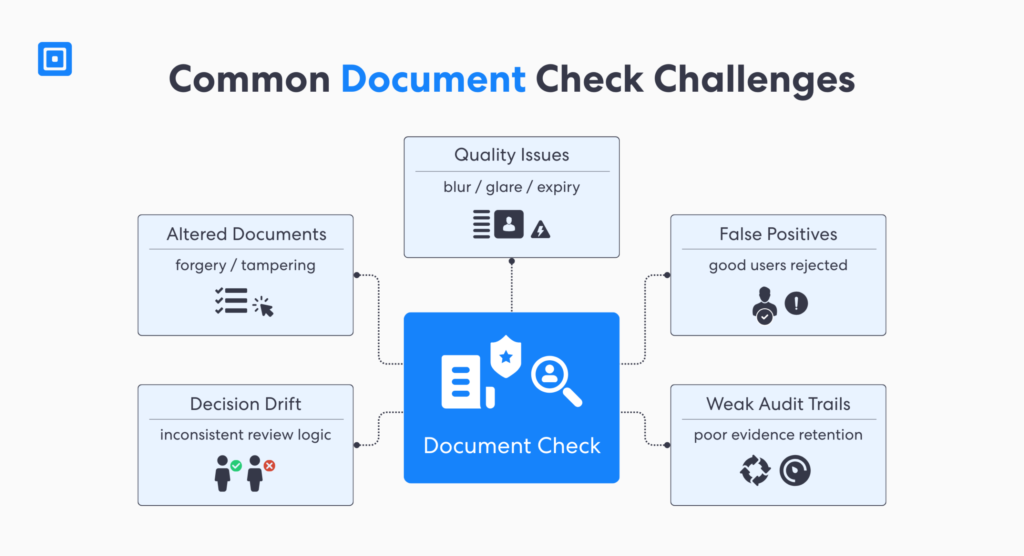
As a result, document review must be framed as part of a broader, end-to-end compliance infrastructure rather than an isolated fraud filter. In this section, we cover the biggest document check challenges from ComplyCube’s network experience, following authoritative, regulatory-backed solutions.
1. Distinguish Genuine from Altered Documents
Over the years, document forgery and tampering have advanced, with Cifas reports recording over 440,000 identity fraud cases. Additionally, the rise of “template farms,” which produce and sell editable fakes fuel document fraud growth. These mimic genuine layouts, personal details, and images, making detection complex.
Multi-layered document review moves beyond a single check to scale verified onboarding.
To combat this challenge, the US NIST encourages a multi-layered verification process. Organizations can stack biometric liveness, database checks, and device intelligence to build complete customer risk profiles, supporting faster compliance decisions. ComplyCube’s CPO, Harry Varatharasan, notes, “A multi-layered review process moves beyond a single check to enhance verified onboarding.”
2. Document Quality and Eligibility Issues
Poor image quality remains a core challenge for many organizations, eroding document integrity. For example, blur, glare, or cropped edges can lead to false positives and unnecessary resources wasted on escalations. Additionally, expired documents and damaged surfaces add to these failures.
Quality controls must be dedicated at the point of capture. For example, businesses can implement real-time image quality checks, capture prompts, field validation, and mandatory multi-side capture to create cleaner submissions and defensible audit trails:
Real-Time Image Quality Checks:
- Blur detection: If the sharpness score falls below 80% → Trigger “Hold steady, retake.”
- Glare analysis: For overexposures above 30% → Trigger “Angle away from lights.”
- Framing complete: All 4 corners of a document are visible → Trigger a green checkmark.
Guided Capture Prompts
- Live previews: Indicate proper framing with green and red zones.
- Step-by-step: Showcase clear steps and a progress bar, such as “Front → Back → Selfie”
- Context-aware: Add guidance on specific document types, for example, “Passports need MRZ visible.”
Pre-Submission Field Validation
- Name/Date of Birth auto-fill: Extract data from OCR, which a customer later confirms with a tick.
- Expiration Validation: If the ID expires, release a statement to get it replaced with other valid document.
- Document Damaged: Flag and prompt for a replacement with an alternative document type.
3. False Positives
Poor-performing, outdated systems can reject legitimate users and drive up manual reviews. At scale, false positives drive up compliance resources, distort risk metrics, and lead to onboarding friction. Overly strict thresholds, poor country routing, and weak exception handling can all lead to artificial fail rates.
Risk assessment requires analysis of false positive data points and previously generated false positives.
To combat this challenge, it is first crucial to assess the previously generated false-positive data points. As a solution, organizations can fine-tune risk thresholds and route localized templates to eliminate generic model failures. In the US, for instance, every state issues driver’s licenses differently. By routing each state to its correct template library, false positives can be minimized.
4. Inconsistent Decision and Governance
Different compliance officers may reach conflicting outcomes on document cases. Additionally, fragmented ownership leads to unclear accountability during reporting. Inadequate training on changing regulations can also leave teams applying outdated regulatory standards.
Organizations are encouraged to create a clear control ownership model. This includes who owns, has access, and can modify change controls. Modern document verification software includes role-based access controls (RBAC), which restrict access to different staff according to role type. Pairing this with periodic training and using pre-built policy templates enables consistent application across global regulatory frameworks, including the US Financial Crimes Enforcement Network (FinCEN), Singapore’s MAS, eIDAS, and the Financial Action Task Force (FATF).
5. Weak Audit Trails
Document verification does not end with successful onboarding. Regulatory authorities expect organizations to submit reports with comprehensive decisions. Just last year, Anti-Money Laundering (AML) fines totalled over $6 billion, showcasing heightened enforcement towards compliance. Common pitfalls at this stage can point to data collection and integration gaps.
Modern document management leverages version control and AI algorithms to automatically deliver the latest version of compliance policies. API and SDK integration captures real-time decision logs for every case, which support real-time data integrity, timestamped evidence of customer risk profiles, and decision framework changes. Moreover, centralized dashboards with audit-ready features can identify training gaps and red flags before regulatory examination.
Document Verification Mistakes to Avoid
Document verification mistakes can happen during review and policy response. These operational mistakes might seem minor from the outset, but they can produce fragmentation. As a result, genuine documents are delayed, while fraudulent documents slip through the gaps.
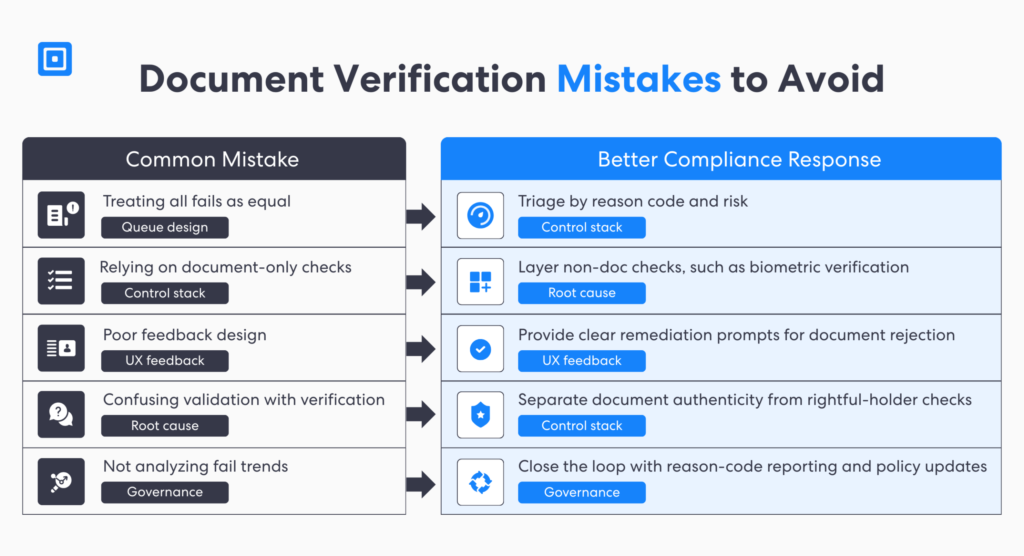
Consequently, these errors compound into higher manual review volumes, rapid customer drop-off, and regulatory exposure. However, with the right tools and framework, organizations can create a strong culture of compliance while maintaining a satisfied customer and client base. The common mistakes we see in many organizations include:
- Treating all fails as equal: For example, a blurred image should not follow the same customer messaging and reviewer path as a suspected document forgery. Instead, build reason-code discipline and route each issue at each stage according to the risk level present.
- Reliance on document check: Typically, a document-only decision can lead to high false positives or negatives due to a narrow risk profile. In contrast, combining biometric and database verification offers robust customer profiles, catching fraud while onboarding real customers faster.
- Poor feedback design: Generic messages, such as “try again”, can lead to multiple submissions without better quality. Clear remediations tell the user whether the issue relates to an unaccepted document type or cropped edges, eliminating friction and boosting conversion.
- Validation vs verification: The US NIST separates evidence validation, where a document is analyzed for its genuineness from identity verification, where the applicant is checked to be the rightful owner of the same document. Without the other, remediation steps can be weakened.
- Weak insights: Failure reasons, including understanding where a user drops off in the onboarding stage, provide key insights into the root cause. When data are not analyzed, organizations cannot tell whether rising failure rates are due to fraud risks or weak user experience.
Case Study: Money Laundering Heist Traced to Poor Document Verification
In 2023, Singapore authorities exposed the largest money laundering case in the country, with over S$3 billion in illicit assets transacted. In 2025, nine financial institutions were linked to the case, with a total S$27.45 million fine due to weak document checks and due diligence.
Shocking investigation uncovers years of non-compliance
Leading firms, including UOB and Citibank, were found to have gaps in their identity verification processes. This includes the failure to verify source-of-wealth documents, outdated or incomplete documentation, and approving high-risk clients despite red flags.
Outcomes
The total fines across these 9 firms amounted to S$27.45 million, with the highest fines for Credit Suisse (S$5.8M) and UOB (S$5.6M).
Several senior executives faced harsh sanctions, including the CEO and COO of Blue Ocean Invest, who had to exit the financial services sector.
The case highlights the impact of policies and compliance discipline, indicating that the right tools are not enough without strong governance.
Respond Better to Document Check Challenges
Jurisdictions such as the EU, U.S., Singapore, UK, and UAE generally require risk-based customer due diligence and identity verification using reliable, independent sources. However, the exact documents, methods, and sector-specific obligations vary by jurisdiction and by regulated entity.
Non-compliance can risk multimillion fines, erode customer trust, and cause reputational damage. Effective document verification analyzes if the process is risk-based, consistent, and auditable, as per the FATF’s Recommendation 10. This goes beyond fraud prevention, supporting regulatory defensibility.
For compliance teams, that usually means five step-by-step improvements:
1. Adaptive workflows: Use smarter, structured rules to bypass, escalate or request alternate evidence from live risk signals. Test and tweak them where necessary.
2. Better capture guidance: Real-time prompts to eliminate wrong user behavior, such as glare, cropping, and incomplete submissions, before review.
3. Tiered routing: Route each customer workflow by jurisdiction, document type, and risk profile, moving away from one uniform decision logic.
4. Layered identity checks: Combine document review with biometric verification, device intelligence, and database checks where appropriate.
5. Reason-code reporting: Track failure reasons at a granular level, with segmented, visual analytics to separate UX issues from fraud effectively.
Key Takeaways
Common document check challenges include poor document quality and eligibility, high fraud positives, and weak governance.
Document verification fails are triggered by unclear onboarding instructions, technological limitations, and user behavior.
Multi-layered verification removes document review as a standalone check, producing robust customer risk profiles and fraud detection.
Real-time image quality checks, guided capture prompts, and pre-submission field validation improve customer experience and onboarding
Document verification software with pre-built policy templates, such as ComplyCube, supports firms in meeting KYC obligations.
Save Time with Compliant Document Verification
Document verification failures are not just onboarding errors. Compliance teams can leverage them as data points to built stronger KYC outcomes throughout the onboarding and monitoring process. Adopting a smarter response to document check challenges with a layered, risk-based approach positions firms to better detect fraud and maintain compliance.
Additionally, embedding real-time document quality checks and clear prompts fosters enhanced customer experience, and in turn, long-term loyalty and revenue. Discover how ComplyCube’s automated document verification and fraud intelligence solutions can transform your compliance operations.

Frequently Asked Questions
What are the reasons for a document verification fail?
Document verification failures include poor image capture, such as blurry, glare, damaged, or cropped edges. Expired documents, unaccepted original document types, and software failures when extracting customer information also cause document check challenges. Other reasons point to compliance failures, such as suspicion of fraud or a high-risk customer profile.
What are the top document check challenges?
Common document check challenges include the inability to identify tampered documents, poor document quality, high false positives, and weak governance. These challenges, when not resolved, lead to fragmented decision-making in compliance, hampering KYC and fraud prevention efforts.
How does document verification support compliance?
Document verification supports KYC and AML processes by verifying that a user is a real person and a legitimate holder of a document. It involves validating security features on a document (watermarks, holograms, etc) to prevent fraudulent activity. Global regulations, such as the EU’s eIDAS, US FinCEN, and Singapore’s MAS, mandate document checks in customer due diligence.
What are common document verification mistakes?
The most common document verification mistakes that compliance teams make include over-reliance on manual reviews, dependence on document review as a standalone check, and poor feedback design. These mistakes negatively impact customer experience and can introduce compliance risks due to human error, leading to reputational harm and legal exposure.
Can ComplyCube’s document check stay ahead of regulatory changes?
Yes. ComplyCube’s bespoke document verification solutions accept over 14,000 document types in 250+ territories. The platform provides pre-built policy workflows aligned with international regulations (Canada’s FINTRAC, Singapore MAS, UAE CBUAE, UK DIATF, etc). Additionally, its no-code workflows support quick workflow deployment aligned with new rules in seconds.