TL;DR: Multi-bureau identity verification cross-checks customer data against multiple authoritative sources to confirm authenticity. Using 1+1 verification, 2+2 check, match logic, it cross verifies multiple combinations of data attributes through an identity database for information such as name, date of birth, address, and national identity numbers.
What is Multi-Bureau Identity Verification?
Multi-bureau identity verification is an automated identity-checking method. It validates customer information by comparing it against multiple independent and trusted data sources. Businesses use sources such as telecom records, credit bureaus, government registries, and utility providers to build a more complete and reliable picture of who a person is.
This identity verification approach allows organizations to verify key data points, and assess identity risk with far greater precision. By distributing checks across different bureaus, businesses can reduce the chance of fraud slipping through gaps in any system. This ensures that customers with limited documentation can still be verified.
Why Multi-Bureau Identity Verification Matters
It is clear that multi-bureau identity verification checks are central to the customer onboarding process. Most verify customer information across two or more data sources, such as government records, utility bills, and credit bureaus. Businesses can easily ensure they meet detailed due diligence and compliance requirements through an additional third-party as part of a comprehensive multi-bureau process.
Fraudsters have evolved, and so must our defenses.
Milosh Caunhye, Solutions Consultant from ComplyCube states that, “Fraudsters have evolved, and so must our defenses. By combining telecom data, credit bureaus, and alternative data, multi-bureau verification disrupts the very signals bad actors depend on. It allows businesses to identify manipulation early especially in the face of deepfakes and AI-generated social engineering.”
Financial services and regulated platforms worldwide face growing pressure to verify customers quickly and accurately over time. The UK government must be ready to use trusted digital identity services, provided they meet individual regulatory requirements. Multi-bureau identity verification, such as 1+1 verification and 2+2 checks, offers:
- Improved match algorithm accuracy, reducing false positives and the friction they cause.
- A broader range of defined data coverage options, helping onboard users who may lack traditional documents
- Flexible compliance, supporting evolving regulations in jurisdictions such as the UK, the US, and the EU.
Understanding 1+1 Verification and 2+2 Checks
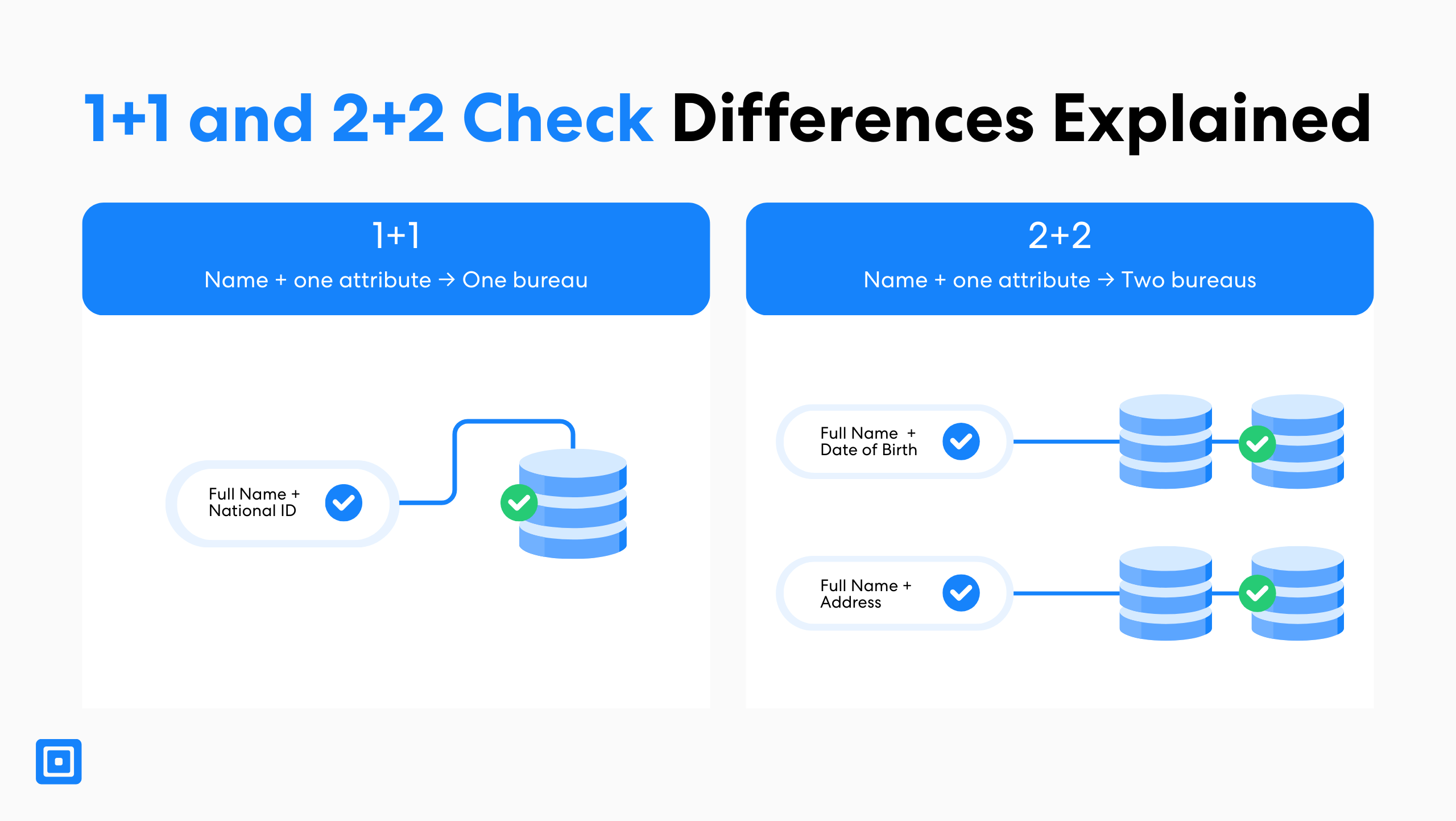
Verifying customer identity through various identity databases operates under two regulatory framework options. This includes 1+1 verification and 2+2 checks. These match frameworks define how many attribute pairs (name plus one additional attribute) must be verified, and across how many independent data sources, to meet regulatory and compliance requirements.
What is a 1+1 Verification?
1+1 verification involves matching a customer’s name plus one additional attribute, such as date of birth, address, or an ID number, within a single authoritative data source. While less intensive than 2+2 logic, this approach is often acceptable for lower-risk scenarios or jurisdictions with more flexible requirements. It enables businesses to verify customers who may lack extensive financial histories by using alternative or locally available data.
What is a 2+2 Check?
A 2+2 check requires matching a customer’s name plus one additional attribute across two separate and reliable data sources. This could include name and date of birth, or name and address, verified independently by two bureaus. Frequently, this 2+2 check is considered the gold standard for electronic identity verification in many regulated environments. For example, a FinTech in the UK might verify a customer’s full name and address across both a credit bureau and an electoral roll database.
The Joint Money Laundering Steering Group (JMLSG) supports financial industry sectors in complying with anti-money laundering (AML) and counter-terrorist financing (CTF) legislation. It recommends the 2+2 check as a preferred method to verify electronic ID (eID) in high-risk customer onboarding scenarios, requiring due diligence.
How Match Logic Works in Multi-Bureau Identity Verification
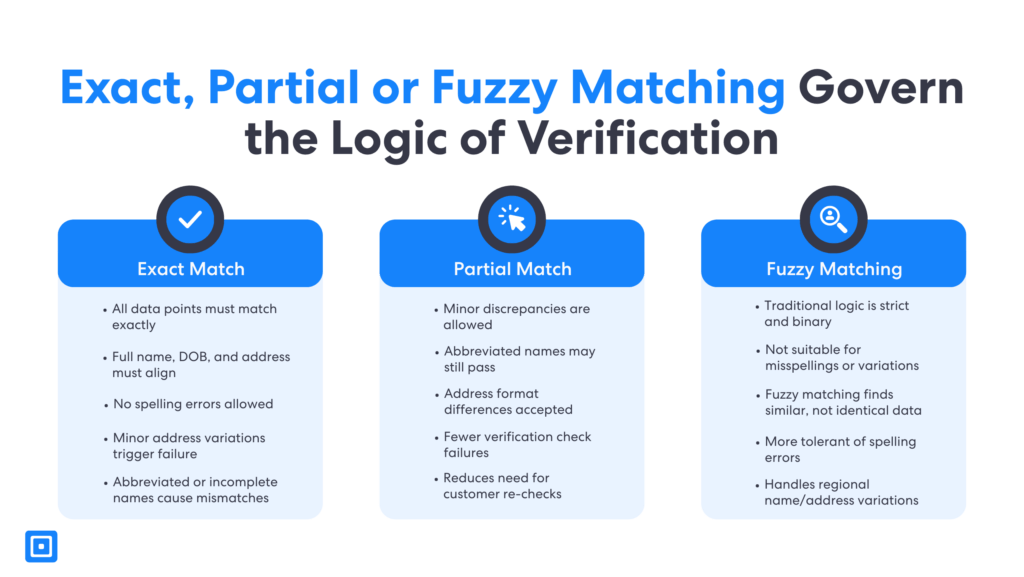
Match logic is the set of rules that govern how individual customer information must align across different identity databases. Often, match logic determines whether a user is “verified”; otherwise, further action is required to complete the process. In practice, this typically boils down to either an exact match or a partial match between sources.
Exact Match Logic
With exact match logic, the identity verification rules are clear. In order to be verified, every piece of data referenced must align perfectly with a real birth date, full name, and address within a relevant identity database. Even a small discrepancy, such as a street name typo or forgetting a middle name, can still trigger an instant failure during a check.
Partial Match Logic
In a partial match, some minor discrepancies in results are allowed, for example, an abbreviated name or address formatting differences between sources. This can ensure reduced fail rates and the need for re-checking or requiring a customer to update their information, such as their address or email, to complete the process.
Fuzzy Matching: When Ordinary Match Logic Doesn’t Fit the Bill
Traditional algorithm logic is binary and straightforward, but this is not always the best approach, as a range of options may need to be considered. Names can be misspelt, and some areas can be known by multiple names. These logic algorithms identify similar, but not identical, text or data properties. Compared to other logic system algorithms, fuzzy matching is more tolerant of simple misspellings or regional variations.
Businesses can adjust their risk tolerance ranges to customise their processes according to use case requirements, geographic regions, and customer segments. For example, there are times when a payment platform operates in both Europe and Africa. It might have added stricter match logic for European users due to recently published local AML laws, while accepting partial matches in Nigeria, where address formats vary widely.
What Are Customer Identity Databases?
Identity databases are structured, trustworthy sources of customer data used for complete electronic verification. These sources vary by country and regulatory framework but must generally correspond to detailed standards for independence, accuracy, and data freshness. Common examples or types of identity databases include:
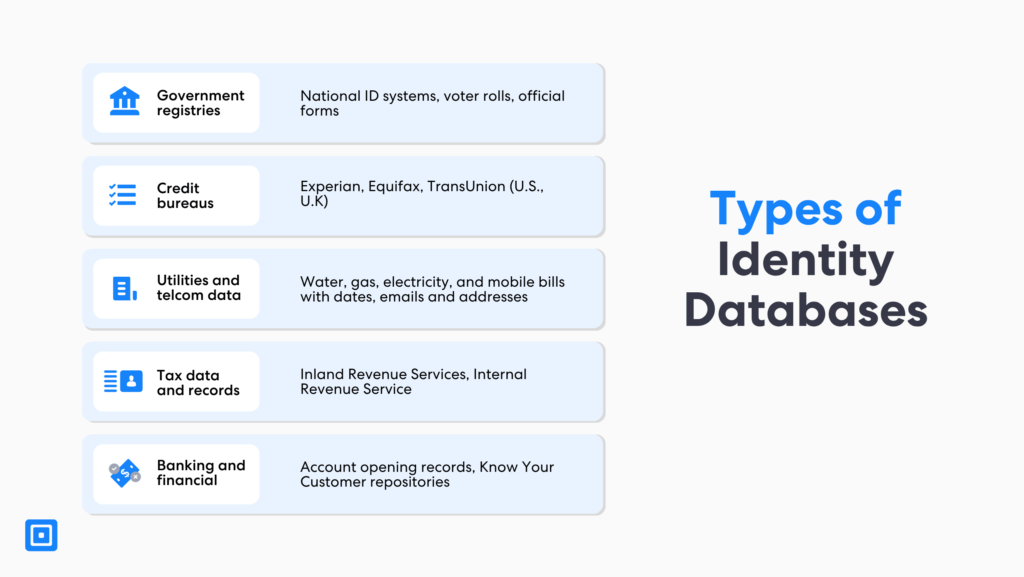
Note that, to meet regulatory expectations, at least one identity database used in the verification should come from a regulated authority. This ensures that underlying data meets standards for accuracy, integrity, and freshness. Combining information from both public records and private entities such as telecom providers or utility companies only strengthens the verification process, offering a more complete and trustworthy view of an individual’s identity.
Use Cases in Different Sectors and Geographic Regions
Multi-bureau verification is incredibly vital across various types of sectors and different regions. Businesses that face stringent due diligence requirements must be prepared to implement detailed processes that correspond to their respective industry and any regional regulations. Some use cases include:
FinTech and Digital Banks
Fintech and the banking industry, in general, are expected to uphold stringent customer identity verification measures and update information. Digital banks operating in high-growth regions such as India and Brazil often rely on 2+2 verification to verify identities, prevent fraud risk, and meet local regulatory requirements. Integrating multi-bureau identity databases into your customer application results in a fast, document-free onboarding process.
Crypto and Blockchain
Crypto exchanges are vulnerable to exploitation and abuse and are, therefore, also becoming increasingly subject to regulation. In the EU, the US, and the UAE, these businesses must address both national KYC laws and FATF recommendations. Multi-bureau checks enable complete frictionless onboarding while supporting different forms of risk-based controls and identity monitoring. You can learn more about the topic here: What is a Risk-Based Approach (RBA)?
Telecommunications and Marketplaces
It’s not just the financial sector that needs diligence and stringent individual identity verification due to the rise of fraud at this time. Telecom operators in Africa often face a higher volume of SIM card fraud compared to other developed countries. Using mobile operator data and government ID registries for a 1+1 logic has proven effective in countries where the availability of identification documents varies.
Case Study: Multi-Bureau Identity Verification at Paytm Payments Bank
Paytm Payments Bank operates at significant scale in a mobile-first market, where customers expect fast digital onboarding. At the same time, it must comply with Reserve Bank of India (RBI) KYC and customer due diligence requirements, which place strong expectations on identity verification.
Introducing Multi-Bureau Identity Verification
To meet these demands, digital banks in India commonly use a layered identity verification approach, combining primary identity evidence (such as government-issued identifiers) with additional independent data sources to validate key identity attributes (e.g., name, date of birth, and contact details).
Outcomes
- Faster onboarding by reducing reliance on manual checks and rework
- Stronger identification of inconsistent or high-risk identity profiles
- Better alignment with RBI KYC expectations and audit requirements
Benefits of Multi-Bureau Identity Verification
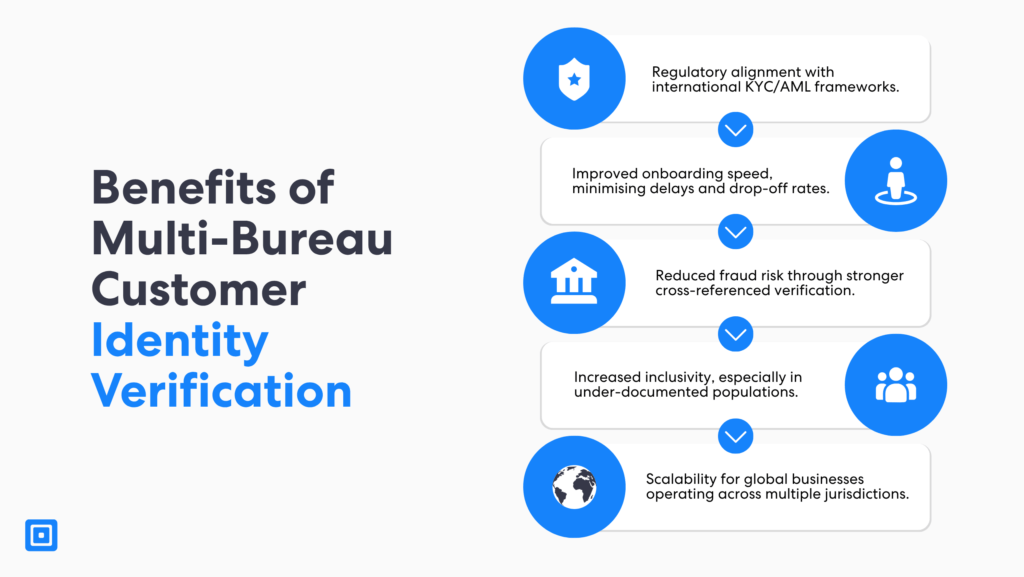
At first glance, multi-bureau identity verification might seem a bit excessive. This is true especially if you’re concerned about the cost of KYC measures and APIs. However, these multi-bureau checks, in addition to thorough document verification, offer numerous operational and compliance advantages. They provide a deeper level of assurance that single-source checks simply cannot achieve, helping secure and scalable.
It also accelerates customer onboarding by reducing delays and drop-off rates, while lowering fraud risk through more reliable cross-referencing across independent data sources. Beyond fraud prevention, multi-bureau verification expands access for customers with limited documentation and offers scalability for businesses operating across multiple jurisdictions. Together, these advantages make multi-bureau verification a foundational tool for modern, compliant, and inclusive onboarding.
Five Compliance Considerations for Multi-Bureau Identity Verification
Multi-bureau is the safer, more accurate choice to address KYC compliance, and it’s an effective means to prevent fraud. But adopting this approach comes with key compliance considerations that global businesses must evaluate to ensure it supports their broader strategy. Done well, multi-bureau enhances onboarding; done poorly, it can add friction and complexity.
The most important considerations are workflow alignment, auditability, privacy, source integrity, and risk-based match logic. Multi-bureau checks should integrate cleanly into existing CDD processes, maintain a defensible audit trail of sources and attributes, protect customer data under laws like GDPR and CCPA, rely only on reputable independent datasets, and calibrate match thresholds according to the risk profile of each onboarding journey.
Key Takeaways
- Multi-bureau verification increases verification pass rates by 9% reducing onboarding friction.
- Drawing from multiple identity databases improve accuracy and compliance alignment.
- Using both 1+1 verification and 2+2 checks allowed the firm to balance low- and high-risk cases.
- Reduced manual intervention sped up onboarding and gave stronger audit trails for regulators.
- ComplyCube’s multi-bureau verification solution delivers the same advantages at scale, helping global businesses achieve compliance while offering customers a seamless onboarding journey.
The Future of Multi-Bureau Identity Verification
Multi-bureau plays a critical role in modern digital identity verification. By using 1+1 verification and 2+2 logic to check customer identity information such as name, address, email, etc, across multiple pages of trusted identity databases. Businesses are then able to achieve higher complete rates, speed up onboarding, and stay KYC compliant. As regulatory expectations evolve, scalable identity verification strategies, such as multi-bureau checks, remain essential to building trust with customers and ComplyCube has the solution you need.

Frequently Asked Questions
What is multi-bureau identity verification?
Multi-bureau identity verification checks a person’s name, date of birth, and address across many sources. Typical sources are electoral rolls and credit files in the UK/IE, population registers and eID in the EU, and credit bureaus plus USPS/NCOA in the US. Canada uses provincial and credit data, AU/NZ uses credit, postal, and (NZ) electoral data.
What is the difference between 1+1 verification and 2+2 checks?
The difference between 1+1 verification and 2+2 checks is the strength of the evidence. Where a 1+1 verification check confirms one attribute in two independent sources and suits lower-risk cases, a 2+2 check confirms two attributes in two sources and fits higher assurance needs.
Why do FinTech, crypto, and telecom companies use multi-bureau checks?
FinTech, crypto, and telecom companies use multi-bureau checks to lift pass rates and block fraud across regions. In the UK/EU, multi-bureau checks support AML and eIDAS while keeping sign-up fast. Over in the US/CA, multi-bureau checks help meet CIP/FINTRAC with fewer manual steps.
How does match logic work in identity verification?
Match logic in identity verification sets how close two records must be to count as a match. Exact matching is strict and suits high risk. Normalised and fuzzy matching handle local name styles, address formats, and date orders.
What are examples of identity databases used in multi-bureau verification?
Databases used for verification depend on the country and what is legal to use. The UK/IE often use electoral rolls, credit files, and PAF/UPRN, the EU uses population or municipal registers and postal files. The US/CA use credit bureaus, USPS/NCOA, utilities, and provincial records, AU/NZ use credit, postal, and (NZ) electoral data. In APAC/MENA/LATAM, databases used for verification can include national ID, tax or municipal files, and telecom KYC, where allowed.