Kurz gesagt: In dynamic workflows for KYC, teams can route customers through verification journeys based on identity data, customer preferences, and compliance requirements, rather than asking users to complete the same process. This guide will teach compliance teams dynamic workflows for onboarding and how to simplify processes with no-code.
Why Traditional KYC Onboarding Is No Longer Enough
Imagine a genuine customer trying to open a bank account but is unable to complete identity verification (IDV) because they lack the required documents. Meanwhile, another customer has access to an approved digital identity service but still needs more verification steps. Both are ready to onboard, but a rigid process creates unnecessary barriers.
Even in 2026, this remains a challenge. According to the UK government’s 2026 Inclusion Monitoring Report, only 49% of organizations using biometric technology offer an alternative route for users who do not wish to provide biometric data. It also found that 80% of organizations collect data on incomplete user journeys, although only 66% of those collect information on why users drop out. This demonstrates growing attention to the reasons why users struggle to complete identity verification.
Digital identity can make some services easier, and more accessible, but only if services are designed around people’s real lives.
James RJ Brown from the Office for Digital Identities and Attributes (OfDIA) also notes, “That includes people will lower digital confidence, lower digital access, fewer identity documents, disabilities, or other circumstances that make standard verification routes harder.”
The consistent issue is that while IDV technology advances, many onboarding journeys cannot meet different customer needs. For businesses operating across multiple markets, the challenge is even more complex. Customers may have different identity documents, verification preferences, and regulatory requirements. However, traditional workflows force people through the same pipeline. This creates unnecessary friction, higher operational costs, and missed opportunities to onboard real customers.
Dynamic workflows offer a far more flexible approach. They use predefined conditions aligned with company policies to select the right onboarding process. They rely entirely on available customer data and approved verification methods. For regulated businesses, dynamic onboarding workflows offer more customer choice while maintaining consistent identity assurance and compliance controls.
How Do Dynamic Workflows Work?
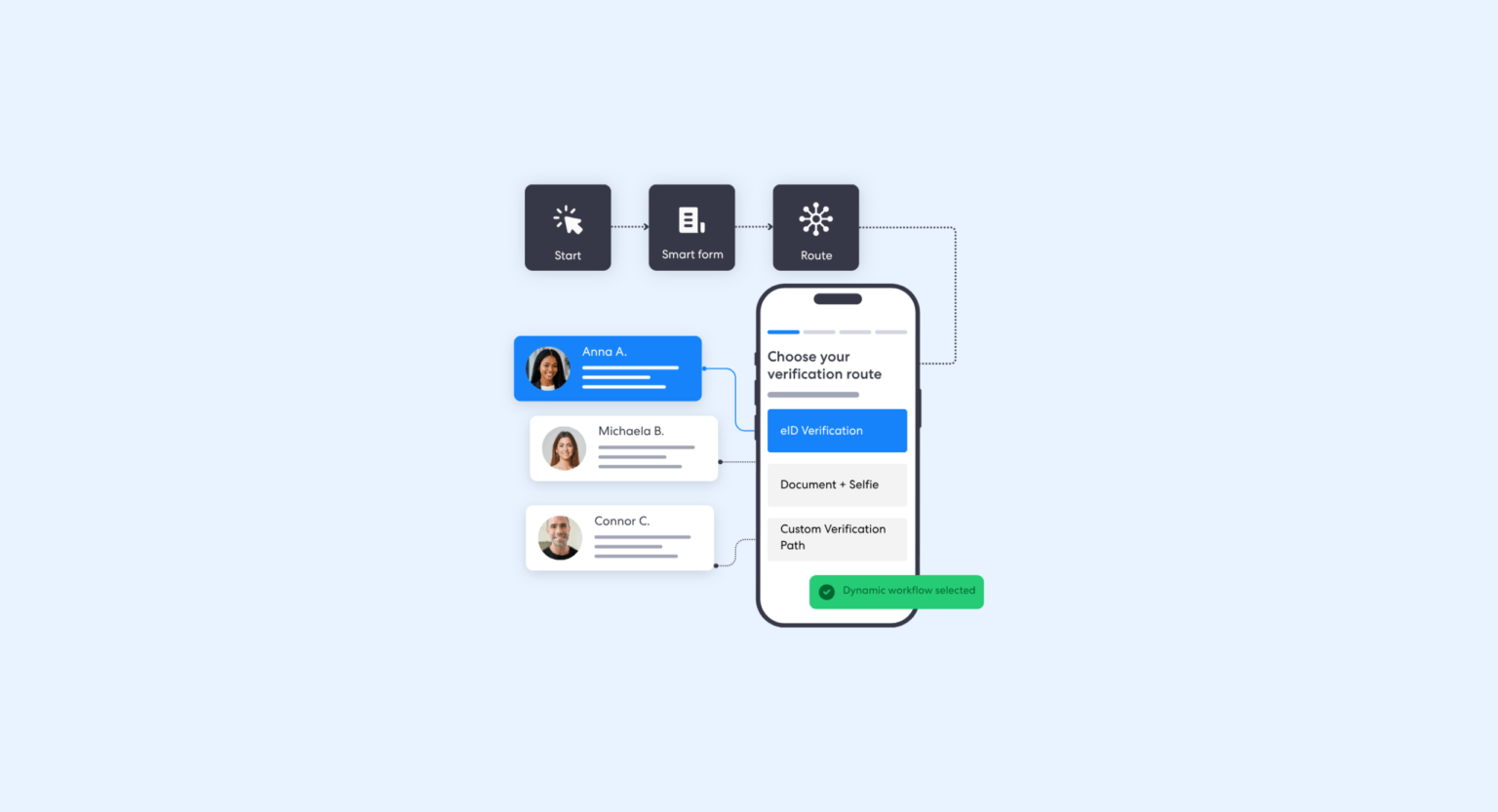
Unlike static workflows, which follow a fixed sequence of tasks, dynamic Know Your Customer (KYC) or onboarding workflows use logic to determine which route a customer must follow. For instance, one customer with access to an approved electronic identity (eID) service can verify their identity through a national digital identity scheme.
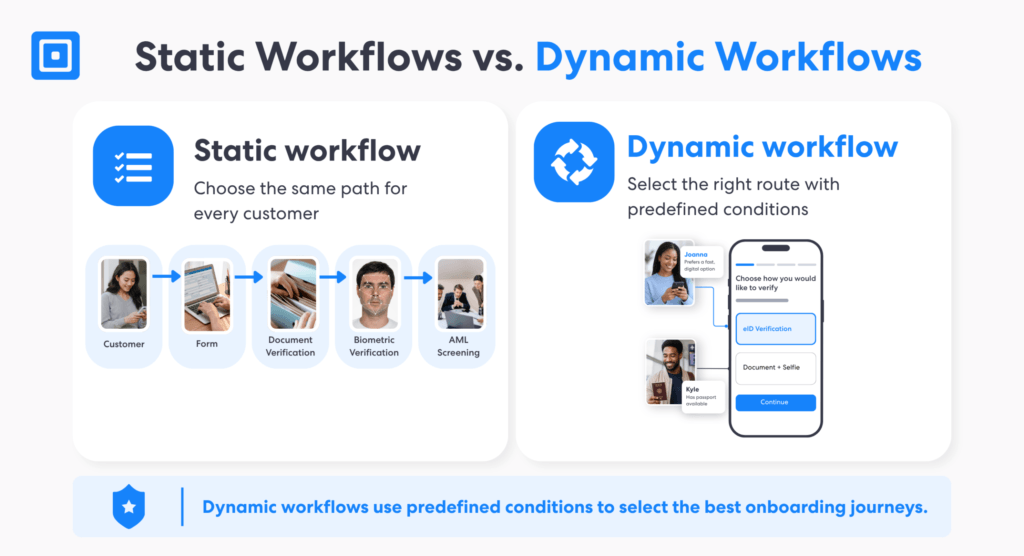
Someone else may need to upload an official identity document and go through biometric verification. The procedure varies depending on what data is available to confirm the customer’s identity. This is because dynamic workflows combine control flow and conditional logic.
Understanding Control Flow and Conditional Logic in Dynamic Workflows
Control flow is the order in which a system carries out tasks and figures out what happens next. In a traditional workflow, that sequence is fixed; dynamic workflows introduce conditional routing. It allows different paths based on predefined rules that follow an “if-then” structure. For example, if an eligible customer selects eID verification, then direct them to the electronic identity journey.
This routing mechanism evaluates supported information against the configured parameters. Dynamic execution allows the platform to select the right journey without manually assigning each customer to a separate process. This approach lets organizations create tailored experiences while keeping control over the verification steps each customer must complete. Moreover, dynamic workflows improve exception handling by routing anomalies to the right handlers seamlessly. They can also apply to multiple business functions, including finance, HR, and logistics.
Why Are Dynamic Workflows Important for KYC Compliance?
Dynamic workflows are crucial for KYC and Anti-Money Laundering (AML) regulations. They require businesses to identify customers, verify their identities, and apply the necessary due diligence measures. However, onboarding requirements can vary by jurisdiction, customer profile, and the nature of the business relationship.
For organizations that operate globally, implementing these requirements in a single fixed process can create too much complexity. Dynamic workflows help businesses deal with this challenge by supporting different approved verification journeys within a consistent compliance framework.
Supporting Risk-Based Customer Onboarding
Der Task Force Finanzielle Maßnahmen (FATF) promotes a risk-based approach to AML compliance. It requires regulated organizations to identify risks and apply proportionate controls. In practice, due diligence that is needed for one customer may differ from that required for another. You can learn more here: Was ist ein risikobasierter Ansatz (RBA)?
Dynamic workflows support these policies by helping organizations configure verification routes aligned with their identity assurance requirements. Identity assurance refers to the level of confidence a business needs to establish that a customer is exactly who they claim to be. An organization can use different verification methods as long as they satisfy the identity assurance standard needed by its onboarding policy.
Flexible workflows allow customers to follow an approved route without completing extra steps not needed for that journey. Yet, conditional routing should not be mistaken for automated customer risk assessment. Risk scoring, Enhanced Due Diligence (EDD), and decisions based on completed verification results are separate compliance functions.
Adapting to Changing Regulatory Requirements
Regulatory requirements are constantly changing, with new legislation, updated guidance, and emerging fraud risks. This requires businesses to revise their existing customer verification procedures. Many companies rely on hard-coded workflows, so implementing even a small change can require several development resources.
No-code workflow configuration provides a much more adaptable alternative. If a jurisdiction introduces new identity assurance requirements, compliance teams may need to add verification steps or adopt an approved identity verification method. With a visual workflow builder, companies can implement these changes without writing an entirely new process from scratch. This improves speed and helps businesses keep consistent policies across various markets.
Although dynamic workflows support regulatory adaptability, they don’t automatically mean they are compliant. Organizations still need to define the appropriate controls and verify that their procedures meet regulatory requirements.
How Dynamic Workflows Improve Operational Efficiency
Beyond compliance, dynamic workflows reduce the complexity linked with managing different onboarding journeys. Traditional processes often involve repetitive administrative tasks, manual handoffs, and disconnected verification tools.
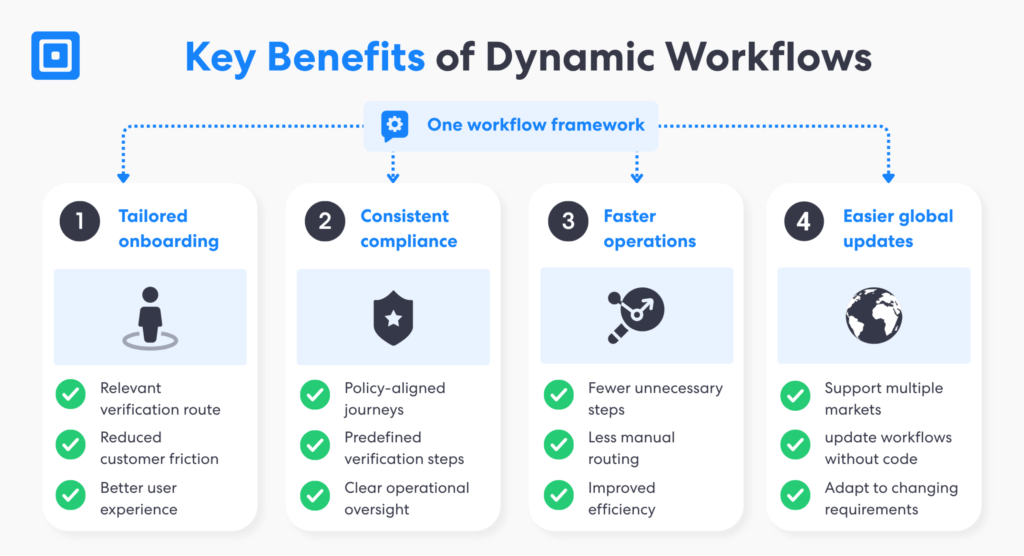
As onboarding volumes grow, inefficiencies can place more pressure on compliance teams and operational budgets. Automating the selection of predefined verification routes allows dynamic workflows to help teams coordinate onboarding activities more efficiently.
Reducing Manual Work and Processing Costs
Imagine if a financial services provider is supporting many identity verification methods across different regions and jurisdictions. Without a centralized routing mechanism, separate processes or additional coordination is needed to determine which verification method works for each customer. Dynamic workflows bring multiple onboarding journeys into one system, but also greatly lower the cost and resources linked with keeping disconnected workflows.
Without a centralized routing mechanism, the organization may need separate processes or additional coordination to determine which verification method applies to each customer. Actual savings depend on factors such as verification volumes, workflow design, operational structure, and the costs of the checks performed.
Improving Workflow Visibility and Management
Operational efficiency depends on understanding where customers struggle. Without enough visibility, businesses can struggle to find incomplete applications, processing delays, or recurring onboarding errors.
A centralized workflow management system provides a clear view of how verification journeys are structured and executed. Workflow activity records and session insights also help companies understand how customers move through an Onboarding-Prozess. They can also learn where completion issues arise. This greatly helps improve verification instructions, customer-facing descriptions, and workflow configurations.
Platforms with more advanced automation can also use real-time alerts or event-driven exception handling. This notifies teams when a process needs more attention. Yet, because these capabilities depend on specific solutions, you should not assume they’re part of every dynamic workflow implementation.
Dynamic Workflows vs. AI Agent Workflows
Dynamic workflows exist outside regulated customer onboarding, especially in AI-powered applications and software development. In these environments, an AI model can create a plan, assign tasks to specialized agents or sub-agents, and use external tools to complete the actual work. A great example is a research app that coordinates several digital workers to gather information, verify sources, generate descriptions, and write a report.
Unlike a predefined onboarding sequence, an AI-agent workflow can adapt its execution plan when new data becomes available or an unexpected event occurs. Such systems require developers to manage context, function calls, runtime parameters, error handling, and task completion across various agents. Though both involve automation and control flow, their decision-making mechanisms differ.
AI-agent workflows can choose or create new actions during execution, while dynamic workflows select from predefined KYC verification routes based on supported customer inputs. For regulated onboarding, this provides structure where compliance teams can define the available journeys and the conditions under which each applies.
Dynamic Workflows Use Cases
Dynamic workflows are especially helpful for organizations serving customers with different identity evidence, verification preferences, and regulatory requirements. They apply across several industries where a flexible onboarding process can improve accessibility without compromising established controls.
Financial Services and Digital Banking
Digital banks often onboard customers across multiple jurisdictions, each with different identity documents and electronic identity systems. For instance, a bank operating in Europe will likely support national eID verification in certain markets. Others may offer a combination of document and biometric verification.
Dynamic workflows let financial services and institutions build these journeys within a single onboarding environment. This reduces unnecessary verification steps while helping the bank maintain consistent identity assurance policies.
Cryptocurrency and Digital Assets
Cryptocurrency exchanges and Virtual Asset Service Providers (VASPs) need to verify customers while managing jurisdiction-specific AML and KYC obligations. A global exchange may need to support different identity documents and approved verification methods by jurisdiction.
Dynamic KYC and onboarding workflows help organize these routes within a structured onboarding framework. When combined with AML screening and other compliance services, this can simplify managing international customer verification.
Online Marketplaces and Gig Economy Platforms
Online marketplaces frequently onboard different participant groups. This includes buyers, sellers, freelancers, and business representatives. For example, an individual seller may experience a personal IDV process, but someone acting on behalf of a business might need to provide company information.
Dynamic workflows for online marketplaces and gig economy platforms can use supported onboarding inputs to guide customers into the right predefined journey. It helps reduce unnecessary information collection.
Recruitment and Employment
Another important use case is recruitment agencies and employers. They often need to verify candidates with different identity documents, nationalities, and eligibility requirements. When multiple approved verification methods exist, dynamic workflows help candidates follow a route based on the evidence they can provide.
A candidate eligible for a supported digital identity method may follow a different verification journey than someone using physical documents. This can provide a more accessible candidate experience while keeping applicable verification controls.
Case Study: India Targets 15 Crypto Exchanges Over AML Compliance Failures
In September 2026, India’s Financial Intelligence Unit (FIU-IND) issued non-compliance notices to 15 cryptocurrency exchanges and sought to restrict access to their websites and applications. It reinforced that overseas crypto platforms serving customers in India need to comply with India’s AML requirements, regardless of their physical location.
Adapting Onboarding to Different Jurisdictions
This case shows why global businesses cannot rely on identical compliance procedures across every market. Cryptocurrency exchanges need to identify applicable local requirements and dynamic workflows can help companies configure jurisdiction-specific verification journeys, using customer data to select predefined onboarding routes.
Ergebnisse
- 15 crypto exchanges received non-compliance notices with potential restrictions.
- India’s AML guidance reinforced requirements around CDD, monitoring, and other controls.
- The case shows the importance of workflows instead of one fixed process globally.
Core Features of Dynamic Workflows
Not every workflow automation platform provides the same functionality. Businesses evaluating a solution should focus on capabilities that support flexibility in customer journeys. The right dynamic workflow solution should also retain operational and compliance oversight.
No-Code Workflow Configuration
A visual workflow builder allows compliance and operations teams to build, test, and update verification processes without writing custom code. This reduces pressure on development teams for configuration changes and helps organizations implement new onboarding requirements more efficiently.
Conditional Routing Logic
Another key feature to look out for is conditional routing logic. It uses predefined rules to select the appropriate verification journey based on supported customer inputs. So, instead of following a default process, customers can be routed into different approved paths based on data collected during onboarding.
Flexible Verification Methods
Different types of customers may have access to different identity documents and verification services. This is why dynamic workflows need to accommodate approved alternatives, including eID verification, document checks, and biometric Überprüfung. This lets businesses provide more accessible onboarding while meeting their defined assurance requirements.
Integrated Compliance Tools
A unified workflow platform can bring together Smart Forms, IDV, biometrics, and AML screening. It can also accommodate registry checks and other compliance services. It lets organizations manage multiple onboarding activities in one environment instead of relying on disconnected systems.
Global Workflow Management
For organizations operating internationally, a centralized framework can help manage verification journeys across jurisdictions and markets. By building routes according to supported customer information and business policies, compliance teams can maintain greater consistency while accommodating local requirements.
Die wichtigsten Erkenntnisse
- Use predefined conditions to help customers follow the appropriate verification journey.
Conditional logic and control flow help tailor onboarding with customer information.
No-code workflows help companies adapt verification journeys without extensive development.
Flexibel IDV lowers friction and improves accessibility helping customer onboarding procedures.
Dynamic workflows use smart forms, IDV, and integrated compliance tools in one platform.
Create Smarter KYC Dynamic Workflows With ComplyCube
As businesses expand across markets, dynamic workflows provide a more adaptive approach than fixed verification processes. It allows organizations to tailor onboarding journeys to customer circumstances while keeping control over their compliance requirements.
ComplyCube combines no-code configurations, conditional routing, and integrated verification to simplify customer onboarding and improve operational efficiency. Dynamic workflows for KYC help businesses achieve this through a unified workflow environment designed for modern KYC and compliance operations. Explore ComplyCube’s Dynamic Workflows to discover how flexible verification journeys can help your business.

Häufig gestellte Fragen
What are dynamic workflows in KYC onboarding?
Dynamic workflows are automated processes using conditional logic to guide customers through a tailored identity verification journey. They select predefined paths based on customer information, identity documents, and verification preferences.
How do dynamic workflows improve the customer onboarding process?
Dynamic workflows improve the customer onboarding process by guiding users to appropriate verification methods instead of needing everyone to follow the same process. Using predefined routing rules, businesses reduce friction, minimize manual intervention, and improve onboarding.
What is the difference between static and dynamic workflows?
Static workflows follow a fixed order of verification steps. Dynamic workflows use conditional logic to trigger predefined routes based on customer data. They support multiple verification methods within one onboarding framework, lowering complexity, and improving the customer experience.
How do dynamic workflows support KYC and AML compliance?
Dynamic workflows help support KYC and AML compliance. It enables businesses to create IDV journeys based on policies and regulatory requirements. It also supports consistent due diligence while allowing compliance teams to adapt workflows as expected requirement change.
How does ComplyCube help businesses implement dynamic workflows?
ComplyCube enables businesses to create tailored dynamic workflows for KYC and onboarding journeys through its no-code solution. Using conditional logic, companies can route clients or customers based on supported data, and selected verification methods.