London, September 17, 2026 – ComplyCube earned 150 badges in the G2 Fall 2026 Report, including 12 #1 rankings and 28 #2 rankings across various categories such as identity verification, address verification, age verification, and biometric authentication. Moreover, ComplyCube earned badges for Anti-Money Laundering (AML), digital customer onboarding, and reference checks.
These new rankings highlight a key point for digital identity. According to the UK government, 77% of consumers have now used digital identity for at least one purpose, while 81% report some general understanding of it. The real challenge is what happens next. Digital identity must work across various use cases, markets, and complex customer journeys.
Digital Identity Has Moved Into Everyday Life
Digital identity is becoming increasingly difficult to separate from the wider digital economy. According to gov.UK’s Digital Identity Sectoral Analysis Report 2026, the UK sector generates approximately £2.03 billion in annual revenue. The report also found almost 4,700 customer relationships and partnerships across industries ranging from financial services to healthcare, government, and transport.
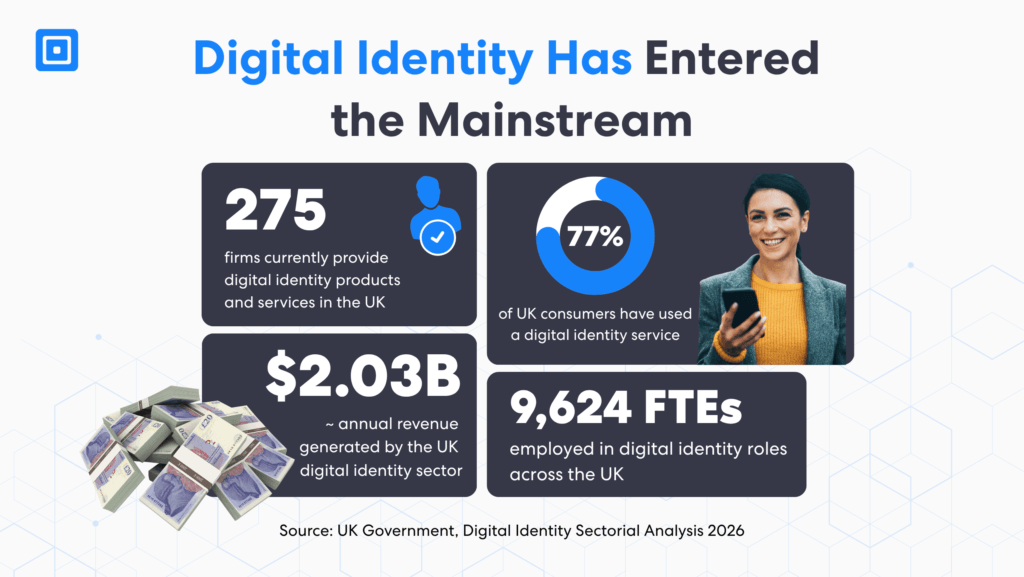
Consumers also expect it, as usage has reached 77%, while 71% believe digital identity services will be important over the next five years. This proves that greater adoption does not make verification simpler. It only creates more situations in which businesses need to establish something different about a customer. The challenge is therefore shifting from simply verifying an identity to establishing the right level of trust for each interaction. That shift is beginning to reshape what businesses expect from digital identity providers.
One Identity is Creating More Verification Questions
UK government research also shows that the share of digital identity providers supporting age assurance increased from 23% to 31%. Meanwhile, professional and credential verification rose sharply from 28% to 55%, and age verification for online services has also doubled to 33%.
This growth strongly indicates a broader shift in how identity is used. A business may need to know whether someone is genuine, old enough to access a service, their address can be corroborated, the credential is valid, or whether their risk profile needs additional due diligence.
This means each question requires a different level of identity assurance. Businesses need to determine the appropriate level of due diligence and at which stage. ComplyCube’s newest regional G2 Fall 2026 rankings reflect that shift.
Regional G2 Fall 2026 Rankings Show Why Context Matters
ComplyCube is ranked #1 for UK Address Verification and #2 for Age Verification across Europe in G2 Fall 2026. It also remains #2 for Digital Customer Onboarding, and those categories intersect. Customer onboarding in one country may require different evidence, assurance levels, age controls, or address checks than in another. A single rigid journey becomes harder to maintain as businesses enter more markets and regulations become more specific.
The goal is to make verification more tailored to the customer and the context. That means connecting identity, address biometrics, screening, fraud signals, and risk-based decisioning so the journey can change without the entire compliance process changing with it. Once those decisions are made at enterprise scale, technology quality is only part of the equation.
Enterprise Recognition Shows What Happens After Go-Live
The G2 Fall 2026 enterprise results tell a different side of the story. ComplyCube was ranked #1 in the Enterprise Relationship Index for Reference Checks and #2 for Enterprise Relationship in Identity Verification. It also ranked #5 for both Enterprise Usability and Results in Reference Checks. These metrics matter because enterprise compliance rarely stays still.
As volumes grow, policies change, and new jurisdictions are added, fraud patterns evolve too. What initially was one onboarding journey can quickly become dozens of variations. The real test of compliance technology is quickly becoming dozens of variations. The question is whether teams can continue adapting it without making their operations much harder to manage.
Digital identity is being asked to solve more specific problems.
Harry Varatharasan, Chief Product Officer at ComplyCube, says, “For enterprise teams, the goal is to bring those requirements together in a way that remains manageable as the business grows. That is where flexibility, usability, and the relationship between the technology become critical.” This explains why the G2 Fall 2026 results extend well beyond one verification category.
The G2 Fall 2026 Numbers Tell a Wider Story
ComplyCube now holds five top-two positions across regional, enterprise, and onboarding reports for G2 Fall 2026. The breadth mirrors where digital identity itself is heading. The UK government found that 53% of digital identity providers now support KYC and AML use cases, 50% support fraud prevention, and 41% support Right to Work checks. Identity is increasingly becoming the layer that connects multiple decisions, rather than a single moment at the beginning of onboarding.
That is what makes the G2 Fall 2026 results more interesting than the badge count alone. Digital identity has already moved into the mainstream. Now businesses need it to work across more specialized use cases, more markets, and more complex risk decisions.
ComplyCube’s G2 Fall 2026 reviews also show growing recognition across exactly those layers. They cover everything from regional verification and customer onboarding to enterprise relationships, usability, and results. The next phase of digital identity will not simply be about verifying more people. It will be about making better decisions about what to verify, when, and why.
Über ComplyCube
ComplyCube, three-time RegTech Partner of the Year, supports businesses and firms where trust and compliance cannot be an afterthought. ComplyCube’s platform pairs first-class compliance infrastructure with enterprise-level certifications including ISO 27001:2022, ISO 9001:2015, and SOC 2.
About G2 Reviews & G2 Fall 2026 Report
G2 helps evaluate technology through verified customer feedback and independent market reports. Their badges and category rankings are globally recognized, giving businesses a trusted view of which software products stand out for customer satisfaction, market presence, and real-world performance.