The US Treasury found over $8BN in suspicious cross-border payments directed by foreign agents. This took place through American money transfer businesses between 2021 and 2025. The findings have raised concerns that criminals are using real financial networks to hide money laundering and terrorist financing activities.
The Financial Crimes Enforcement Network (FinCEN) issued an alert that urged financial institutions to investigate suspicious payments. Yet, how could such transactions move through established banking channels while hiding their ultimate beneficiaries?
How Did $8BN in Suspicious Payments Move Across Borders?
FinCEN looked into money services businesses (MSBs), which facilitate international payments, remittances, and currency exchanges. These businesses often partner with foreign agents to move money across borders. However, investigators found arrangements where foreign agents instructed US-based MSBs to send funds to unrelated third parties. This included trading companies and foreign exchange businesses with no clear commercial connection.
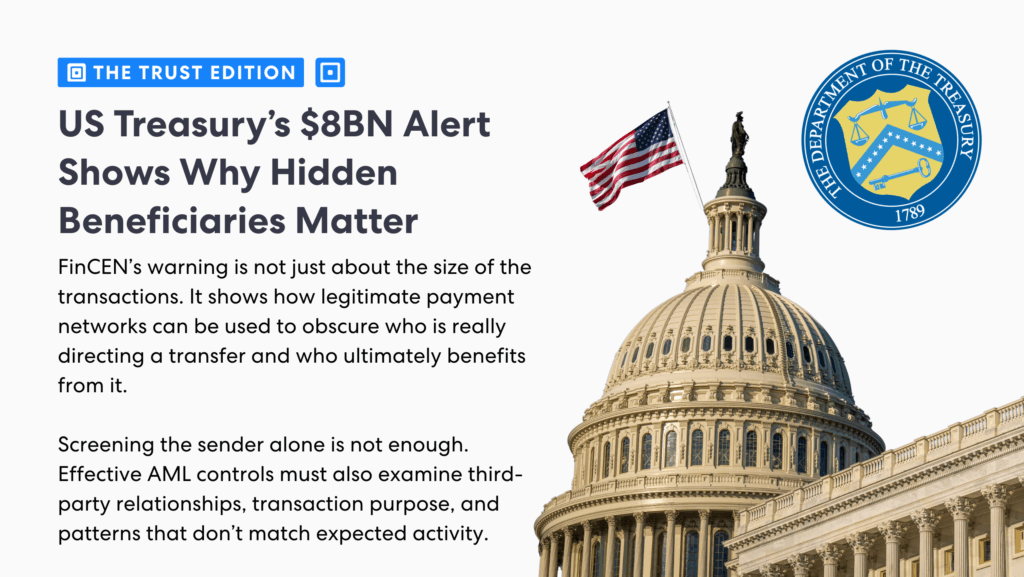
In other cases, funds were transferred overseas within hours of hitting US accounts. Moreover, payment descriptions gave very little explanation of their underlying purpose. These arrangements can hide who receives the money, creating more opportunities for criminals or fraudsters to exploit real payment networks.
US Treasury Expands Crackdown in Financial Crime
This alert is part of a much wider US Treasury initiative that targets fraud and illicit financial flows. This came shortly after major investigations in Minnesota. US Treasury Secretary Scott Bessent announced that authorities stopped almost $190M linked to overseas fraud. They also returned more than $100M to American victims.
Separately, FinCEN issued a notice that charities and non-profits are at risk of being exploited to facilitate terrorist or fraud financing. Minnesota’s Feeding Our Future scandal prompted this remark, as investigators uncovered a $250M fraud scheme involving federal child nutrition funding. These developments show how real businesses and organizations can be misused to move illicit funds.
FinCEN and US Treasury Warns Financial Institutions
FinCEN also identified several transaction patterns. This includes repeated round-value transfers, unexplained third-party beneficiaries, and payments inconsistent with a business’s normal activity. The regulator also highlighted transactions involving companies with limited commercial visibility, including new businesses or entities without a proper online presence.
Most importantly, the $8B found by the US Treasury represents alleged suspicious activity. These are not confirmed criminal proceeds. FinCEN emphasizes that investigators must evaluate individual warning signs alongside the broader transaction context. The findings raise a question for financial institutions about how effectively they can find financial crime. This includes cases where the customer initiating a payment is not the party ultimately directing or benefiting from it.
Compliance Lessons for Regulated Businesses
The US Treasury case reinforces the importance of looking beyond the immediate customer. Kunden-Due-Diligence (CDD) must establish the purpose of transactions. It must also consider the role of foreign agents and the identities of relevant third-party beneficiaries.
When risks increase, Enhanced Due Diligence (EDD) applies. It can help verify whether a payment arrangement reflects real activity. Another way to inspect further and in detail is through effective Suspicious Activity Reports (SARs). It helps regulators such as FinCEN link related transactions across the full financial system.
In summary, the US Treasury findings highlight broader vulnerabilities in the global financial system. Financial institutions must detect financial crime as cross-border payments become faster and more interconnected. The $8B alert is a reminder that effective Anti-Money Laundering (AML) compliance depends on monitoring how money moves, understanding who controls it, and why.

Weitere Neuigkeiten zum Thema Geldwäschebekämpfung finden Sie in ComplyCubes Newsletter „Trust Edition“. Wir beleuchten die neuesten Entwicklungen im Bereich der Identitätsprüfung und der Bekämpfung von Geldwäsche weltweit.