Kurz gesagt: A biometric verification software comparison goes beyond feature count. To compare biometric verification solutions effectively, evaluate performance metrics such as false match rates and onboarding completion. The best biometric authentication software combines reliable performance, cost-effectiveness, and seamless onboarding.
What Makes Biometric Verification Software Comparison Reliable?
A reliable biometric verification software comparison analyzes real-world operational performance. For businesses, this means prioritizing how well the software meets its operational and regulatory needs. Take this example. Two providers may offer sophisticated facial recognition technology and claim 99% accuracy. However, the outcomes delivered can vary for the same population.
This is because testing a biometric system under controlled conditions on a narrow demographic biometric sample won’t reflect the same outcomes for your actual users. This guide evaluates the essential requirements and the differentiating factors of biometric verification software. Most importantly, it explores how to measure performance and validate vendor claims objectively.
Biometric Software and Evolving Fraud Patterns
Biometric software captures a user’s biometric data to verify customer identity. Examples of these biometric traits include facial features, fingerprints, voice, and even the iris patterns. A few years ago, attempts to trick biometric verification relied on physical materials, such as printed photos or videos played on another screen. Today, AI has made fraud prevention tougher.
AI-created accounts are more likely to be used for criminal activity, such as money laundering or terrorist financing.
Global regulators highlight the same challenge. For example, the UK’s Gambling Commission warns that attempts to bypass customer due diligence using AI-generated documents, deepfakes, and face swaps are increasing. Additionally, the National Crime Agency links higher AI use to illicit activity.
The biometric identity verification market is forecast to hit $17.81 billion bis 2030.
But the question remains: how do we know which biometric software can withstand evolving threats? In a NIST study, researchers tested 82 presentation attack detection algorithms against nine categories of facial presentation attacks. Shockingly, none of the algorithms captured all nine attack types. The study highlights differences in fraud detection capabilities across software.
As the biometric verification market expands, firms must choose credible software. As fraudsters evolve their tactics, historical vendor accuracy claims may not address newer threats. Thus, to compare biometric verification software practically, independent test results under real-world conditions is key.
Biometric Verification vs Biometric Authentication vs Biometric Identification
Biometrische Technologien confirm and verify a user’s identity through unique physical traits or behavioral characteristics. While biometric verification, authentication, and identification aim to achieve this, they differ in their purpose and implementation.
Biometric verification: Also known as Biometrische Identitätsüberprüfung, it compares a user’s biometrics against a known reference, such as submitted customer information. For example, match a selfie check against an uploaded passport photo during a document check to confirm identity.
Biometric authentication: A biometric check that confirms a customer is authorized to access a service or device by using previously enrolled biometric data. It is most commonly used for face authentication or fingerprint verification. For example, opening banking apps using iPhone Face ID.
Biometric identification: Generally used by law enforcement, it helps confirm an unknown individual’s identity by comparing biometric information against a large database of records. For example, police officers compare a fingerprint against a fingerprint database to surface a potential match.
Compare Biometric Verification: Essential Requirements
While biometric technologies differ in capability, a few factors are non-negotiable for buyers considering biometric verification software. These factors are deemed essential, rather than competing differentiators, due to their direct impact on security, regulations, and operations:
1. Regulatory compliance and identity assurance
Biometric verification supports businesses in Know Your Customer (KYC) and Bekämpfung der Geldwäsche (AML) compliance. It enables firms to perform ID verification and prevent fraud risk. For example, biometric systems can reduce fraud by confirming bank account ownership. As such, companies must evaluate providers that support AML/KYC requirements in their industry, jurisdiction, and risk appetite.
2. Liveness and fraud resistance
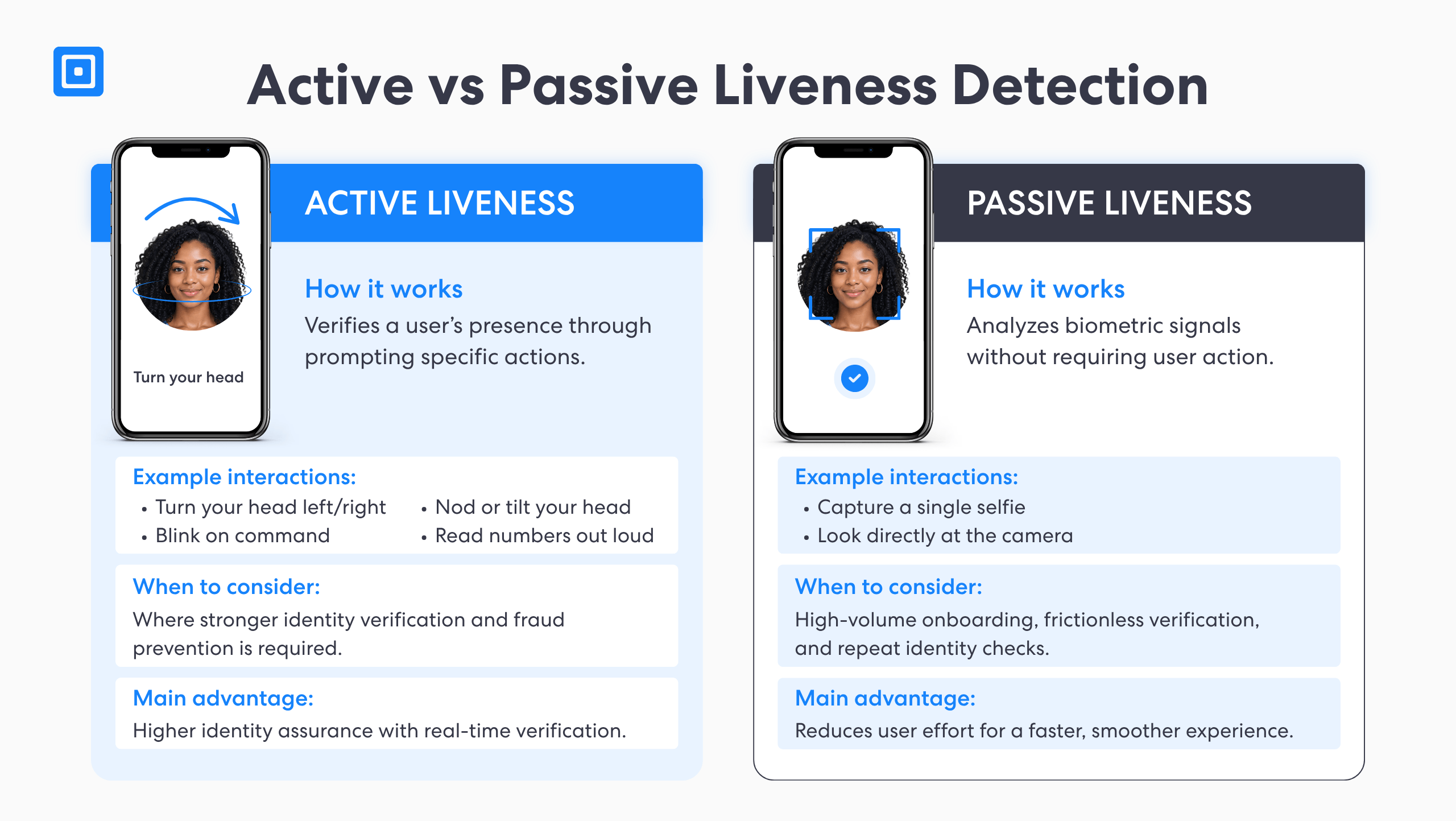
Lebendigkeitserkennung checks whether biometric data comes from a live person rather than a pre-recorded video, deepfake, or 3D mask. Biometric technologies support two forms of liveness checks: active and passive. Active liveness detection prompts users to perform specific actions, while passive liveness detection analyzes biometric samples without requiring user action. While liveness detection helps prevent spoofing attempts, firms must assess its accuracy across different attack types.
3. Security and biometric data protection
Biometric data requires special protection as compromised traits cannot be changed, unlike passwords. This means choosing software with strong security standards to process sensitive information is important. For example, the GDPR classifies biometric data as a special category of data. Businesses should therefore evaluate encryption, data retention policies, and access controls.
4. Exception handling
Poor lighting, device camera issues, or changes in physical appearance can cause a legitimate customer to fail biometric checks. Businesses should consider software with strong exception handling, such as offering alternative verification methods or manual reviews for inconclusive results. This significantly enhances consumer onboarding and inclusion.
Case Study: Hong Kong Regulators Warn of AI Cyberattacks
Withstanding Evolving AI Attacks
Ergebnisse
- Firms cannot rely solely on legacy security measures to prevent AI impersonation attacks.
- AI has enabled more varied methods of falsifying, concealing, and impersonating identities.
- Independent testing of liveness detection, fraud resistance, and security controls is vital.
Compare Biometric Verification: Competitive Differentiators
After businesses evaluate the main security and compliance requirements, they can compare how each biometric verification solution supports onboarding and operational efficiency. Market-leading providers offer additional features that strengthen the customer experience and support market growth.
1. Seamless customer experience
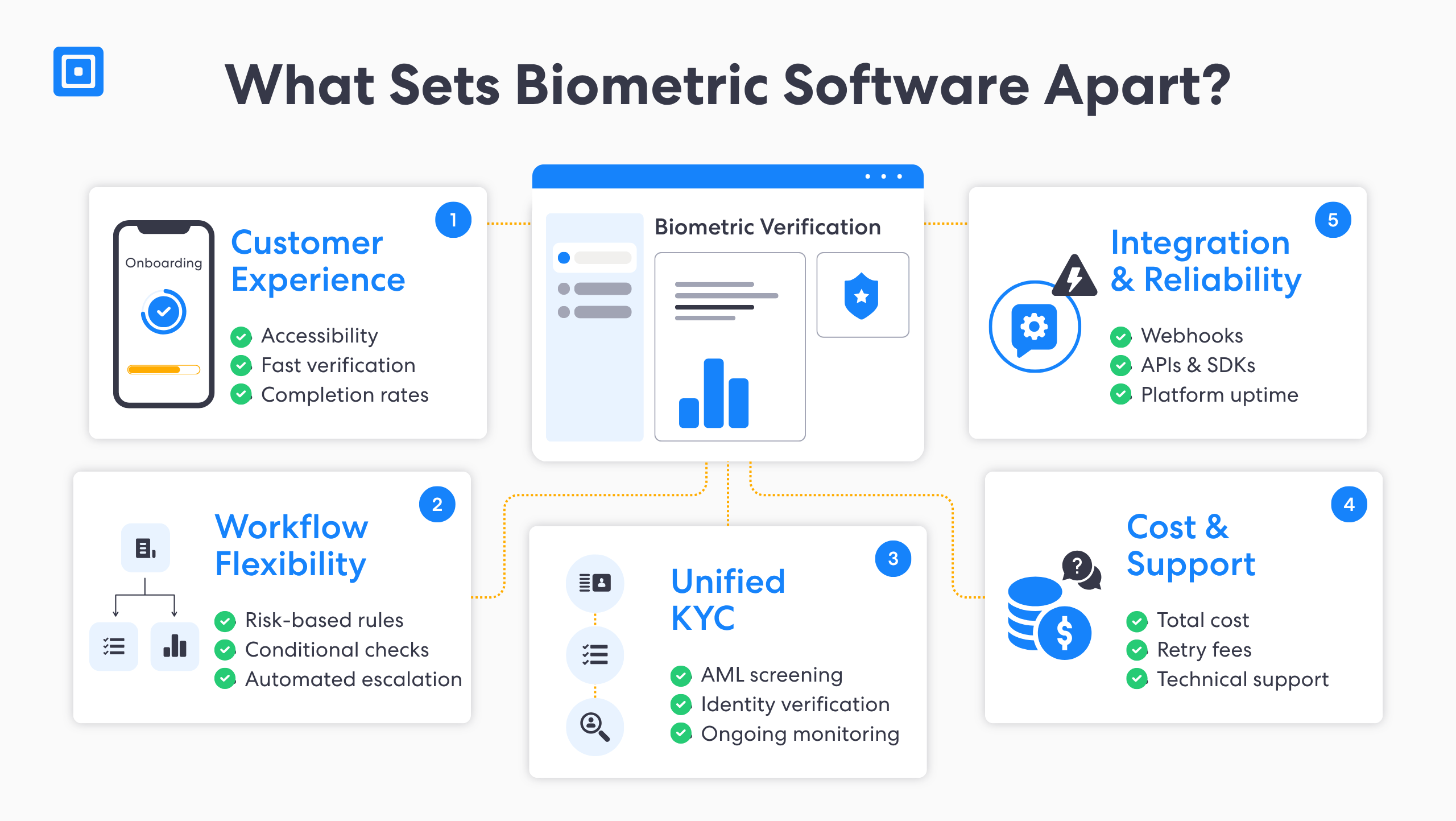
Secure remote identity proofing improves convenience and reduces costs. Facial recognition enables frictionless authentication in high-throughput environments. The best biometric software offers multilingual support, robust exception handling, customizable workflows, and strong accessibility to reduce user friction. Buyers should evaluate device compatibility, completion rates, and speed.
2. Customization and workflow flexibility
Each user presents different risk levels. The risk-based approach (RBA) lets firms route customers to the appropriate verification step after analyzing multiple risk signals. Effective biometric software supports RBA with highly configurable matching thresholds, conditional checks, and automated escalation. No- and low-code workflows can also support quicker responses to evolving regulations.
3. Operational efficiency and unified KYC
Global regulators increasingly expect businesses to connect financial crime prevention, risk assessments, and ongoing monitoring. As such, a unified KYC lifecycle software is critical. It supports document authentication, AML screening, and case management in a single platform. As a result, firms can manage risk consistently, at scale, and securely throughout the customer lifecycle.
4. Cost and vendor support
Advertised biometric checks do not reflect the full Total Cost of Ownership (TCO). For example, deployment costs, maintenance, and customer support fees can skew total cost. As such, request a full price that excludes any hidden or additional expenses, including account management, monthly commitments, and retry costs.
5. Integration and Platform Reliability
Biometric verification should integrate securely and reliably with your existing systems. This ensures there are no gaps in your compliance infrastructure. For example, cloud APIs allow rapid deployment and global scalability for biometric verification. For buyers, examine API and SDK compatibility, webhook support, and hosted options.
Performance Metric for Best Biometric Authentication Software
However, what makes the best biometric authentication software stand out is its real-world performance, not its paper claims. These performance metrics must be tracked to support reliable biometric verification software comparison:
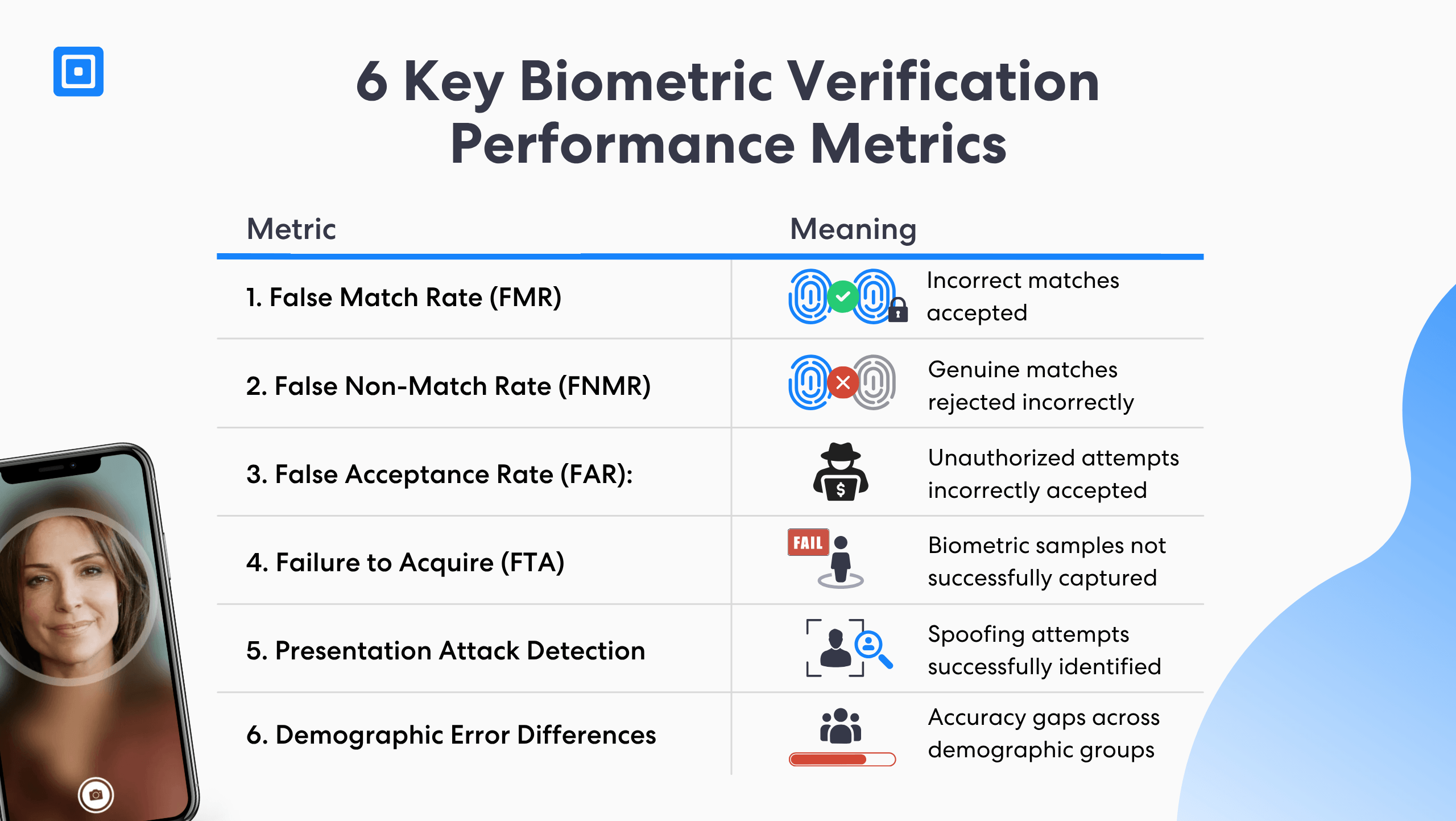
- False Match Rate (FMR): When the software matches two individuals wrongly.
- False Non-Match Rate (FNMR): When the software fails to match two biometric samples to one user.
- False Acceptance Rate (FAR): When the software incorrectly accepts an unauthorized user.
- Failure to Acquire (FTA): When the software fails to capture and process a biometric sample.
- Presentation Attack Detection: How effectively the software detects spoofing attempts.
- Demographic Error Differences: The error rates across different demographic groups.
Other metrics to track include verification completion rate, drop-off rates, first attempt success rate, and system uptime. These metrics will test the overall effectiveness of the software in onboarding verified customers and businesses.
Test Biometric Identity Verification Software
The essential requirements and competitive differentiators above serve as a guide for firms that need to compare biometric verification. To determine whether the software meets those requirements and can perform compliantly and effectively, conduct independent testing:
Establish a representative test population
Test from a sample population of your customers. Also simulate common edge cases, such as facial hair, low-quality documents, or head coverings, to test whether the software works consistently. This lets businesses confirm that the software accurately reflects the complexities of real-world operations.
Analyze genuine and incorrect match outcomes
Build labeled test sets with positive pairs (same person) and negative pairs. Compute FMR and FNMR at your chosen operating points. It is best not to rely heavily on vendor-provided accuracy claims alone. Instead, measure outcomes independently against your own data.
Measure onboarding efficiency
As touched on above, it is crucial for companies to not only measure biometric technology performance, but also the onboarding journey as a whole. As such, keep clear audit trails of verification failures to diagnose if the issue is due to the software or user complications.
Test exception handling and operational workloads
When results are inconclusive, or verification fails, test how accurately the software routes, flags, or rejects customers. Check that all exception events translate to clear, timestamped records for regulatory review. Tracking manual review rates and resolution time is also a key performance indicator.
Calculate the real cost of verification
Repeated tries or manual reviews can affect the total cost per verified customer. Financial institutions should confirm total cost per check for successful and unsuccessful trials to model costs under realistic volumes. For global enterprises, also consider deployment and data residency fees across countries.
Die wichtigsten Erkenntnisse
Effective biometric verification software comparison focuses on performance outcomes.
Compare biometric verification based on liveness accuracy, false match rates, and conversions.
The best biometric authentication software depends on risk appetite, jurisdiction, and industry.
Biometric checks cannot be used as a standalone solution for AML compliance.
Unified KYC/AML software strengthens financial crime detection, escalation, and compliance.
Choose the Best Biometric Authentication Software
To evaluate the best biometric authentication software, buyers must assess key criteria such as regulatory compliance, fraud resistance, and exception handling. Additionally, it tracks essential performance metrics, particularly those to reduce fraud risk and enhance user convenience, including false acceptance rates and processing times.
ComplyCube supports full AML compliance with powerful PAD Level 2 certified liveness biometric technology. Sprechen Sie mit einem Mitglied of the team to learn more today.

Häufig gestellte Fragen
What is multimodal versus unimodal biometric verification systems?
Unimodal systems use a single biometric trait, while multimodal systems combine multiple traits when verifying a person’s identity. The latter is commonly used for higher-risk onboarding and can combine facial recognition systems, fingerprint scanning, and voice recognition.
How is biometric verification different from traditional KYC checks?
Traditional KYC uses static identity attributes, such as name, address, or database lookups to verify identity. Biometric verification links a user’s biometric attributes to their documents in real-time. It adds a biometric layer to confirm a person’s live, physical presence.
What happens if biometric authentication fails for a legitimate user?
Biometric authentication can fail for a legitimate user due to device limitations or physical changes. Stronger fallback options, such as multi-factor authentication or manual review, can help. Also, monitor false reject rates to spot recurring failures and reduce friction for real users.
Is biometric identity verification enough for AML compliance?
No, biometric identity verification must be combined with other checks for AML compliance. Biometric checks support identity verification; however, regulators expect proportionate customer due diligence (CDD), sanctions and PEP screening, and ongoing monitoring to meet AML rules.
How does ComplyCube’s biometric check differ from other vendors?
ComplyCube’s PAD Level 2-certified biometric liveness detection offers secure and compliant facial matching for businesses. It enables firms to make confident compliance decisions with granular risk insights to prevent fraud. The platform also combines AML screening and ongoing monitoring to strengthen financial crime controls.