Kurz gesagt: Crypto KYC risk assessment involves identifying high-risk customers to prevent financial crime and meet AML obligations. An effective KYC risk assessment for crypto evaluates a user’s exposure to money laundering and terrorism financing. It includes AML risk scoring to support laufende Überwachung and due diligence.
What is KYC Risk Assessment for Crypto?
Know Your Customer (KYC) risk assessment is the process of measuring a customer’s risk of involvement in financial crime. Crypto firms use risk scores from crypto KYC risk assessments to determine the level of due diligence required. KYC risk assessments are essential in ensuring regulatory compliance. They are especially crucial for cryptocurrency businesses as they operate in a high-risk sector.
In 2025, crypto money laundering hit $82 billion.
Harry Varatharasan, Chief Product Officer at ComplyCube, notes, “Crypto exchanges offer an attractive channel for bad actors to launder money and engage in illegal activity. The quick, high-volume, and anonymity of cryptocurrency transactions makes it particularly difficult to track illicit funds.” According to Reuters, crypto money laundering reached $82 billion in 2025.
More recently, Ukrainian authorities shut down a crypto scam network that made over a million each month. The scale of these crimes can even lead to more harmful illicit activities. For example, in 2025, Coinbase was fined $25 million, with over 2,700 potential transactions linked to financial crime, drug trafficking, and sexual exploitation.
Crypto AML and KYC Risk Assessment Rules
Anti-Money Laundering (AML) and KYC obligations now extend beyond financial institutions. Regulatory bodies around the world require Virtual Asset Service Providers (VASPs) to enforce strong AML frameworks. AML regulations help prevent criminals from converting illegal cryptocurrencies into fiat. Consequently, the failure to assess high-risk customers can lead to fines and operational shutdowns.
Regulators require crypto exchanges to maintain strong AML and KYC programs:
Global, Travel Rule
The Financial Action Task Force (FATF) implemented global AML regulations for cryptocurrency in 2018. Particularly, the Travel Rule extended to VASPs in 2019, providing guidance on risk-based approaches and identity verification. Moreover, it calls for robust collection, verification, and sharing of customer information.
European Union, Markets in Crypto-Assets Regulation (MiCA)
The MiCA rule sets out key authorization and operational requirements for Crypto-Asset Service Providers (CASPs), including the Transfer of Funds Regulation for transaction screening. It works alongside the Sixth AML Directive to oversee risk management, suspicious activity reporting, and identity verification. You can learn more here: Europäische Krypto-Regulierung gegen Geldwäsche.
USA, Bank Secrecy Act (BSA)
In the US, crypto exchanges are classified as Money Services Businesses (MSBs) and must comply with the BSA. The Financial Crimes Enforcement Network (FinCEN) requires crypto exchanges to identify money laundering and meet U.S. Travel Rule mandates, including collecting customer information for transactions over $3,000.
Singapore, Payment Services Act (PSA) 2019
The Monetary Authority of Singapore oversees crypto AML compliance. The PSA deems crypto as Digital Payment Tokens (DPTs). Firms operating as DPTs, including token dealers, brokerages, and custodial services, must meet stringent registration, transaction monitoring, and customer due diligence rules.
UK, Financial Conduct Authority (FCA)
Der FCA Crypto Gateway broadens authorization and compliance rules for crypto firms. The regime launches in October 2027 and signals higher expectations around governance and risk management. It calls for stronger demonstration of how KYC, risk profiling, case management, and ongoing monitoring feeds into financial crime prevention.
In addition, depending on the service, stablecoin issuers, crypto ATM kiosks, crypto-to-fiat platforms, and custodial wallets may face KYC/AML mandates. While regulatory classification may differ, it is clear that crypto compliance rules are expanding globally.
Core Risk Factors for Crypto KYC Risk Assessment
A typical risk-based KYC assessment for firms in the crypto industry evaluates customer risk across five factors. Compliance teams can specify the risk weighting and threshold for each of these dimensions, which feeds into an overall risk rating of low, medium, or high. This risk rating is then used to route customers into Simplified Due Diligence (SDD), Kunden-Due-Diligence (CDD), Enhanced Due Diligence (EDD), or rejection.
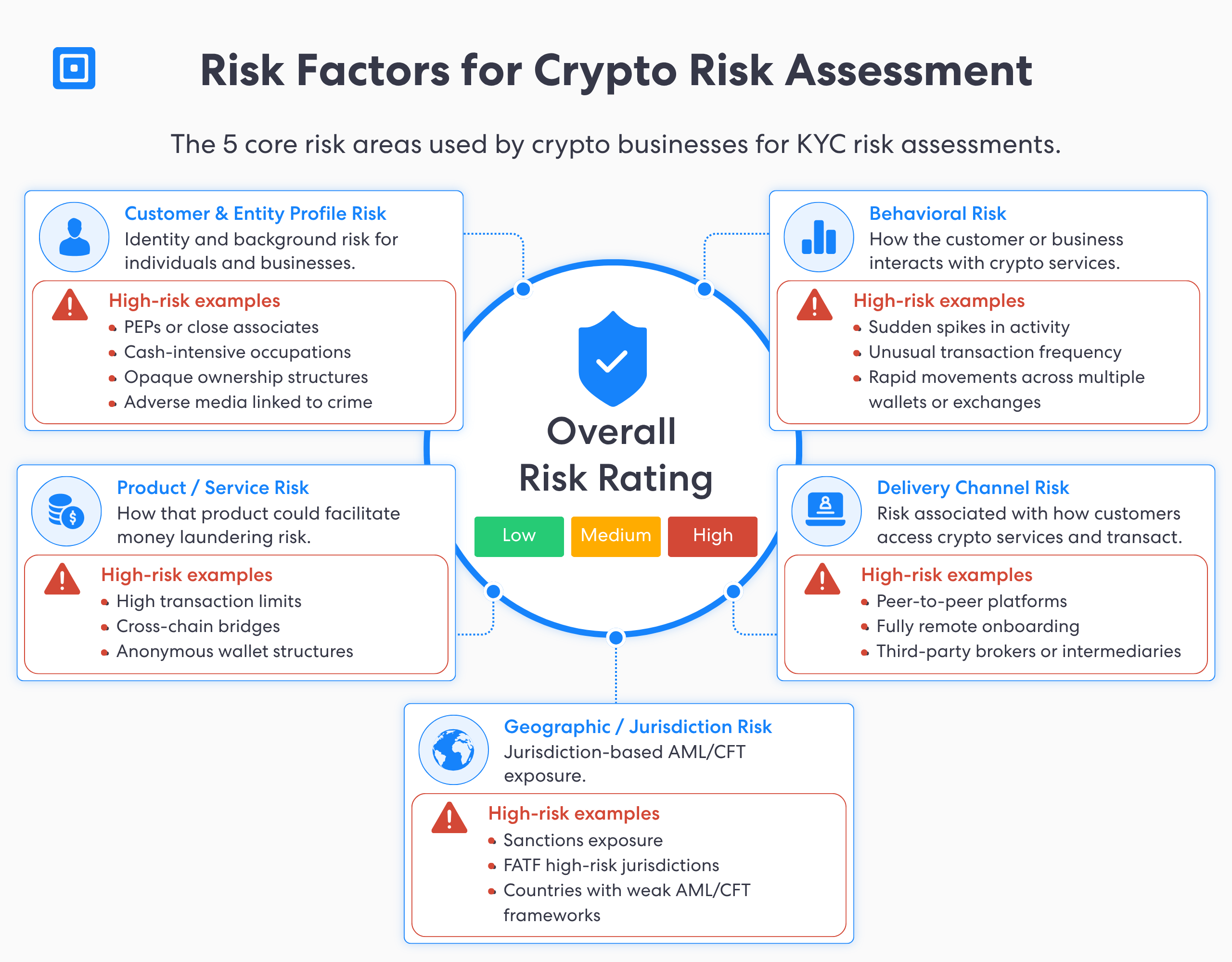
These five risk dimensions are:
1. Customer and Entity Profile Risk
This includes identity and background risk signals of those seeking crypto services. KYC requirements involve determining the business or individual customer’s identity by gathering critical information. Additionally, AML screening identifies exposure to Politisch exponierte Personen (PEPs), sanctions, and adverse media.
For individuals, this includes performing document checks and biometric verification to collect customers’ names, dates of birth and addresses. For businesses, it can extend to corporate registry, background checks, and Ultimatives wirtschaftliches Eigentum (UBO) verification to determine company operations.
2. Behavioral Risk
This assesses how a customer interacts with crypto services and whether the nature of their transaction matches account behavior. Behavioral risk assessment goes beyond identity verification. It can include transaction monitoring, Geräteintelligenz, and blockchain analytics to detect suspicious patterns.
3. Product or Service Risk
These refer to the potential risks that can be facilitated via the specific product or service offering. For crypto exchanges, this can include rapid, high-value transactions such as high-leverage derivatives, cross-chain bridges, and OTC block trading.
4. Delivery Channel Risk
Delivery channel risk are the vulnerabilities present in the channels used to deliver a product. For example, remote onboarding, peer-to-peer (P2P) platforms, and tumbling services provide heightened anonymity, which can conceal identities and make illicit crypto transactions difficult to monitor.
5. Geographic or Jurisdiction Risk
Certain jurisdictions are deemed as high-risk due to the higher threats of money laundering, sanctions exposure, and tax evasion. For example, the FATF and EU compiles high-risk jurisdictions under the grey or increased monitoring list. Therefore, crypto KYC risk assessments should consider residence and nationality.
Case Study: AUSTRAC Warns Against Blanket De-Risking
The Australian Transaction Reports and Analysis Center (AUSTRAC) published a warning on 30th September 2026, urging companies not to indiscriminately restrict or reject high-risk customers. Instead, businesses must assess various risk signals before making a compliance decision.
Automated Rejection and Increasing Risks
Crypto service providers must document clear evidence and justify proportionate compliance controls. Consequently, blanket de-risking can push legitimate crypto customers or businesses to less-regulated platforms, making financial crime even harder to detect.
Ergebnisse
- High-risk classification does not equal automatic rejection or account restriction.
- Crypto KYC risk assessment must distinguish manageable risks from unacceptable threats.
- The risk-based approach should trigger appropriate due diligence measures.
Connecting AML Risk Scoring for Crypto to Due Diligence
Crypto KYC risk assessment must connect to the wider AML infrastructure. Consequently, after evaluating the risks present, compliance professionals should determine the appropriate level of due diligence. This includes basic verification for low-risk customers, standard CDD, EDD for high-risk customers, or rejection where risks cannot be mitigated.
Vereinfachte Due Diligence: Reduced due diligence measures for very low-risk customers or entities. For example, light-touch identity verification applies to basic student savings accounts or publicly listed companies that have already undergone rigorous public disclosures.
Sorgfaltspflichten gegenüber Kunden: Standard due diligence checks for low- to medium-risk customers. It includes full identity verification to establish whether the user is legitimate. For instance, common examples are opening a standard bank account or registering with a cryptocurrency exchange.
Erweiterte Due Diligence: Requires deeper checks for high-risk profiles. This includes gathering proof of funds documentation, UBO verification, and AML screening. For example, PEPs, high-risk countries, complex ownership structures, and unusual transaction volumes call for EDD.
Rejection: Where there are clear links to criminal activity, including sending funds to sanctioned entities or use of mixers, it should be escalated to Suspicious Activity Reporting (SAR). This is vital, as law enforcement agencies rely on this information to effectively dismantle illicit activities.
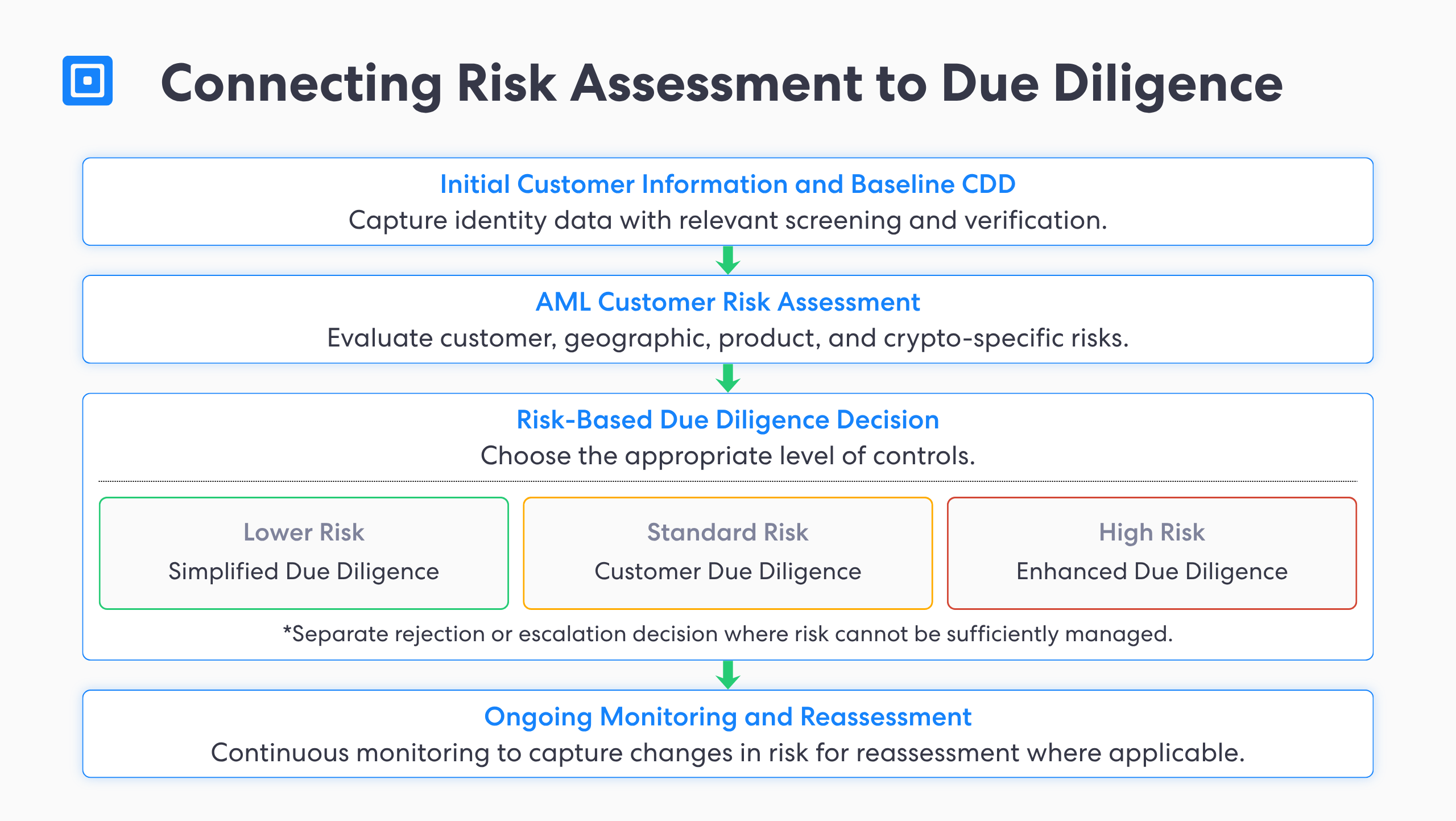
The graphic included above is a simplified representation of standard CDD. In practice, verification, risk scoring, and due diligence can happen simultaneously or iteratively. Additionally, real-time monitoring is a crucial tool in AML processes. It ensures these measures evolve as customer risk profiles change.
Design Customizable AML Risk Scoring for Crypto
Typically, AML software standardizes risk factors, weights, and thresholds across organizations. However, this can be challenging because every company has varying operating jurisdiction and risk appetite. For example, a risk model used by a cryptocurrency exchange differs largely from one used by a retail firm.
Platforms such as ComplyCube enable crypto firms to build and apply their own customizable risk model consistently and at scale. Crypto firms can choose to assign, add, or remove their own risk factors. Additionally, risk weights and thresholds can be set independently. Thus, this will form the risk scoring logic that underpins due diligence and ongoing monitoring.
- Risk rating: How severe is the identified risk?
- Risk weight: How much should that indicator influence the final score?
- Risk threshold: What action should the business take based on the result?
A Kundenspezifische Risikoberechnungs-Engine model is crucial for crypto exchanges. It significantly reduces false positives, streamlines case reviews, and builds a targeted approach to financial crime prevention. To achieve this, firms can develop a tailored risk scoring model in three simple steps.
Step 1: Assign weight and rating to each risk indicator
Based on the company’s risk appetite, operating country, and regulatory obligations, assign specific weight and rating to each risk indicator. Higher-weighted dimensions contribute more significantly to the final result. Moreover, the risk rating is continuously recalculated as risk changes.
Step 2: Total risk score calculation
Subsequently, once the company assigns a risk rating and weight, the model calculates the weighted score for each factor. This weighted score will be added up automatically by the risk scoring model, producing a total risk score, typically assigning an overall low, medium, or high risk.
Step 3: Define the risk thresholds and escalation rules
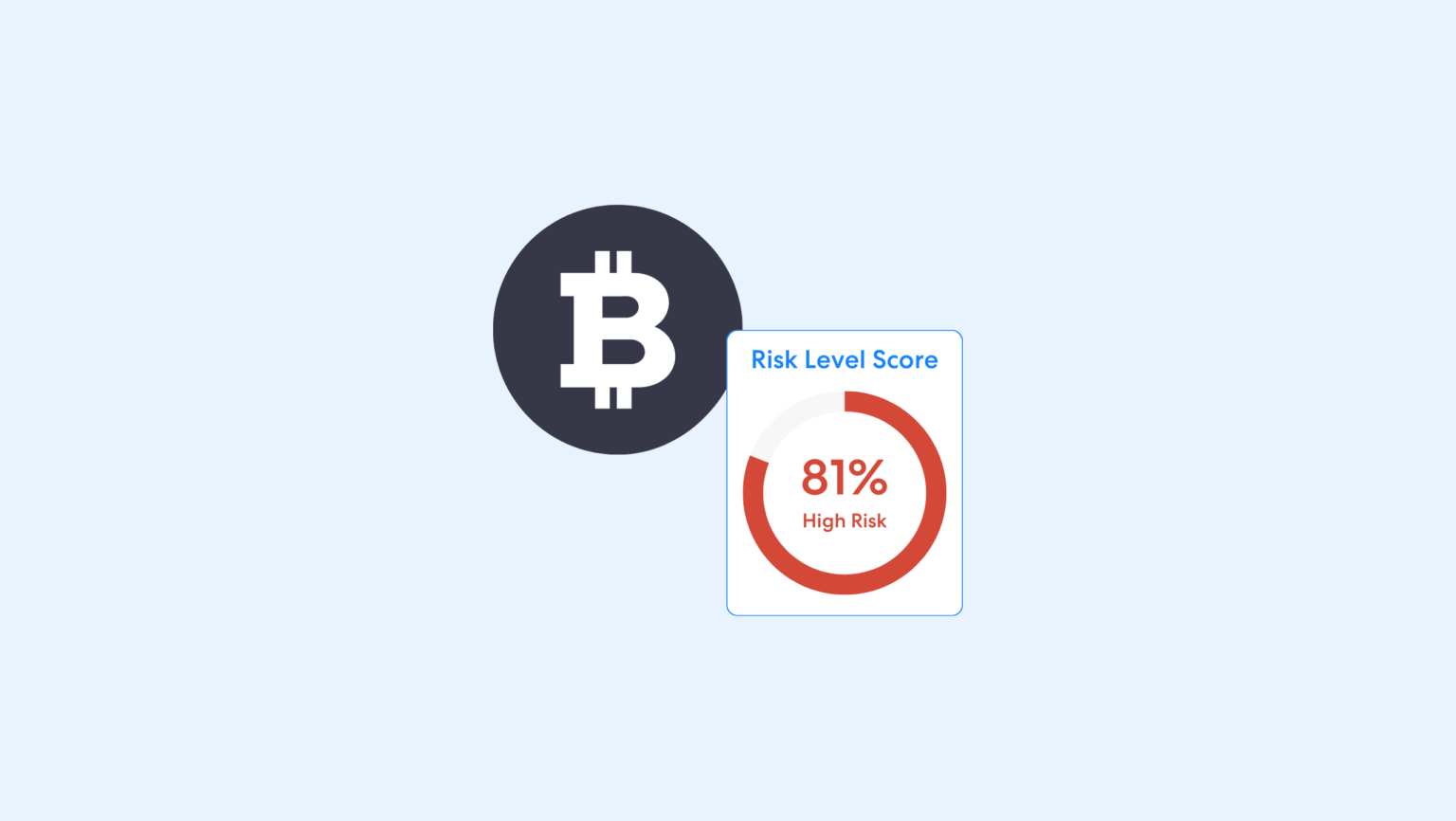
Consequently, the total risk score must trigger a compliance decision. Businesses must set their own risk thresholds (for example, a score of 0-39 is classified as low risk, 40-69 as medium risk, and 70-100 as high risk) and escalation flows that will define the compliance outcome.
It is important to note that risk scores do not operate in isolation. For example, a confirmed sanctions match should trigger mandatory controls regardless of the weight score. AML compliance tools analyze data faster than human professionals. Also, choose solutions that support trusted regulatory reporting and audit trails. For example, ComplyCube’s AML Custom Risk Engine offers fully explainable risk assessments and traceable AML decision-making.
Operationalizing KYC Risk Assessment for Crypto
Consequently, to achieve an effective KYC risk assessment for crypto, the next step is integration. Cryptocurrency exchanges should continuously calibrate, reassess, and pivot risk logic to reflect current customer, channel, product, jurisdiction, and behavioral risks.
1. Integrate logic into KYC onboarding: Embed the risk scoring model into customer onboarding.
2. Connect risk data: Ensure data captured from identity verification and AML screening continuously feed back into the scoring model.
3. Route to proportional due diligence measures: Configure workflows to automatically apply verification steps aligned to level of risks.
4. Ongoing assessment: Implement ongoing monitoring and event-driven triggers to reassess customers as risk evolves.
5. Maintain audit trails: Use real-time audit logs that document rationale, evidence outcomes, and manual overrides.
Die wichtigsten Erkenntnisse
- KYC risk assessment for crypto involves assessing risks to determine appropriate due diligence.
Robust KYC processes help connect cryptocurrency addresses to real-world identities.
CDD verifies Identität details and assesses user activity’s consistency with expected behavior.
Effective risk assessment includes ongoing monitoring to identify emerging financial crime risks.
Evolving global requirements demand documented and explainable risk assessments.
Strengthen KYC Risk Assessment for Crypto
Effective risk scoring prevents fraudulent funds from entering liquidity pools and preserves institutional trust. As such, crypto businesses must implement robust, effective KYC risk assessments to stop money laundering and terrorist financing at the point of entry. ComplyCube’s AML lifecycle compliance capabilities offer crypto firms a trusted financial crime prevention layer in one platform. Sprechen Sie mit einem Mitglied of the team to learn more today.

Häufig gestellte Fragen
What is an AML rating in crypto?
In crypto, an Anti-Money Laundering (AML) rating is the risk score assigned to a customer or business that uses crypto services. Crypto businesses calculate this risk rating by assessing a user’s or entity’s exposure to money laundering and terrorism financing. Typically, the risk rating derives from five factors: customer profile, channel, product, geography, and behavioral risk.
How do crypto firms score new customers with limited historical data?
To score new customers with limited historical data, crypto businesses can make use of other risk signals. These include device, mobile, and email intelligence solutions that detect suspicious browser or network activity. Additionally, using KYC smart forms, firms can collect additional information, including transaction activity, intended purpose, and source of funds.
How often do crypto exchanges need to re-score customers?
There is no standard timeline for re-scoring customers. Instead, cryptocurrency exchanges should adopt a risk-based approach, scoring based on the risk level. Additionally, event-driven Anti-Money Laundering (AML) programs automatically re-score customers when there is a material change in their information or behavior.
What evidence do regulators expect to see for a crypto AML risk scoring model?
Regulators increasingly demand an Anti-Money Laundering (AML) risk scoring model that can proactively prevent money laundering. Crypto firms must provide clear audit trails of compliance rationale, onboarding decisions, and rule configurations. It must prove that the data used is accurate and that systems are recalibrated regularly to reflect current risk.
How does ComplyCube’s solutions support crypto KYC regulations?
ComplyCube provides a full KYC lifecycle compliance infrastructure to help crypto businesses meet regulatory requirements across 250+ countries and territories. The platform offers advanced identity verification, ongoing AML screening, and customizable risk models to help crypto firms accelerate onboarding and build regulatory trust based on their own risk infrastructure.