
ملخص: Crypto document verification helps exchanges detect fake IDs, verify identities, and meet KYC requirements. Designed for crypto, this guide explores the seven capabilities for effective document verification for crypto from authentication to fraud detection and intelligent retries. Learn how to build a secure crypto document check for crypto KYC.
The Crypto Identity Fraud Problem in 2026
When a crypto company receives a submission, the photo or personal information may look convincing but still be counterfeit. Someone may have manipulated it or used a stolen identity. This exposes businesses to unauthorized account access and broader financial crime risks.
AI-generated images and fake IDs have made identity verification much harder. In 2025, the Federal Bureau of Investigation (FBI) reported 181,565 crypto-related complaints with over $11B in reported losses. Although these figures reflect broader crypto-related crime, regulations are developing alongside these threats. Acting U.S. Attorney Ryan Ellison warned, If you build or sell tools that let offenders impersonate victims, you are part of the crime.”
As a result, regulatory expectations are changing internationally. In July 2026, the Financial Action Task Force (FATF) reported that 83% of surveyed jurisdictions had passed legislation implementing the Travel Rule, compared with 73% in 2025.
Moreover, the Financial Action Task Force (FATF) reported that 83% of surveyed regions passed legislation implementing the Crypto Travel Rule, which aims to prevent money laundering and terrorist financing. With over 120 countries enacting اعرف عميلك (KYC) و مكافحة غسيل الأموال (AML) rules for their crypto businesses, exchanges must comply with the Travel Rule for transactions over $1,000.
What is Crypto Document Verification?
Crypto document verification uses official identity documents to confirm a person’s identity. The process finds any invalid credentials used for money laundering and other financial crimes. It commonly uses passports, national identity cards, and driver’s licenses as proof of identity, and, in some cases, proof of address.
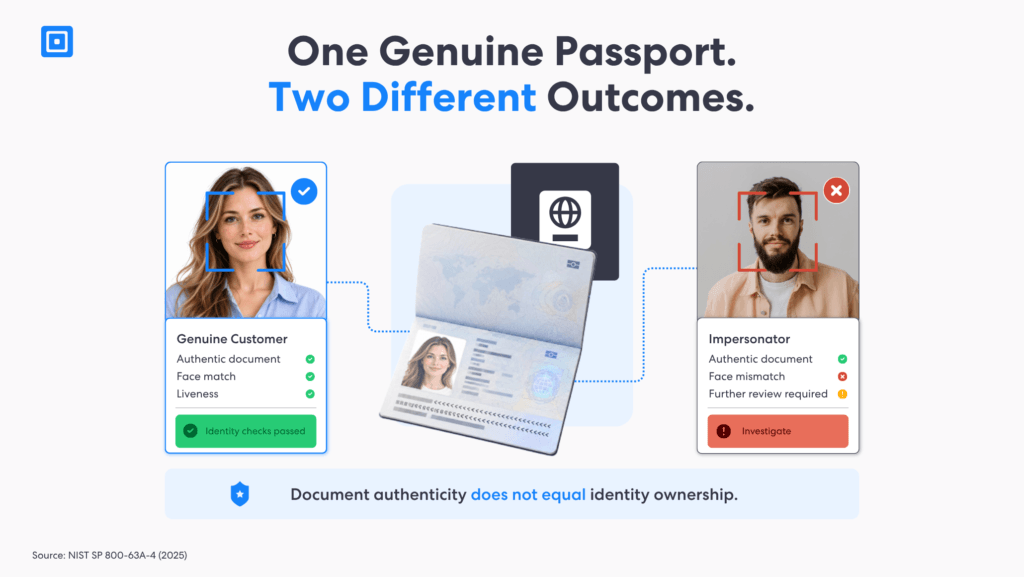
Document verification supports compliance obligations, and although KYC requirements vary by country, exchanges must establish procedures to verify user identities. Whether it takes minutes or several days, KYC processes help assess financial crime risks and comply with relevant AML regulations. Therefore, crypto document verification is an important component of the broader crypto market.
Customers must submit a government-issued ID during crypto onboarding to prevent identity theft. التعرف البصري على الحروف (OCR) extracts personal information, while authentication checks security features, expiration dates, and potential forgery or manipulation.
Traditional Document Identity Verification Is Not Enough
When verifying clients during KYC onboarding or transactions, crypto companies must assess document authenticity, submission integrity, and identity ownership. With 86% of crypto regulatory actions involving KYC/AML violations from 2019 to 2024, these four common fraud threats demonstrate why checking a document on its own is not enough:
- Counterfeit IDs: Faked or altered identity documents
- AI-generated documents: Synthetic or digitally manipulated identity evidence
- Stolen genuine IDs: Real credentials that are being used by fraudsters
- Injection attacks: Manipulated images sent through compromised capture sessions
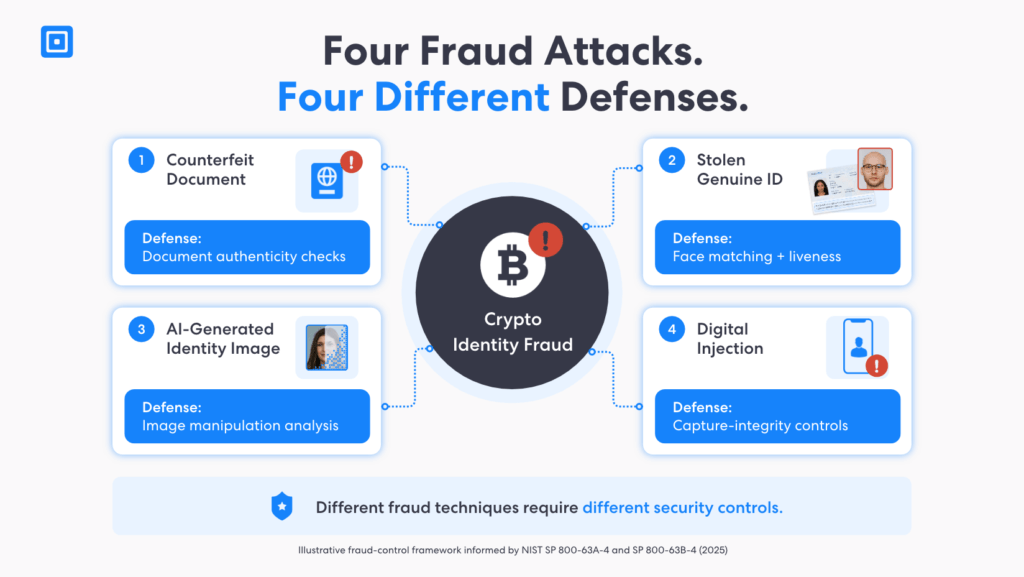
This shows why document authentication alone can’t establish customer identity. Crypto exchanges need complementary verification controls that address counterfeits and impersonation without adding unnecessary checks for every applicant.
7 Crypto Document Verification Must-Haves
A strong crypto document check uses the right technology to detect fraudulent KYC submissions. It confirms identity ownership, ensures regulatory compliance, and resolves real-time verification issues without unnecessary friction.
Automated Document Authenticity and Tamper Detection
The first step is determining whether a submitted identity document, such as a national ID, is real. Many counterfeit passports, altered driver’s licenses, and fake IDs look convincing, so visual inspection isn’t enough.
Automated document verification examines security features, layouts, Machine-Readable Zones (MRZs), and other potential signs of tampering to detect suspicious credentials during digital identity verification. Moreover, electronic chip authentication can give more assurance for supported documents. You can learn more here: A Developer’s Guide to MRZ Verification.
AI-Generated Document and Digital Injection Detection
Fraudsters in the crypto world can create synthetic documents, manipulate photos, or inject altered images directly into crypto transaction verification sessions. These attacks can bypass conventional visual inspection.
AI-powered image analysis helps detect suspicious alterations, while capture-integrity controls can detect manipulation during submission. Together, these safeguards protect against sophisticated identity fraud that document authentication alone can miss.
OCR and Automated Data Consistency Checks
OCR in identity verification solutions extracts names, dates of birth, document numbers, and expiration dates. Crypto exchanges compare these details against customer registration information such as email and phone numbers as well as MRZ fields.
Inconsistencies often indicate manipulation, inaccurate information, or data-entry errors that require further review. Automated comparison reduces repetitive form filling and manual transcription during KYC verification and onboarding.
Biometric Analysis, Face Matching, and Liveness Detection
Biometric face matching compares a customer’s selfie with their identity document photo to detect any impersonation. Liveness detection also protects against spoofing attempts using pictures, videos, or masks. Together, these checks will help determine if the person presenting the document is its rightful owner.
Real-Time Image Quality Checks and Guided Capture
Glare, blur, and poor lighting can stop real customers from finishing verification. That is why real-time quality checks can flag these issues during capture. This lets users correct mistakes before submission. Clear instructions and mobile-friendly interfaces help reduce avoidable failures without weakening fraud controls.
Risk-Based Verification and Intelligent Escalation at Crypto Companies
Using every possible check for every customer can create unnecessary onboarding friction. Risk-based verification applies additional scrutiny based on customer risk, jurisdiction, identity inconsistencies, and suspicious activity.
Applications that meet mandatory identity-check requirements may move on, while unexplained inconsistencies or high-risk circumstances may require EDD, more evidence, or ongoing monitoring. This type of approach best aligns with FATF’s risk-based principles.
Intelligent Retries, Alternative Verification, and Manual Review
Not every failed verification indicates fraud. A blurred document may need a new photo, while an unsupported ID can be replaced with an acceptable alternative. Suspicious alterations, inconsistencies, or potential impersonation may require more checks or manual review. Moreover, providing clear next steps helps real customers finish onboarding without weakening security.
Case Study: Korbit Fined $1.9M for Crypto Document Verification Failures
South Korea’s Financial Intelligence Unit (FIU) announced a $1.9M penalty against crypto exchange Korbit following approximately 22,000 violations. About 12,800 involved CDD failures, including accepting blurry identity documents, incorrect information, and failing to re-verify.
The Need for Automated Document Quality Assessments
FIU issued a warning against the relevant executives. This case shows the need for automated document quality assessments, real identity evidence, complete customer information, and risk-based verification to prevent incomplete applications from being incorrectly approved.
النتائج
- Two marketplace domains and an associated blog were seized.
- Approximately $6.4M in illicit proceeds were identified.
- Layered verification helps mitigate document fraud and identity impersonation risks.
Run a Crypto Document Check Without Drop-Offs
Strong identity verification should streamline onboarding with clear capture instructions, automated authenticity checks, and biometric verification. It should also offer guided retries to resolve common user submission errors.
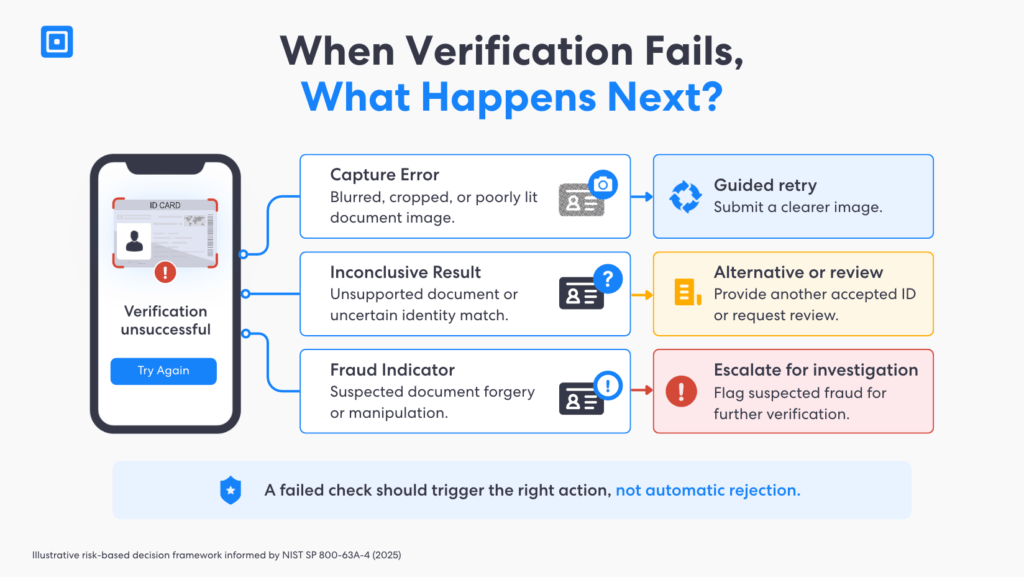
When verification fails, the response should reflect the underlying issue. A blurred ID may require another photo, while an unexplained identity mismatch or suspected forgery may warrant further investigation. By combining efficient capture with appropriate risk-based decisions, cryptocurrency businesses can help real users onboard without weakening essential KYC controls.
Measure Document Verification Performance
Crypto exchanges must measure verification effectiveness through both fraud prevention and customer completion, not just processing speed. Five measures of success and useful indicators for KYC checks include:
- First-attempt pass rate: Customers who pass verification without resubmission.
- Completion rate: Applicants successfully finish the verification process.
- False rejection rate: Real customers are incorrectly rejected, where reliable evidence is available.
- Manual review rate: Applications that need human intervention.
- Verification time: The time that is taken to reach a final verification decision.
Monitoring these document verification performance metrics across multiple transactions lets crypto companies identify avoidable friction. It also helps improve onboarding, and assess whether their identity verification controls are performing as intended.
النقاط الرئيسية
- AI-powered fraud demands stronger crypto KYC compliance.
Document authenticity does not guarantee identity or ownership.
Risk-based protocols lower unnecessary friction across multiple transactions.
Failed sessions do not automatically mean fraud or account takeovers.
An effective crypto document check will balance security, compliance, and user conversion.
Implement Crypto Document Verification with ComplyCube
Exchanges need to build confidence in customer identities without overcomplicating onboarding. Supporting 14,000+ identity document types, ComplyCube combines AI-powered document authentication, OCR, biometrics, and liveness to help crypto businesses detect suspicious identity submissions worldwide.
By bringing document verification, biometrics, AML screening, risk assessment, and configurable KYC workflows together within one platform, ComplyCube helps businesses reduce operational complexity and deliver smoother onboarding experiences. Its integrated capabilities support identity assurance and risk-based customer due diligence without introducing unnecessary friction for genuine applicants. Discover how ComplyCube can help your cryptocurrency business prevent identity fraud, streamline customer onboarding, and build trusted verification journeys.

الأسئلة الشائعة
How can cryptocurrency exchanges find fake or AI-generated IDs?
Crypto exchanges can detect suspicious identity data by combining automated authenticity checks, image manipulation analysis, OCR data consistency, and biometric checks. Facial matching and liveness detection add identity assurance, while complementary fraud signals help flag suspicious submissions that inspection alone may miss.
Is crypto document verification required under KYC and AML regulations?
Cryptocurrency exchanges are legally required to meet applicable Know Your Customer (KYC) and Anti-Money Laundering (AML) global financial regulations. These rules help comply with AML standards. The FATF Travel Rule also applies to crypto transfers and requires virtual asset service providers to collect and transmit sender and recipient data to help prevent illicit activity.
What is accepted for crypto identity verification?
Exchanges verify identities with commonly accepted documents such as government-issued national identity cards and driver’s licenses. Accepted documents completely depend on the platform, the customer’s location, or any applicable legal or regulatory requirements. Some crypto KYC processes also need proof of address or other identity evidence.
How can a crypto document check reduce onboarding drop-offs?
Document verification can reduce drop-offs through guided document capture, automated authenticity checks, clear error messages, and intelligent retries. Risk-based workflows during transactions can avoid unnecessary steps while routing suspicious applications to appropriate further checks, without bypassing mandatory compliance controls across different countries.
How does ComplyCube help crypto platforms and crypto wallets?
ComplyCube combines document authentication, biometrics, liveness, and onboarding to help crypto platforms, wallet providers, and other financial institutions find suspicious activity during user verification. Whether they use custodial wallets or non-custodial wallets where users control their own private keys, their compliance capabilities help secure customer onboarding.