
TL;DR: AML checks for accountants UK are essential for compliance and preventing financial crime. Strong AML checks for accountants include due diligence, ongoing monitoring, and suspicious activity reporting. Effective AML checks reduce risk, protect firms, and support regulatory compliance.
Anti-Money Laundering (AML) screening is a significant aspect of the UK financial landscape. Particularly, this is relevant for accountants with immediate access to customers’ financial information. Screening against money laundering, fraud, and terrorist financing is a fundamental aspect in protecting businesses against exploitation for criminal purposes.
Therefore, with stringent regulations surrounding every move, accountants must exercise caution and adhere to such regulations to guarantee the healthiness of the financial system. In this guide, we’ll explore the importance of AML checks for accountants UK, the key regulations to be aware of, and the steps accountants should take to ensure compliance.
What Are AML Checks?
In the first place, AML screening detects and discourages money laundering activities. Money laundering is making illegally obtained proceeds appear legal. It typically consists of three stages: placement (depositing illegal money), layering (concealing the illegal source of money), and integration (making the illegal money appear legal).
Additionally, for accountants, this means they must do due diligence on their clients, their clients’ transactions, and even, in some cases, their clients’ customers, to ensure that the funds flowing through the financial system are not from crime.
Each firm’s AML compliance also needs to be unique.
David Winch, the AML & Onboarding Adviser at MLRO Support Ltd, argues, “Each accountancy firm is unique – not least because the partners in it have a unique experience, knowledge, and interests,” said Winch. “In my opinion, each firm’s AML compliance also needs to be unique.” For more on UK AML regulation, read “Achieving Compliance: UK AML Regulation.”
Why Are AML Checks Important for Accountants?
Indeed, as they are gatekeepers to the financial system, accountants have an excellent opportunity to report suspicious transactions. Non-compliance with AML regulations can be extremely costly for accountants and their firms, such as hefty fines, loss of reputation, or even prosecution. In doing so, accountants are not only helping preserve the integrity of the financial system but also keeping themselves from being a passive facilitator of illicit activity.
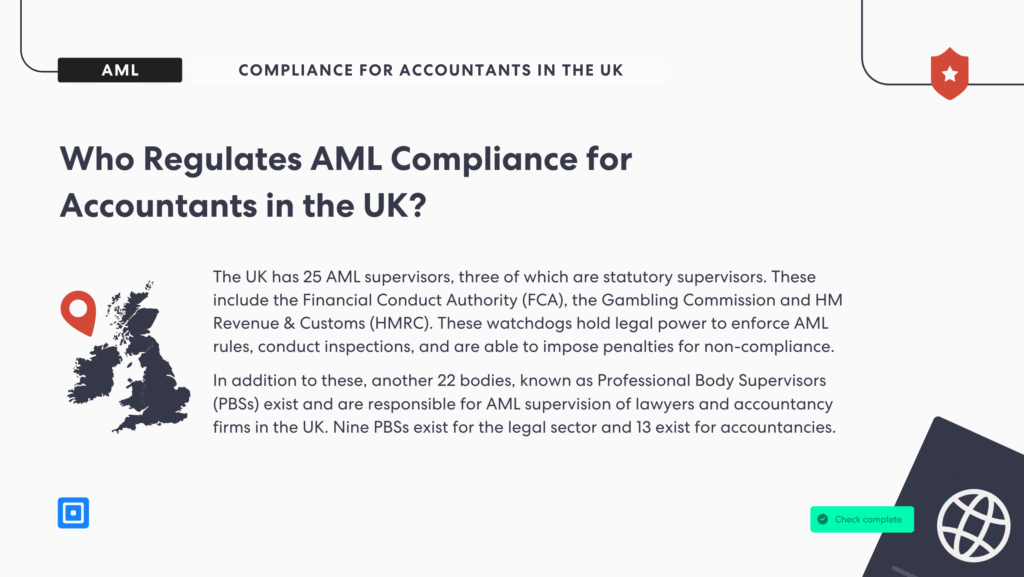
UK Accountants’ Key AML Legislation
In fact, the UK boasts a robust anti-money laundering regime, based on a risk-based approach, and it is crucial that accountants know which specific legislation applies to their practice. Some of the key acts are:
1. The Proceeds of Crime Act 2002 (POCA)
Firstly, the POCA forms the basis of UK anti-money laundering. It criminalizes money laundering and establishes the obligations of UK businesses, including accountants, to report suspicious transactions.
2. The Money Laundering, Terrorist Financing and Transfer of Funds Regulations 2017
These regulations, more commonly referred to as the “MLR 2017,” set the detailed requirements of the regulated business entities, i.e., accounting firms. They prescribe requirements such as Customer Due Diligence (CDD), record-keeping, and reporting of suspicious transactions.
3. The Terrorism Act 2000
This legislation renders financing terrorism a crime, and accountants need to be sensitive to the possibility of clients’ terrorism finance involvement.
4. The Criminal Finances Act 2017
This legislation established new corporate crime offences for the inability to prevent the facilitation of tax evasion, an additional burden on accountants and their firms. This law made important amendments to the Proceeds of Crime Act 2002, Terrorism Act 2000 and the Anti-terrorism Crime and Security Act 2001.
The Criminal Finances Act 2017 introduces consequences that are far more severe for businesses who facilitate this criminal activity. The UK government states that, “CFA 2017 introduces corporate criminal offences of failing to prevent tax evasion which may apply to businesses who facilitate this criminal activity. This means that businesses can be criminally liable where they fail to prevent those who act for, or on behalf of, the business from criminally facilitating tax evasion.”
AML Obligations for Accountants
It is important to realize that accountants are required to comply with several key requirements in the UK’s anti-money laundering legislation. These include:
1. Customer Due Diligence (CDD)
Before entering into a business relationship or for certain transactions, accountants will be required to conduct CDD on their customers. This involves identifying the customer, verifying their identity, and identifying their business. For high-risk customers, there is the possibility of needing enhanced due diligence (EDD).
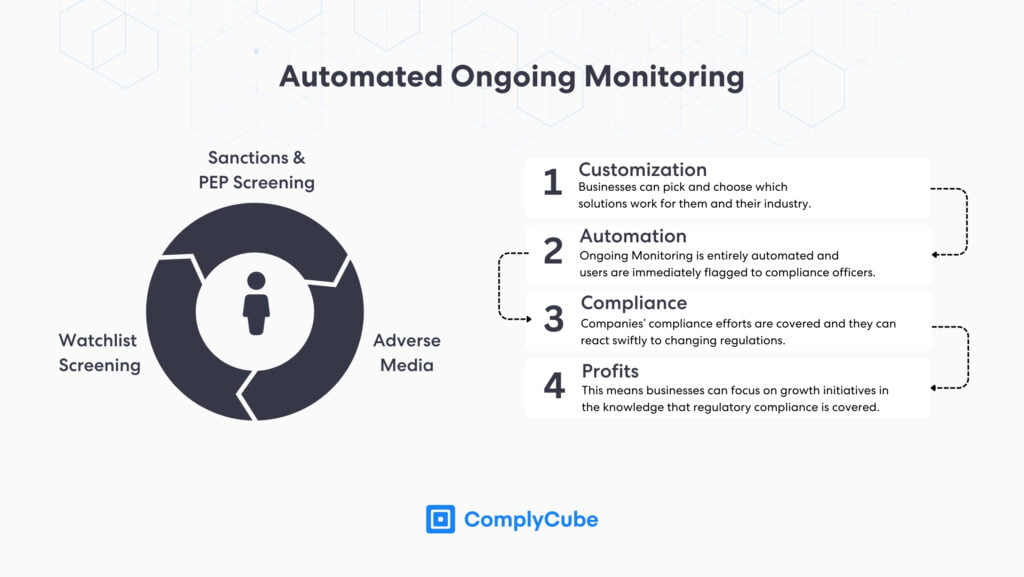
2. Ongoing Monitoring
AML rules necessitate accountants to always keep a check on their clients’ transactions to verify that they are aligned with what is known regarding the client and business. Suspicious or unusual transactions need to be identified and reported.
3. Record-Keeping
Accountants must retain their AML screening for a minimum of five years. This must include all their records on CDD, transactions, and the reports to the authorities.
4. Suspicious Activity Reporting (SAR)
If there is any suspicion that an accountant’s client is involved in money laundering or terrorist financing, the accountant is required to file a SAR to the National Crime Agency (NCA). Criminal liability will be attracted if this is not done.
5. Training and Awareness
Accountants must ensure their staff are regularly trained in AML procedures and comprehend what their responsibilities are to report and identify suspicious transactions. This is an essential part of building a compliance culture within the firm.
6. Independent Audits
Finally, firms need to conduct independent audits of their AML procedures to guarantee efficacy and adherence to the rules. This guarantees that loopholes within the process are addressed as soon as possible
Case Study: Weak AML Checks Led to Enforcement for Two Connected Firms
In ICAEW’s 2024/25 AML supervision report, two connected firms were found to have serious control gaps. Reviewers identified no documented AML risk assessments, no evidence of ongoing risk review for existing clients, no Customer Due Diligence (CDD) for some new clients, outdated AML training for staff and partners, and an ineffective review.
Control Gaps from Onboarding to Ongoing Monitoring
That means combining identity verification, sanctions and Politically Exposed Person (PEP) screening, documented CDD, periodic risk reviews, staff training, and a clear audit trail for compliance oversight. This aligns with current UK guidance, which confirms certified digital identity services can support CDD under the Money Laundering Regulations.
Solutions & Outcomes
Firms went through a follow-up review at their own expense, and ICAEW later said they had made progress in improving and applying their CDD and AML procedures.
The matter was referred to the Conduct Department, and the Conduct Committee made consent orders of £31,700 and £10,400 against the two connected firms.
The case shows how weak risk assessments, missing CDD, poor staff training, and ineffective compliance review can escalate into formal enforcement for UK accountancy firms.
The Role of Technology in AML Checks
Today, the modern era of technology has transformed the implementation of AML checks. As a result, most accountancy firms use technology to help in customer identification, risk management, transaction monitoring, and reporting. AML software supports many parts of the process to be automated, thus being more accurate and efficient.
For example, digital verification software for identification may automate the CDD process by instant verification of clients’ details from government records and biometric data. Transaction monitoring systems may also flag an activity based on predetermined parameters, enabling accountants to recognize red flags with simplicity.
Challenges in AML Compliance for Accountants
Even though the regulatory landscape is clear, AML compliance can be challenging for accountants. Some of the key challenges are:
1. Resource Shortages
Small accounting firms may not have the resources to implement effective AML procedures, and thus they fail to comply. Training and automation tools become more essential for small firms in such a scenario.
2. Complicated Clients and Transactions
For accountants handling foreign clients or high-risk industries, it is not always easy to make an objective judgment of the validity of transactions. This is particularly the case when handling advanced financial products or cross-jurisdictional transactions.
3. Staying Ahead of Evolving Regulations
AML regulations keep evolving, and accountants must be up-to-date with any modifications to stay compliant. It is a matter of ongoing learning and the adoption of new technologies to stay in accordance with regulations.
Anti-money laundering screening is a significant responsibility for accountants in the United Kingdom. It is high-risk, and non-compliance could lead to severe consequences. So, being aware of the key regulations and proactive implementation of robust AML controls, accountants are able to safeguard the integrity of the financial system as well as maintain their own business safe from the risks of money laundering.
Key Takeaways
AML checks for accountants UK are a legal requirement and a key part of staying compliant helping firms reduce exposure to money laundering and other financial crime risks.
Checks must follow a clear compliance framework including customer due diligence, record-keeping, and reporting suspicious activity when needed.
AML checks do not stop at onboarding. Accountants also need ongoing monitoring to spot changing client risks over time.
A risk-based approach is essential for effective AML checks for accountants. Firms should tailor their controls to the clients, services, and risks they deal with.
Technology can make AML checks faster, more accurate, and easier to manage. Digital tools help accountants improve efficiency while strengthening compliance.
Leverage Robust AML Checks for Accountants UK
In summary, adopting the right KYC and AML infrastructure can enhance your customer due diligence process and overall AML compliance. Financial crime is at an all time high, and money laundering regulations continue to tighten for accountants, meaning that those without advanced AML and KYC solutions will face consequences in the long run. So, if you’re looking to fortify your operations with advanced AML infrastructure, get in touch with one of our compliance experts today.

Frequently Asked Questions
What are AML checks for accountants in the UK and why do they matter?
AML checks for accountants UK are compliance checks designed to detect money laundering, fraud, and terrorist financing. They matter because accountants handle sensitive financial information and play a key role in stopping illicit funds from moving through the financial system.
Why do accountants need AML checks in the UK?
AML checks for accountants help firms meet legal obligations, identify suspicious activity, and reduce exposure to regulatory penalties. Strong AML checks also protect an accountancy firm’s reputation and support the integrity of the wider UK financial system.
What AML legislation must UK accountants comply with?
UK accountants must understand key AML laws including the Proceeds of Crime Act 2002, the Money Laundering Regulations 2017, the Terrorism Act 2000, and the Criminal Finances Act 2017. Together, these laws shape how AML checks for accountants UK should be carried out in practice.
What customer due diligence and monitoring checks must accountants carry out?
AML checks for accountants typically include customer due diligence, identity verification, ongoing monitoring, record-keeping, and suspicious activity reporting. For higher-risk clients, firms may also need enhanced due diligence to assess risk more closely and stay compliant.
How can ComplyCube help accountants in the UK improve AML checks?
ComplyCube helps streamline AML checks for accountants UK through automated identity verification, customer due diligence, risk screening, and ongoing monitoring.This makes AML checks for accountants faster, more accurate, and easier to manage at scale.