
TL;DR: UK firms must check employees right to work before enrolment to avoid penalties. As such, right to work compliance is crucial. Additionally, automating right to work checks enables firms to reduce hiring friction and keep audit-ready records. This guide explains proof of right to work in UK processes and how to stay compliant while enhancing employee satisfaction.
What are Right-to-Work Checks?
In the UK, right-to-work (RTW) checks are a mandatory Home Office process. During this process, employers have the responsibility to verify that a job applicant is allowed to work in the UK legally before hiring. Without robust RTW, companies can face civil penalties of up to £60,000 per person.
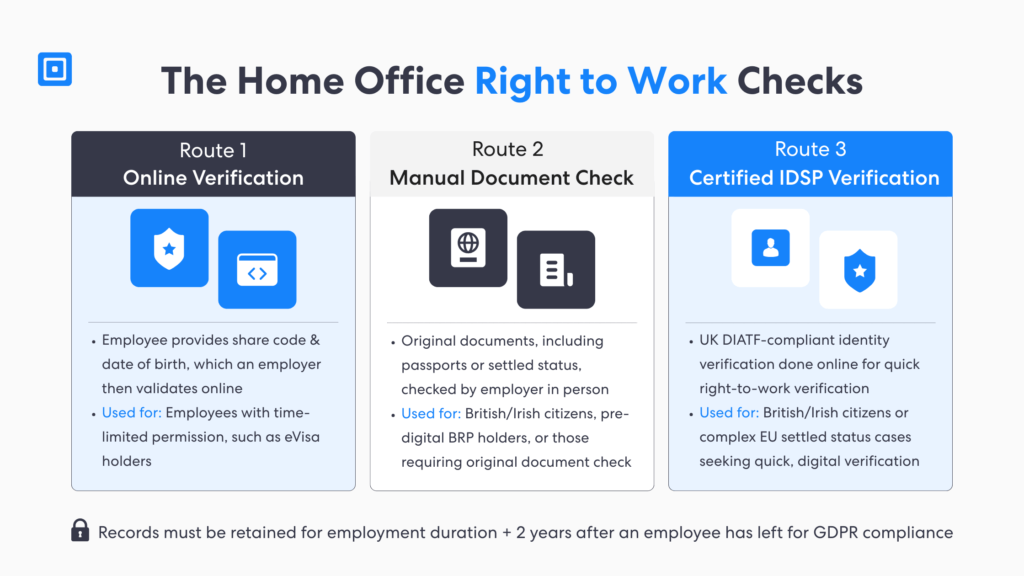
The Home Office department guides employers on how to conduct sufficient checks, which include three distinct routes:
1. Check RTW Online
Under this process, an employer can view and confirm an individual’s RTW record in real-time using the Home Office service. The information required from an individual’s online account is their date of birth and share code (generated by the user themself via the GOV.UK website). Typically, international talent and commonwealth citizens use this service. Irish or British citizens cannot generate a share code and must undergo route two or three instead.
2. Check RTW with Physical Documents
Use original documents from the Home Office’s acceptable list, which includes a British passport or an Irish passport. If no passport is available, other documents, such as a birth or adoption certificate, and an official document letter showing the National Insurance number, are required. If an individual has just attained British citizenship, they must prove so via a Certificate of Registration or Naturalisation.
3. Check RTW via an Identity Service Provider (IDSP)
An IDSP is a certified digital identity verification provider used by employers, landlords, and organizations to perform RTW, right to rent, and DBS checks. Firms that choose to perform RTW checks with an IDSP typically do so because it enables quicker, compliant onboarding at scale.
Employers must keep all copies of right to work documents throughout the employment contract, plus for two years after that. Under the UK’s General Data Protection Regulation (GDPR) law, this worker’s information must then be safely destroyed afterwards. Implementing complete right to work checks supports UK employers in obtaining a statutory excuse, which can legally help against penalties for hiring illegal workers.
Automating Right to Work Checks with an IDSP
UK employers are increasingly adopting IDSPs, as they provide a high level of automation, removing the need for manual intervention. In 2022, the UK government launched the IDSP framework, enabling employers to partner with digital IDSPs to verify an employee’s right to work status accurately. An IDSP complies with the UK’s Digital Identity and Attributes Trust Framework (UK DIATF).
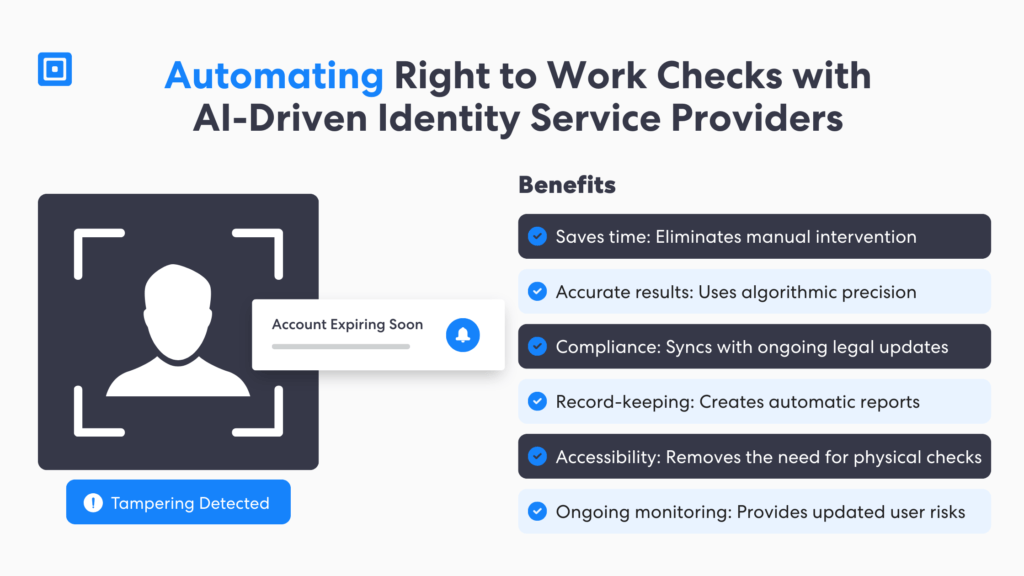
Automation uses Artificial Intelligence (AI) and Machine Learning (ML) to rapidly extract valid information and detect tampered identity documents. AI-driven IDSPs support right to work checks with instant compliance records and fraud detection alerts. The advantages of automation with a certified IDSP include:
- Saves time through instant digital verification, eliminating manual document management.
- Reduces human errors with algorithmic precision and automated confirmation of identity.
- Ensures compliance via integration with UK Home Office systems and real-time updates.
- Creates audit-ready digital records for easy documentation and inspections upon request.
- Cuts costs by minimizing dependencies on manual paperwork and potential penalties.
- Improves accessibility with remote, authorized checks from any device.
- Goes beyond pre-screening by enabling continuous monitoring and real-time risk updates.
Modern IDSPs, including ComplyCube, support UK businesses in complying with both pre-employment checks and continuous compliance with the UK Anti-Money Laundering (AML) regulations. Additionally, these digital systems simplify the hiring process, ensuring each worker has a valid right to work status instantly. You can learn more here: Choosing a UK DIATF-Certified IDSP.
Compliant Proof of Right to Work in UK
According to the UK Government, the most common risk factor for UK employers is not understanding the requirements for compliance with right to work checks. It is noted that 80% of UK employers answered at least one compliance question incorrectly during a survey.
This can pose a huge risk to a business, especially as it can cause bad actors to manipulate the verification system. For example, individuals can commit identity theft by using stolen details to create fraudulent certificates or visa status, evading the correct employment status.
Compliant IDSPs mitigate these risks by providing by cross-referencing contact information and official documents against trusted databases in real-time. As a result, firms can flag discrepancies before onboarding, strengthening fraud prevention. In addition, certified IDSPs such as ComplyCube offer cutting-edge verification tools. This includes liveness checks and Optical Character Recognition (OCR), to further enhance identity verification and protect businesses from fraud.
Case Study: Make Employees’ Right to Work Checks Faster and Compliant
A leading UK staffing and recruiting firm needed to perform right to work checks for all new hires. However, the firm was struggling with inefficiencies due to reliance on multiple third-party vendors to run initial verification and onboarding.
End-to-End Identity Verification Flow
To streamline its complex processes, the firm partnered with ComplyCube, the IDSP-certified KYC provider under the UK DIATF. ComplyCube provided unified verification, including document verification, and ongoing compliance monitoring across the candidate lifecycle.
Outcomes
The firm was able to layer multiple checks in one workflow, including selfie and proof of address checks to enhance security.
With a unified, automated platform, the UK business was able to seamlessly integrate effective right to work checks into its CRM.
As a result, the company was able to hire and onboard new hires at a faster rate, increasing the verification rate by 14%.
Common Mistakes and How to Avoid Them
Not implementing the correct right to work verification process results in huge losses. Firstly, employing workers without valid rights or work visa can lead to fines and potential imprisonment. Secondly, genuine applicants who undergo complex right to work checks can feel alienated by the process. For example, filling in a form repeatedly or having no transparency on document submission can lead to a bad experience.
According to the UK’s Digital Identity Sectoral Analysis 2025:
- 79% of users report privacy and security as the main factors when using digital identification
- Next, 76% of applicants chose service provider reputation and clarity on forms needed as important
- 75% of individuals indicate reliability and conformity to government standards as vital
- 75% of respondents mention faster transactions with digital identity services
Right to work checks form a crucial component of onboarding programs. Consequently, effective onboarding has a large role in employee satisfaction and retention. For example, reports indicate that workers who don’t receive a preboarding experience are more likely to leave within six months.
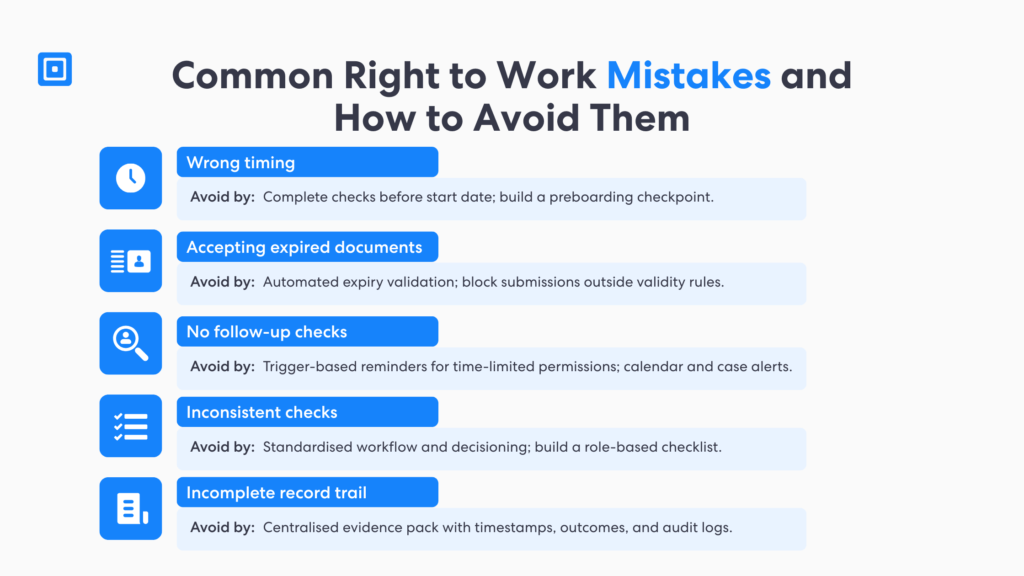
The most common mistakes during right to work checks are:
1. Conducting checks at the wrong time: According to the Home Office, carrying out a right to work check after employment has begun will ultimately invalid statutory excuse. As a solution, employers are encouraged to always run a right to work check before employment begins, including starting an unpaid trial that is considered work.
2. Accepting expired or incorrect documents: Processing documents that are not valid, such as visa past an expiry date is not allowed. However, an expired British passport can still be accepted. To avoid this mistake, check the required documents for each applicant based on their country or citizenship (review List A and List B document types). The share code, versus the manual route, versus the IDSP route, caters to different workers and requires different documents for compliance.
3. Inconsistent checks: Enforcing different right to work checks per employee can create legal risks, such as discrimination claims. Thus, businesses must conduct checks using a standardised process to build defensibe proof during regulatory checks. Ensure to align names and date of birth with other checks, including proof of address.
4. Not conducting follow-up checks: For employed workers with time-limited permission to work, failing to perform checks before their RTW expires can lead to non-compliance. To mitigate this, set follow-up triggers where permission is time-limited and schedule the follow-up checks in advance to ensure they’re completed on time.
5. Incomplete record trail: Not keeping clear copies of documents may mean losing statutory excuse. On the other hand, not disposing of employee data two years after they have left is non-compliant. Businesses must retain dated copies of relevant documents and detail who conducted the check and when. For online or IDSP checks, retain output evidence as required.
Key Takeaways
UK employers can face heavy fines and imprisonment for failing to check employees right to work, while workers who cannot prove it may face deportation.
An online share code is mandatory for most non-British or Irish citizens to verify their right to work in the UK and can be applied for online, valid for 90 days.
British/Irish citizens must present original documents, such as a passport, either in person or live video link, or via a certified IDSP.
An automated IDSP empowers employers to remain compliant with right to work checks, perform rapid, real-time screening, and strengthen fraud detection.
Right to work checks play a crucial role in customer onboarding, influencing an applicant’s experience and retention rate.
Right to Work Checks as a Growth Enabler
Embracing right to work checks through compliant IDSPs shifts compliance from a complex process into a growth enabler. By leveraging AI-driven IDSPs to prove right to work eligibility, whether via document checks such as passports or share codes from a previous employer, UK businesses can protect their operations from fines. Access compliant, automated UK DIATF certified identity service providers today and hire talent at scale. Contact a member of the ComplyCube team to learn more.

Frequently Asked Questions
What is proof of right to work in UK?
Proof of right to work in UK confirms a person has legal permission to work by verifying their immigration status or employment eligibility. Usually, individuals submit a passport, a share code to prove visa status, or a document with a national insurance number before employment. UK employers must check employees right to work for compliance.
How do UK employers check employees right to work?
UK employers can check employees right to work through 3 different routes: checking documents online via a share code, physically accessing original documents, or remote verification through a certified identity service provider (IDSP). Documents collected must be kept throughout the applicant’s employment contract and for 2 years afterwards, before being disposed.
What are the benefits of automating right to work checks?
Automating right to work checks offers benefits such as quicker hiring, reduced human errors during document validation, and real-time confirmation of right to work or immigration status. In addition, it builds a defensible, audit-ready report, cuts costs, and ensures ongoing compliance beyond the job offer.
How do you partner with an IDSP for right to work checks?
To partner with a UK IDSP, businesses can view these providers on the UK’s GOV.UK website. Some factors to consider when choosing IDSP include UK DIATF alignment, integration capability, automation level, and compliance with AML rules.
What documents are needed for proof of right to work in uk?
Documents for proof of right to work in UK include a valid passport, biometric card, share code, or national insurance number for Irish or British citizens. Applicants from a specific country may need additional information, such as a job offer letter or work permission certificate. Examples include List A (unlimited employment) or List B (time-limited work).