
On 7 October 2026, the UK Gambling Commission announced £5M (~$6.6M USD) in regulatory settlement involving three Rank Group-owned casinos after finding Anti-Money Laundering (AML) failures in their operations. It covers Grosvenor Casinos Limited, Grosvenor Casinos (GC) Limited, and Gaming Group Limited. All of these companies operated 51 casinos across Great Britain.
An independent third-party auditor will assess whether the businesses are implementing their AML and safer gambling controls effectively. However, beyond the size of the settlement, the most important part of the case is understanding where the controls completely broke down.
What Happened to the AML Controls of Rank Group?
The Gambling Commission found several significant weaknesses in the casino operators’ AML framework. The operator has not updated its policies to reflect changes introduced by the UK Money Laundering Regulations from 2020. Unclear procedures caused staff to make inconsistent decisions for customers who carry elevated money-laundering risk.
The operators wrongly assigned higher-risk customers to inappropriate risk levels while accepting other high-risk funds without any issue or further scrutiny. The Commission also found cases where operators failed to carry out تعزيز العناية الواجبة (EDD), despite their own policies requiring it.
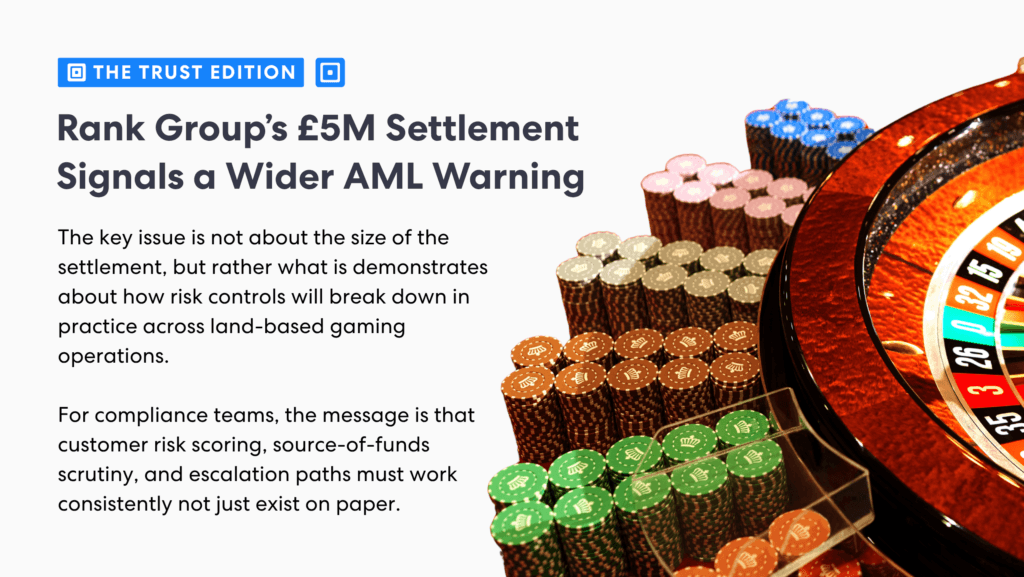
Reporting on the investigation provides an especially useful example. Policies around crypto lacked clarity, with converted crypto funds reportedly accepted without sufficient examination of their original provenance. Venue managers could not be consistent without any clear guidance around Source of Funds (SoF) and Source of Wealth (SoW). Now, finding risk is not enough if that risk does not consistently change the checks a customer receives.
Land-Based Casinos Face the Same AML Scrutiny
Large gambling enforcement cases such as that of Rank Group and its £5M settlement could draw attention toward online casino operators. It does not reduce the larger AML obligations that these physical venues face on a regular basis.
Anti-money laundering and social responsibility failures are equally alive in the land-based sector.
Executive Director of Operations at the Gambling Commission, Sue Young, said, “We would advise all premises-based operators to take a careful look at this case and ensure their own business is not making the same mistakes, and therefore they do not face costly and inevitable Commission action”.
Physical casinos blend several characteristics that are interesting to financial criminals. There are several high-value transactions, cash, fast movement of funds, and customers whose financial behaviour changes significantly over time. The real compliance challenge is around building AML controls that are capable of detecting when behaviour, funding sources, or customer circumstances no longer match the original risk assessment.
Lessons From The £5M Rank Group Settlement
The Rank Group case highlights the gaps between having an AML policy and the practical challenge of executing it consistently. For many gambling operators that are reviewing their own controls, teams must look at these three questions:
- Does customer risk change the workflow? Higher-risk indicators should trigger proportionate EDD SoF or SoW checks instead of leaning on staff interpretation.
- Can funding risk be traced? Turning an asset into GBP does not remove the risk linked to its source. Compliance teams need evidence to understand the origin of higher-risk funds.
- Can every decision be defended later on? Risk classifications, escalations, supporting evidence, and compliance choices must have a clear audit trail. It must show why a customer was approved, challenged, or restricted.
These principles extend beyond casinos and gambling operators. Across many regulated industries, gambling enforcement truly focuses on whether AML controls work in reality. The existence of policies on paper does not mean much in the grand scheme of AML frameworks.
Turning AML Policies Into Decisions
Modern AML programs need to link Customer Due Diligence (CDD), risk assessment, screening, ongoing monitoring, and EDD into one risk-based process. ComplyCube can support businesses looking to build dynamic compliance workflows. They can create customer and fraud risk signals that trigger additional verification, AML screening, document collection, or EDD. Decisions and supporting evidence can then be maintained within an auditable investigation workflow.
The Rank Group £5M settlement sets out a timely warning for gambling operators. AML risk does not go away at the casino door, and neither does regulatory scrutiny. Businesses should review cases such as these carefully to ensure that they are not at risk of making the same mistakes.

Find out more AML updates in ComplyCube’s نشرة إخبارية من إصدار الثقة. We explore the latest developments across identity verification and AML globally.