
As of 1 October 2026, the new right to work changes are live across the UK. The Home Office published 83 pages of employer guidance about how organisations must conduct Right to Work checks under the revised framework.
These changes go beyond traditional employee onboarding. They impact businesses that use contractors, flexible workers, and digital identity services. Employers must review who they check, how the checks are completed, and whether the chosen verification route can give the necessary statutory protections.
What Are The New Right to Work Changes?
The biggest right to work change is who falls within the revised framework and how digital verification works with it. The updated rules broaden the relevance of right to work checks across many different working arrangements.
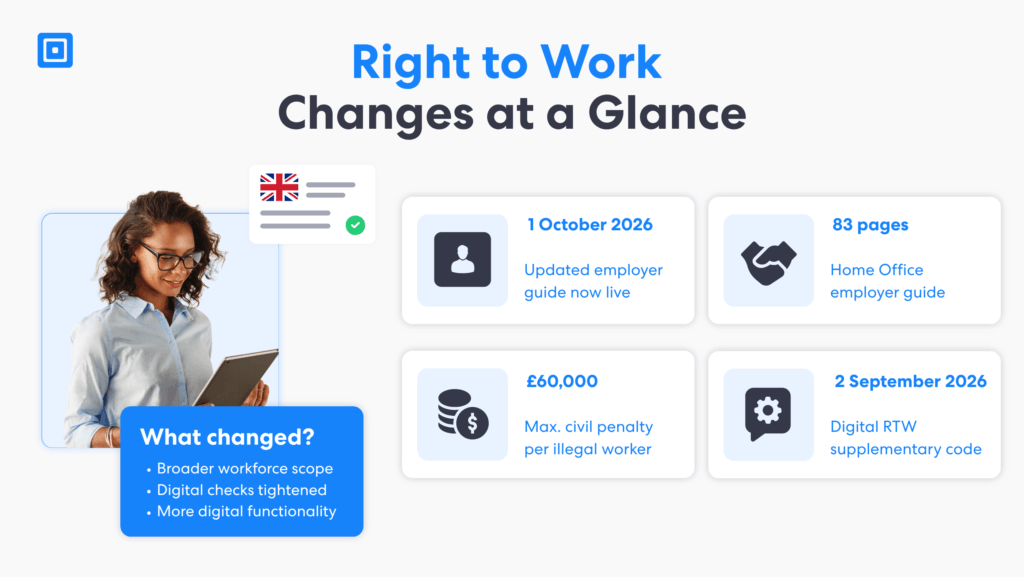
Along with the updated guidance from the Home Office, version 1.1 of the supplementary code for digital right to work checks sets out specific requirements for digital verification providers. It supports employers with Right to Work checks.
Right to Work Rules Extend Beyond Traditional Employees
There is also an increased focus on relevant worker contracts, individual subcontractors, and some online matching services. This means that businesses with flexible or platform-based workforce models must look beyond their traditional employees.
That makes workforce classification an important part of risk management. Businesses need to find out which types of workers sit within the right to work scope. They must ensure that the correct checks take place during onboarding instead of assuming that contractors and other non-employees simply fall outside the rules.
The Cost of Getting Right to Work Changes Wrong
There are huge consequences for incorrect checks. According to GOV.UK, employers can face a civil penalty of up to £60,000 for each illegal worker where they cannot show that the prescribed checks were completed. That is also why the audit trail for each check is important. Digital verification lowers manual friction. Employers must ensure they carry out the appropriate checks and retain the evidence needed to establish a statutory excuse.
What Hasn’t Changed for Employers?
然而, digital verification does not mean that every right to work process needs to be digital. Moreover, using technology does not transfer the employer’s underlying responsibility to the provider. The updated right to work changes in the Home Office guidance show how employers must conduct initial checks and follow-ups using the correct routes.
The purpose is still to establish that a candidate is permitted to perform the work. Home Office needs assurance that the prescribed requirements have been followed to establish a statutory excuse against a civil penalty. Employers need both the right technology and internal processes.
What Should Employers Do Following 1 October 2026?
Three immediate areas of right to work changes require team review. Teams must look at workforce scope, verification providers, and any internal processes. Those companies using contractors, subcontractors, or any other flexible workforce models should understand if their existing Right to Work policy covers everyone falling within the updated scope from 1 October 2026.
Employers using digital checks must confirm that their providers meet the applicable certification and registration requirements. They should also review how they manage evidence, follow-up checks, and re-verification. For those managing onboarding at scale, the new right to work framework makes a consistent verification process important.

了解更多反洗钱新闻,请访问 ComplyCube 网站。 信任版简讯. We explore the latest developments across identity verification and AML globally.