TL;DR: Europe’s digital identity framework, eIDAS, has evolved with eIDAS 2.0, mandating higher interoperability, security, and privacy protections across EU member states. With it comes new eID check requirements and the EUDI Wallet , which is projected to fully deploy by the end of 2026. Get ahead of these changes in our latest guide.
How is Europe Building Secure Digital Identification with eIDAS 2.0 and the EUDI Wallet?
Electronic Identification (eID) schemes have become critical to Europe’s digital transformation. It establishes a robust and interoperable ecosystem for individuals and businesses to verify identities online. At the heart of these schemes is Europe’s digital identity framework, eIDAS. eIDAS Regulation sets the standards for trust services and identity verification across Europe. It mandates the mutual recognition of eID schemes among member states, ensuring interoperability for cross-border digital services.
The EU formally introduced eIDAS 2.0 in 2023, with its implementation in progress over the course of 2024 and beyond. eIDAS 2.0 revamped regulations crafted for a modern, digital Europe. These new mandates established the “European Digital Identity Framework,” which will introduce the EU Digital Identity Wallet (EUDI). EUDI marks greater trust in digital identities, whereby European citizens, residents, or businesses can use eID check across member states without additional registration.
The Deployment and Adoption of the EUDI Wallet
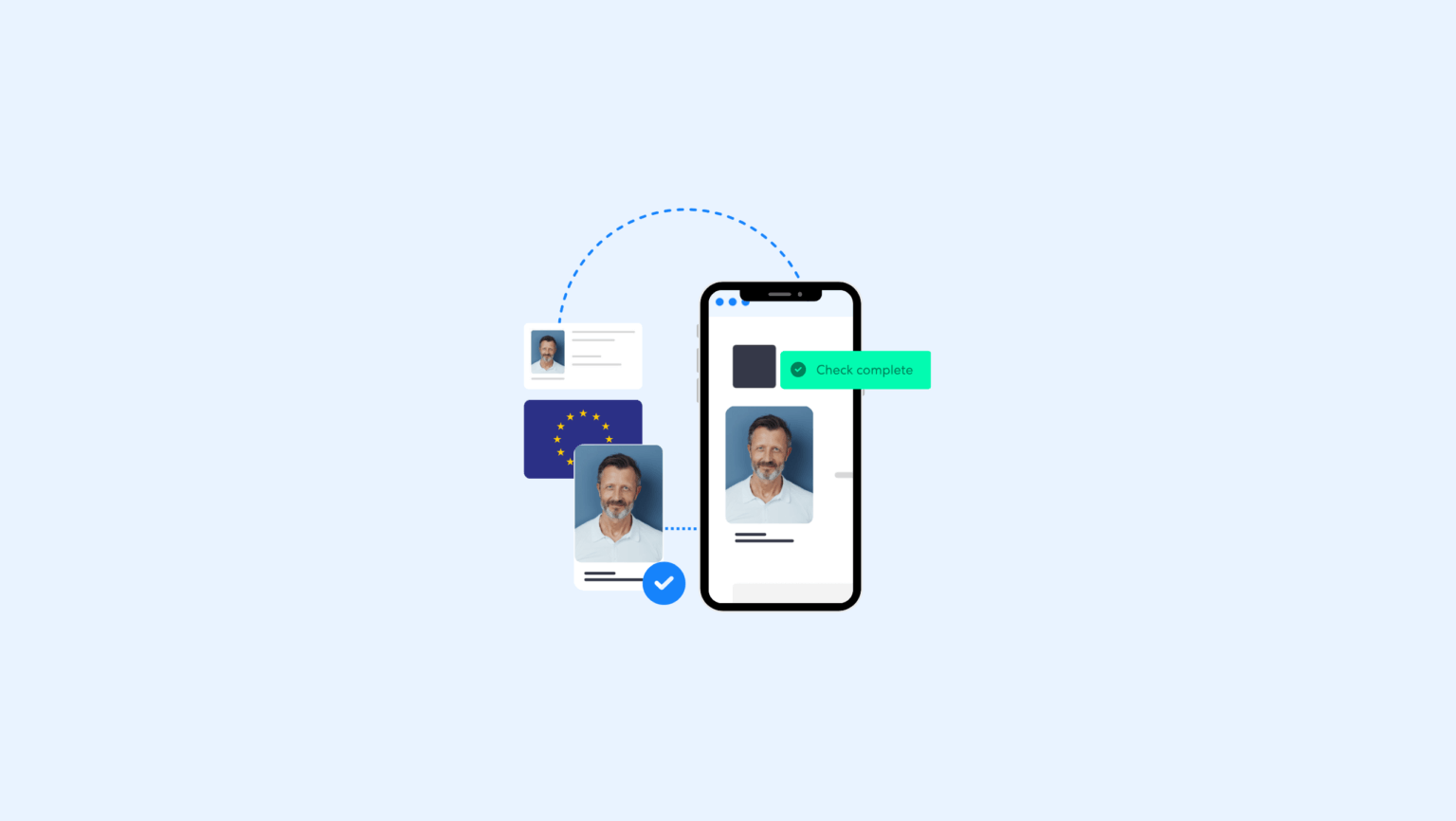
The EUDI Wallet further strengthens the European Digital Identity Framework under eIDAS 2.0. It facilitates secure and interoperable eID verification across the EU, contributing to a secure and digital Europe. The notion of a EUDI Wallet was first proposed in 2021 by the European Commission, with the aim of creating a single digital ecosystem that could span across Europe.
EU Digital Identity Wallets are the European Union’s response to the challenges of digital identification.
The European Commission proposed to reshape the original eIDAS legislation (No 910/2014) in order to introduce this new concept of an accessible and interoperable European Digital Identity. In addition to enhancing seamless cross-border use, the introduction of a secure digital wallet would offer users increased privacy and control, granting them the power to decide what data to share and with whom.
Shaping The Future of Identification in the EU: What a Digital Identity Future Looks Like
Practical use cases will include opening a bank account, filing tax returns, renting a car using a digital license, dealing with public services that request birth certificates or medical certificates, applying for university, reporting a change of address, and much more. A digital future offers increased practicality, as outlined by the 2030 Digital Decade policy which currently sets out Europe’s digital transformation goal.
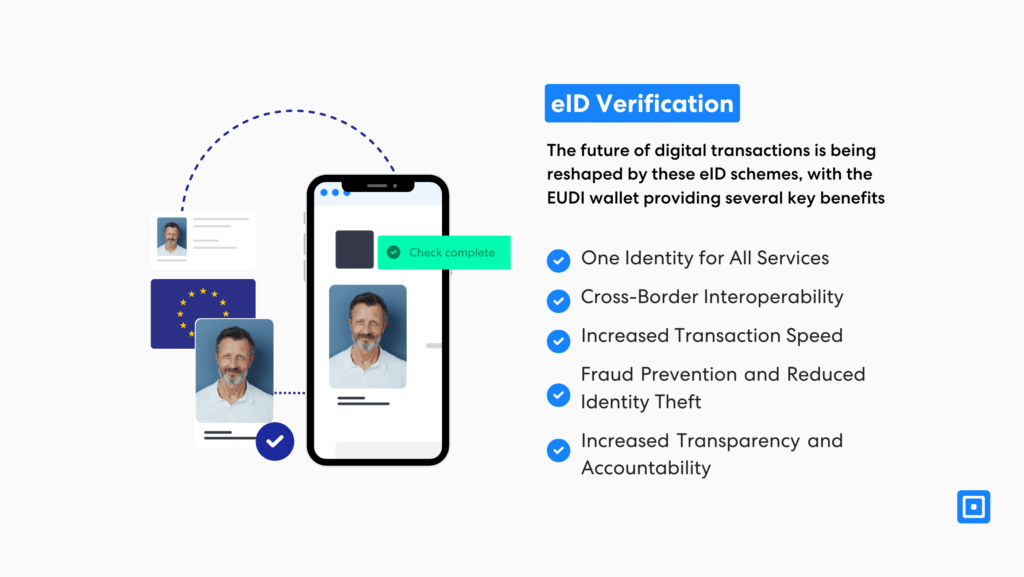
These targets outline that by 2030, all key public services in the European Union should be available online, thereby increasing accessibility to services such as health records across all member states. The future of digital transactions is being reshaped by these eID schemes, with the EUDI wallet providing several key benefits:
- Increased Transparency and Accountability: Each transaction tied to an eID check is logged securely, creating an audit trail that prevents fraudulent activity. Digital Identity Service Providers (IDSPs) can be certified under the DIATF framework, with a medium level of confidence required by HMRC.
- One Identity for All Services: Users will no longer need multiple credentials for different platforms. A single digital wallet will be far more practical, supporting increased interoperability across various public and private services.
- Cross-Border Interoperability: EU citizens will be able to use their eID across EU member states without the need for registration. This will allow for a more seamless user experience, as a Spaniard can open a bank account in Germany using the same eID credentials.
- Increased Transaction Speed: Manual document submissions or in-person verification can now be eliminated, with instant verification for services such as government applications or e-commerce transactions.
- Fraud Prevention and Reduced Identity Theft: Fraudulent transactions can be effectively prevented by using identity verification within payment processes. The fact that eIDs are government-certified minimizes the risks of fake IDs and tampering, both online and offline.
Broader Impact: The Possibility For Economic Growth
Beyond streamlining identity verification practices, the eID scheme also lays the foundation for a fast digital economy in which transactions can be carried out quickly and securely, even across borders. This allows businesses to expand their operations across Europe member states as well as cater to a larger customer base.
Businesses, particularly SMEs, can expand their operations more effectively, entering new markets and handling increased workloads without the burden of fragmented or inconsistent processes.
In addition, building public trust in online systems can lead to more people carrying out purchases online, leading to economic growth. eIDs also reduce bureaucratic barriers, allowing for sectors such as FinTech, e-commerce, and healthcare to innovate and evolve at a higher speed.
eID Schemes Across Europe
eID schemes have been put in place across Europe in countries like Sweden, Denmark, Norway, Belgium, and the Netherlands. While these nations have fully operational systems, other European countries are still continuing to establish their schemes.
Denmark
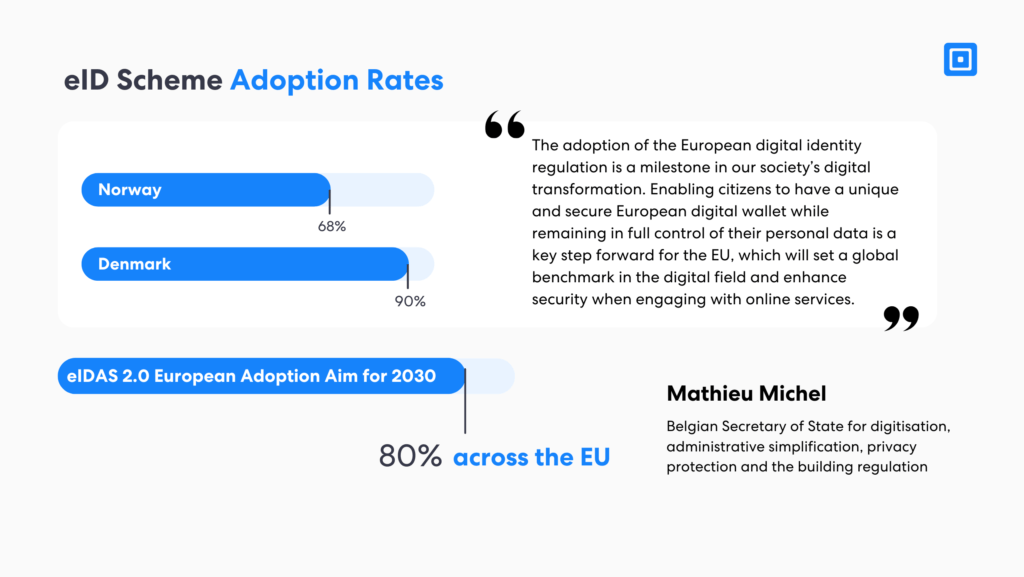
Denmark’s national eID, MitID, has transformed how citizens interact with digital services. Adopted by over 90% of the population, it facilitates more than 75 million monthly transactions, highlighting its pivotal role in everyday life. Estimated at €117 million, the eID market underscores its economic and societal significance.
Introduced in 2022, MitID replaced NemID as the country’s third-generation eID, offering enhanced security and functionality. Its applications range from secure authentication to Qualified Electronic Signatures, enabling seamless access to public and private digital services.
Today, more than 96.95 percent of the population uses their national eID in situations where it is essential to document one’s identity electronically. It allows for residents to access their public services 24 hours a day.
5.6 million Danes use MitID to verify their identities daily. The Danish Agency for Digital Government, which operates under the Danish Ministry of Finance, states that “eID is the key to digital Denmark,” cementing MitID’s position as a cornerstone of the nation’s digital-first approach.
Norway
BankID is a cornerstone of Norway’s digital infrastructure, used by approximately 97% of the population for secure verification, authentication, and Qualified Electronic Signatures (QES). It establishes a trustworthy digital foundation across key services such as banking, government, healthcare, e-commerce, and real estate.
From logging into online banking and filing taxes to signing digital contracts and renewing driver’s licenses, BankID ensures seamless and secure access. In healthcare, it enables authentication for patient portals and e-prescriptions, while in e-commerce, it facilitates secure payments.
The transition to the BankID app represents a leap forward in user experience. With features like facial recognition, fingerprint scanning, and PIN authentication, the app reduces login times from 30 to just 10 seconds. Additionally, the new BankID Biometric option introduces a streamlined, lower-assurance solution tailored to specific use cases, enhancing accessibility and convenience.
Belgium
The eID scheme in Belgium, ItsME, was co-created by banks and telecom providers. It enables seamless identity verification. Seven million users rely on this scheme, with an estimated 80% of the Belgian adult population relying on it. Up to 1 million identity verifications are carried out each day.
ItsME has drastically up-levelled onboarding processes across Belgium, helping businesses identify clients quickly, minimise acquisition costs, prevent fraud, and achieve regulatory compliance. The ItsME platform plans to expand its operations and usage across various markets, with over 17 European countries leveraging it.
Netherlands
iDIN, a joint initiative of Dutch banks, is transforming digital identity in the Netherlands by combining security, usability, and privacy. Built on the banks’ expertise in online banking and the widely trusted iDEAL payment service, iDIN offers a seamless way for users to verify their identity, log in to services, and sign documents electronically.
iDIN increases usability without compromising security and privacy. Moreover, iDIN secures and protects personal data.
Since its launch, more than 200 organizations across industries have integrated iDIN into their customer journeys, with over 8 million transactions logged for identification and authentication. With high user trust and adoption, iDIN is quickly being utilized as the preffered method of identity verification, reducing multiple passwords and logins.
The Role of the EUDI Wallet in Cross-Border eID Verification
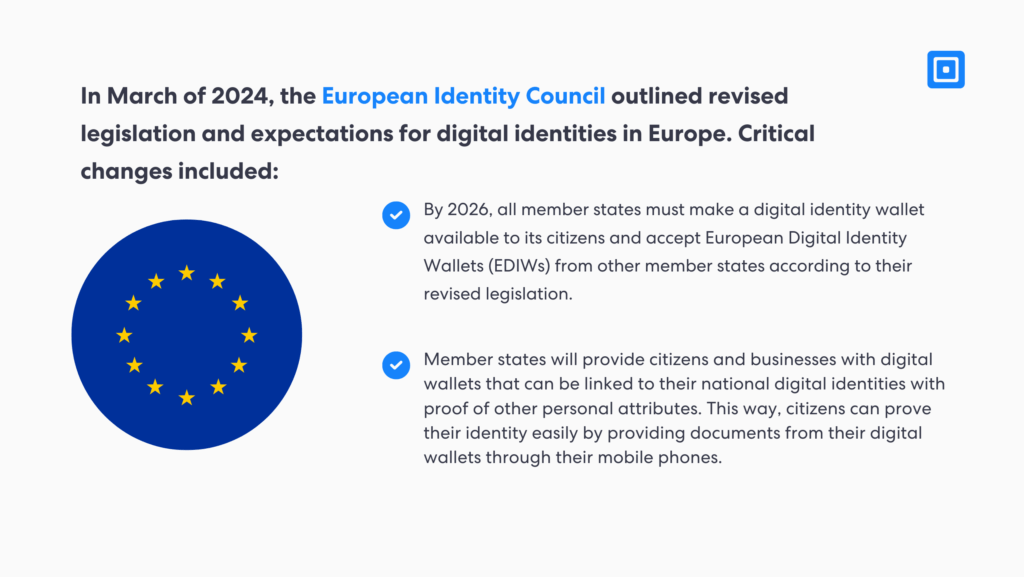
As of November 2024, several EU Member States have notified their eID schemes under the eIDAS Regulation, indicating their readiness for cross-border recognition. In March of 2024, the European Identity Council outlined revised legislation and expectations for digital identities in Europe. Critical changes included:
- Member states will provide citizens and businesses with digital wallets that can be linked to their national digital identities with proof of other personal attributes. This way, citizens can prove their identity easily by providing documents from their digital wallets through their mobile phones.
- By 2026, all member states must make a digital identity wallet available to its citizens and accept European Digital Identity Wallets (EDIWs) from other member states according to their revised legislation.
By 2030, The European Identity Council also aims for a 100% adoption rate of eID schemes across the EU. The next five years will be critical for governments, European regulators, and digital ID providers as they fine-tune the EUDI Wallet, and adoption increases across Europe.
Key Takeaways
- eIDAS 2.0 ensures secure, interoperable digital identity across EU member states with enhanced privacy and data protection.
- The EUDI Wallet is a straightforward way to enable citizens to store, manage, and share personal IDs across borders.
- Full EUDI Wallet deployment is expected by the end of 2026, enabling seamless access to public and private services.
- Countries such as Denmark and Norway have shown successful national eID implementation and adoption, which are used and trusted by a large population.
- Firms that leverage multi-scheme eID checks can gain a competitive advantage through faster onboarding rates, higher customer conversion rates, and lower costs.
eID Verification with ComplyCube
ComplyCube empowers businesses to harness eID check across Europe through a single integration, streamlining identity verification while ensuring compliance. By processing unique data points like ID numbers, names, and addresses from national eID schemes, ComplyCube integrates these with services such as Proof of Address (POA), AML Screening, and Ongoing AML Monitoring, delivering secure and efficient onboarding solutions.
With eID adoption surging, including Denmark’s MitID with 5.6 million Danes adopting it and Norway’s BankID supporting millions, ComplyCube’s scalable platform is built to handle high volumes across markets. Businesses can reduce onboarding times, enhance customer satisfaction, and meet stringent regulatory standards effortlessly.
As Europe moves toward the eIDAS 2.0, ComplyCube’s eID check is ideally positioned, offering a reliable, secure, and accurate way for firms to verify identities without the hassle of manual document and selfie uploads. For more information on ComplyCube’s services, reach out to their expert compliance team.
Frequently Asked Questions
What is the difference between eIDAS and eIDAS 2.0?
The eIDAS regulation focuses primarily on establishing a secure and legal framework for electronic identification, signatures, and trust services. The revised eIDAS 2.0 regulation requires higher interoperability, privacy, and security for EU member states. It introduces the EUDI Wallet as a way for users to gain greater control over their digital identities.
What are the benefits of eID checks for businesses?
eID checks enable businesses to verify and onboard customers digitally without the need for physical document submission or selfie uploads. These checks reduce fraud risk, lower identity verification costs, and streamline the customer onboarding process while meeting KYC and AML compliance requirements.
What are the requirements for eIDAS 2.0?
eIDAS 2.0 mandates greater security and data control through enhanced encryption methods and alignment with data and privacy laws, including the GDPR. Under eIDAS 2.0, European citizens and businesses have more consent and control over the data attributes they choose to share via their eID scheme.
Does eIDAS 2.0 apply to the UK?
eIDAS 2.0 does not apply to the UK as it is not a member state of the European Union. However, the UK government is actively moving toward more digitized and portable identity verification solutions. UK businesses that operate with customers or partners in the EU should comply with eIDAS 2.0 standards to ensure seamless cross-border digital identity verification and maintain regulatory alignment.
Which companies use ComplyCube’s eID check?
ComplyCube’s eID verification is utilized by a wide range of companies in regulated industries, including finance, fintech, crypto, and telecoms. These firms adopt ComplyCube’s eID check as it serves as a one-point access to multiple eID schemes. Businesses can align with stringent global KYC and AML regulations and data privacy laws through a unified eID provider.