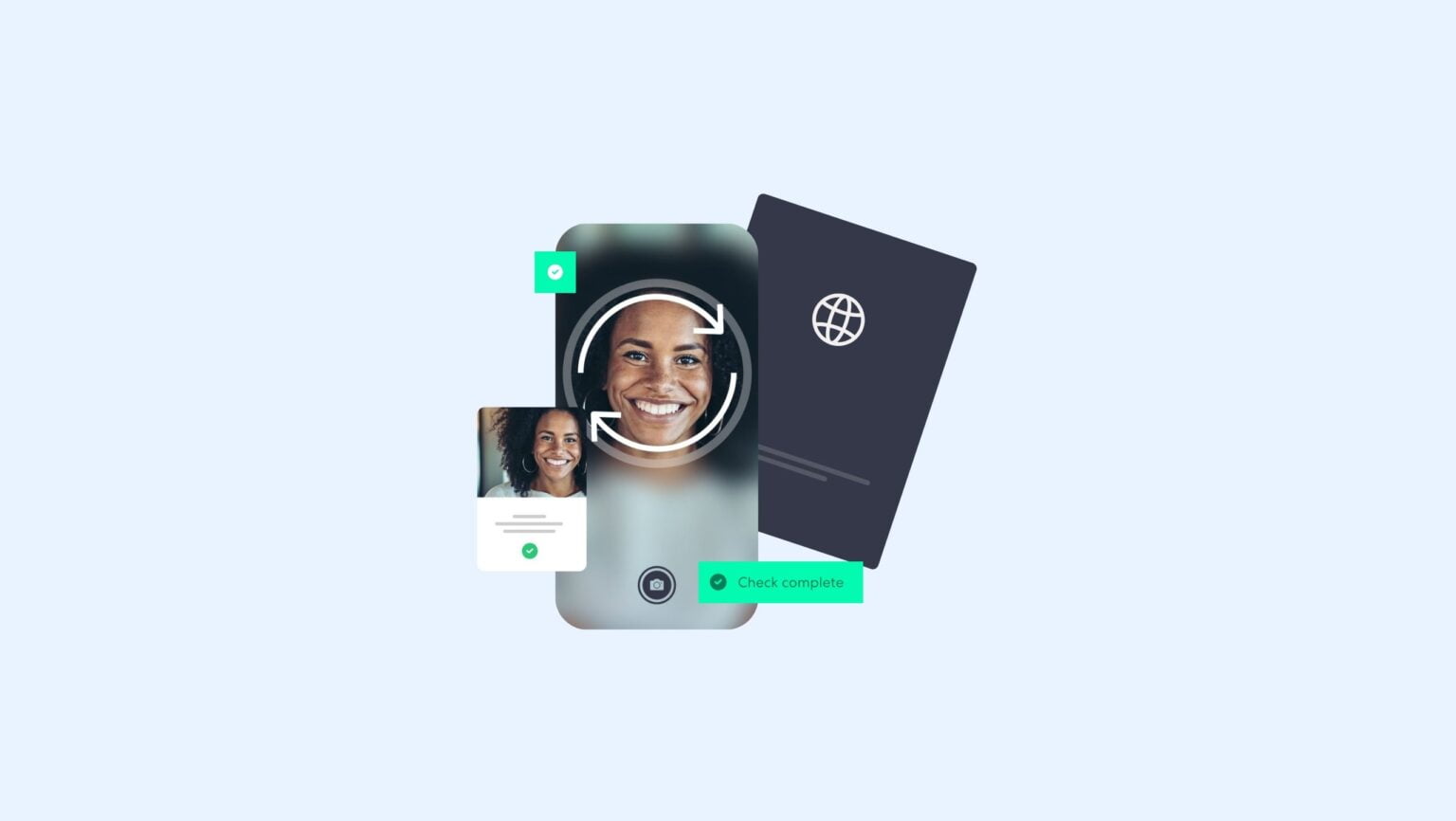
TL;DR: eKYC (electronic Know Your Customer) modernizes onboarding by replacing manual checks with secure, automated identity verification. It helps organizations roll out digital KYC faster, reduce fraud risk, and stay compliant while improving the customer experience.
What does eKYC mean?
eKYC, or electronic Know Your Customer, is a digital KYC process that verifies a customer’s identity remotely using electronic checks and evidence, rather than relying on in-person or paper-based methods. At its core, eKYC addresses modern identity authentication challenges by streamlining how organizations verify identities.
Secure online transactions are central to trust in an increasingly digital economy. According to Zendesk, 70% of consumers will choose not to buy a product or service from a company with weak security measures. As a result, prioritizing secure, robust online identity verification is essential.
Additionally, electronic know your customer helps firms comply with digital KYC requirements and strengthen defenses against money laundering and other financial crimes. You can learn more here: The Profound Challenge of AI-Driven Deepfakes Versus eKYC Solutions.
Why is eKYC Important?
eKYC plays a critical role in today’s digital landscape by enabling more secure and efficient customer onboarding. With fraud on the rise and regulations growing more stringent across regions, businesses can no longer afford to rely on outdated, manual methods. The growth of the eKYC market reflects this shift.
The electronic Know Your Customer market is projected to grow to around $2.79 billion by 2030.
In addition to enhanced onboarding, secure KYC is increasingly mandated by leading jurisdictions. Regulators, including the U.S. Financial Industry Regulatory Authority, the Monetary Authority of Singapore, and the Australian Transaction Reports and Analysis Center (AUSTRAC), demand rigorous customer verification, strong data privacy, and transparent documentation. You can learn more here: Navigating Changing eKYC Verification Rules.
As a result, eKYC enables businesses to:
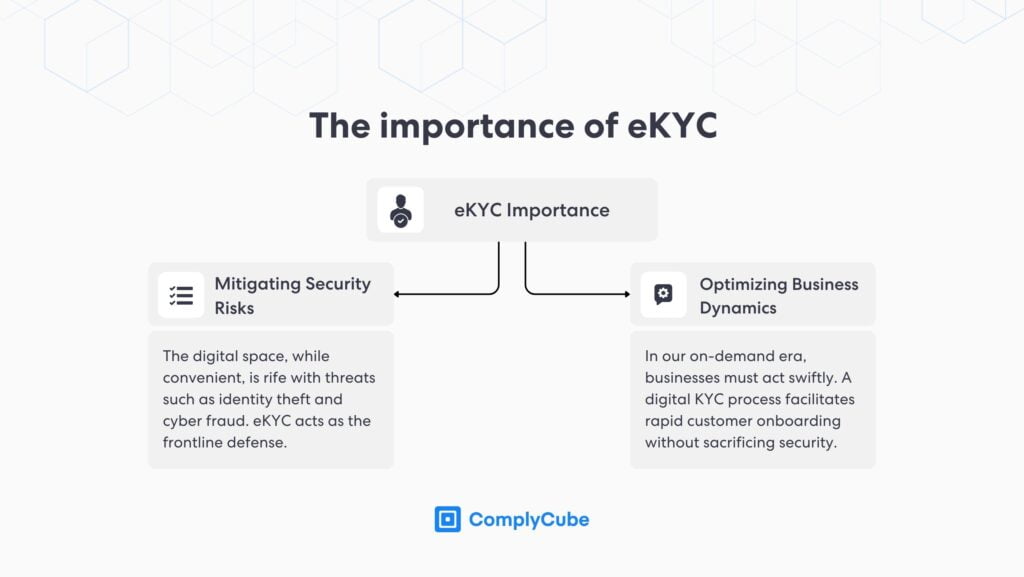
- Mitigate Security Risks: The digital space, while convenient, is rife with threats such as identity theft and cyber fraud. eKYC acts as the frontline defense against these digital adversaries.
- Support KYC Compliance: Align with global identity verification and customer due diligence obligations to prevent fines and reputational damage.
- Optimize Business Dynamics: In our on-demand era, businesses must act swiftly. A digital KYC process facilitates rapid customer onboarding without sacrificing any security.
eKYC vs. Traditional KYC Processes
eKYC shifts away from heavy reliance on manual document collection and review. Instead, it digitalizes identity verification through automated document checks, biometric verification, and Anti-Money Laundering (AML) screening. You can learn more here: The Value of Automation.
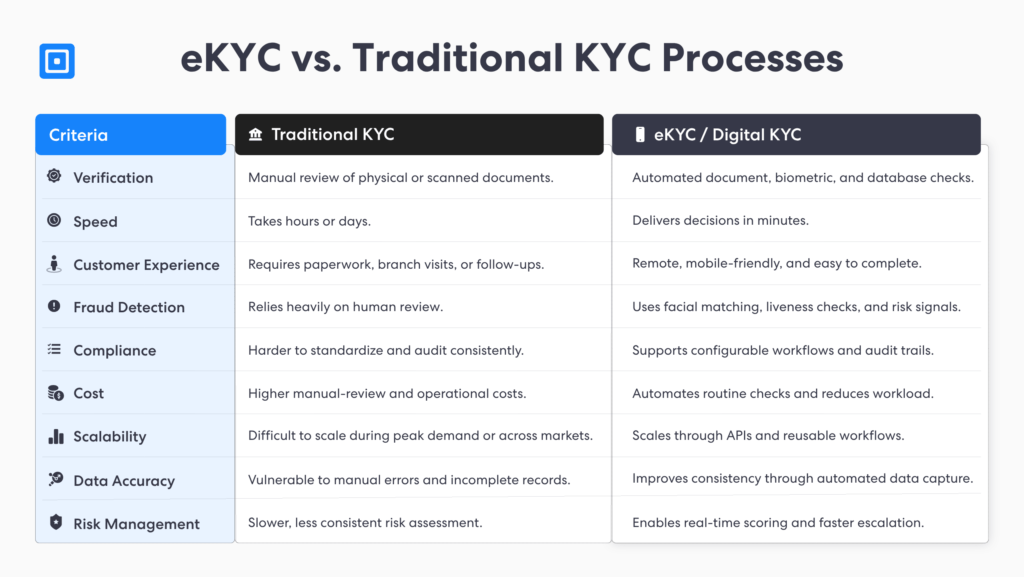
Traditional Know Your Customer methods have long required physical presence, paper documentation, and in-person checks. These processes can be time-consuming, resource-intensive, and highly prone to human error. As such, it can make it difficult for businesses to scale and meet growing customer demands.
On the other hand, digital KYC harnesses technology to streamline customer identity verification through online platforms and documentation. It reduces human error and ensures a consistent approach through a paperless process. Moreover, it can service customers globally without the limitations of physical boundaries.
Building a Reliable eKYC Process
For financial institutions and other regulated industries, understanding the electronic KYC process is vital. Businesses must grasp the effectiveness of digital identity verification and prevent identity fraud. As firms move toward digital onboarding, understanding eKYC verification and how it maintains compliance, protects customers, and builds a secure and scalable verification framework is key.

1. Customer Identification Program (CIP)
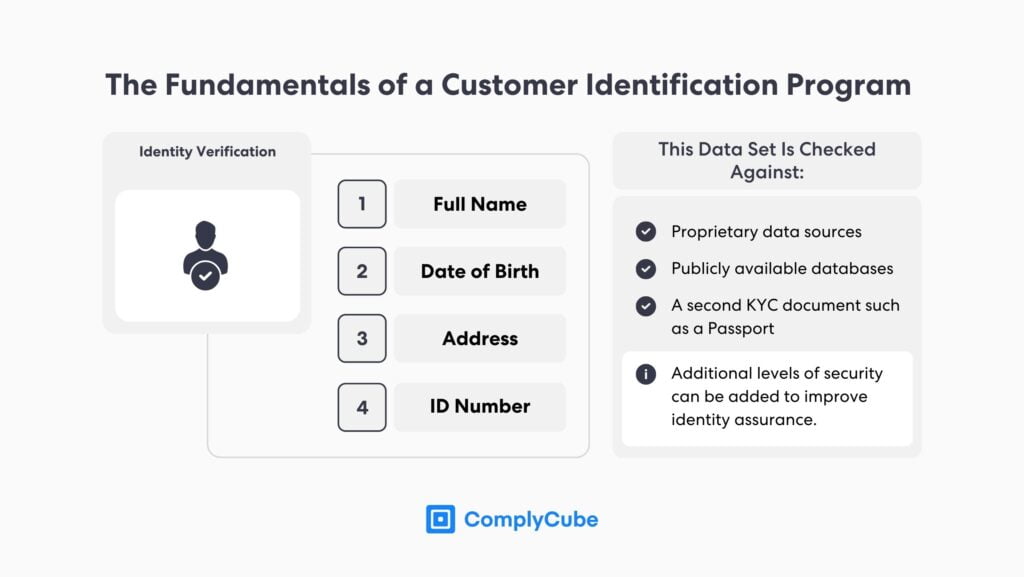
A CIP is vital for businesses when obtaining client information. You can learn more here: What is CIP? It is completed during the online registration process. For example, when a new account is created, a user enters their personal details through a secure online interface. Typically, it starts at the beginning of a customer’s journey, such as opening a new bank account.
2. Automated Identity Verification (IDV)
IDV is required to verify a customer’s identity, proving they are who they claim to be. The authenticity and integrity of an individual’s collected identity data are verified through artificial intelligence tools. This includes tools such as identity document verification, biometric data checks, facial recognition, and more. You can learn more here: The Essential Guide For Identity Verification.
3. Customer Due Diligence (CDD)
Once customer identities are confirmed, users undergo further checks. This is done via AML screening and cross-verification with third-party databases, known as multi-bureau checks, or database verification. For example, a user’s residency could be verified against information from a credit bureau’s database. You can learn more here: What is Database Verification?
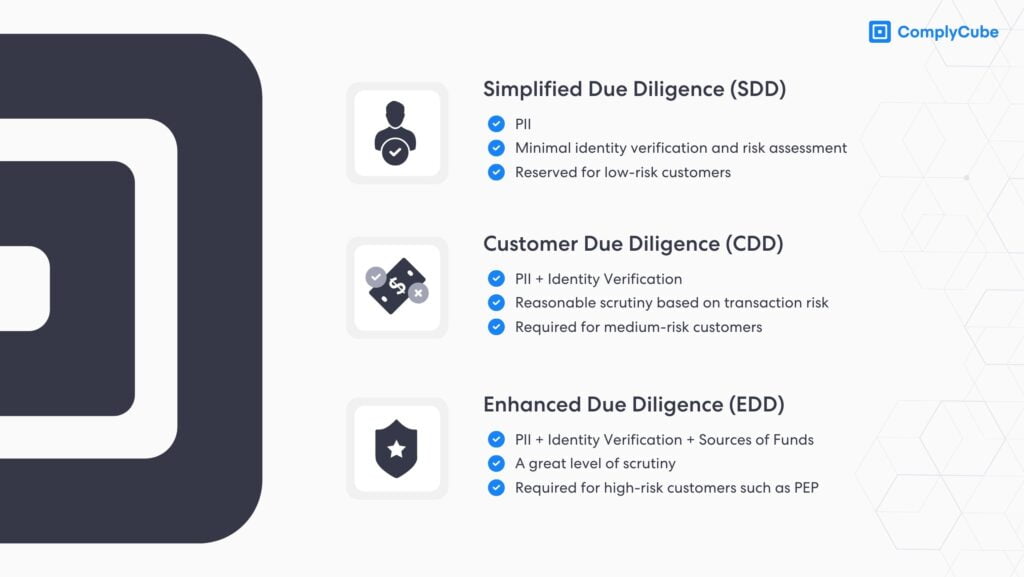
4. Feedback and Result Interpretation
The eKYC system analyzes and verifies the results electronically. It confirms true identities or highlights discrepancies that require further investigation. Based on the findings, a risk score is swiftly produced and assessed against a financial institution’s Risk-Based Approach (RBA). This automatically determines whether a user passes or fails verification. This process eliminates manual reviews, enabling faster, more accurate, and consistent onboarding decisions.
5. Secure Data Storage
Verified data is securely stored, ensuring future transactions are streamlined and protected against breaches. As data security remains a top priority for regulators worldwide, businesses must ensure their solutions provider is fully compliant with both local and international data regulations. This safeguards customer information and maintains regulatory adherence at every stage of the verification process.
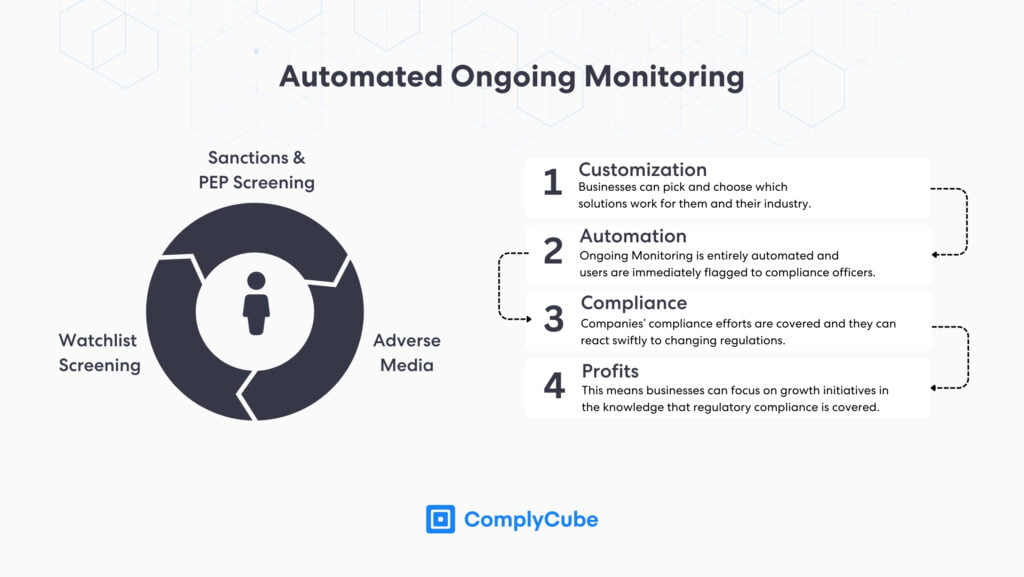
6. Ongoing monitoring
eKYC verification not only streamlines initial identity assurance but also facilitates continuous monitoring, ensuring ongoing trust and compliance in digital interactions. In an era where fraud tactics are constantly evolving, ongoing monitoring is critical to effective electronic KYC. This ensures that a customer’s compliance status remains accurate and up to date long after their initial onboarding.
Choosing the Right eKYC Provider
Partnering with the right eKYC solutions provider helps businesses meet their unique needs, scale, and maintain strong anti-money laundering practices. As requirements continue to evolve, selecting a provider that aligns with your electronic KYC standards can make the difference between smooth compliance and costly setbacks.
Here’s a guideline to ensure a selection that matches your required electronic identification standards:
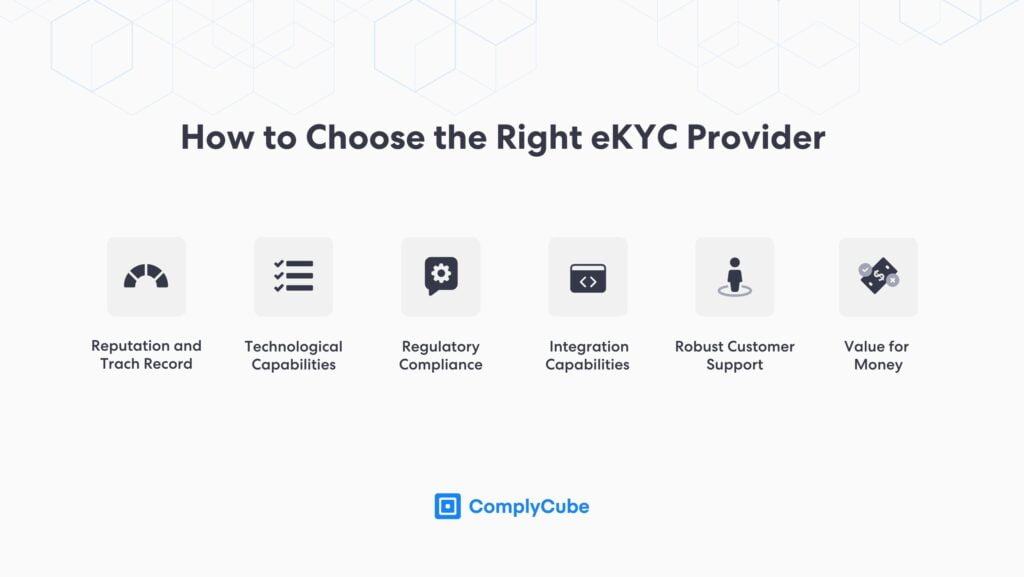
- Reputation and Track Record: Research potential providers’ market reputation and past performance. Examining client feedback, reviews, and success stories can offer a clear picture.
- Technological Capabilities: Ensure your chosen provider uses advanced tools, including AI, facial biometrics, automated video identification, and other cutting-edge verification methods.
- Regulatory Compliance: The provider should be well-versed in global and local KYC policies and regulations, ensuring adherence to worldwide data privacy norms.
- Seamless Integration: Your solution should seamlessly integrate with your current digital ecosystem, causing minimal disruption and maximizing efficiency.
- Robust Customer Support: A provider’s value is also in their post-integration support. A dedicated, responsive team is indispensable for addressing concerns or optimizations.
- Value for Money: An effective eKYC provider should offer top-notch services that align with your budgetary constraints without compromising quality.
With these criteria in mind, businesses can confidently navigate the eKYC solutions landscape. They can ensure they partner with a provider that truly complements their identity verification objectives. In effect, choosing the right electronic KYC partner is not just a compliance decision; it is a strategic one that directly impacts the security, scalability, and long-term success of your business. You can learn more here: Selecting KYC Software for Your Industry and Growth Stage.
eKYC Processes: Benefits and Challenges
While eKYC verification offers numerous benefits, it is crucial to acknowledge the accompanying challenges that businesses may face during implementation. Understanding both the advantages and limitations of electronic KYC is key to building a verification framework that is resilient and future-proof.
What are the Benefits of eKYC?
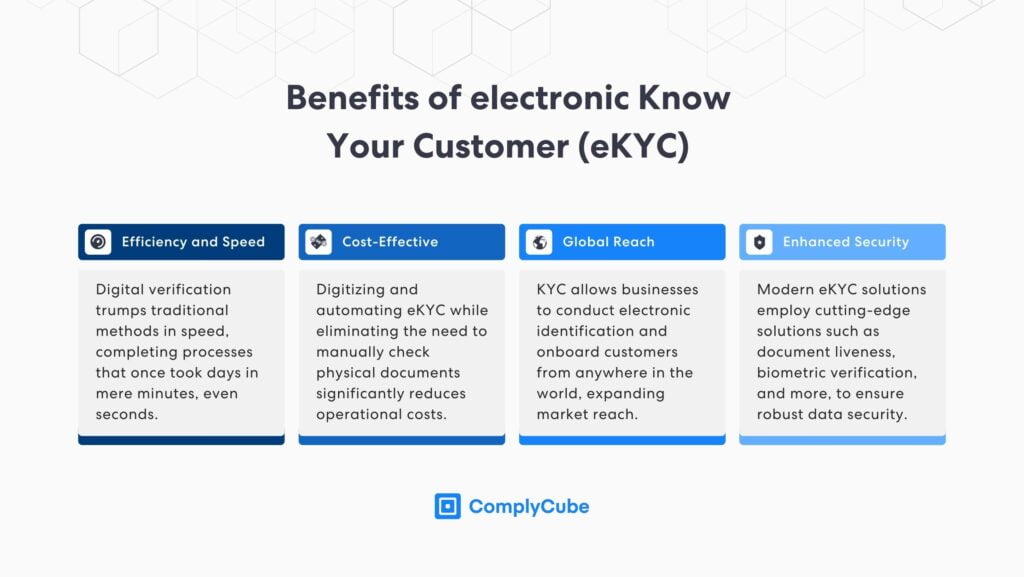
- Efficiency and Speed: Digital verification trumps traditional methods in speed, completing processes that once took days in mere minutes, even seconds.
- Cost-Effective: Digitizing and automating the eKYC services while eliminating the need for manually checking physical documents significantly reduces operational costs.
- Global Reach: Digital KYC allows businesses to conduct electronic identification and onboard customers from anywhere in the world, expanding market reach.
- Enhanced Security: eKYC solutions employ cutting-edge technologies such as document liveness, biometric verification, and AI, ensuring compliance with data protection regulations.
What are the Challenges of eKYC?
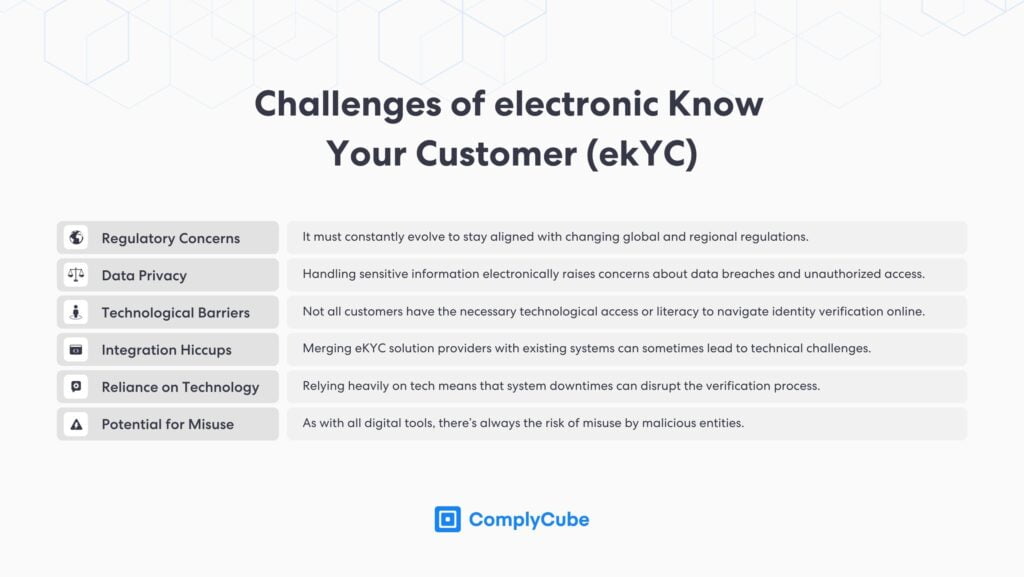
- Regulatory Concerns: It must constantly evolve to stay aligned with changing global and regional regulations.
- Data Privacy: Handling sensitive information electronically raises concerns about data breaches and unauthorized access.
- Technological Barriers: Not all customers may have the necessary technological access or literacy to navigate online identity verification processes smoothly.
- Integration Hiccups: Merging electronic Know Your Customer solution providers with existing systems can sometimes lead to technical challenges.
- Dependency on Technology: Relying heavily on tech means that system downtimes can disrupt the verification process.
- Potential for Misuse: As with all digital tools, there’s always the risk of misuse by malicious entities.
Recognizing both the advantages and challenges of electronic KYC allows businesses to make informed decisions. In practice, organizations should proactively navigate these potential pitfalls and adopt a culture of continuous optimization. As a result, teams can streamline onboarding, reduce fraud, and maintain compliance while building a robust verification framework that adapts to an ever-evolving regulatory and threat landscape.
Sectors Thriving on eKYC
As the digital era evolves, electronic Know Your Customer has become a cornerstone for various sectors. The application of digital KYC is clear across various industries, each leveraging its capabilities to enhance operations. Common examples of sectors that capitalize on these solutions include banking, real estate, and telecommunications.
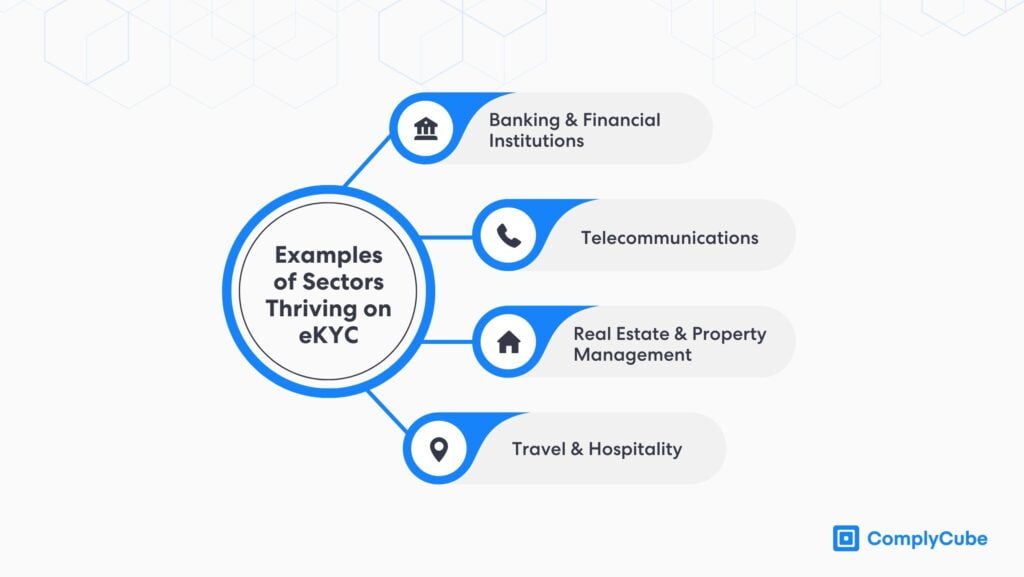
Banking & Financial Institutions
For many modern banking operations, digital KYC enables swift, secure customer onboarding for bank account opening. It is also crucial to meet ongoing due diligence obligations during the life of the customer relationship, preventing financial crimes and money laundering, and enhancing user trust in the financial sector.
Telecommunications
As subscribers and services grow, telecommunication providers use electronic Know Your Customer practices to validate user identities, making legal procedures for registering new users and SIM activations smoother. With regulatory requirements around SIM registration tightening across regions, eKYC verification enables telecoms to meet compliance obligations efficiently, reduce fraudulent activations, and deliver a faster, more seamless onboarding experience for their customers.
Real Estate & Property Management
eKYC verification assists in verifying both buyers’ and sellers’ identity documents, streamlining customer onboarding, property transactions, and rental agreements across the real estate sector. As property transactions remain a key target for money laundering and identity fraud, electronic KYC solutions play a critical role in helping real estate businesses meet their compliance obligations, protect against financial crime, and build a more secure and transparent transaction process for all parties involved.
Travel & Hospitality
For online bookings and check-ins, eKYC verification provides an additional layer of identity assurance, enhancing customer trust and ensuring that reservations are made by genuine, verified individuals. As the travel and hospitality industry continues to shift toward fully digital experiences, electronic KYC solutions are becoming an increasingly essential tool for preventing fraudulent bookings and safeguarding both businesses and their customers.
Case Study: NHS App and Identity Proofing
As NHS App usage scaled, services like test results and prescription ordering required stronger assurance that the person logging in was the right patient. The NHS needed a secure, self-serve way to confirm identity without forcing everyone through in-person checks.
“Full access” identity checks in UK healthcare
NHS login enables users to “prove who you are” using photo ID plus a facial video/self-capture, or via GP online-registration details where photo ID isn’t available. This supports a digital KYC-style identity step for accessing sensitive healthcare features inside the NHS App.
Outcomes
Reduced reliance on in-person identity confirmation for access to personal health features.
Supports secure access to sensitive services like prescriptions, appointments, and records.
Offers digital service usage at large scale, with millions of sessions and unique logins.
The Future of Electronic Know Your Customer
As the identity verification landscape evolves rapidly, businesses must stay ahead of emerging trends and technologies shaping the future of eKYC. From AI-powered fraud detection to increasingly stringent global regulations, the future presents both exciting opportunities and new challenges for organizations looking to strengthen their electronic KYC processes and build a more secure digital future.
The future of electronic Know Your Customer converges on technological fusion and enhanced security:
- Technological Fusion: The merging of groundbreaking technologies such as Blockchain and AI is set to amplify the efficiency and reliability of eKYC processes and online procedures.
- Enhanced Security Protocols: With the digital landscape continually shifting, there will be a heightened focus on continually adapting digital customer onboarding and reinforcing electronic KYC processes to counter emerging digital challenges.

Key Takeaways
eKYC (electronic Know Your Customer) verifies identity remotely using digital checks.
It enhances onboarding by reducing manual steps while strengthening fraud and AML controls.
Digital KYC outperforms traditional KYC on speed, scale, and consistency across markets.
A reliable eKYC flow spans CIP, automated IDV, CDD/AML screening, and risk scoring.
Long-term value comes from secure storage, ongoing monitoring, and smooth integration.
About ComplyCube’s eKYC Solution
eKYC isn’t just another digital trend; it forms the blueprint for future digital interactions. As businesses navigate the digital age, eKYC stands out as an invaluable ally, offering the speed, security, and adaptability required to prevent terrorist financing. Learn more about how you can rapidly integrate eKYC solutions today. Speak to a member of the team.

Frequently Asked Questions
What does eKYC mean in the UK and Europe?
eKYC means electronic Know Your Customer. It is a digital KYC process that verifies identity electronically and remotely instead of paper or in-person verification. In the UK and Europe, eKYC is commonly used to support compliant and quicker onboarding under local KYC/AML rules.
Is eKYC compliant with UK Customer Due Diligence (CDD)?
Yes, eKYC can support CDD requirements in the UK by collecting customer details, verifying identity through automated IDV, and applying risk-based checks like screening and database comparisons. The key is using appropriate assurance levels, audit trails, and data protection controls.
What is the difference between eKYC and traditional KYC for UK and EU businesses?
Traditional KYC typically relies on physical documents and manual or in-person checks. eKYC (digital KYC) uses automated, remote verification to speed up onboarding, reduce human error, and deliver consistent outcomes across regions.
What are eKYC steps for fintechs and banks?
Most strong electronic Know Your Customer flows include customer data capture, automated identity verification (document + biometric checks), CDD/AML screening, risk scoring, and secure data storage. Additionally, ongoing monitoring is required to detect changes in risk over time.
How does ComplyCube support eKYC requirements?
ComplyCube supports organizations in aligning with eKYC (electronic Know Your Customer) compliance through automated identity verification, configurable onboarding checks, and ongoing monitoring to support CDD workflows. It’s designed to integrate into digital customer journeys while maintaining strong security and compliance alignment.