TL;DR: Document Optical Character Recognition (OCR) supports quicker onboarding through smarter data extraction and validation. With identity document OCR solutions, regulated businesses can lower manual intervention, cut verification time, and reduce operational costs.
What Is Identity Document OCR?
Identity document OCR is a tool that reads and extracts information from various identity documents, including passports, driver’s license, and national ID cards. Organizations use OCR solutions during Know Your Customer (KYC) flows to support identity verification.
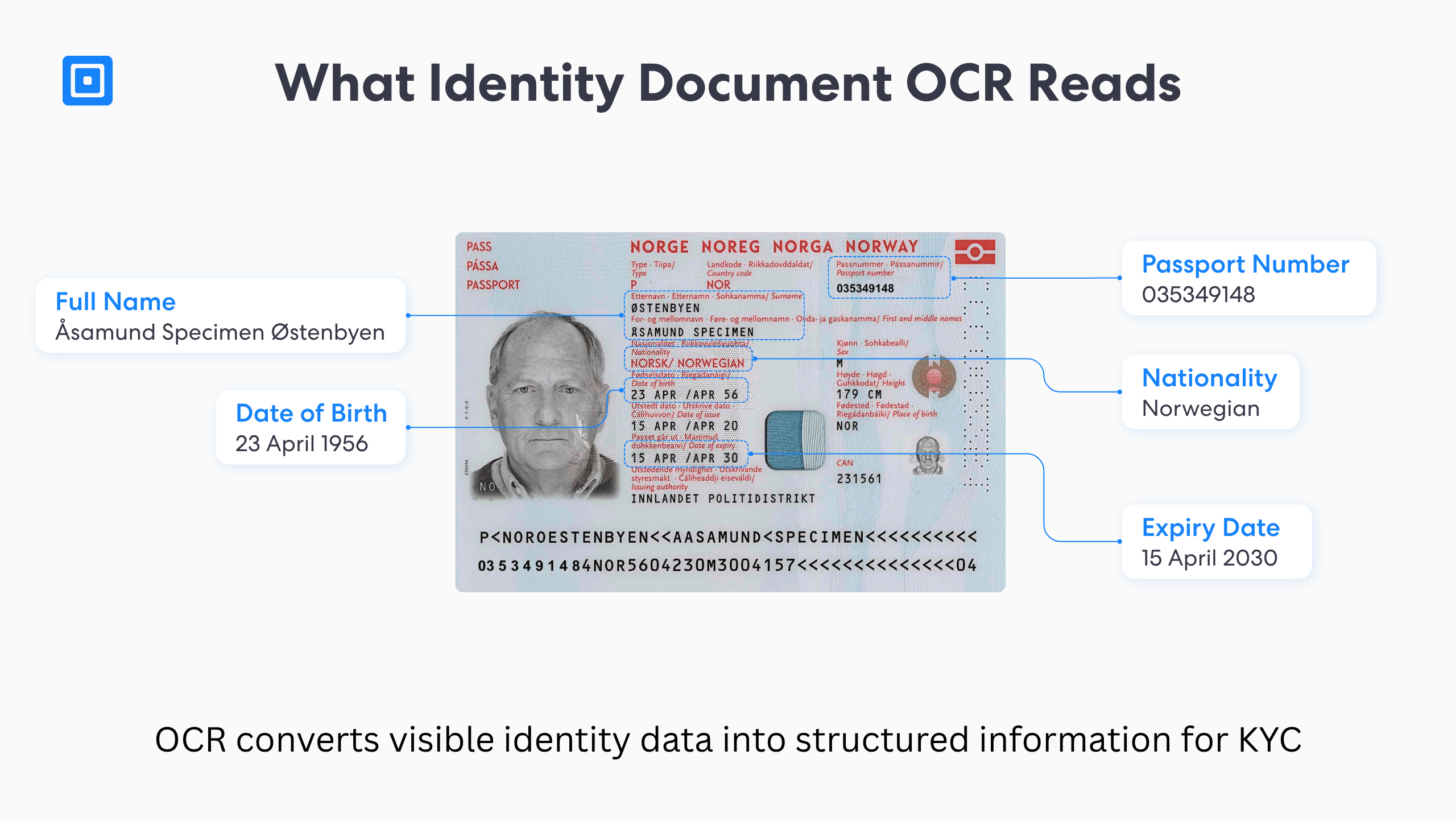
AI-powered document OCR solutions can scan and understand the structure of an ID. They can determine where specific information is located, then provide it as structured data. This can include critical identity attributes used for customer due diligence, such as:
- First and last name
- Birth date
- 国籍
- Issue and expiry dates
- Address, where present
- Machine-Readable Zone (MRZ) data
- Other document numbers such as Social Security Numbers (SSNs)
What this implies is that a business doesn’t need to manually copy details from an identification document into its onboarding or KYC system. Instead, the system automatically extracts data from the scanned documents in the backend and passes it directly to the verification, screening, and risk-assessment process. No manual typing required.
What is the difference between identity document OCR and generic OCR?
The difference between identity document OCR and generic OCR lies in context. Generic OCR reads and extracts text from any image or document. On the other hand, identity document OCR goes further by scanning for specific layouts, fields, and formats found on documents.
Moreover, it’s essential to differentiate OCR systems from 文件验证. Although often used interchangeably, OCR is the feature that extracts information from a document, while verification determines whether a document is genuine, such as through security feature analysis. Simply put, OCR supports automated data entry in document verification, which speeds up onboarding. You can learn more here: 什么是文件验证?
Identity Document OCR for KYC Compliance
Digital onboarding plays a leading role in compliance and fraud prevention. It enables real-time identity verification. However, because it happens remotely, bad actors can now create and scale fake identities behind a screen. According to UK Finance, payment fraud losses reached £1.28 billion in 2025, and the US Federal Trade Commission recorded $15.9 billion in fraud losses that same year.
Slow or inaccurate identity data capture is no longer merely an operational inconvenience.
OCR works by turning the visible information on passports, driver’s licenses, and national identity cards into structured data that KYC systems can then process automatically. Instead of manually extracting and re-entering data, firms can capture the necessary information consistently and at scale.
一个 identity document OCR solution enables compliance teams to:
1. Enhance data accuracy
OCR technology uses artificial intelligence solutions and machine learning for smarter data recognition and extraction. For example, it can use context clues to differentiate characters such as the number one (1), lowercase letter L (l), and uppercase letter I (I) in identity and business documents. It also removes common human errors, such as spelling mistakes or transposed digits. As a result, OCR improves screening performance and minimizes false positives from poor-quality or incorrectly entered information.
2. Strengthen privacy
Identity document OCR software transforms complex image files and PDF documents into machine-readable text, allowing automatic redaction in line with data privacy laws. For example, the Netherlands treats the Burgerservicenummer (BSN) as a highly sensitive government identifier. OCR can locate this data, enabling separate redaction or data-masking controls to meet privacy rules.
3. Scale verified onboarding
OCR can scan through thousands of documents in multiple languages at the same time. It can scale to large increases in verification volume without creating operational bottlenecks. OCR reduces the need for human review, typing, and verification, which drastically reduces processing time and compliance costs. This enables regulated businesses to scale onboarding while ensuring consistent data capture.
4. Helps detect fraud
OCR provides structured identity data that can be compared with other document and identity information to detect and prevent fraud. This extracted data can be cross-referenced against other known information such as biometric, NFC, or MRZ data to identify image tampering and anomalies like mismatched fonts, manipulated portraits, or inconsistent shadows, which are missed by manual checks. You can learn more here: How Document Fraud Software Works.
When to Use Identity Document OCR
The real value of identity document OCR isn’t just to scan and read an ID. It’s the ability to move critical customer due diligence identity attributes through onboarding, review, and ongoing KYC流程 without any need for manual entry.
Document optical character recognition powers several KYC touchpoints:
- Remote onboarding: It allows financial institutions to onboard customers without the need for a physical office or interaction. Since verification happens remotely, it can be done in seconds.
- Assisted or branch onboarding: IDs can be scanned instantly, instead of keying in data one by one, which removes human error and increases the efficiency of day-to-day business processes.
- Automated KYC workflows: Document information, such as from loan documents or financial statements, can feed immediately into CRM, case management, and other digital workflows.
- High-risk reviews: Where there are high-risk cases that need step-up checks, OCR can be used for enhanced due diligence, re-verification, and exception handling easily.
- Cross-border verification: OCR can standardize data capture across global document types that contain varying formats, images, or languages.
- Periodic KYC refreshes: During KYC refreshes, OCR can automatically re-scan and keep all identity documents up-to-date, with any changes flagged in real-time.
Typical Identity Document OCR in a KYC Workflow
A typical KYC workflow starts when a user takes a photo or uploads their ID. It is at this stage that OCR extracts the information in that document and turns it into readable data that teams can view. This data is then verified for accuracy. This can be done via cross-verifying with other customer data provided or captured during the KYC journey, including 生物识别验证 and multi-bureau verification.
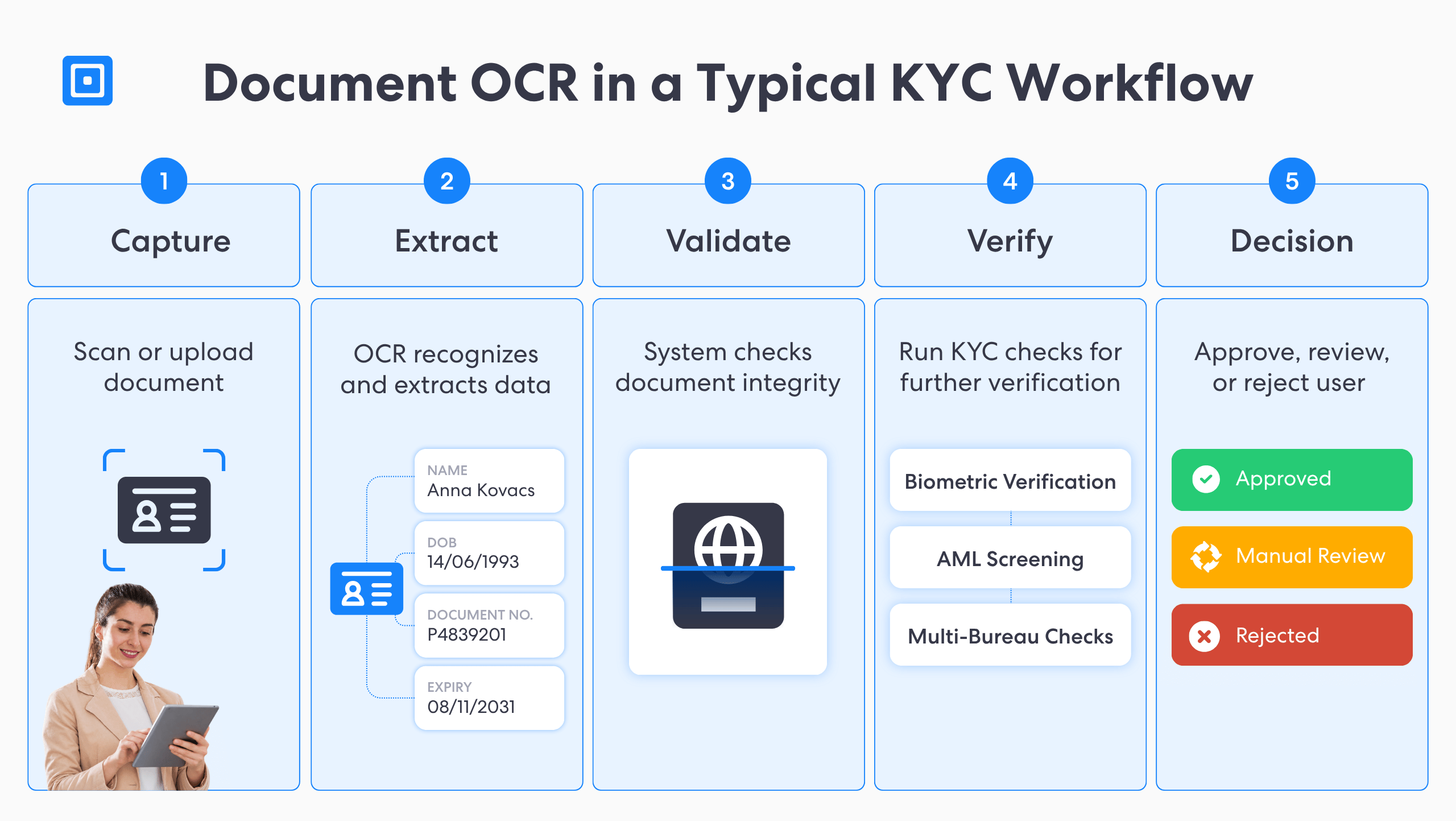
However, it is important to remember that document OCR does not determine compliance outcomes itself. Instead, its core function is to quickly and reliably produce usable data from ID information. The main outcome is to remove manual data entry, fast-track onboarding, and capture better data for 反洗钱 (AML) controls.
Common OCR Document Processing and Data Extraction
OCR is a foundational technology. However, its value really depends on how well it handles different ID formats, security features, and languages. Unlike basic OCR for printed paper documents, handwritten notes, or invoice processing, identity verification requires highly accurate text detection across complex, domain-specific documents.
The common identity documents that OCR software can detect include:
- Passports: Feature a standardized MRZ layout for easy OCR extraction. In particular, its stored glyphs and standardized OCR-B font are designed to be easily read by computer systems.
- NFC chips: Reads and extracts embedded RFID chips in electronic identity documents, such as ePassports. Confirms that a document is genuine and not altered.
- Driver’s licenses: Driver’s licenses vary across countries in background, holography, and layout. A strong template library and classification model is key to handling varying layouts.
- Paper-based documents: Other document types that can be processed include handwritten notes or aged paper, such as birth certificates, tenancy agreements, or bank statements.
Beyond that, modern document verification solutions include other data extraction technologies:
- NFC chips: Reads and retrieves embedded RFID chips in electronic identity documents, such as ePassports. Confirms that a document is genuine and not altered.
- Barcode and QR code: Scans and extracts encoded information from machine-readable patterns such as QR codes in digital identity credentials.
To measure the effectiveness of OCR tools on real-world images, businesses can perform testing and controlled benchmarking. For example, they can analyze field-level extraction accuracy, processing speed, and manual review rates across the various document types above.
The Mechanics Behind Identity Document OCR
Identity document OCR is able to transform scanned images, TIFF files, and image-only PDFs into structured, machine-readable text data. A robust OCR process turns complicated document images into well-structured identity data that KYC systems can then process automatically.
However, OCR relies on a number of different stages functioning together:
- Image acquisition: When it comes to capturing images, web and mobile SDKs assist users in taking clear images of documents by minimizing glare, blur, and poor framing. Good image acquisition is a necessity because it directly affects output quality.
- Image pre-processing: The document image gets cleaned up first before starting text recognition via advanced techniques such as resizing, noise reduction, contrast adjustment, or even color normalization.
- Document and layout detection: Pattern recognition and computer vision determines the type of document used and identifies relevant areas such as the MRZ, address fields, photo, or barcode. Neural networks can help interpret complex layouts found on various documents.
- Text recognition and extraction: Modern OCR models transform visible characters into editable text data, while Intelligent Character Recognition (ICR) can handle more difficult cases, such as irregular or handwritten text where appropriate.
- Structuring and validation: The information extracted is arranged in the form of key-value pairs, for example, those relating to the name, the date of birth, and the document number. Format rules and checks can then detect any inconsistencies before the data is passed downstream.
Case Study: Ukrainian KYC Crypto Scam Network
In September 2026, Ukrainian watchdogs found an alleged crypto scam network targeting over 20 countries and generating over $1 million per month. The network bypassed onboarding by stealing victims’ passport, photograph, and other information.
Why Document Verification is Critical
Effective KYC programs do not stop at OCR data entry. They combine multiple risk signals to determine if a customer is real. In this case, businesses must connect OCR technology with multi-layered fraud detection tools, such as document verification, biometric check, and AML screening.
结果
- Over 62 victims were identified with 34 searches leading to seized devices and documents.
- Identity data can be stolen and reused to appear as genuine account holders.
- Firms must verify extracted ID data against other fraud signals before approving customers.
How to Evaluate Identity Document OCR Solutions?
The effectiveness of identity document OCR solutions can vary across software vendors. For example, factors such as multi-language support and ID coverage can impact output quality. This section covers the key criteria to consider when choosing document optical character recognition software.
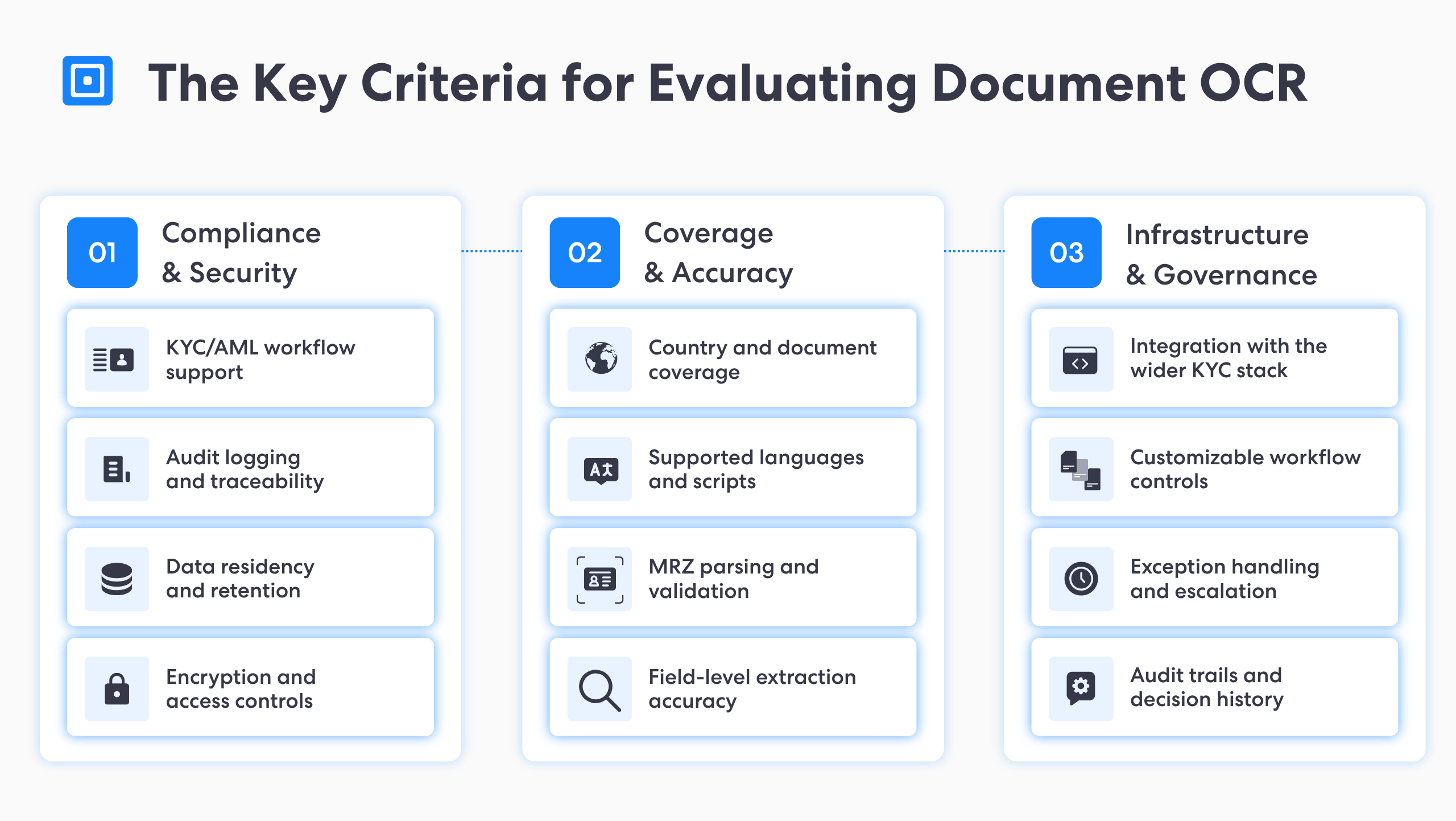
1. Document and Language Coverage: Ensure the solution provides coverage in the relevant countries your users are in. Additionally, confirm that it can process the specific document type in the particular jurisdiction, as well as support for multi-scripts (Latin, Chinese characters etc.) and languages.
2. Privacy and Security: Verify that the identity document OCR provider has clear audit logging, data residency controls, and adherence to privacy rules such as the EU GDPR and US NIST. Check for encryption, retention settings, and role-based access controls to understand how data is handled.
3. Regulatory Assurance: Consider whether the OCR capability supports the wider KYC/AML process. Look for providers that connect OCR outputs with AML screening, 持续监控, and risk assessment to strengthen compliance and reduce fragmented systems.
4. 整合: Look for identity document OCR solutions with well-documented APIs and SDKs. Compatibility with existing document workflows, CRM, and cloud environments, including cloud storage and platforms such as Google Cloud, is critical to seamless deployment.
5. Document AI capabilities: Strong document AI solutions stand out in their precision. It can classify document type, locate relevant fields, and return usable identity attributes. Also, it can support handwritten text, read unstructured and printed documents, which overall reduces manual intervention.
关键要点
Modern document OCR solutions recognize and extract key identity attributes in real time for verification.
OCR enhances data accuracy and privacy by reducing human error and exposure to sensitive data.
受监管企业 use identity document OCR to accelerate onboarding and strengthen compliance.
Advanced image acquisition, pre-processing, and text recognition support accurate data extraction.
文件覆盖, integration, and regulatory assurance must be considered during OCR evaluation.
Strengthen KYC Compliance with Advanced OCR Solutions
Document optical character recognition is most useful when integrated into the full KYC process. The best identity document OCR software is one that can automate KYC compliance, offer regulatory assurance, and support faster compliance decisions. 学到更多 about how you can strengthen regulatory alignment and fraud prevention with AI-powered identity document OCR solutions today.

常见问题
What is the best OCR software for KYC?
The best Optical Character Recognition (OCR) software for Know Your Customer (KYC) compliance supports accurate document data extraction, robust identity verification, and fraud detection. Businesses should compare false positive rates, document coverage, processing speed, and manual review rates.
Does document OCR solutions replace human compliance officers?
No, identity document Optical Character Recognition (OCR) automates repetitive data-entry tasks. OCR processing allows compliance teams to focus on suspicious activity rather than manual data entry. However, human compliance officers should investigate and escalate complex, high-risk cases.
Can OCR-based KYC work with low-quality or damaged documents?
OCR can still convert low-quality or partially damaged documents into machine-readable text. Advanced methods, such as pre-processing, multiple image captures, and fallback strategies, can improve OCR accuracy where the ID document is particularly weak. However, exceptionally poor quality cases must be routed to manual review.
How long does it take to integrate identity document OCR into onboarding?
It can take a few hours to several weeks to integrate identity document Optical Character Recognition (OCR) into onboarding. The time depends largely on integration, testing, and compliance sign-off. For example, basic SDK integration into a mobile app can take a few hours, while integration into a full KYC lifecycle verification stack can take a few weeks.
How does ComplyCube’s identity document OCR support KYC programs?
ComplyCube’s identity document Optical Character Recognition (OCR) automatically extracts key identity attributes to support fraud prevention and KYC compliance. It uses an advanced AI OCR engine to analyze over 14,000 document types, detect sophisticated fraud anomalies, and meet Customer Due Diligence (CDD) requirements across 250+ territories and languages.